
People pleasing often begins with a seemingly harmless thought: “I don’t want to upset anyone.”
How many times have we changed our own plans, ignored our feelings, or said yes to something we didn’t really want to do simply because we were afraid someone else might be disappointed?
An accommodative personality or what is sometimes informally described as a universal pleaser, may involve consistently prioritizing other people’s preferences, needs, and emotions over one’s own.
“Will they be upset if I say no?”
“Will they think badly of me?”
“What if they stop liking me?”
“I want everyone to like me.”
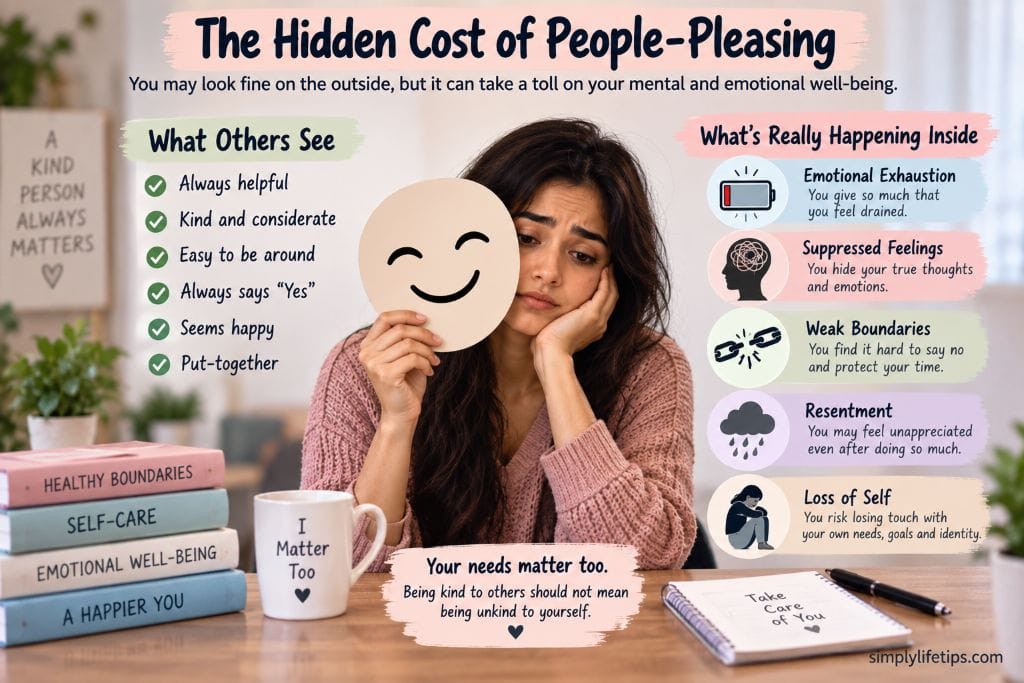
From the outside, such a person may appear exceptionally kind, helpful, cooperative, and considerate. They may avoid arguments, help whenever someone asks, and repeatedly say:
“It’s okay. I don’t mind.”
But what happens inside?
Sometimes, the person who appears to be keeping everyone else happy is quietly becoming exhausted themselves.
What Does People Pleasing Mean?
People pleasing describes a pattern of behavior in which someone repeatedly tries to gain approval, avoid conflict, prevent disappointment, or maintain relationships by putting other people’s needs ahead of their own.
Being kind or helpful is not automatically people-pleasing.
There is an important difference between choosing to help and feeling unable to say no.
For example, imagine a friend asks you to help them move house on Saturday.
You have free time, genuinely want to help, and willingly agree.
That’s kindness.
Now imagine you have an important commitment, desperately need rest, and don’t want to help—but you immediately say yes because you’re afraid your friend will become angry or think you are selfish.
That may be a people-pleasing pattern.
The problem is not kindness.
The problem is when fear replaces choice.

Why Do People Please Others?
People-pleasing can develop for different reasons, and there is no single explanation that applies to everyone.
Some people may have learned early in life that keeping others happy reduces conflict or earns approval. Others may become especially concerned about rejection, criticism, disappointing people, or losing relationships.
Over time, a person can become accustomed to checking other people’s reactions before considering their own needs.
Instead of asking:
“What do I want?”
the automatic question becomes:
“What does everyone else want from me?”
That shift can gradually change the way a person makes everyday decisions.
For example:
- “Where do you want to eat?” — “Anywhere is fine.”
- “Can you help me this weekend?” — “Sure.”
- “Do you agree with this?” — “Yes, that’s fine.”
- “Are you tired?” — “No, I’m okay.”
Eventually, “I’m okay” can become a response even when the person is clearly not okay.
The Brain Science Behind People Pleasing
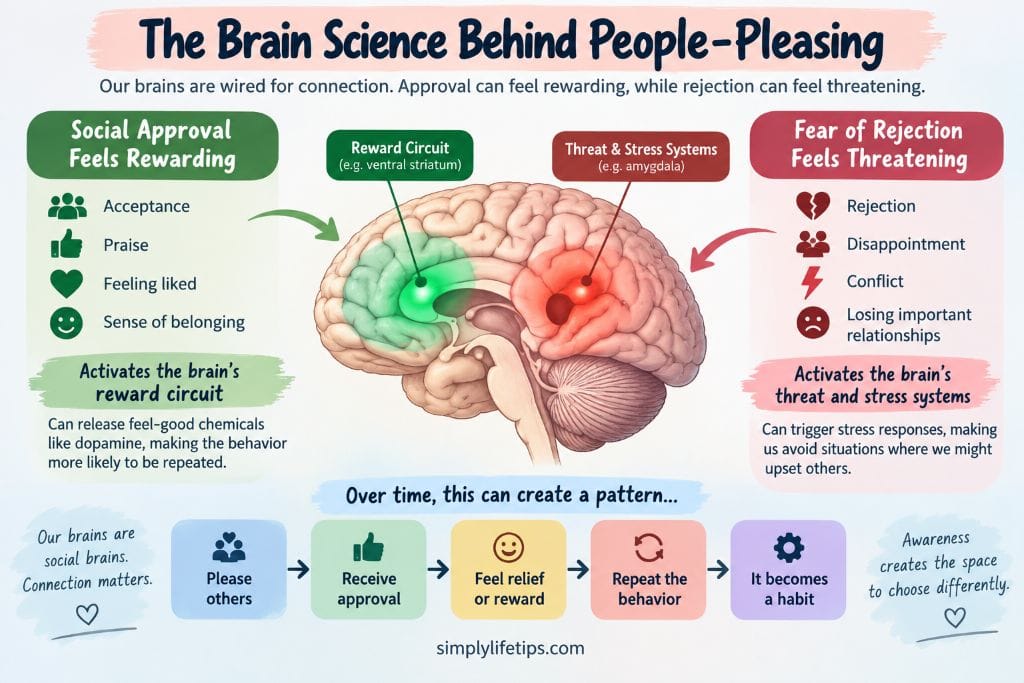
Our brains are highly responsive to social acceptance and rejection.
Research in social neuroscience shows that experiences of acceptance can engage brain regions associated with reward processing, while rejection and changes in perceived social value involve neural systems associated with social evaluation and threat-related processing.
This does not mean that people pleasing is simply a “brain disorder” or that one specific brain circuit causes the behavior.
Rather, repeated social experiences can influence what we learn to expect from other people.
Consider a simple cycle:
Please someone → receive approval → feel relief or reward → repeat the behavior
At the same time:
Consider saying no → anticipate rejection → feel uncomfortable → say yes → anxiety decreases
When this pattern happens repeatedly, saying yes may become the easier automatic response.
Research has also found that the brain can distinguish between rewarding social outcomes and information about how much another person appears to value us. This suggests that social approval and perceived relationship value can influence learning and future behavior.
So the pattern can gradually become deeply familiar.
Not necessarily because someone consciously decides:
“I must make everybody happy.”
But because their experiences may have taught them:
“Keeping people happy keeps me safe, accepted, or connected.”
When Approval Becomes the Center of Life
This is where people-pleasing can become exhausting.
Your decisions may gradually become dependent on other people’s reactions.
You might ask:
- Will they approve?
- Will they be disappointed?
- Will they become angry?
- Will they reject me?
- Will they stop talking to me?
- Will they think I’m selfish?
Meanwhile, another important question becomes quieter:
“What do I actually need?”
This can happen in friendships, marriages, families, workplaces, and social groups.
For example, someone might accept extra work at the office despite being overwhelmed because they don’t want their manager to think they are uncooperative.
A parent might constantly put everyone else’s needs first and rarely take time for themselves.
A friend might repeatedly listen to other people’s problems while hiding their own struggles.
A partner might avoid expressing disagreement simply because they fear conflict.
From the outside, everything may appear peaceful.
Inside, however, resentment and exhaustion may gradually build.
The Hidden Cost of People Pleasing
People pleasing can come with a high personal cost when it becomes chronic.
You May Struggle to Say No
One of the clearest signs is difficulty saying no even when you genuinely want to.
You may say:
“Yes, I’ll do it.”
while thinking:
“I really don’t have the time.”
The result is often an overloaded schedule and unnecessary stress.
Learning to establish boundaries can help protect your time, energy, and emotional well-being. Simply Life Tips also explores this topic in Setting Boundaries in Relationships and 10 Misconceptions About Boundaries.
Your Own Needs May Come Last
When everyone else’s needs constantly appear more important, your own needs can gradually disappear from the priority list.
You postpone:
- Rest
- Exercise
- Personal interests
- Family time
- Hobbies
- Quiet time
- Important personal decisions
You may become very good at caring for others while becoming disconnected from yourself.
You May Suppress Your Feelings
People pleasers often try to avoid expressing emotions that could create conflict.
They may hide:
- Anger
- Disappointment
- Frustration
- Hurt
- Disagreement
- Fatigue
Instead of saying, “That hurt me,” they may say, “It’s okay.”
Instead of saying, “I disagree,” they may remain silent.
Instead of saying, “I need some time alone,” they may continue helping everyone else.
Suppressing feelings doesn’t necessarily make them disappear.
Sometimes they simply remain unresolved.
Resentment Can Build
This creates an interesting contradiction.
You may say yes because you want to be kind.
But if you repeatedly sacrifice yourself without genuinely choosing to do so, resentment can eventually appear.
You might think:
“I do everything for them. Why doesn’t anyone do anything for me?”
The other person may not even realize there is a problem because you repeatedly told them everything was fine.
This is one reason healthy boundaries require honest communication rather than silently expecting others to understand your needs. Cleveland Clinic similarly recommends clearly communicating boundaries and using “I” statements rather than expecting others to read your mind.
People Pleasing and Emotional Exhaustion
Constantly managing other people’s expectations can become mentally tiring.
Imagine spending an entire day monitoring:
“Did I upset them?”
“Was that message okay?”
“Should I apologize?”
“Maybe I should agree.”
“What will they think?”
That mental effort can add to an already demanding day.
If prolonged stress and emotional pressure leave you feeling drained, it may be useful to understand the signs of Mental Exhaustion: Signs, Causes, and Ways to Recover.
Mental exhaustion can affect concentration, decision-making, emotions, relationships, and everyday functioning.
Similarly, chronic stress can contribute to burnout. If you’re interested in this connection, see Burnout in Young Adults: Always Tired Even After Sleeping.
People pleasing itself should not be treated as a diagnosis, and not everyone who struggles to say no will develop anxiety, burnout, or emotional exhaustion. The effects depend on the person, circumstances, duration, and intensity of the pattern.
Empathy Is a Strength—but Boundaries Matter
There is nothing wrong with caring about other people’s feelings.
Empathy is a strength.
Kindness is a virtue.
Helping others can be deeply meaningful.
The problem begins when helping others consistently requires abandoning yourself.
Healthy relationships need room for both people’s needs.
A boundary does not mean:
“I don’t care about you.”
It can mean:
“I care about you, but I also need to take care of myself.”
Healthy boundaries can support self-respect, clearer communication, and more balanced relationships.
Saying No Is Not the Same as Being Selfish
For many people, the hardest word is a very small one:
No.
But saying no does not automatically make you selfish, rude, or uncaring.
Consider these situations:
“Can you work this weekend?”
You could say:
“I’m sorry, I can’t this weekend. I already have plans.”
Or:
“Can you lend me money?”
You could say:
“I’m not able to do that right now.”
Or:
“Can you take care of this for me?”
You could say:
“I don’t have the capacity to take that on.”
You don’t always need a long explanation.
A respectful boundary can be simple.
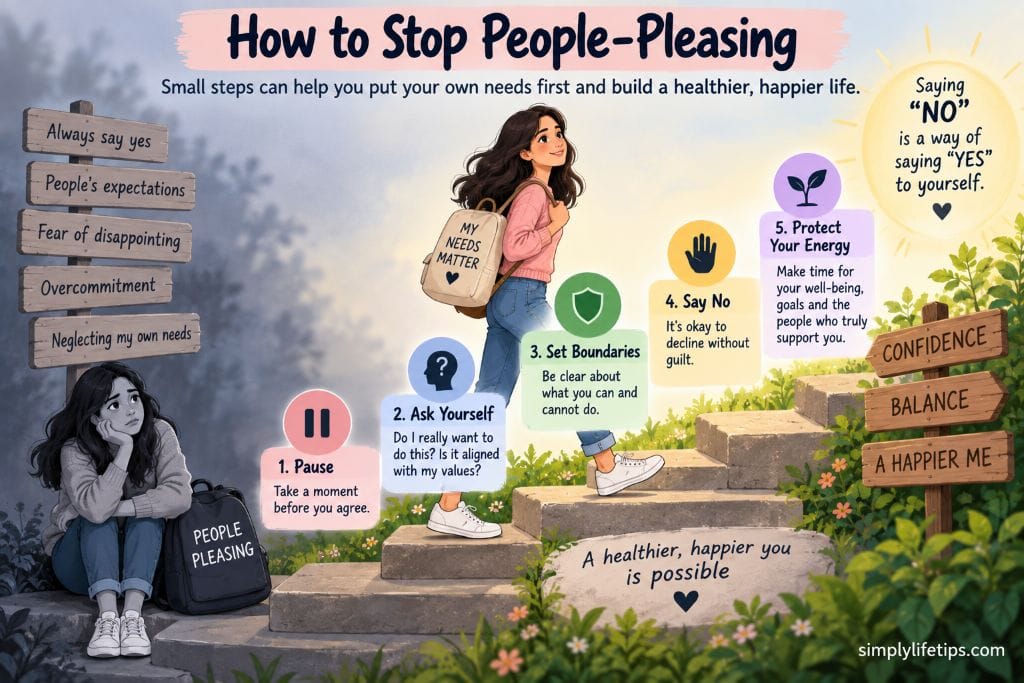
How to Stop People Pleasing
Breaking a long-standing pattern doesn’t require becoming cold or insensitive.
The goal is not to stop caring about people.
The goal is to care about others without completely abandoning yourself.
Pause Before Saying Yes
Don’t answer immediately when someone asks you for something.
Try:
“Let me think about it and get back to you.”
That short pause creates space between the request and your automatic response.
Ask Yourself What You Want
Before agreeing, ask:
“Do I actually want to do this?”
Then ask:
“Am I saying yes because I want to—or because I’m afraid of saying no?”
That distinction can be surprisingly revealing.
Start With Small Boundaries
You don’t need to transform your relationships overnight.
Start with small situations.
If someone asks you to do something when you’re tired, try saying:
“I can’t today, but perhaps another day.”
Each small boundary gives you an opportunity to discover that disagreement does not automatically destroy a relationship.
Accept That Someone May Be Disappointed
This can be one of the hardest lessons.
You can communicate respectfully, and someone may still feel disappointed.
That doesn’t necessarily mean you did something wrong.
Other people are allowed to have feelings.
You are also allowed to have boundaries.
You cannot completely control another person’s emotional reaction.
This idea is also explored in How to Stop Taking Things Personally: 3 Practical Steps for Emotional Security.
Pay Attention to Your Resentment
Resentment can sometimes be useful information.
If you repeatedly think:
“I don’t want to do this, but I have to.”
pause and examine the situation.
Ask:
“Did I actually agree freely?”
“What boundary am I avoiding?”
“What am I afraid will happen if I say no?”
The answer may reveal a pattern that needs attention.
Protect Your Time and Energy
Your time and energy are limited resources.
You don’t have to give unlimited access to everyone.
Creating space for rest isn’t selfish.
In fact, deliberately stepping away when mentally overwhelmed can help restore clarity. Simply Life Tips explores this in The Power of Stepping Away: Why a Pause Helps.
A Simple Question to Ask Yourself
The next time you are about to say yes, pause for a moment.
Ask yourself:
“If I knew this person would not be disappointed, what would I choose?”
That question can separate your genuine choice from your fear of rejection.
You may still choose to help.
That’s perfectly fine.
The important difference is that you’re helping because you choose to—not because you feel trapped by the need for approval.
You Don’t Have to Be Liked by Everyone
One of the most difficult truths about life is also one of the most liberating:
You cannot make everyone happy.
Someone may disagree with you.
Someone may misunderstand you.
Someone may be disappointed.
Someone may simply not like your decision.
And you can still be a good person.
Your worth does not have to depend on universal approval.
The goal isn’t to become someone who never cares what other people think.
The goal is to develop enough self-awareness to ask:
“What do I think?”
“What do I need?”
“What matters to me?”
“What am I willing to give?”
“What am I not willing to give?”
Those questions bring your own voice back into the conversation.
Could you be a people-pleaser without realizing it?
Sometimes the signs are easy to overlook because they can look like kindness, cooperation, or simply being a “good” person. But if you regularly put other people’s needs ahead of your own, struggle to say no, or worry constantly about how others see you, it may be worth taking a closer look at the pattern.
Here are seven common signs to reflect on:
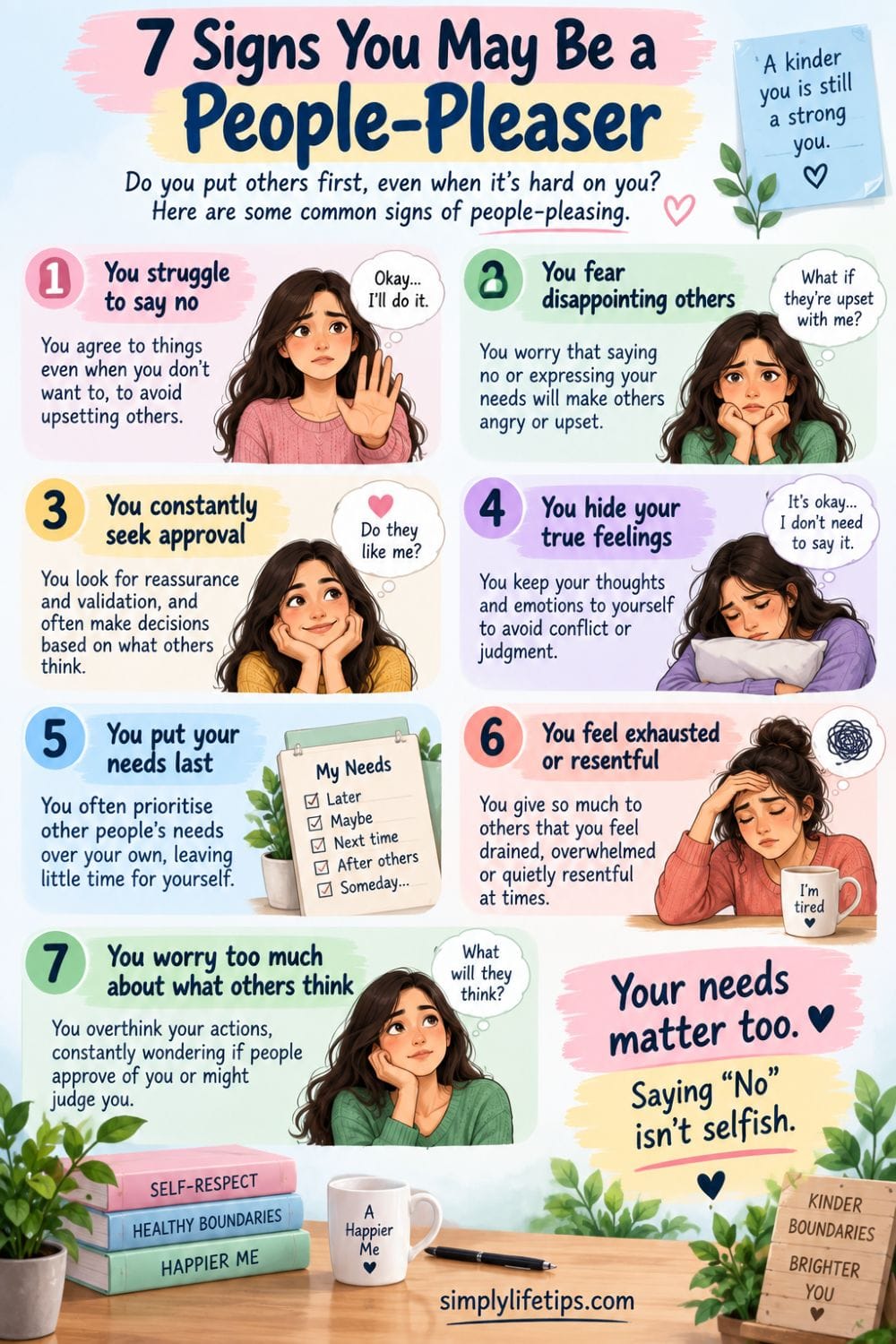
You don’t need to identify with every sign to recognize a people-pleasing pattern in your life.
The goal isn’t to stop being kind or helpful. It’s to make sure your kindness doesn’t require you to continually ignore your own needs, feelings, and boundaries.
Your needs matter too. Learning to say no can be an important step toward healthier relationships and greater self-respect.
Conclusion
People pleasing often begins with kindness, empathy, and a desire to maintain good relationships. But when the fear of disappointing others becomes stronger than your ability to express your own needs, the pattern can become emotionally exhausting.
You don’t have to stop being kind.
You don’t have to stop helping people.
You don’t have to become insensitive.
You simply need to remember that your needs matter too.
Saying “no” is not always rejection.
Sometimes, “no” is a healthy “yes” to yourself.
So ask yourself honestly:
“How much of myself am I changing just to make other people like me?”
And perhaps the more important question is:
“While seeking everyone else’s approval, am I forgetting to give myself permission to be myself?”
Frequently Asked Questions
What is people pleasing?
People pleasing is a pattern of repeatedly prioritizing other people’s needs, preferences, or approval over your own, often because of fear of conflict, rejection, criticism, or disappointing others.
Is people pleasing a mental health disorder?
No. People pleasing is not, by itself, a formal mental health diagnosis. It is better understood as a behavioral pattern that can occur for different psychological and social reasons.
Why is it so difficult to say no?
Some people associate saying no with rejection, conflict, guilt, or disappointing others. Previous experiences and learned relationship patterns can influence how strongly someone reacts to these possibilities.
Can people pleasing cause emotional exhaustion?
Persistent people pleasing can contribute to emotional strain, particularly when someone repeatedly ignores their own needs, takes on too many responsibilities, or constantly worries about other people’s reactions. It is not, however, the only possible cause of emotional exhaustion.
How can I stop being a people pleaser?
Start gradually. Pause before automatically saying yes, identify what you genuinely want, practice small boundaries, communicate your needs respectfully, and accept that other people may sometimes be disappointed. If the pattern is causing significant distress or interfering with daily life and relationships, consider speaking with a qualified mental health professional.
Reference Links
- Social rejection and reward learning: PubMed — Neural responses to social rejection and relational value
- Social acceptance and conformity neuroscience: PMC — Brain Systems Underlying Fundamental Motivations of Human Social Conformity
- Social threat and reward: PubMed — Brain structure correlates of expected social threat and reward
- Healthy boundaries: Cleveland Clinic — Healthy Boundaries

Mathukutty P V is a Blogger, YouTuber, and Content Writer and the founder of Simply Life Tips. After taking voluntary retirement in 2017, he embraced a free lifestyle focused on learning, personal growth, and sharing practical wisdom to help others live with more purpose and positivity.