The power of stepping away is easy to underestimate. When something matters to us, we often keep going. We keep thinking about the problem, replaying a conversation, staring at the same task, or searching for an answer even when our minds are already tired.
But pushing harder is not always the answer.
Sometimes, the most useful thing we can do is step away.
Stepping away does not necessarily mean giving up. It can mean creating enough distance to think clearly, calm down, regain perspective, and return when we are better prepared to deal with whatever is in front of us.
In a world that often celebrates constant productivity, learning when to pause can be surprisingly powerful.
What Does Stepping Away Really Mean?
Stepping away means deliberately creating some distance from a situation, task, conversation, or thought for a period of time.
That distance might last five minutes, an afternoon, or even longer, depending on the situation.
For example, imagine that you are working on an article and cannot find the right way to explain an important idea. You read the same paragraph repeatedly, delete sentences, rewrite them, and become increasingly frustrated.
Instead of forcing yourself to continue, you close the document and take a walk.
When you return later, the solution may suddenly seem obvious.
Nothing magical happened while you were away. Your brain simply had an opportunity to stop struggling with the problem directly.
That is one of the simplest ways to understand the power of stepping away.
Why Do We Find It Difficult to Step Away?
One reason is that we often confuse persistence with constant effort.
Persistence is valuable. It helps us continue when something is difficult. But constant effort without recovery can eventually become counterproductive.
There is also an emotional reason.
When we are invested in something, stepping away can feel like admitting defeat. We may think, “If I stop now, I am wasting time,” or “I need to solve this immediately.”
Sometimes we are also afraid that taking a break will allow the problem to become worse.
But stepping away does not automatically mean abandoning the problem. It can simply mean choosing a better moment to address it.
The Power of Stepping Away When You Are Angry
Arguments are one situation where stepping away can be particularly useful.
When emotions are running high, we may say things that we would not say after calming down. A conversation that could have been resolved peacefully can become much more difficult because neither person is ready to listen.
A short pause can change the situation.
You might say, “I need some time to calm down. Let’s talk about this later.”
That is different from ignoring the person or refusing to address the issue.
The goal is to create space before reacting.
After emotions settle, you may be able to explain what bothered you without turning the conversation into another argument.
Stepping away can therefore protect a relationship while still allowing the underlying issue to be addressed.
Stepping Away Can Clear a Tired Mind
Mental fatigue can make ordinary problems feel much larger than they really are.
If mental tiredness continues even after taking short breaks, learning more about mental exhaustion can help you understand why your mind may need more than simply pushing through.
After spending hours concentrating, making decisions, answering messages, or dealing with responsibilities, your ability to think clearly may decline.
At that point, continuing to work may not produce your best thinking.
A short break can provide a reset.
Get up from your desk. Walk outside. Drink some water. Stretch. Look away from the screen. Talk to someone about something completely unrelated.
When you return, the task may feel less overwhelming.
This doesn’t mean you can solve every difficult situation by taking a break. Some problems require sustained effort and professional support. But when tiredness is making clear thinking difficult, a pause can be useful.
Research on psychological detachment from work has linked mentally switching off from work with lower exhaustion, greater well-being, better sleep, and improved recovery.
The Power of Stepping Away From a Difficult Decision
Important decisions can become harder when we think about them continuously.
When too many choices begin to drain your mental energy, understanding decision fatigue can help you recognize when it is time to pause rather than keep forcing a decision.
Suppose you are choosing between two options. You compare the advantages and disadvantages again and again, ask several people for opinions, and keep changing your mind.
Eventually, you may become mentally exhausted.
Instead of continuing the cycle, step away for a while.
Do something unrelated. Sleep on it if appropriate. Return to the decision later and ask yourself what still matters.
Distance can sometimes reveal which concerns were genuinely important and which were simply the result of temporary anxiety or overthinking.
This is especially useful when a decision does not need to be made immediately.
A systematic review of research on work recovery also identifies psychological detachment as an important recovery experience associated with employee health, well-being, and work performance. Learn more about psychological detachment and recovery
Stepping Away Is Not the Same as Avoiding
This distinction matters.
Healthy stepping away has an intention to return.
Avoidance usually means refusing to deal with something because it feels uncomfortable.
For example, taking a 20-minute break from a difficult conversation so you can calm down can be constructive.
Continuously postponing the conversation because you never want to face it is different.
Similarly, taking an afternoon away from a challenging project can help you recharge. Abandoning the project indefinitely because you are afraid of making mistakes is avoidance.
The question is not simply, “Am I stepping away?”
Learning to pause, reflect, and return with a fresh perspective is part of personal growth, which connects naturally with the idea behind never stop learning.
A better question is, “Why am I stepping away, and what will I do when I return?”
A Change of Environment Can Change Your Perspective
Sometimes we do not need a completely new solution. We simply need to see the situation from somewhere else.
A change of environment can help create that mental distance.
If you have been sitting at a desk for hours, go outside.
If you have been thinking about a disagreement all evening, do something that occupies your attention.
If you have been writing about the same subject for too long, leave the draft and return later.
Even a short physical change can interrupt a repetitive thought pattern.
That is another practical example of the power of stepping away.
Stepping Away Can Help With Overthinking
Overthinking often creates the illusion that more thinking will automatically produce a better answer.
But thinking about the same question repeatedly does not always lead to greater clarity.
Sometimes it produces more questions.
You might replay something someone said, imagine different outcomes, worry about what could happen, and repeatedly search for certainty that may not exist.
A deliberate pause can interrupt that cycle.
Instead of asking yourself the same question for another hour, shift your attention to something else.
The problem may still be there when you return, but your relationship with the problem may have changed.
When Should You Step Away?
There is no universal rule, but certain signs suggest that a pause may be useful.
You may benefit from stepping away when:
- you are becoming unusually frustrated
- you keep making the same mistake
- you cannot concentrate
- an argument is becoming increasingly emotional
- you have been staring at the same problem without progress
- you are making decisions simply because you are mentally exhausted
- You are repeatedly replaying the same thoughts
- You feel overwhelmed by too many competing demands
A pause does not need to be complicated.
Sometimes five quiet minutes are enough.
Other times, you may need several hours or a good night’s sleep.
How to Step Away Without Losing Momentum
One concern people have is that taking a break will destroy their momentum.
A simple way to prevent this is to decide what you will return to before stepping away.
For example, instead of leaving your work with a vague thought like “I’ll continue later,” write down:
“When I return, I will rewrite the introduction and check the second section.”
That small action gives your brain a clear starting point.
You can also set a reasonable return time.
For example, take a 20-minute walk and then return to the task.
This makes the break intentional rather than indefinite.
Small Ways to Practice the Power of Stepping Away
You do not need to wait for a major problem to practice this skill.
Try stepping away when you notice yourself becoming frustrated with a task.
Put your phone down for a while when constant notifications are making you restless.
Leave a heated conversation before it turns into a collection of words you may later regret.
Take a short walk when your thoughts feel crowded.
Close your laptop after completing an important piece of work instead of immediately moving to another task.
Permit yourself to pause before responding to an emotional message.
These small habits can gradually change how you respond to pressure.
Sometimes Distance Reveals What Closeness Hides
When we are too close to a problem, our attention naturally focuses on individual details.
Stepping away can allow us to see the larger picture.
A minor disagreement may seem enormous during an argument but much smaller the following morning.
A difficult writing problem may appear impossible at midnight but straightforward after breakfast.
A decision that feels confusing after hours of analysis may become clearer after a period of rest.
The circumstances may not have changed.
Our perspective has.
That is perhaps the deeper lesson behind the power of stepping away.
Stepping Away Can Be an Act of Self-Respect
There is nothing admirable about exhausting yourself simply to prove that you can keep going.
Recognizing your limits is not weakness.
Sometimes stepping away means acknowledging that you are tired, emotional, distracted, or simply not in the right state of mind to continue.
That awareness can help you make better choices.
You are not saying, “I cannot handle this.”
You may simply be saying, “I want to handle this properly, so I need a moment.”
That small difference can change the way we approach difficult situations.
More recent longitudinal research has also examined how psychological detachment from work relates to later mental well-being and life satisfaction among working-age adults. Read the research on psychological detachment and mental well-being
The Power of Stepping Away Does Not Mean Giving Up
Perhaps the biggest misunderstanding is that stepping away means surrender.
It does not have to.
A runner may slow down without abandoning the race.
A writer may close the laptop without abandoning the article.
Two people may pause an argument without abandoning the relationship.
Someone facing a difficult decision may take time to reflect without avoiding responsibility.
Stepping away can be part of moving forward.
The important thing is knowing whether your pause is helping you return with greater clarity or simply helping you escape something you do not want to face.
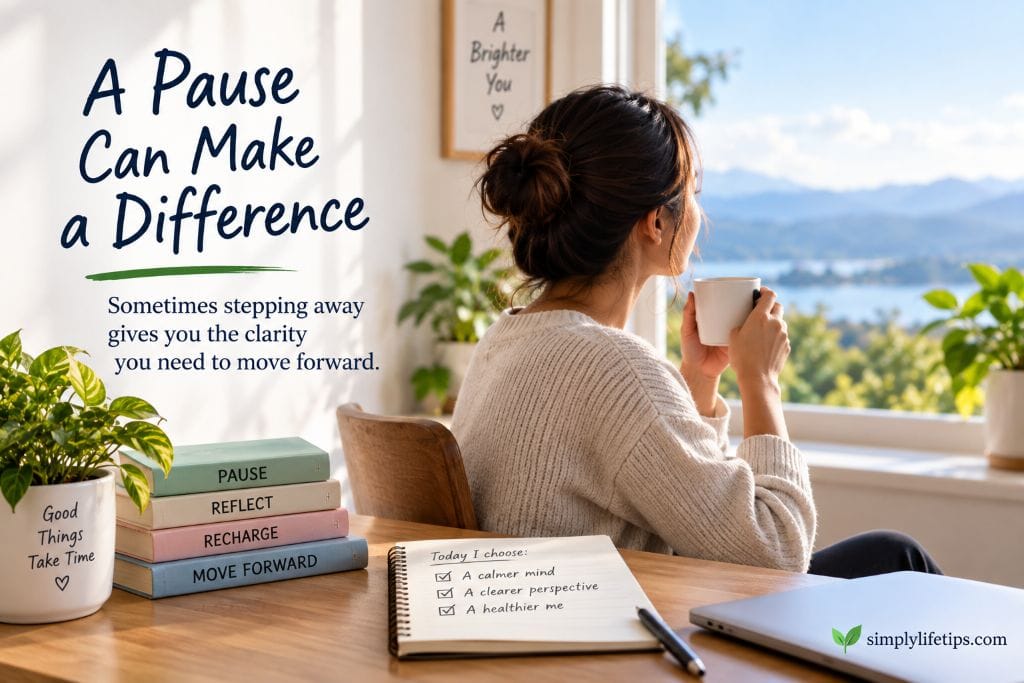
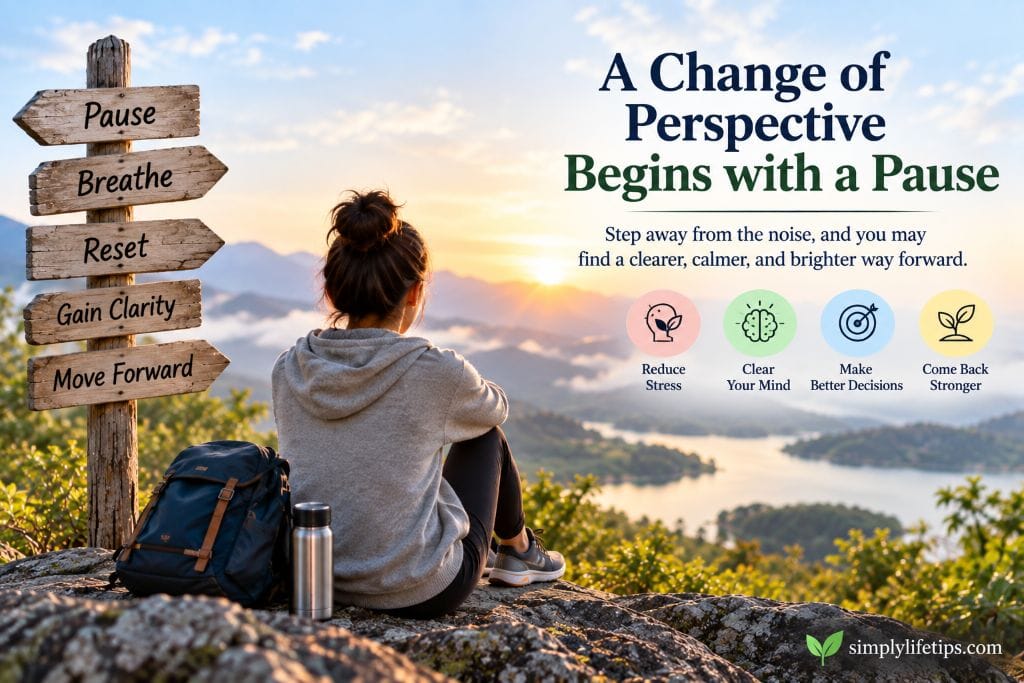
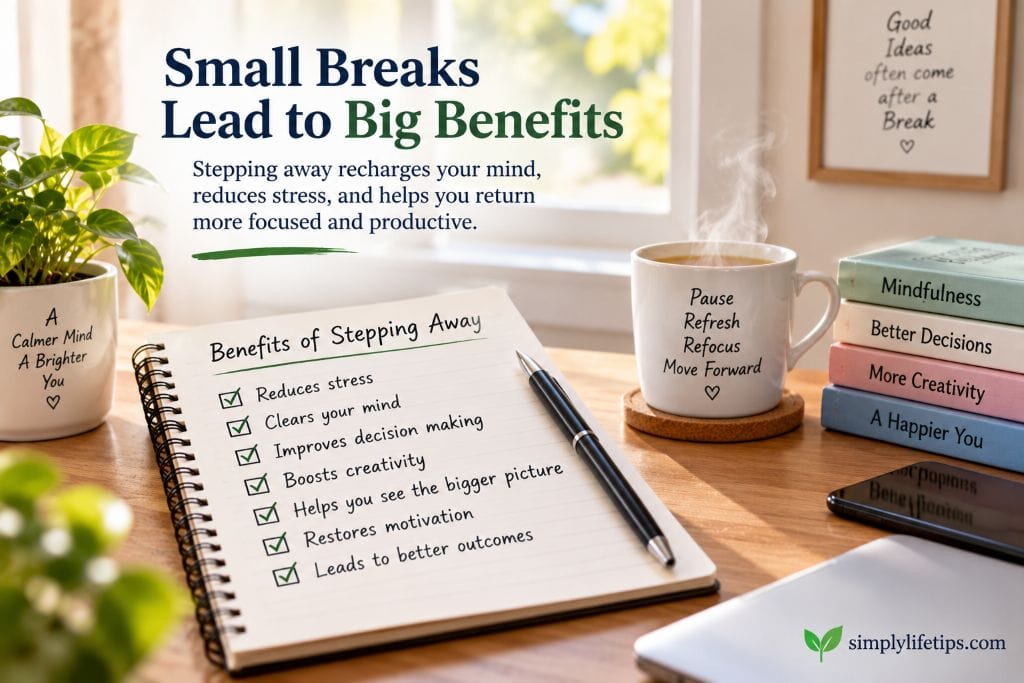
Sometimes, stepping away is exactly what we need to regain perspective, restore our energy, and approach a situation with a clearer mind. This infographic highlights some of the ways taking a purposeful pause can support better thinking and everyday well-being.
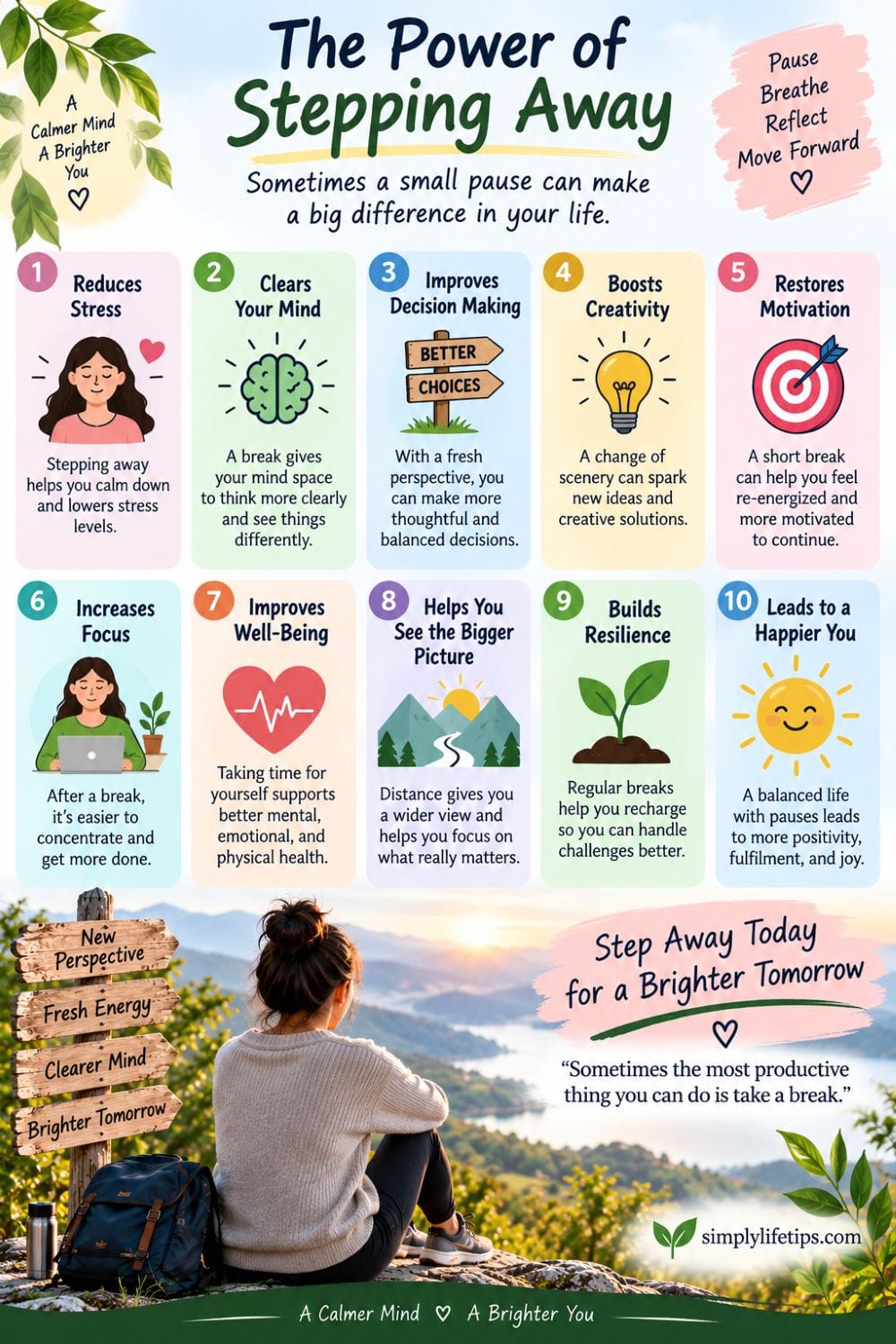
A pause does not have to be long or complicated. Even a few intentional moments away from the noise can give you the space to breathe, reflect, and return with a fresh perspective.
Conclusion
The power of stepping away lies in creating space between ourselves and the things demanding our immediate attention. A pause can give an exhausted mind time to recover, allow emotions to settle, and provide a different perspective on a difficult problem.
We do not always need to push harder.
Sometimes we need to stop, breathe, change our surroundings, and permit ourselves to return later.
The next time you feel stuck, angry, overwhelmed, or mentally exhausted, consider stepping away for a while. The problem may still be waiting when you return—but you may be better prepared to deal with it.
And sometimes, stepping away is not moving backward; it is creating the space needed to move forward.
FAQs
What is the power of stepping away?
The power of stepping away refers to the benefits of temporarily creating distance from a difficult task, situation, or emotional experience. A pause can help restore perspective, reduce immediate emotional pressure, and support clearer thinking.
Is stepping away the same as giving up?
No. Stepping away can be temporary and intentional. Giving up means abandoning an objective, while stepping away can provide time to recover and return with a clearer mind.
How long should you step away from a problem?
It depends on the situation. A short five- or ten-minute break may be enough for a simple task, while a difficult emotional situation may require several hours or more. The important thing is to use the pause purposefully.
Can stepping away help with overthinking?
Yes. Changing your activity or environment can interrupt repetitive thought patterns. Returning to the issue later may make it easier to distinguish useful thinking from unnecessary rumination.
When does stepping away become avoidance?
Stepping away becomes avoidance when the purpose is repeatedly escaping responsibility rather than creating space to deal with the issue. A healthy pause generally has some intention of returning and addressing the situation.

Mathukutty P V is a Blogger, YouTuber, and Content Writer and the founder of Simply Life Tips. After taking voluntary retirement in 2017, he embraced a free lifestyle focused on learning, personal growth, and sharing practical wisdom to help others live with more purpose and positivity.