

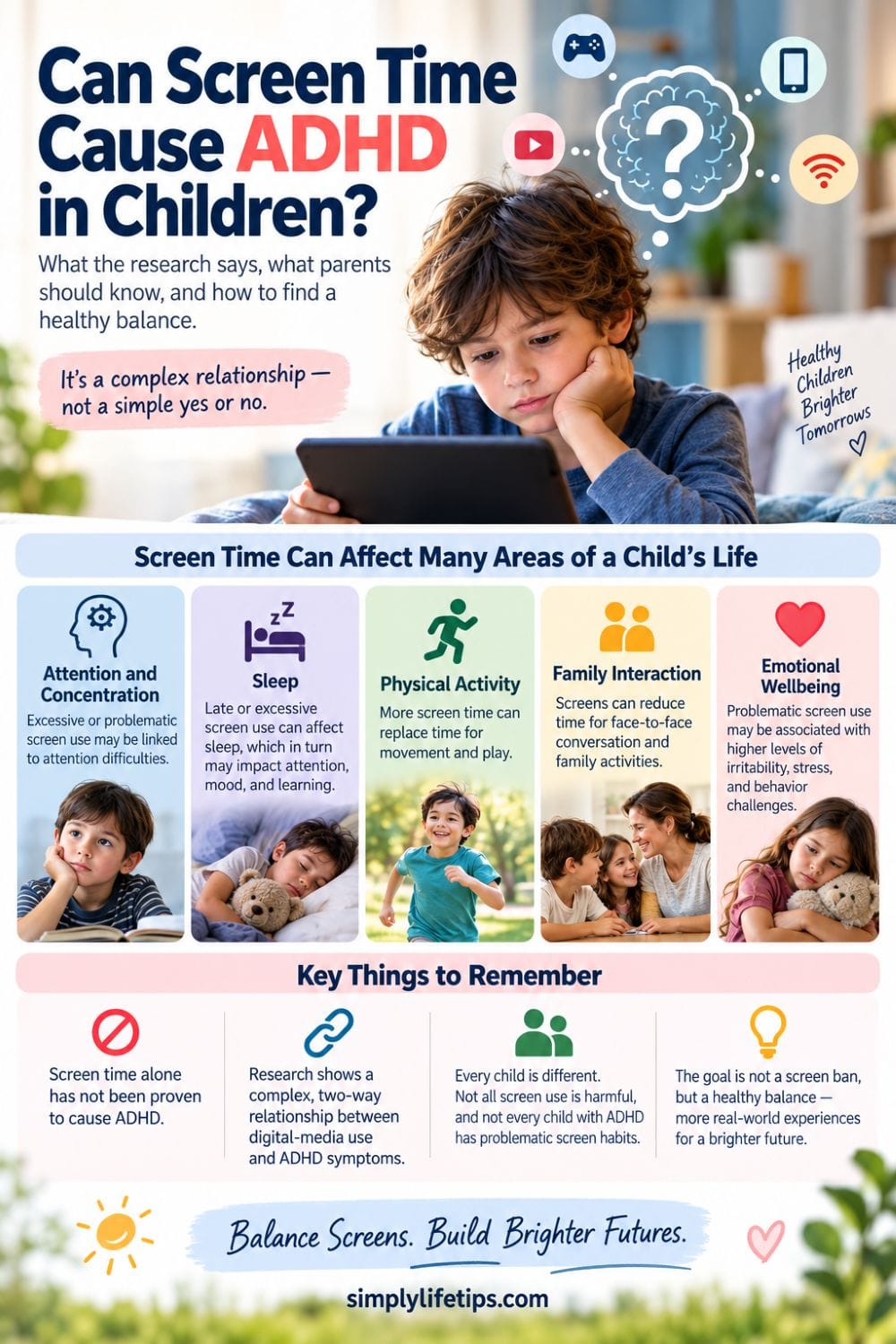
Can screen time cause ADHD in children? It is a question many parents ask when a child struggles to concentrate, becomes restless during homework, or seems unable to put down a phone or tablet.
“Give the phone, and the child becomes quiet. Take it away, and everything changes.”
Many parents recognize this situation. A child may spend hours watching videos, playing games, or scrolling through short-form content, yet struggle to stay focused on reading, homework, or a conversation.
The answer is more complicated than a simple yes or no.
Current research has found associations between digital-media use and ADHD symptoms, but it does not establish that screen time alone causes ADHD. Some longitudinal research also suggests that the relationship may work in both directions: children with ADHD symptoms may be more vulnerable to problematic digital-media use, while some patterns of digital-media use may also be associated with later ADHD symptoms.
For parents, understanding this distinction is important.
Screen time effects can extend beyond attention to sleep, physical activity, and family interaction.
What Is ADHD?
ADHD stands for attention-deficit/hyperactivity disorder, a neurodevelopmental disorder that can affect a child’s attention, activity level, and impulse control. The CDC’s guide to ADHD in children provides further information about ADHD, its symptoms, causes, diagnosis, and treatment.
Children with ADHD may have persistent difficulties with attention, hyperactivity, or impulsivity. The condition can present predominantly with inattentive symptoms, predominantly with hyperactive-impulsive symptoms, or with a combination of both.
If you want to learn more about the condition itself, see our detailed guide to ADHD: Attention Deficit Hyperactivity Disorder.
It is important to remember that occasional distraction, restlessness, forgetfulness, or difficulty following instructions does not automatically mean that a child has ADHD.
This distinction matters when parents ask, “Can screen time cause ADHD in children?” Attention problems can have several possible explanations, so screen use should not automatically be treated as the cause.
According to the CDC, diagnosing ADHD involves several steps. Healthcare professionals also consider other conditions that may cause similar symptoms, including sleep disorders, anxiety, depression, and certain learning difficulties. CDC: Diagnosing ADHD provides more information about the diagnostic process.
So, the most accurate answer is:
Screen time should not be described as a proven cause of ADHD. However, unhealthy or problematic digital-media habits may be associated with attention difficulties and ADHD symptoms, and the relationship may work in both directions.
Can Screen Time Cause ADHD?
Current evidence does not establish that phones, tablets, television, or video games directly cause ADHD.
ADHD has complex causes and risk factors. Genetic factors play an important role, while researchers have also identified other biological and environmental factors that may contribute to the development of the condition.
At the same time, researchers have found associations between children’s digital-media use and ADHD symptoms.
A systematic review of longitudinal research involving children and adolescents found evidence of reciprocal associations between digital-media use and ADHD symptoms. Importantly, the association was more consistent for problematic digital-media use than for screen time alone. The researchers noted that children with ADHD symptoms may be more vulnerable to problematic digital-media use, while digital media may also influence later ADHD symptom levels through direct or indirect pathways, including sleep and social relationships. Read the systematic review on PubMed.
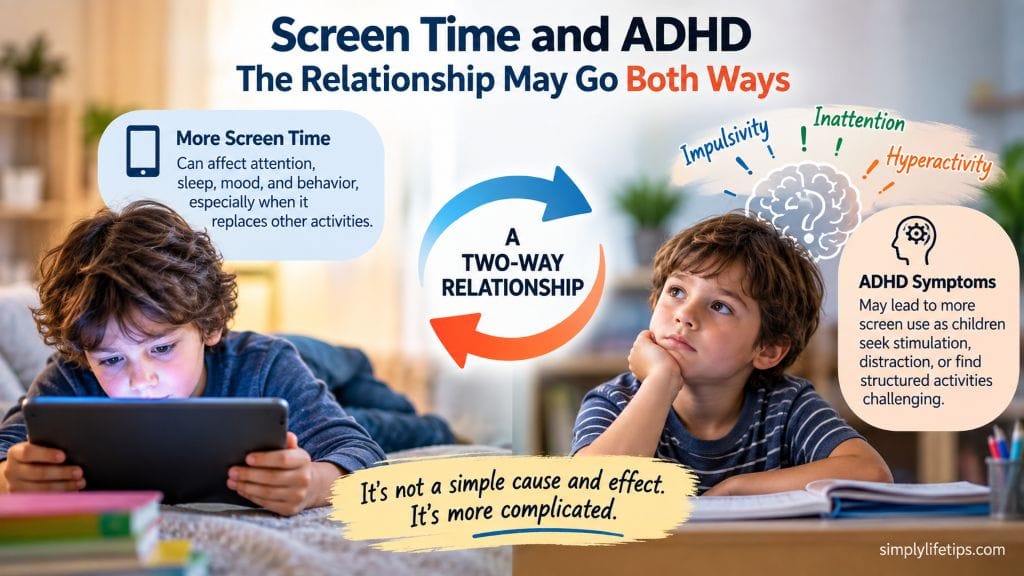
The Relationship Between Screen Time and ADHD May Go Both Ways
One of the most important questions is not simply whether screens affect attention, but which direction the relationship goes. This helps explain why the question “Can screen time cause ADHD in children?” is more complicated than it first appears.
Could excessive or problematic digital-media use contribute to attention difficulties? Or are children who already have ADHD symptoms more likely to seek out highly stimulating digital activities?
Research suggests the relationship may be bidirectional, not a simple one-way cause-and-effect relationship. Children with ADHD symptoms may be more vulnerable to problematic digital-media use, while certain patterns of digital-media use may also be associated with later ADHD symptoms.
For example, a child who struggles to sustain attention during a quiet activity may prefer a fast-paced game that provides immediate feedback and frequent rewards. At the same time, if digital activities begin to replace sleep, physical activity, reading, family interaction, or other everyday experiences, those changes may also affect the child’s overall well-being and daily functioning.
This does not mean that a child who enjoys video games or watches many videos has ADHD. Nor does it mean that every child with ADHD will have problematic screen habits.
The more useful question for parents may therefore be:
Is screen use becoming a problem in my child’s daily life, regardless of whether the child has ADHD?
For children who already have ADHD, parents may also benefit from practical strategies for routines, behavior, and daily support in our guide to Expert Parenting Tips for ADHD Kids.
The goal is not to blame the screen or the child. It is to understand the relationship and identify whether digital-media habits are interfering with sleep, learning, physical activity, relationships, or other important parts of childhood.
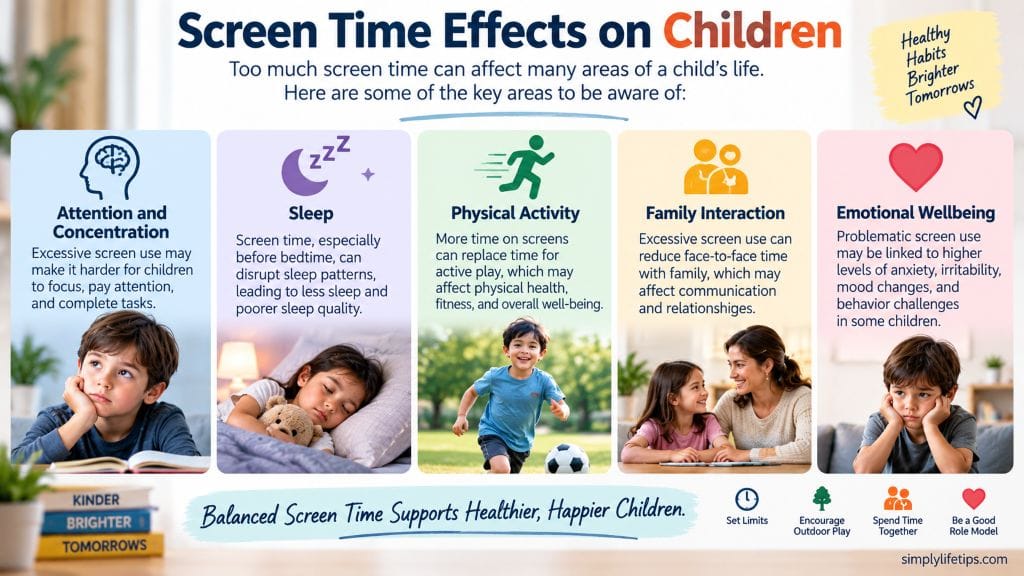
Screen Time Effects on Children
The effects of screen time on children are not limited to attention. What matters is also what screen use replaces in a child’s daily routine. Understanding the screen time effects on children is also important because screen use can influence several parts of a child’s daily routine. Parents may also need to look at how screen use affects sleep, physical activity, learning, family interaction, and other parts of daily life.
When screens take up a large part of the day, they can reduce time available for sleep, physical activity, reading, creative play, face-to-face interaction, and family activities. Research has also found associations between screen exposure and attention difficulties, although these findings do not prove that screen time directly causes those difficulties.
Attention and Concentration
When parents notice changes in concentration, they may naturally wonder whether screen use is playing a role.
Children are naturally drawn to activities that are interesting, interactive, and rewarding. Many digital platforms are designed to keep attention through rapid changes, sounds, notifications, and continuous new content.
This does not mean that every fast-paced game or video damages a child’s attention. However, parents may notice that a child becomes frustrated with slower activities such as reading, homework, drawing, or playing quietly after spending a long time with highly stimulating digital content.
The important issue is not simply how many minutes a child spends looking at a screen, but whether screen use is interfering with the ability to concentrate on other important activities.
A systematic review examining screen time and attention in children found an association between screen exposure and attention problems, while also highlighting the need for further research to understand the direction and causes of these relationships. Read the systematic review on PubMed.
Sleep
Screen use can also affect children’s sleep, particularly when devices are used close to bedtime. Poor sleep can itself affect daytime attention and behavior, which is another reason parents should look at the child’s overall routine rather than screen use alone.
A child who stays up late watching videos, playing games, or chatting online may simply get fewer hours of sleep. Notifications and the habit of checking a device can also make it harder to settle into a consistent bedtime routine.
Poor sleep can then show up during the day as tiredness, irritability, difficulty concentrating, or problems staying attentive.
For this reason, protecting sleep should be one of the first priorities when a family is trying to establish healthier screen habits.
Physical Activity
Time spent sitting with a phone, tablet, television, or gaming device can sometimes replace opportunities for movement and outdoor play.
Children need regular physical activity as part of a healthy lifestyle. The CDC recommends healthy habits for children with ADHD that include daily physical activity, adequate sleep, and limiting screen time.
A practical approach is therefore not simply to remove a screen but to replace some of that time with activities that involve movement—playing outside, walking, cycling, sports, dancing, or active games.
Family Interaction
Screens can also affect the amount of time family members spend talking and interacting with one another.
A child watching a video during dinner may miss a conversation. A parent checking messages repeatedly while a child is talking may unintentionally send the message that the phone deserves immediate attention.
Small changes can make a difference. Family meals, conversations, playtime, and other shared activities can become opportunities to create regular periods without devices.
The aim is not to eliminate technology from family life. It is to make sure that digital activities do not crowd out the real-world experiences children need for healthy development.
Why Do Some Children Find Screens So Difficult to Put Down?
Digital media can be extremely engaging.
Games may offer immediate rewards. Videos can change rapidly. Social platforms can provide an endless stream of new material. Notifications can encourage people to check their devices repeatedly.
For some children, these features can make stopping particularly difficult.
But a child who becomes upset when a game ends does not automatically have ADHD.
Likewise, enjoying video games or watching many videos does not by itself indicate a disorder.
Parents should look at the child’s overall behavior, routine, sleep, school functioning, relationships, and well-being.
Is Fast-Paced Content Making Children Less Patient?
This is one reason parents may question whether highly stimulating digital content is affecting their child’s ability to engage with slower activities such as reading or homework.
Many parents notice a striking difference:
A child may watch short videos for an hour but struggle to read for ten minutes.
It can be tempting to conclude that the videos have permanently damaged the child’s attention span.
That conclusion would go beyond the available evidence.
However, it is reasonable to consider whether a child’s media habits are crowding out activities that require sustained attention.
Reading, drawing, building, playing outdoors, solving puzzles, listening to stories, helping with household tasks, and talking with family members all provide opportunities for children to practise different skills without constant digital stimulation.
The goal is not to make every activity compete with a screen.
The goal is to give children a balanced range of experiences.
Screen Ban Is Not the Solution: Screen Balance Is
Completely banning screens is not practical for many families.
Children use digital devices for schoolwork, communication, creativity, information, entertainment, and other everyday activities.
Instead of thinking only in terms of “screen or no screen,” parents can think about screen balance.
The American Academy of Pediatrics recommends creating a personalized Family Media Plan that fits a family’s routines and values. Its guidance includes ideas such as screen-free zones, turning off unnecessary notifications, choosing quality content, and making room for reading, outdoor play, hobbies, and family activities.
Screen balance is not about removing technology from childhood. It is about making sure technology does not crowd out childhood.

Practical Screen-Balance Rules for Families
Small changes can make digital habits more manageable.
Keep meals screen-free
Family meals can provide an opportunity for conversation and connection.
Make the dining table a place where phones and tablets are put aside.
The American Academy of Pediatrics specifically suggests screen-free zones such as the dinner table, during homework, and before bed.
Turn off unnecessary notifications
Notifications constantly compete for attention.
Turning off unnecessary alerts can reduce distractions and make it easier for children—and adults—to concentrate on one activity at a time.
The AAP also recommends considering notifications and autoplay when developing healthy family media habits.
Protect bedtime
Try to make the period before bedtime calmer and less dependent on screens.
A predictable bedtime routine can help children transition away from stimulating activities.
Parents can establish a household rule that phones and tablets stay outside bedrooms or are put away before bedtime, depending on the child’s age and family circumstances.
Make time for physical activity
Children need opportunities to run, jump, play, walk, cycle, practise sports, and simply move.
Physical activity should be part of everyday life rather than something children receive only after completing their screen time.
Create screen-free spaces
Families can establish areas where screens are normally not used.
The dining table and bedrooms are two possible examples.
The precise rules should be appropriate for the child’s age and the family’s circumstances.
Spend time together without screens
Talk.
Read together.
Cook together.
Play a board game.
Go outside.
Take a walk.
Let your child tell you about their day.
These ordinary experiences matter because children need opportunities for face-to-face interaction and activities that do not depend on digital stimulation.
Parents Need to Look at Their Own Screen Habits
Children learn from what adults do, not only from what adults say. When parents frequently check or scroll on their phones during family interactions, children may learn that constant phone use is a normal part of everyday life. Our article on The Impact of Parental Phone Addiction on Children looks more closely at this parent-child dynamic.

It can be difficult to tell a child:
“Put your phone away.”
while repeatedly checking your own phone during dinner or conversation.
Parents do not need to be perfect.
But modelling healthier digital habits can make family rules easier to understand and follow.
The AAP specifically encourages parents to create media plans for the whole family, including themselves, and describes parents as important role models for healthy digital habits.
If phones are put away during meals, conversations, and family activities, children learn that being offline is a normal part of everyday life.
Looking at the whole family environment is important because children’s digital habits do not develop in isolation.
What If My Child Becomes Angry When I Take Away the Phone?
A strong reaction to losing screen access does not, by itself, indicate ADHD.
Some children may cry, argue, protest, or become angry when asked to stop a game or video. The reaction can become especially intense when the child is deeply engaged in an activity.
That reaction alone does not indicate ADHD.
Instead of suddenly removing every screen, parents can establish predictable rules.
For example:
- Tell the child when screen time will end.
- Give a warning before the transition.
- Keep the rules consistent.
- Avoid renegotiating the rules every day.
- Offer another activity after the screen is turned off.
- Keep bedtime and daily routines predictable.
The replacement activity matters too.
If the only alternative to a fascinating game is “sit quietly and do nothing,” the transition will naturally be harder.
The AAP also provides practical guidance for parents dealing with difficult transitions away from screens.
What Can Replace Screen Time?
Taking a phone or tablet away should not leave a child’s world empty.
Give children something to do.
A playground.
A bicycle.
A football.
A book.
Drawing materials.
Building blocks.
Music.
A board game.
A walk with a parent.
Time with friends.
Unstructured play.
A conversation.
Children need opportunities to explore the real world, solve problems, use their imagination, interact with other people, and develop interests beyond digital entertainment.
For families dealing with broader developmental or parenting challenges, our article on parenting a child with special needs may also provide useful perspectives.
Reducing screen time is therefore only one part of the solution.
Increasing real-life time matters too.
When Should Parents Talk to a Healthcare Professional?
Parents should not try to diagnose ADHD based on screen habits alone. If you are asking “Can screen time cause ADHD in children?” because your child is experiencing persistent attention or behavior difficulties, it is important not to assume that screen use is the cause.
If a child consistently has significant difficulties with attention, hyperactivity, impulsivity, learning, behavior, or relationships, it is appropriate to discuss those concerns with a qualified healthcare professional.
The CDC explains that there is no single test for ADHD. Diagnosis involves several steps, and healthcare professionals consider whether other conditions could better explain the symptoms or occur alongside ADHD.
For children, information from parents, teachers, and other caregivers may be considered because symptoms need to be understood across different settings.
This distinction is important:
A child who spends a lot of time on a phone does not automatically have ADHD.
And:
A child with ADHD is not simply a child who spends too much time on a phone.
These are different issues, even though they can overlap.
The Bigger Question Parents Should Ask
Instead of asking only:
“How many hours does my child spend on a screen?”
parents can also ask:
“What is the screen replacing?”
Is it replacing sleep?
Outdoor play?
Reading?
Homework?
Family conversation?
Time with friends?
Creative activities?
Or is the child using technology for schoolwork, creativity, communication, or another constructive purpose?
The answer can provide more useful context than a single number.
The AAP’s Family Media Plan similarly encourages families to consider what media use is crowding out and to make room for sleep, physical activity, learning, play, hobbies, and family connection.
Looking at the child’s entire routine provides better context than simply asking, “Can screen time cause ADHD in children?”
Conclusion
So, can screen time cause ADHD in children?
Current evidence does not support the simple claim that screen time alone causes ADHD. Research does show associations between digital-media use and ADHD symptoms, and longitudinal evidence suggests that the relationship may work in both directions, particularly when digital-media use becomes problematic.
That is why parents do not need to panic about every minute a child spends on a screen.
Instead, focus on balance.
Protect sleep.
Encourage physical activity.
Make room for reading, play, conversation, and creativity.
Create predictable screen-free times and spaces.
And if a child’s attention, behavior, learning, or development is causing persistent difficulties, seek professional advice rather than assuming the screen is the cause.
A screen can be part of a child’s life. It should not become the child’s whole life.
Frequently Asked Questions
Can screen time cause ADHD in children?
Current evidence does not establish that screen time alone causes ADHD. Studies have found associations between digital-media use and ADHD symptoms, but the relationship appears complex and may work in both directions.
Does excessive screen time make ADHD symptoms worse?
Problematic digital-media use is associated with ADHD symptom levels, but the evidence does not mean that every increase in screen time will worsen ADHD. Children with ADHD symptoms may also be more vulnerable to problematic digital-media use.
How much screen time should children have?
There is no single screen-time rule that is appropriate for every child and every family. The American Academy of Pediatrics (AAP) provides a personalized Family Media Plan to help families decide how digital media fits into their daily lives. The plan can include screen-free zones, rules around notifications and autoplay, appropriate content, and making time for sleep, outdoor play, hobbies, reading, and family activities. The AAP emphasizes that every family is different, so the plan should fit the family’s routines and values.
How can I reduce my child’s screen time?
Start with predictable rules rather than sudden restrictions. Establish screen-free meals or spaces, turn off unnecessary notifications, protect bedtime, and offer attractive alternatives such as outdoor play, reading, hobbies, creative activities, and family time.
How do I know whether my child has ADHD?
You cannot determine ADHD from screen use or a few attention problems alone. ADHD diagnosis requires a proper evaluation by a qualified healthcare professional. The CDC notes that other issues, including sleep disorders, anxiety, depression, and some learning difficulties, can cause similar symptoms.
Medical disclaimer: This article is for general educational purposes and is not a substitute for professional medical advice, diagnosis, or treatment. If you are concerned about your child’s attention, behavior, development, sleep, or wellbeing, speak with a qualified healthcare professional.

Mathukutty P V is a Blogger, YouTuber, and Content Writer and the founder of Simply Life Tips. After taking voluntary retirement in 2017, he embraced a free lifestyle focused on learning, personal growth, and sharing practical wisdom to help others live with more purpose and positivity.



