
Sex education for children is an important part of raising informed, confident, and responsible young people in today’s digital world. Children can now access websites, social media posts, videos, and online discussions about sex and relationships with just a few taps. Unfortunately, not everything they encounter is accurate, appropriate for their age, or helpful for understanding real-life relationships.
Some children come across sexually explicit content accidentally. Others may search for answers because they feel embarrassed to ask their parents, teachers, or another trusted adult. Teenagers may also turn to online videos because they are curious about puberty, attraction, intimacy, and relationships.
The concern is not that children have questions. Curiosity about the body and growing up is a normal part of development. The real concern is that children may receive confusing, misleading, or harmful information before they have the maturity and knowledge to understand it.
Parents and schools have an important role in addressing this challenge. Children need accurate information at the right age, opportunities to ask questions without shame, and guidance to understand what they see online.
Sex education for children should not be a single uncomfortable conversation postponed until adolescence. It should be an ongoing process that develops as children grow.
Why Sex Education for Children Matters in the Digital Age
The internet has changed how children discover information. In the past, parents, teachers, books, and health professionals were often the main sources of information about growing up. Today, children can encounter sexual content through social media feeds, advertisements, messaging platforms, search results, and entertainment videos.
Although the internet provides valuable educational resources, it also contains pornography, myths, unrealistic portrayals of relationships, and inaccurate health advice.
The World Health Organization explains that comprehensive sexuality education provides scientifically accurate, age-appropriate information about bodies, relationships, health, and rights. It also helps young people correct misconceptions and develop skills for making informed decisions.
Source: WHO – Comprehensive Sexuality Education
What can happen when children lack reliable information?
Consider a child who notices physical changes during puberty but has never been told what to expect. The child may become worried, believe something is wrong, or search online for an explanation.
Another teenager may wonder whether a relationship shown in an explicit video represents real intimacy. Without reliable education, the teenager may develop unrealistic expectations about bodies, consent, affection, or sexual relationships.
A young person who feels embarrassed to ask questions may also accept incorrect information from friends or strangers online.
These examples demonstrate why age-appropriate education matters. Parents do not need to explain everything at once. They need to provide accurate answers as questions and developmental needs arise.
Sex education is not encouragement to become sexually active
One common misconception is that teaching children about sexuality encourages them to experiment sexually. Comprehensive sexuality education is intended to provide knowledge, develop responsible decision-making, and promote healthy relationships.
According to the WHO, well-implemented comprehensive sexuality education can help delay sexual initiation and reduce sexual risk-taking.
The goal is not to encourage premature sexual activity. It is to help children and young people understand their bodies, respect themselves and others, recognise unsafe situations, and make informed decisions as they mature.
Parents’ Responsibility in Teaching Sex Education
Parents are often a child’s first and most trusted source of information. Their responses to questions can influence whether children feel comfortable seeking guidance later.
You do not need to be a medical expert or deliver a formal lecture. You need to be willing to listen, provide accurate information, and find reliable answers when you do not know something.
1. Start early with simple, age-appropriate information
Sex education can begin in early childhood with ordinary lessons about body parts, privacy, personal space, family relationships, and respect.
For example, when a toddler is learning body-part names, parents can introduce correct names for body parts rather than treating some words as shameful. They can explain that certain parts are private and that children can tell a trusted adult if something makes them uncomfortable.
These early lessons do not require discussions about sexual activity. They establish a foundation of body awareness, communication, and respect.
2. Answer questions honestly without creating shame
Children may ask questions at unexpected moments.
A young child might ask, “Where do babies come from?” An older child might wonder why their body is changing. A teenager may ask about attraction, menstruation, erections, relationships, or sexual health.
Avoid laughing at the question, scolding the child, or saying that good children should not ask such things.
Instead, find out what the child already knows and answer at a level they can understand.
For example:
Child: “Why is my voice becoming deeper?”
Parent: “Your body is growing and changing as you go through puberty. Your voice may become deeper, and other changes will happen too. These are normal parts of growing up.”
If a child asks something you cannot answer confidently, say, “That’s a good question. Let’s find a reliable answer together.”
This response teaches children that asking questions is acceptable and that accurate information matters.
For more guidance on communication and understanding children’s needs, read Understanding Your Children.
3. Make difficult conversations a normal part of family life
Parents sometimes wait for a major event before discussing puberty or sexual health. By that time, children may already have encountered information elsewhere.
Short, regular conversations are often more comfortable than one long, formal talk.
For example, a discussion about a television character becoming a parent can introduce the subject of pregnancy. A conversation about a classmate experiencing puberty can lead to a discussion about body changes. A question about a social media video can provide an opportunity to explain the difference between reliable information and entertainment.
The purpose is to build trust over time.
Sex Education for Children by Age: What Should Parents Teach?
Children do not all develop at the same rate. The following age groups are practical guidelines, not rigid deadlines. Parents should adjust the detail and language to suit each child’s development, questions, and understanding.
The central principle is simple: begin with basic knowledge, add more information as children mature, and keep communication open throughout adolescence.
Children need different kinds of sex education as they grow. From learning the correct names for body parts in early childhood to understanding puberty, consent, healthy relationships, and online safety during adolescence, each stage requires age-appropriate guidance.
The following infographic highlights eight practical ways parents can teach children about their bodies, answer questions honestly, and help them find reliable information as they grow.
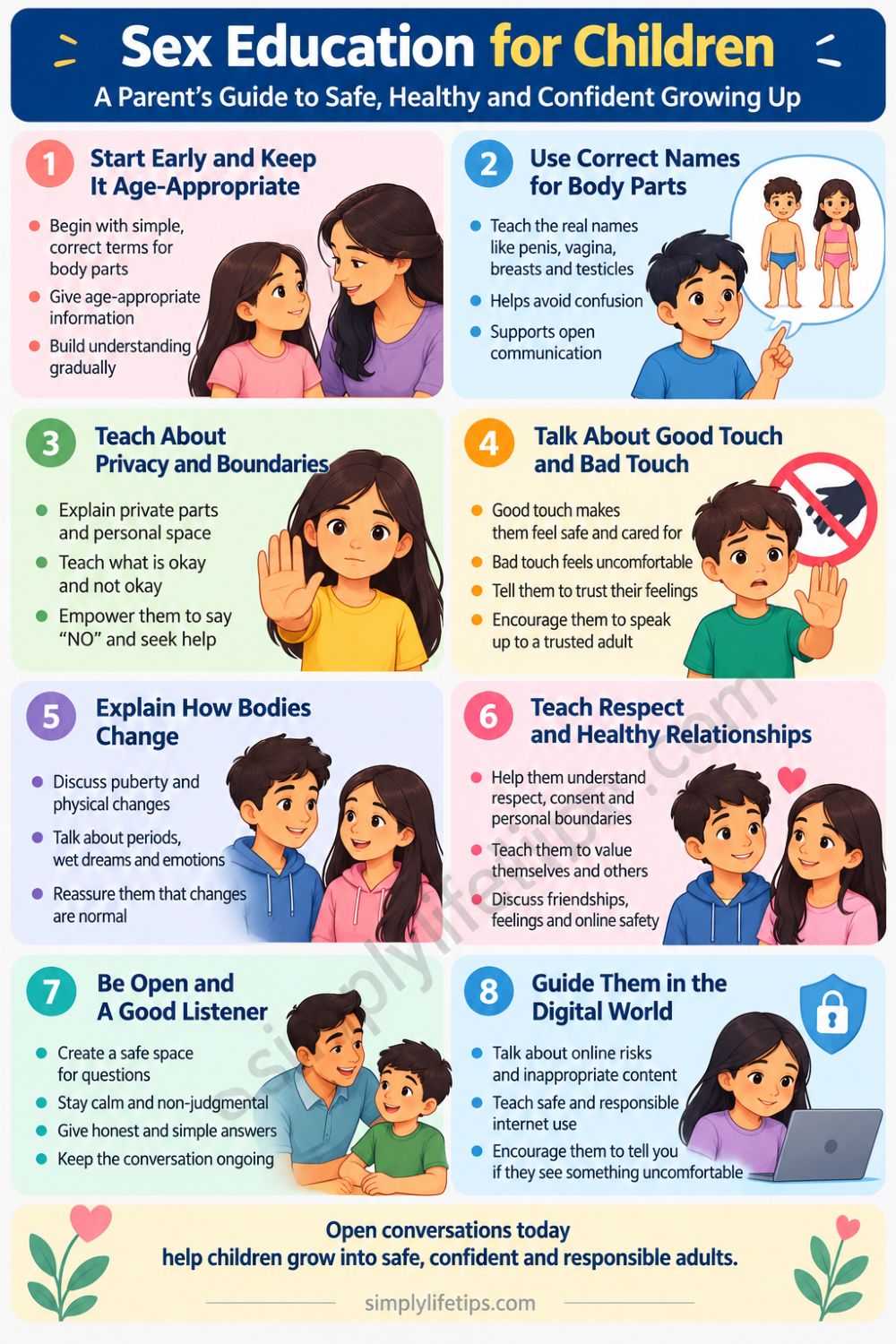
Remember, every child develops at their own pace. Use these age groups as general guidelines, adapt conversations to your child’s understanding, and encourage questions without embarrassment or pressure.
Let’s look at what parents should teach children at each stage of development.
Toddlers and preschoolers: Teach body parts and privacy
Approximate ages: 2–5 years
Young children are naturally curious about their bodies. At this stage, parents should focus on naming body parts, understanding privacy, recognising feelings, and learning simple boundaries.
Teach children:
- The correct names for body parts.
- That their bodies deserve care and respect.
- That some body parts are private.
- That they can say when they feel uncomfortable.
- That they can ask a trusted adult for help.
- That questions about bodies are acceptable.
For example, during dressing or bathing, parents can explain that private parts are generally covered by underwear and that privacy should be respected. They can also explain that a parent or healthcare professional may sometimes need to help with hygiene or examine a child for a genuine health reason, while respecting the child’s dignity.
If a toddler asks where babies come from, a simple answer might be: “A baby grows inside a special organ in the mother’s body called the uterus.”
There is no need to provide more detail than the child is asking for at this stage.
The objective is not to introduce adult concepts too early. It is to help children develop healthy body awareness and feel safe asking questions.
Early school-age children: Explain bodies, reproduction, and respect
Approximate ages: 6–8 years
As children grow, their questions may become more detailed. They may hear unfamiliar words at school, encounter information through media, or become interested in pregnancy and how babies develop.
Parents can gradually explain:
- Basic human anatomy and body functions.
- How a baby develops during pregnancy.
- Differences in physical development.
- Privacy, consent, and respecting other people’s boundaries.
- The importance of speaking to a trusted adult when something is confusing or uncomfortable.
For example, if a child asks how a baby begins to grow, explain reproduction using clear, factual language suited to the child’s understanding.
If the child repeats an inaccurate claim heard from a friend, avoid ridicule. Ask what they heard, explain what is correct, and invite further questions.
These conversations also help children understand that people should treat one another respectfully, regardless of differences in appearance or development.
Older children and preteens: Prepare them for puberty
Approximate ages: 9–12 years
Puberty may begin during this period, although its timing varies considerably. Children should receive information before or as physical changes begin, rather than being left to discover everything through friends or online searches.
Topics to discuss include:
- Growth spurts and changes in body shape.
- Breast development and menstruation.
- Penis and testicle development.
- Erections and wet dreams.
- Body odour, sweating, acne, and personal hygiene.
- Emotional changes and growing independence.
- Reproduction and the basics of sexual health.
- Consent, privacy, and respectful friendships.
For example, explain menstruation before a child experiences their first period. A girl who understands what is happening is less likely to mistake it for an injury or believe she has done something wrong.
Likewise, explain that erections can occur naturally and sometimes unexpectedly during puberty. Wet dreams can also occur as the body develops. These experiences should be discussed factually, without ridicule or embarrassment.
Parents should make it clear that puberty does not happen at the same age for everyone. A child who develops earlier or later than friends should not be made to feel inferior.
The important lesson is that body changes are part of development, and questions about them deserve accurate answers.
Teenagers: Discuss sexuality, relationships, and reproductive health in greater detail
Approximate ages: 13–18 years
Adolescence brings more complex questions about identity, attraction, relationships, intimacy, and personal responsibility. Teenagers need opportunities to discuss these subjects with trustworthy adults.
Conversations can cover:
- Reproductive health and sexual health.
- Consent and the importance of freely given agreement.
- Emotional readiness, respect, and healthy relationships.
- Pregnancy prevention and contraception.
- Sexually transmitted infections and prevention.
- Peer pressure and responsible decision-making.
- Pornography, online sexual content, and unrealistic portrayals of intimacy.
- Digital privacy, sextortion, and requests for intimate images.
For example, a teenager who asks about sexual relationships should not automatically be treated as someone planning to become sexually active. Begin by understanding the question and providing accurate information.
Parents can explain that healthy relationships require mutual respect, honest communication, and freedom from pressure. No one should be manipulated into sexual activity or intimate image-sharing to prove love or loyalty.
Teenagers should also understand that pornography is produced for adult entertainment and should not be treated as a guide to real-life intimacy. It may present unrealistic bodies, behaviours, and expectations, and it does not reliably teach consent, emotional connection, or sexual health.
The aim is to help young people think critically, recognise pressure, and make responsible decisions as they mature.
Young adults: Support independent, informed decisions
Approximate ages: 18–19 and beyond
Young adults may need continued guidance as they develop greater independence and make decisions about relationships, education, work, and health.
Parents can continue to discuss:
- Healthy communication and mutual respect.
- Consent and relationship boundaries.
- Contraception and reproductive health.
- STI testing and access to reliable healthcare.
- Digital privacy and online exploitation.
- Recognising misinformation and manipulative behaviour.
- Seeking professional medical advice when needed.
For example, a young adult who has questions about contraception should be encouraged to consult a qualified healthcare professional rather than relying on unverified social media advice.
At this stage, parents should respect growing independence while remaining available for guidance. Supportive communication is more useful than trying to control every decision.
The Role of Schools in Sex Education
Parents cannot be expected to provide every piece of information alone. Schools can offer structured, age-appropriate education and ensure that students receive consistent, scientifically accurate explanations.
A good school-based programme should develop progressively, covering basic body awareness in younger grades and more detailed information about puberty, relationships, consent, and reproductive health as students mature.
Why school-based sex education matters
Not every child has access to a parent who feels comfortable discussing sexuality. Some children may lack reliable information at home, while others may find it easier to ask questions in an educational setting.
Schools can provide a shared foundation of knowledge and correct common misconceptions.
For example, a science lesson may explain menstruation and reproductive anatomy. A health education session can discuss puberty, hygiene, and emotional changes. Age-appropriate relationship education can help students understand boundaries, respect, and consent.
Teachers should be trained to explain these subjects accurately and sensitively. Students should be able to ask questions without being humiliated, and schools should provide appropriate routes for seeking further help.
Parents and schools should work together
Sex education is more effective when messages from home and school reinforce one another.
Parents can ask what their children are learning, discuss questions that arise, and consult teachers or qualified health professionals when clarification is needed.
Schools, in turn, should communicate the educational objectives and content of their programmes to parents and follow applicable curriculum requirements.
The aim should not be to replace family values or remove parents from the conversation. It should be to give children reliable knowledge while encouraging respectful, responsible behaviour.
The WHO’s comprehensive sexuality education guidance explains why structured, age-appropriate education should continue throughout childhood and adolescence.
Why Teenagers Turn to Pornography and Online Sexual Content
Teenagers may encounter pornography accidentally, receive links from peers, or search for sexual content out of curiosity. Some may turn to it because they have unanswered questions about bodies, attraction, or intimacy.
Understanding these reasons is important. Shaming teenagers for being curious may discourage them from asking for help, even when they encounter content that confuses or distresses them.
At the same time, parents should recognise that sexually explicit content is not a substitute for education.
Pornography is not a reliable source of sex education
Pornographic material is generally created for adult entertainment, not to educate children or teenagers about healthy relationships and reproductive health.
It may present exaggerated or unrealistic depictions of bodies, sexual behaviour, pleasure, and relationships. It may not show the communication, mutual agreement, emotional considerations, or health precautions that matter in real life.
For example, a teenager who learns about relationships primarily through pornography may mistakenly believe that what is depicted represents typical expectations or behaviour.
Parents can explain that entertainment is not the same as education. Real relationships involve individual boundaries, mutual respect, communication, and responsibility.
This does not mean that every teenager who encounters pornography will experience harm. The appropriate response depends on the circumstances, the young person’s age, and whether the content was accidental, repeated, distressing, or coercive.
Correct misinformation without humiliating the child
Imagine that a parent discovers a teenager watching explicit content. An angry confrontation, insults, or public embarrassment may close the door to future conversations.
A calmer response might be:
“I want to understand what happened. If you have questions about bodies or relationships, you can ask me. Some things online are made for entertainment and do not show how healthy relationships work. Let’s talk about what you saw and find reliable information.”
This approach does not mean ignoring inappropriate content. Parents can set age-appropriate boundaries, explain household rules, and use suitable parental controls while still keeping communication open.
If a child has been exposed to disturbing content, pressured by someone, or threatened over intimate images, respond seriously and seek appropriate professional or child-protection assistance.
How Parents Can Help Teenagers Find Reliable Sex Education
Simply telling teenagers not to search online is unlikely to answer their questions. A better approach is to help them evaluate information and direct them towards trustworthy resources.
1. Teach them to question what they see online
Encourage teenagers to ask:
- Who created this content?
- Is the information supported by qualified health professionals?
- Is it trying to educate, entertain, sell something, or provoke a reaction?
- Does it explain consent, safety, and health accurately?
- Can the information be verified through a reputable health organisation?
For example, a video claiming that a particular body change always indicates a medical problem should not be accepted without verification. A teenager can check the information through a reputable medical resource or ask a healthcare professional.
2. Recommend age-appropriate educational resources
Parents can guide children towards reliable information from public-health organisations, qualified medical professionals, and established parenting education services.
Useful starting points include:
- World Health Organization: Comprehensive Sexuality Education
- UNESCO: Comprehensive Sexuality Education
- Raising Children Network: Talking About Sex with Children Aged 0–8
These resources help parents understand how information can be introduced progressively according to children’s age and development.
Parents should review resources before recommending them, particularly for younger children, to ensure that the language, examples, and detail are appropriate.
3. Do not pressure teenagers to read or watch particular content
Young people differ in their readiness to discuss sensitive subjects. Some ask many questions, while others prefer to read privately or speak with a trusted teacher, counsellor, or healthcare professional.
Offer reliable resources and explain why they may be useful, but do not force teenagers to read a book, watch a video, or participate in an uncomfortable discussion simply to prove that they are listening.
For example, a parent might say, “You may have questions about puberty or relationships as you grow up. Here are some reliable resources. You can ask me anything, and we can look for answers together.”
The essential distinction is that parents should not pressure young people to consume sexual content, but they should remain available to answer genuine questions.
4. Set sensible digital boundaries
Digital safeguards can reduce exposure to inappropriate content, especially for younger children. Depending on the child’s age and needs, parents can use safe-search settings, age-appropriate content filters, parental controls, and agreed screen-time rules.
Explain these safeguards rather than presenting them only as punishment.
For example, tell a child that some websites contain material intended for adults and that filters help keep unsuitable content away. Reassure the child that if something inappropriate appears, they can close it and tell a trusted adult without automatically being blamed.
For teenagers, combine reasonable safeguards with conversations about privacy, online manipulation, explicit image requests, and the permanence of digital content.
Technical controls are useful, but they cannot replace accurate education and a trusting relationship.
Teach Consent, Respect, and Healthy Relationships
Sex education should cover more than reproductive anatomy. Children and teenagers also need to understand respect, communication, personal boundaries, and responsibility.
Young children can learn that other people have a right to personal space and that unwanted affection should not be forced. Teenagers can gradually learn how consent applies to romantic and sexual relationships.
For example, a teenager should understand that being in a relationship does not mean owing someone physical intimacy. A person can change their mind, refuse a request, or end a relationship without being threatened or manipulated.
Parents should also model respectful communication at home. Children learn from how adults listen, resolve disagreements, and treat one another.
For more practical guidance on personal boundaries and protection, read Body Safety for Kids: 7 Essential Safety Rules. This related guide focuses specifically on body autonomy, inappropriate touching, trusted adults, and child protection.
How to Make Sex Education Conversations Comfortable
Parents may feel embarrassed discussing sexual health because they were not taught about it openly themselves. However, discomfort can be managed with preparation and practice.
Listen before explaining
When a child asks a question, first find out what they mean. A simple question such as “What made you wonder about that?” can help parents understand whether the child needs a basic explanation, a factual correction, or emotional reassurance.
Use accurate, age-appropriate language
Avoid frightening children or overwhelming them with details they are not ready to understand. Equally, do not replace factual explanations with myths that may create confusion later.
Admit when you do not know an answer
Parents do not need to know everything. Acknowledging uncertainty and finding reliable information together can build trust.
Keep the door open
A teenager may not be ready to discuss every subject in one conversation. Let them know they can return with questions later and that they will be treated respectfully.
Avoid shame and unnecessary punishment
If a young person asks a question or accidentally encounters inappropriate content, respond according to the circumstances. Address genuine safety concerns, but avoid treating curiosity itself as misconduct.
These principles align with positive parenting approaches that emphasise listening, empathy, and respectful guidance. See Gentle Parenting Techniques for Indian Parents.
What Parents Should Remember About Sex Education
Parents and schools cannot prevent every instance of exposure to misleading online content. However, they can equip children with knowledge, critical thinking skills, and trusted sources of support.
The most useful approach combines:
- Early, age-appropriate conversations about bodies and privacy.
- Clear explanations of puberty and reproductive health as children mature.
- Reliable school-based sexuality education.
- Open discussion of relationships, consent, and responsibility.
- Guidance about pornography and misleading online information.
- Reasonable digital safeguards and supervision.
- Continued support without shame, threats, or unnecessary pressure.
Sex education is not a single conversation that parents complete and forget. It is an ongoing responsibility that changes as children develop.
Conclusion
Sex education for children is essential in a world where information about bodies, sexuality, and relationships is readily accessible online. Children need more than warnings to stay away from inappropriate websites. They need accurate information, age-appropriate explanations, and adults who are willing to listen.
Parents should begin with simple lessons about body parts and privacy, prepare children for puberty, and gradually discuss reproductive health, consent, relationships, and responsible decision-making. Schools should reinforce these lessons through structured, scientifically accurate education.
Teenagers’ curiosity should not be met with shame. Instead, parents can help them distinguish educational information from pornography, misleading videos, and unrealistic online portrayals. Digital safeguards are useful, but open communication and trustworthy guidance remain essential.
The ultimate goal is not to frighten children or control every question they ask. It is to help them grow into informed, respectful, and responsible young people who know where to find accurate information and whom to approach when they need help.
Are we giving children the knowledge and confidence they need to understand their bodies and navigate the digital world safely?
Frequently Asked Questions About Sex Education for Children
1. At what age should parents start sex education?
Parents can begin in early childhood with simple, age-appropriate lessons about body parts, privacy, personal boundaries, and family relationships. As children mature, discussions can gradually cover reproduction, puberty, consent, and sexual health. There is no single age when every topic must be introduced.
2. Does sex education encourage children to become sexually active?
Comprehensive sexuality education is intended to provide accurate information and develop responsible decision-making skills. The WHO reports that well-implemented programmes can delay sexual initiation and reduce sexual risk-taking. Age-appropriate education is not the same as encouraging children to engage in sexual activity.
3. How should parents respond if a teenager watches pornography?
Remain calm and consider the circumstances. Explain that pornography is produced for adult entertainment and is not a reliable guide to real-life relationships, consent, bodies, or sexual health. Discuss any questions the teenager has, establish appropriate boundaries, and seek help if the content involves coercion, threats, exploitation, or significant distress.
4. Should sex education be taught in schools?
Age-appropriate sexuality education can provide students with structured, scientifically accurate information about puberty, relationships, consent, and reproductive health. Schools and parents should complement one another, with teaching adapted to students’ ages, developmental needs, and applicable educational requirements.
5. How can parents talk about sex without embarrassing their children?
Choose a comfortable moment, listen to the child’s question, and respond honestly using age-appropriate language. Avoid teasing, shaming, or forcing a long conversation. If you do not know the answer, look for reliable information together. Regular, brief discussions can make sensitive subjects easier to address over time.

Mathukutty P. V. is the founder of Simply Life Tips. He shares practical advice and useful insights on personal growth, health, well-being, technology, and everyday living. His goal is to help readers build positive habits and make informed decisions. He believes in continuous learning and sharing knowledge to help people live healthier, happier, and more meaningful lives.