

Learning from mistakes is one of the most powerful ways to discover new possibilities, achieve personal growth and create meaningful change. What the world once considered a failure has sometimes become the starting point of extraordinary discoveries, scientific breakthroughs and historical achievements.
If you always follow the same path as everyone else, you may reach destinations others have already discovered. But if you dare to explore a path that nobody else dares to take, you might show the world an entirely new direction.
History was not shaped only by people who followed established ideas. Many remarkable achievements began when someone questioned what others believed, recognised possibilities where others saw failure and continued exploring when the outcome seemed uncertain.
Sometimes, what appears to be a mistake today can become tomorrow’s greatest discovery.
When a Wrong Turn Changed World History
In 1492, Christopher Columbus set sail from Spain with the ambition of reaching Asia by travelling west across the Atlantic Ocean. However, his expedition reached the Caribbean islands in the Americas instead.
Although Columbus did not reach his intended destination, his voyage became a major turning point in world history. It initiated sustained contact between Europe and the Americas, eventually transforming global trade, migration and political relationships.
However, it is important to remember that the Americas were already home to Indigenous peoples and established civilisations long before Columbus arrived. The Taíno people, for example, had complex societies, agricultural practices, political systems and cultural traditions throughout the Caribbean. The arrival of Europeans also brought devastating consequences for Indigenous communities.
The Library of Congress account of Columbus and the Taíno people provides valuable historical context about this encounter.
Columbus’s voyage illustrates an interesting lesson: an unexpected outcome can sometimes have consequences far greater than anyone originally imagined.
Not every wrong turn is a failure. Sometimes, it takes us somewhere we never expected to go.
The Accidental Discovery That Changed Medicine
In 1928, Scottish scientist Alexander Fleming noticed something unusual in his laboratory. One of the Petri dishes containing bacteria had become contaminated with mould.
For many researchers, a contaminated laboratory sample might have seemed like nothing more than an experimental failure. However, Fleming observed something remarkable. The bacteria surrounding the mould were not growing.
Instead of simply discarding the contaminated dish, he investigated what had happened.
His observation led to the discovery of penicillin, the first widely recognised antibiotic of its kind. Although Fleming identified its antibacterial properties, it took the subsequent work of scientists Howard Florey, Ernst Chain and their colleagues to develop penicillin into a practical medicine.
Penicillin eventually transformed the treatment of bacterial infections and helped save countless lives.
The American Chemical Society’s historical account of the discovery and development of penicillin explains how this unexpected observation became one of the most important medical advances of the twentieth century.
Think about it for a moment!
What one person might have dismissed as an unsuccessful experiment became a discovery that changed modern medicine.
Fleming did not plan to discover penicillin. His curiosity, careful observation and willingness to investigate an unexpected result made the difference.
This teaches us an important lesson: unexpected events are not always setbacks. Sometimes, they open doors to opportunities we never knew existed.
When the World Said It Was Impossible, They Made History
Many achievements that seem ordinary today were once considered impossible.
Thomas Edison spent years experimenting with different materials and designs while developing a commercially practical incandescent electric light bulb. His progress came through repeated experimentation, careful observation and improvements based on earlier results.
The idea of electric lighting existed before Edison. His important contribution was developing a practical lighting system that made incandescent electric light more suitable for everyday use.
According to the National Park Service’s biography of Thomas Edison, his work extended beyond the lamp itself to the development of the equipment needed for a practical electric lighting system.
The Wright brothers, Orville and Wilbur, believed that humans could fly using a powered aircraft. At a time when controlled powered flight remained an enormous engineering challenge, many people doubted their ambition.
However, they continued studying aerodynamics, testing designs and learning from unsuccessful attempts.
On December 17, 1903, they achieved the first successful powered, controlled flights of a heavier-than-air aircraft at Kitty Hawk, North Carolina. Their first flight lasted just 12 seconds and covered 120 feet.
Their achievement changed transportation and opened an entirely new chapter in human history.
The Smithsonian National Air and Space Museum’s account of the Wright brothers’ first flight explains how years of research, glider experiments and engineering improvements led to their historic achievement.
Imagine what the world might look like today if people had abandoned their dreams whenever they encountered difficulties.
The achievements of Edison and the Wright brothers remind us that progress often requires patience, experimentation and the willingness to learn from unsuccessful attempts.
Failure does not necessarily mean that an idea is impossible. Sometimes, it simply means that we have not yet found the right approach.
How Learning from Mistakes Changes the Brain
Can making mistakes actually help our brains become better at learning?
Neuroscience offers an interesting explanation.
Neuroplasticity is the brain’s ability to change and reorganise its connections in response to learning, experience and environmental demands. As we acquire new knowledge and practise different skills, the connections between nerve cells can become stronger, weaker or reorganised.
Research on neuroplasticity and the effects of learning and experience explains how the brain continues to adapt throughout life.
Learning from mistakes is one way this process takes place.
When we make a prediction or attempt a task, the actual result may differ from what we expected. The difference between the expected outcome and the actual outcome is known as prediction error.
This information helps the brain update its expectations and improve future decisions.
Dopamine-related signalling plays an important role in certain learning processes, particularly reward prediction errors. These signals help the brain respond when an outcome is different from what was expected. Brain regions involved in planning, decision-making and behavioural control also contribute to recognising mistakes and adjusting our actions.
The National Institute of Mental Health’s explanation of reward prediction error describes how differences between anticipated and actual rewards contribute to learning.
For example, imagine learning to ride a bicycle. During the first few attempts, you may lose your balance and fall. However, each attempt provides information about balance, movement and coordination. Gradually, your brain and body adjust, making it easier to maintain control.
The same principle applies to many areas of life.
When we recognise what went wrong, understand why it happened and change our approach, we create opportunities for learning and improvement.
However, mistakes do not automatically make us smarter or more successful. Real progress happens when we reflect on our experiences and apply what we have learned.
Failure does not define our abilities. How we respond to it can shape our future.
How to Turn Your Mistakes into Opportunities
Making mistakes is a natural part of learning and personal development. What matters most is how we respond when things do not go according to plan.
The first step is to accept that mistakes happen. Trying to hide them or blaming others prevents us from understanding what actually went wrong. Accepting responsibility allows us to examine the situation honestly.
Next, we need to identify the reason behind the mistake. Was it caused by a lack of knowledge, insufficient preparation, poor judgment, or an unexpected situation? Understanding the cause helps us avoid repeating the same problem.
We must also be willing to change our approach. Repeating the same action while expecting a different result rarely produces meaningful progress. Learning requires adjustments, patience and a willingness to explore alternative solutions.
Sometimes, negative thoughts can make it difficult to accept failure and move forward. If you struggle with self-criticism after making mistakes, read our guide on how to overcome negative self-talk. Developing a healthier inner dialogue can help you respond to setbacks more constructively.
Setting clear objectives is another important step. Once you understand what went wrong, you can decide what needs to change and work towards a better outcome. Explore these effective goal-setting strategies to turn your lessons into meaningful progress.
Most importantly, we should not allow temporary setbacks to destroy our confidence. Every successful person encounters challenges, disappointments and uncertain moments. The ability to recover, learn and move forward is often more valuable than achieving immediate success.
A mistake becomes a meaningful learning experience when it changes the way we think and act.
The key lesson is simple: a mistake does not have to define your future. When you accept what happened, understand the reason, and adjust your approach, you turn an unsuccessful experience into valuable knowledge. Every attempt gives you another opportunity to improve.
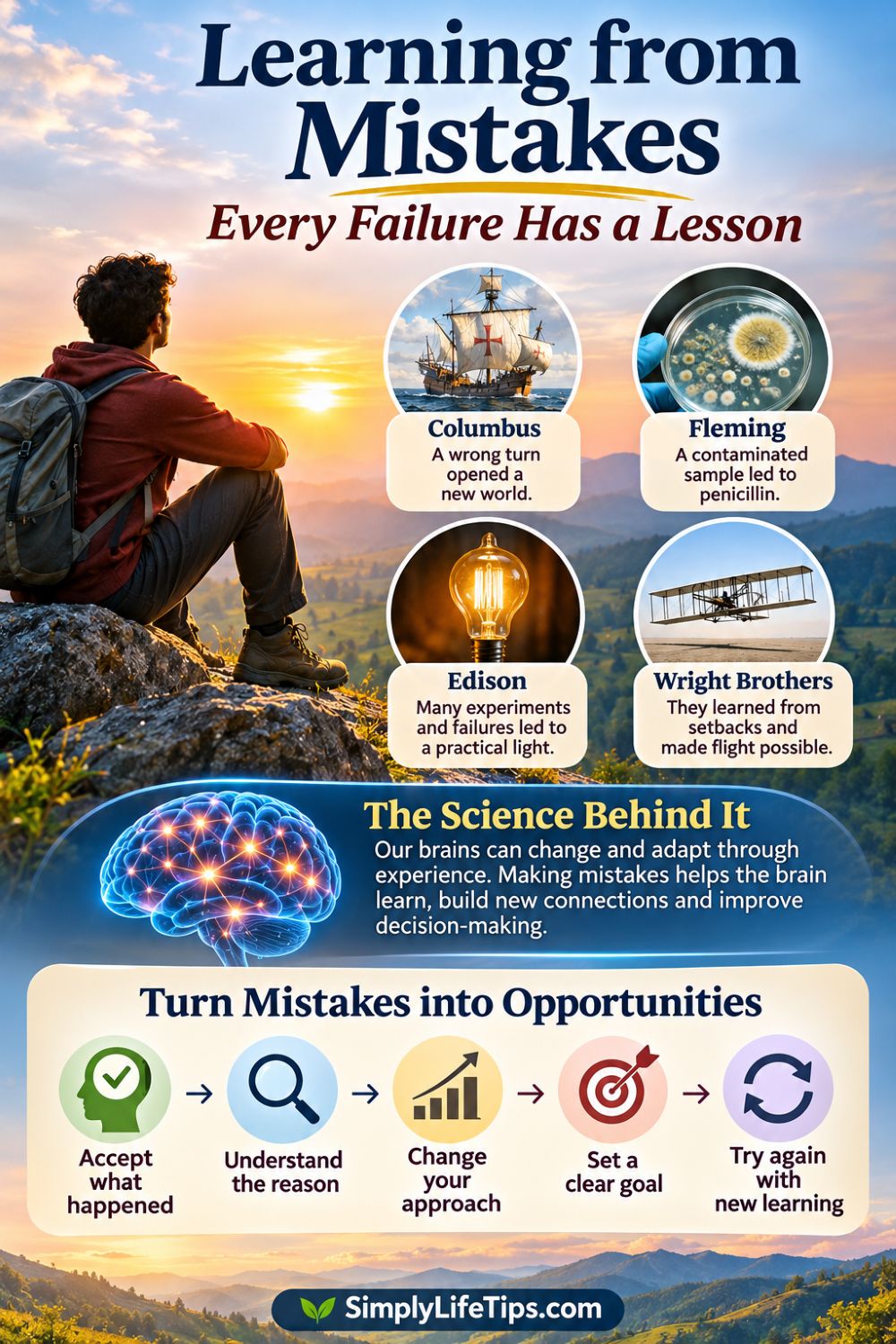
The key lesson is simple: a mistake does not have to define your future. When you accept what happened, understand the reason, and adjust your approach, you turn an unsuccessful experience into valuable knowledge. Every attempt gives you another opportunity to improve.
Dare to Think Differently and Create Your Own Path
People who changed the world were not always those who accepted conventional thinking. They often questioned established beliefs, explored unfamiliar possibilities, and dared to imagine something different.
Your ideas may be criticised. Others may see your dreams as unrealistic. Your first attempts may not produce the results you expect.
But remember that many achievements that inspire us today once seemed impossible.
Following someone else’s footsteps may help you reach a familiar destination. However, discovering a new path requires curiosity, courage and determination.
Sometimes, discovering new opportunities means stepping beyond familiar surroundings and challenging your own limitations. Read more about the benefits of stepping out of your comfort zone and how new experiences can support personal growth.
Do not abandon an idea simply because others fail to understand it. At the same time, remain open to criticism, examine the evidence and be prepared to improve your approach.
True innovation comes from combining imagination with observation, knowledge and persistence.
The world does not always need people who think alike. It also needs people who are willing to question, explore and discover new possibilities.
Your Mistake Could Be the Beginning of Something Great
A mistake you regret today might become an important lesson that guides your future decisions.
The world may laugh at your dreams today, question your abilities or judge you by your unsuccessful attempts. But your present difficulties do not determine everything you can achieve tomorrow.
Never abandon your dreams because of a single failure. The moment you fell might become the beginning of the most meaningful chapter of your life, provided you learn from the experience and continue moving forward.
Remember that the people who changed history were once ordinary individuals. What made many of them extraordinary was their willingness to observe, question, experiment and persist despite uncertainty.
Developing mental discipline can also help you remain focused when challenges arise. You can explore our article on how to discipline your mind for more ideas on building determination and consistency.
Do not simply follow the footsteps of others. Have the courage to create footsteps that may guide those who come after you.
Do not wait for the world to change before you take action. Let your ideas, efforts and discoveries become part of that change.
Sometimes, the mistake you fear most may be the beginning of a discovery you never imagined.
Keep learning, keep exploring and never stop moving forward.
References
- Library of Congress – Columbus and the Taíno.
- American Chemical Society – The Discovery and Development of Penicillin.
- National Park Service – Thomas Edison Biography.
- Smithsonian National Air and Space Museum – 1903 Wright Flyer.
- National Institute of Mental Health – Reward Prediction Error.
- Milbocker, Smith and Klintsova – Maintaining a Dynamic Brain: A Review of Neuroplasticity.
Frequently Asked Questions
1. Why is learning from mistakes important?
Learning from mistakes helps us understand what went wrong, improve our decisions, develop new skills and avoid repeating similar problems. It also encourages self-awareness, resilience and personal growth.
2. Can mistakes lead to success?
Yes. Mistakes can reveal unexpected opportunities, provide valuable information and encourage people to explore better solutions. However, success depends on learning from those experiences and taking appropriate action.
3. What are some famous discoveries made by accident?
Penicillin, discovered by Alexander Fleming in 1928, is a famous example. Other unexpected discoveries include vulcanised rubber and microwave heating technology. These discoveries also required further research and development before becoming useful in everyday life.
4. How does the brain learn from mistakes?
The brain uses information about unexpected outcomes to update its expectations and improve future decisions. Neuroplasticity allows neural connections to change through learning and experience.
5. How can I turn failure into success?
Accept the mistake, understand its cause, identify what you can learn, adjust your approach and try again. Consistent reflection and improvement can turn setbacks into valuable learning experiences.

Mathukutty P. V. is the founder of Simply Life Tips. He shares practical advice and useful insights on personal growth, health, well-being, technology, and everyday living. His goal is to help readers build positive habits and make informed decisions. He believes in continuous learning and sharing knowledge to help people live healthier, happier, and more meaningful lives.


