

Possessiveness in a relationship can begin with a simple desire for closeness but gradually turn into jealousy, insecurity, and controlling behaviour. Is it love, or is it the fear of losing someone? When one partner feels compelled to monitor the other’s every move, love can become a source of anxiety rather than security.
“Why haven’t you replied to my message?”
“You were online, so why didn’t you talk to me?”
“If you really love me, shouldn’t you make time for me?”
Have you ever felt anxious when your partner took too long to reply, worried when they went out with friends, or needed repeated reassurance that they still loved you?
These feelings can arise from insecurity, past experiences, or fear of abandonment. However, when they lead to demands, accusations, or restrictions on another person’s freedom, they can damage even a loving relationship.
Understanding the difference between love and possessiveness is the first step towards building a healthier connection.
What Does Possessiveness in a Relationship Mean?
Possessiveness in a relationship is an excessive desire to keep a partner close, secure their attention, or influence their choices because of jealousy, insecurity, or fear of losing them.
Wanting affection, attention, and emotional closeness is natural. Problems arise when one person believes that love gives them the right to control the other person’s time, friendships, privacy or decisions.
Consider two examples.
Example 1: Healthy love
Anita sends a message to her husband during his working hours. He cannot reply immediately because he is attending a meeting. Anita understands that he is busy and continues with her day. They speak when he is available.
Example 2: Possessive behaviour
Meera sends several messages to her partner. When he does not reply immediately, she assumes he is ignoring her. She repeatedly calls him, accuses him of losing interest and demands to know whom he was meeting.
Both women want attention and connection. The difference lies in how they respond to uncertainty.
Healthy love allows room for trust, personal freedom, and individual responsibilities. Possessiveness attempts to eliminate uncertainty by controlling another person.
Why Does Possessiveness Develop in a Relationship?
Possessive behaviour does not have one universal cause. It may develop from several emotional, psychological, and relationship-related factors.
1. Fear of Abandonment
Some people worry intensely that the person they love will eventually leave them. Even small changes in communication can trigger fears of rejection.
For example, if a partner usually calls every evening but misses one call because of work, an insecure person may immediately think, “Something has changed. Perhaps they no longer love me.”
The missed call is a fact. The belief that the relationship is ending is an interpretation that may not be supported by evidence.
Learning to distinguish facts from fearful assumptions can help reduce unnecessary conflict.
2. Anxious Attachment
Anxious attachment is one possible factor associated with insecurity in close relationships. People who experience attachment anxiety may become especially sensitive to signs of rejection and seek frequent reassurance.
For example, a person may feel loved after receiving an affectionate message but become anxious again a few hours later. They may repeatedly ask whether their partner still loves them, even when the relationship has shown no clear signs of trouble.
The American Psychological Association discusses how attachment insecurity can influence emotional responses and behaviour in close relationships.
Reference: American Psychological Association – Attachment Bonds
Attachment patterns are not fixed labels or diagnoses. People can learn healthier ways to respond to insecurity through self-awareness, supportive relationships, and professional guidance when needed.
3. Previous Betrayal or Emotional Hurt
A person who has experienced dishonesty, infidelity, or abandonment may find it difficult to trust again.
Imagine someone whose previous partner repeatedly lied about meeting other people. In a new relationship, even an innocent delay in replying might bring back memories of that experience.
The fear may be understandable, but a new partner should not automatically be treated as guilty of repeating someone else’s mistakes.
Past experiences deserve attention and healing. They should not become a reason to monitor or restrict another person’s life.
4. Low Self-Esteem
When people doubt their own worth, they may constantly compare themselves with others or fear that their partner will find someone better.
For example, a woman might become upset whenever her husband praises a colleague. She may interpret ordinary appreciation as a threat to their relationship.
Building self-esteem means recognising that personal worth does not depend entirely on another person’s attention or approval.
5. Unrealistic Expectations About Love
Some people believe that true love means being available every minute, sharing every private thought and making the relationship the centre of every decision.
These expectations can create unnecessary pressure.
A loving partner can be committed while maintaining friendships, pursuing personal interests and spending time alone. Independence does not automatically mean emotional distance.
7 Signs of Possessiveness in a Relationship
Recognising possessive behaviour early can help couples address unhealthy patterns before they become deeply established.
1. Delayed Replies and Anxiety: Signs of Possessiveness
One of the most common signs of possessiveness in a relationship is expecting instant responses to every message or phone call.
A delayed reply may trigger questions such as:
- Why are they ignoring me?
- Are they talking to someone else?
- Have their feelings changed?
- Why am I not their priority?
For example, Rahul sends his partner a message while she is at work. After ten minutes without a reply, he sends five more messages and becomes angry when she finally responds an hour later.
The problem is not that Rahul wants communication. It is that he expects immediate access to his partner regardless of her circumstances.
What helps: Agree on reasonable communication expectations. Recognise that people have work, family responsibilities, rest periods, and other commitments.
2. Feeling Jealous of Friends and Family
A possessive partner may feel threatened when the other person spends time with friends, relatives, or colleagues.
For example, Priya plans to meet her childhood friends on Saturday. Her partner responds, “Why do you need to go out with them when you could spend that time with me?”
Occasional jealousy is a common human emotion. However, repeatedly creating guilt, arguments, or restrictions around ordinary social activities can damage a relationship.
Healthy couples make time for each other while respecting the importance of other relationships.
What helps: Discuss how much quality time you both need, but allow each person to maintain meaningful friendships and family connections.
3. Reassurance-Seeking and Possessive Behaviour
Another sign of possessive behaviour is repeatedly asking for proof of love.
Questions may include:
- Do you still love me?
- Am I more important than everyone else?
- Will you ever leave me?
- Do you think someone else is more attractive than me?
Reassurance is not inherently unhealthy. Partners naturally need comfort and affection, especially during difficult periods.
The problem arises when reassurance provides only brief relief before the same fears return.
For example, a partner may receive a loving message in the morning but become distressed by the afternoon because no new message has arrived.
What helps: Accept reassurance when it is offered, while also learning to manage uncertainty independently. Notice whether repeated questioning is solving the problem or merely providing temporary relief.
4. Phone Monitoring as a Sign of Possessiveness
Privacy violations can become a serious warning sign.
A possessive partner might demand phone passwords, inspect messages, check call histories, monitor social media activity, or insist on knowing every person their partner contacts.
For example, someone sees their partner online at midnight and immediately demands an explanation for why they were not answering messages.
Being online does not necessarily mean someone is available for a conversation. They may be reading something, responding to work, or simply taking a moment for themselves.
Mutual transparency can be part of a healthy relationship, but it should not be confused with compulsory surveillance.
What helps: Agree on reasonable boundaries around privacy and digital communication. Sharing access should be voluntary rather than demanded through threats, guilt, or intimidation.
5. Controlling Behaviour in a Relationship
Possessiveness can extend beyond communication into clothing, hobbies, work, friendships, and everyday decisions.
For example, a partner might say:
“You cannot wear that dress.”
“You should stop talking to that colleague.”
“I don’t want you to attend that event.”
A couple can discuss preferences and express concerns. However, one person should not assume the authority to make every decision for the other.
A healthy relationship involves mutual consideration, not unilateral control.
What helps: Discuss disagreements respectfully while recognising each person’s right to make personal choices. Neither partner should have to surrender their identity to prove their love.
6. Becoming Upset When a Partner Needs Personal Space
Every individual needs some time for rest, reflection, and personal interests.
A possessive partner may interpret a request for space as rejection.
For example, after a demanding day at work, Arun wants to spend thirty minutes reading quietly. His partner assumes that he is avoiding her and starts an argument.
The request for quiet time may have nothing to do with the relationship.
What helps: Learn to communicate the difference between needing temporary space and withdrawing from emotional connection. Partners can agree to reconnect later without treating every period of solitude as a threat.
7. Using Guilt, Threats or Emotional Pressure
The most concerning form of possessiveness occurs when someone uses fear or emotional pressure to control a partner.
Examples include:
- “If you loved me, you would never go out without me.”
- “After everything I’ve done for you, you owe me this.”
- “If you leave me, I’ll make sure you regret it.”
- “You are responsible for my happiness, so you must do what I say.”
Repeated threats, intimidation, isolation from loved ones and monitoring are not simply signs of insecurity. They can be indicators of emotional abuse or coercive control.
The NHS identifies possessiveness, extreme jealousy, isolation and controlling behaviour as warning signs of an unhealthy relationship.
Reference: NHS inform – Healthy Relationships
If you feel afraid of your partner or believe that refusing a demand could put you at risk, prioritise your safety and seek support from a trusted person or a qualified local service.
The following infographic highlights seven common signs of possessiveness in a relationship, explains the difference between healthy love and controlling behaviour, and offers practical steps to build trust and respect personal boundaries.
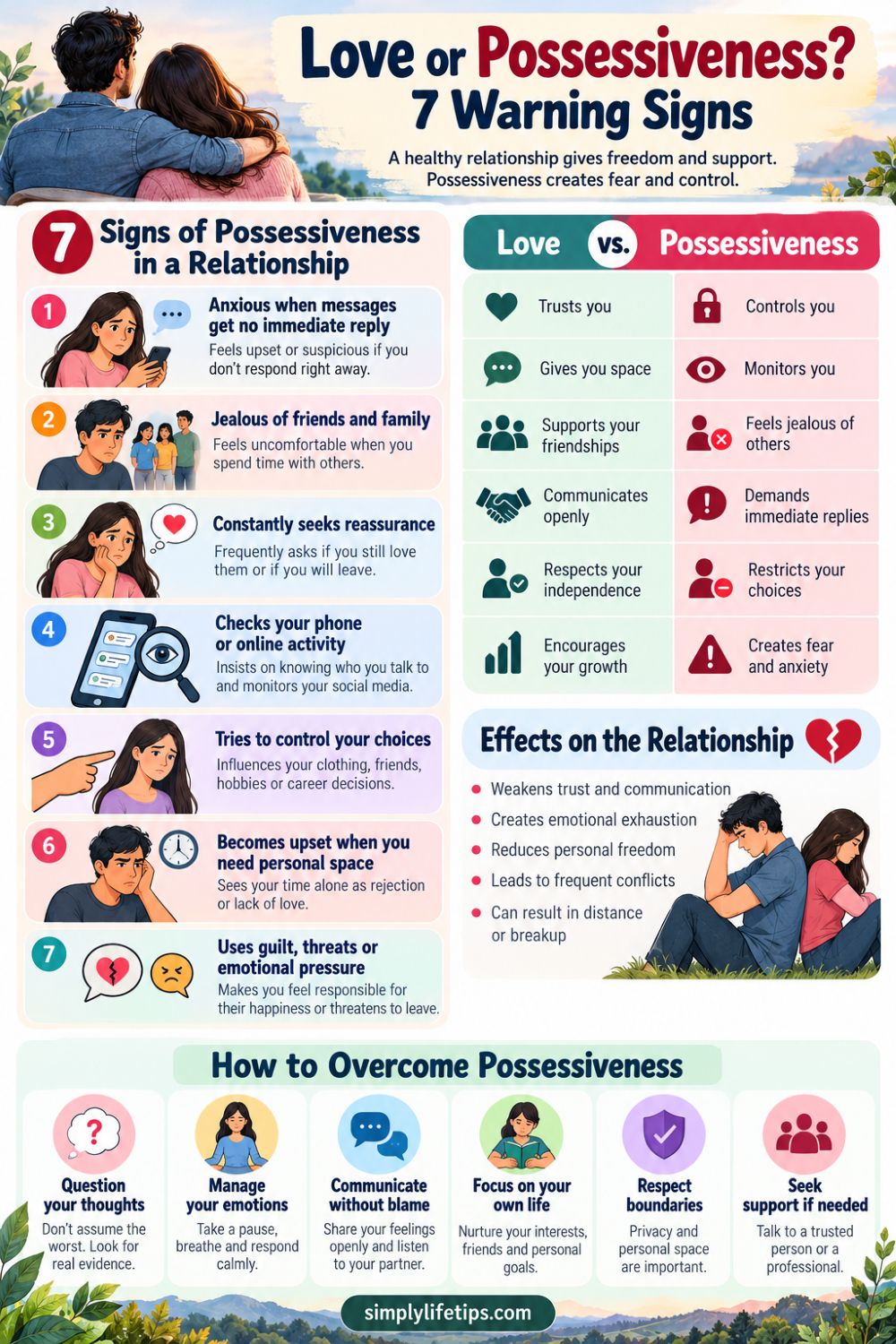
Recognising these warning signs is the first step towards building a healthier relationship based on trust, communication and mutual respect.
Jealousy vs. Possessiveness in a Relationship
Although jealousy and possessiveness are related, they are not the same.
Jealousy is an emotional response that may arise when someone fears losing affection or feels that an important relationship is threatened. Possessiveness, however, involves attempts to control a partner’s behaviour, friendships, or personal choices because of insecurity or fear.
For example, you might feel jealous when your partner spends time talking with an attractive colleague. That feeling alone does not make you possessive.
A healthy response involves acknowledging the emotion and discussing your concerns calmly, if necessary. By contrast, demanding access to your partner’s messages or insisting that they stop talking to the colleague can become controlling behaviour.
Feeling jealous does not automatically make someone possessive or abusive. What matters is how the emotion is expressed and whether it develops into a pattern of control.
The goal is not to eliminate every uncomfortable emotion but to respond to those feelings without undermining your partner’s dignity, privacy or freedom.
How Possessiveness in a Relationship Causes Harm
Possessiveness may begin with a desire for reassurance, but repeated controlling behaviour can create a cycle that becomes increasingly difficult to break.
It Weakens Trust
Trust develops when partners can rely on each other without constant interrogation.
When one person repeatedly demands proof of loyalty, the other may begin to feel that nothing they do is ever enough.
For example, a partner who shares their plans voluntarily may eventually stop discussing ordinary activities because every detail leads to another round of questioning.
This can create more suspicion rather than less.
It Creates Emotional Exhaustion
Constantly explaining one’s whereabouts, responding to repeated messages, and defending harmless decisions can become exhausting.
The person experiencing insecurity also suffers. They may spend hours checking online status, imagining possible threats, and seeking reassurance.
Both partners can become trapped in a cycle of anxiety and frustration.
It Reduces Personal Freedom
A healthy relationship should support individual growth.
When one partner feels unable to meet friends, pursue hobbies or make everyday decisions without facing an argument, the relationship can become restrictive.
Over time, the person being controlled may lose confidence, withdraw socially or feel that their identity has disappeared.
It Creates a Cycle of Fear and Distance
Consider this sequence:
Fear of losing a partner leads to repeated checking. Repeated checking creates pressure. The partner begins withdrawing to avoid arguments. That withdrawal increases the original fear, which leads to even more checking.
The cycle may look like this:
Fear → Suspicion → Control → Emotional Distance → Greater Fear
Breaking this cycle requires more than repeated promises of love. It requires healthier emotional responses, mutual respect, and a willingness to change controlling behaviour.
For further practical guidance, read Setting Healthy Boundaries in Relationships.
How to Overcome Possessiveness in a Relationship
If you recognise possessive tendencies in yourself, change is possible. The first step is to acknowledge the behaviour without judging yourself as a permanently bad partner.
1. Separate Facts From Assumptions
When a message goes unanswered, pause before deciding what it means.
Ask yourself:
- What do I actually know?
- Am I interpreting uncertainty as rejection?
- Is there another reasonable explanation?
- Do I have evidence of a real problem, or am I reacting to fear?
For example, instead of concluding that your partner no longer cares because they missed a call, consider whether they might be busy, tired, or unable to use their phone.
This does not mean ignoring genuine signs of dishonesty. It means avoiding conclusions that are not supported by the available facts.
2. Learn to Manage Emotional Triggers
When jealousy or anxiety rises, avoid reacting immediately.
Try the following steps:
- Put your phone down for a few minutes.
- Take several slow, comfortable breaths.
- Identify the emotion you are experiencing.
- Write down the thought triggering the emotion.
- Decide whether a conversation is necessary after you feel calmer.
For example, if you feel anxious because your partner is out with friends, use the time to read, exercise, cook, or speak with your own friends rather than repeatedly checking their online status.
The purpose is not to suppress your feelings. It is to create enough space to choose a constructive response.
Open communication and emotional support help partners feel secure without resorting to control. Learn how to build emotional intimacy in marriage through understanding, empathy, and meaningful connection.
3. Communicate Without Blaming
Accusations often make difficult conversations more defensive.
Compare these two statements.
Blaming: “You never care about me. You always ignore my messages.”
Constructive: “When we go a long time without communicating, I sometimes feel insecure. Could we discuss a communication routine that works for both of us?”
The second statement explains the feeling and invites cooperation without assuming bad intentions.
For more practical communication strategies, read The Power of Communication in Relationships.
4. Build a Life Beyond the Relationship
A relationship can be deeply meaningful without becoming your only source of happiness.
Maintain your friendships, hobbies, personal goals, family connections, and interests. Develop activities that give you a sense of purpose independently of your partner’s attention.
For example, instead of spending an entire evening waiting for a reply, you might work on a personal project, take a walk, or learn a new skill.
A fulfilling individual life can help reduce the pressure placed on a relationship to meet every emotional need.
5. Respect Privacy and Personal Boundaries
Privacy is not automatically evidence of secrecy or betrayal.
Partners may have different communication preferences, social habits, and needs for personal space. Discuss these differences openly and establish expectations that respect both individuals.
Healthy boundaries might include agreeing not to check each other’s phones without permission, allowing uninterrupted work time, and respecting established plans with friends.
Boundaries should protect both partners’ well-being. They should not be used as excuses for dishonesty or as tools for controlling another person’s behaviour.
6. Address Repeated Insecurity
If you repeatedly experience intense fear of abandonment, jealousy or a need for constant reassurance, explore the underlying concerns.
Ask yourself whether these feelings are connected to earlier experiences, low self-esteem, previous betrayal, or current problems in the relationship.
Journaling may help you recognise patterns. Talking to a trusted person can provide perspective. A qualified mental health professional can help you develop strategies for managing persistent anxiety and improving relationship patterns.
Professional support can also be useful when both partners want to improve communication. However, if a relationship involves intimidation, threats, or abuse, individual support and safety planning may be more appropriate than joint counselling.
7. Recognise When Possessiveness Becomes Control
Personal insecurity may help explain possessive behaviour, but it does not excuse harming another person.
If a partner repeatedly monitors you, isolates you from friends, threatens you or makes you afraid to disagree, take those behaviours seriously.
You do not have to surrender your privacy or freedom to prove that you love someone.
The organisation Love is respect explains common warning signs of controlling and abusive relationships, including extreme jealousy, phone monitoring and isolation.
If you feel unsafe, reach out to someone you trust or a suitable local support service. Seek emergency assistance if there is an immediate threat.
Healthy Relationships Without Possessive Behaviour
A healthy relationship does not require two people to think alike, spend every moment together, or eliminate every feeling of jealousy.
Instead, it allows both partners to feel valued while maintaining their individuality.
In a healthy relationship:
- Partners communicate honestly without constant interrogation.
- Each person can maintain friendships and personal interests.
- Disagreements can be discussed without threats or intimidation.
- Privacy and personal boundaries are respected.
- Affection is freely expressed rather than demanded.
- Both partners take responsibility for their own behaviour.
- Trust develops through consistent actions over time.
Healthy love is not the absence of all fear or uncertainty. It is the ability to handle those feelings without turning them into restrictions on another person’s life.
Healthy relationships grow through trust, mutual respect, and emotional closeness. Couples can strengthen their connection by nurturing intimacy in marriage while respecting each other’s independence.
Conclusion
Possessiveness in a relationship can grow from fear, insecurity, or past emotional hurt. However, love becomes unhealthy when the need for reassurance turns into constant monitoring, jealousy becomes restriction, or affection becomes a demand for obedience.
Wanting to spend time with your partner is natural. Expecting them to devote every moment to you is not.
You can love someone deeply while respecting their friendships, privacy, ambitions and personal choices. You can ask for reassurance without demanding constant proof. You can express insecurity without making another person responsible for every difficult emotion you experience.
Remember that holding someone close and holding them so tightly that they cannot breathe are two very different things.
Real intimacy does not require two people to become dependent on each other for every aspect of life. It allows two individuals to grow, support one another, and freely choose their shared future.
Love. Trust. Communicate. Respect each other’s freedom.
Because love should be a safe place to grow, not a prison built from the fear of losing someone.
In your opinion, what damages a relationship more: lack of trust, unrealistic expectations or the desire to control a partner?
Frequently Asked Questions
1. What is possessiveness in a relationship?
Possessiveness in a relationship is an excessive desire to control a partner’s attention, activities, friendships, or choices because of insecurity, jealousy, or fear of losing them. It becomes harmful when it undermines privacy, independence, or emotional safety.
2. What are the main signs of possessiveness in a relationship?
Common signs include demanding immediate replies, repeatedly seeking reassurance, checking a partner’s phone without permission, becoming jealous of friends, restricting personal choices, and using guilt or threats to influence behaviour.
3. Is possessiveness a sign of true love?
No. Wanting closeness and reassurance can be part of love, but possessive control is not proof of deeper affection. Healthy love includes trust, mutual respect, personal freedom and emotional responsibility.
4. How can I stop being possessive in a relationship?
Identify your emotional triggers, question assumptions, manage anxiety before reacting, communicate without blame, develop interests outside the relationship, and respect your partner’s boundaries. Professional support may help if these patterns persist.
5. Can possessiveness destroy a relationship?
Yes. Persistent jealousy, surveillance, accusations, and restrictions can weaken trust, create emotional exhaustion, and push partners apart. Recognising these patterns early and addressing them constructively can help, provided both partners are safe and willing to participate.

Mathukutty P. V. is the founder of Simply Life Tips. He shares practical advice and useful insights on personal growth, health, well-being, technology, and everyday living. His goal is to help readers build positive habits and make informed decisions. He believes in continuous learning and sharing knowledge to help people live healthier, happier, and more meaningful lives.