

Body safety for kids is essential to raising confident, informed children who understand their personal boundaries and know when to ask for help. Children deserve to feel safe in their bodies, express discomfort without fear, and understand that their bodies belong to them. Parents and caregivers play a vital role in teaching these skills through calm conversations, age-appropriate examples, and everyday practice.
Teaching body safety does not mean making children afraid of other people. It means giving them the knowledge and confidence to recognise inappropriate behaviour, respect other people’s boundaries, and seek help whenever something feels wrong.
7 Essential Body Safety Rules for Kids
1. Teach Children That Their Bodies Belong to Them
One of the most important body safety lessons is that every child deserves respect and has a right to personal boundaries.
Explain to children that they can decide whether they feel comfortable with ordinary physical affection, such as hugs, kisses, or sitting on someone’s lap. They should not be forced to show affection simply because a person is a relative, family friend, or respected adult.
For example, if a relative insists on hugging a child who does not want to, a parent can say, “You can greet your aunt with a wave or a high-five instead. You do not have to hug anyone when you do not feel comfortable.”
This teaches children that their feelings matter while encouraging respectful relationships.
Parents can reinforce this lesson through everyday interactions. Ask permission before helping an older child with personal care, respect their reasonable requests for privacy, and avoid making them feel guilty for expressing discomfort.
2. Explain Safe and Unsafe Touch in Age-Appropriate Language
Children need simple, clear explanations about different types of touching. Explain that some touch is welcome and comforting, while other touch may be unwanted, confusing, frightening, or inappropriate.
Teach children that the parts of their bodies covered by underwear are private. No one should ask them to show or touch these parts for inappropriate reasons, and children should never be asked to touch another person’s private parts.
Learn more about teaching children about personal boundaries, including personal boundaries, safe and unsafe touch, and how children can ask trusted adults for help.
However, avoid teaching that every touch from another person is either good or bad based only on how it feels. Some inappropriate behaviour may initially seem harmless, and children may feel confused about what happened.
Explain that a doctor or nurse may need to examine private areas for a genuine medical reason, or a caregiver may need to assist with personal hygiene. Handle these situations respectfully, explain them in age-appropriate language, and use appropriate safeguards.
The NSPCC’s Talk PANTS guide provides a useful framework for introducing these conversations without frightening children.
3. Encourage Children to Say No and Speak Up
Children should understand that they can say “No,” “Stop,” or “I don’t like that” when someone touches them or behaves in a way that makes them uncomfortable.
Practise simple responses at home so children can become familiar with the words. For example, you might say, “If someone tries to tickle you after you have asked them to stop, what can you say?”
Help your child practise responding with confidence: “Stop. I don’t like that.”
Explain that they can move away and seek help if it is safe to do so. They do not have to confront an adult, fight back, or use particular words to deserve protection.
Most importantly, make clear that a child is never responsible for stopping abuse or preventing another person’s inappropriate behaviour. Speaking up is encouraged, but even if a child freezes, stays silent, or cannot get away, the responsibility remains with the person who crossed the boundary.
4. Teach Children That Unsafe Secrets Should Never Be Kept
Children may be told to keep inappropriate touching, uncomfortable interactions, or requests for private photographs secret. Someone might threaten them, offer gifts, or say that telling anyone will cause trouble.
Explain the difference between a happy surprise, such as a birthday present, and a secret that causes fear, discomfort, guilt, or worry.
For example, tell your child: “You can always tell me if someone asks you to hide something that makes you uncomfortable. I will listen, and you will not be in trouble for telling me.”
Avoid suggesting that all secrets are automatically dangerous. Instead, teach children that they can always share worries with a trusted adult, even when someone has insisted they must not tell.
Children also need to know that they can keep telling other trusted adults if the first person they approach does not listen or help.
5. Help Children Identify Trusted Adults
Every child should know whom they can approach when they feel unsafe, confused, or frightened.
Help your child identify several trusted adults, such as a parent, another responsible family member, a teacher, or a school counsellor. Explain that a trusted adult should listen carefully, take their concerns seriously, and help them stay safe.
Practise what your child might say. For example:
- “Someone touched me in a way I didn’t like.”
- “Someone told me not to tell you something.”
- “I feel uncomfortable around this person.”
- “I need your help, but I’m afraid to explain.”
Explain that they can use their own words, write down their concerns, or ask another trusted adult to help them communicate.
Parents should also teach children that familiar people are not automatically safe in every situation. Body safety rules apply to everyone, including relatives, family friends, teachers, coaches, and older children.
For more guidance on building a supportive relationship with children, read Understanding Your Children.
6. Teach Children to Respect Other People’s Boundaries
Body safety is not only about protecting children from harm. It also means teaching them to respect other people’s bodies, privacy, and personal space.
Children should learn that they must stop when another person says no. They should not touch others without appropriate permission, force someone to hug them, look at private body parts, or share private photographs.
For example, if a child tries to hug a friend who moves away, explain that the friend has a right to choose whether they want a hug. The child can offer a wave or another greeting instead.
Parents can model these lessons by respecting children’s requests for space and avoiding unwanted physical affection.
This approach helps children develop empathy, respect, and an understanding of consent. It also reinforces the principle that everyone’s boundaries deserve consideration.
For more guidance on personal boundaries, safe and unsafe touch, and helping children speak up when they feel uncomfortable, For more practical advice on protecting children in everyday situations, read our guide to essential child safety rules for parents
7. Respond Calmly When a Child Shares a Concern
One of the most important ways to protect children is to create an environment where they feel safe telling adults about uncomfortable experiences.
If a child tells you that someone has crossed their boundaries, remain calm and listen without interruption. Your reaction can influence whether they feel comfortable sharing further information.
Follow these steps:
- Listen carefully. Allow the child to speak in their own words without pressing for unnecessary details.
- Believe and reassure them. Say, “Thank you for telling me. I’m glad you came to me.”
- Remove blame. Make it clear that the incident was not their fault.
- Avoid leading questions. Do not suggest answers or conduct your own investigation. Ask only what is necessary to understand immediate safety concerns.
- Protect the child. Take reasonable steps to prevent further contact with the person who may have caused harm.
- Seek appropriate help. Contact child-protection professionals or the relevant authorities when abuse or immediate danger is suspected.
Do not promise to keep the information secret. Instead, explain gently that you may need to share it with people who can help keep the child safe.
The organisation RAINN offers additional guidance on open communication, prevention, and responding to concerns.
Body Safety for Kids: Six Essential Rules at a Glance
Children learn best when important safety lessons are explained clearly and reinforced with simple visual examples. This infographic summarises six essential body safety rules that parents can discuss with their children to help them understand personal boundaries, recognise inappropriate behaviour, and know when to seek help.
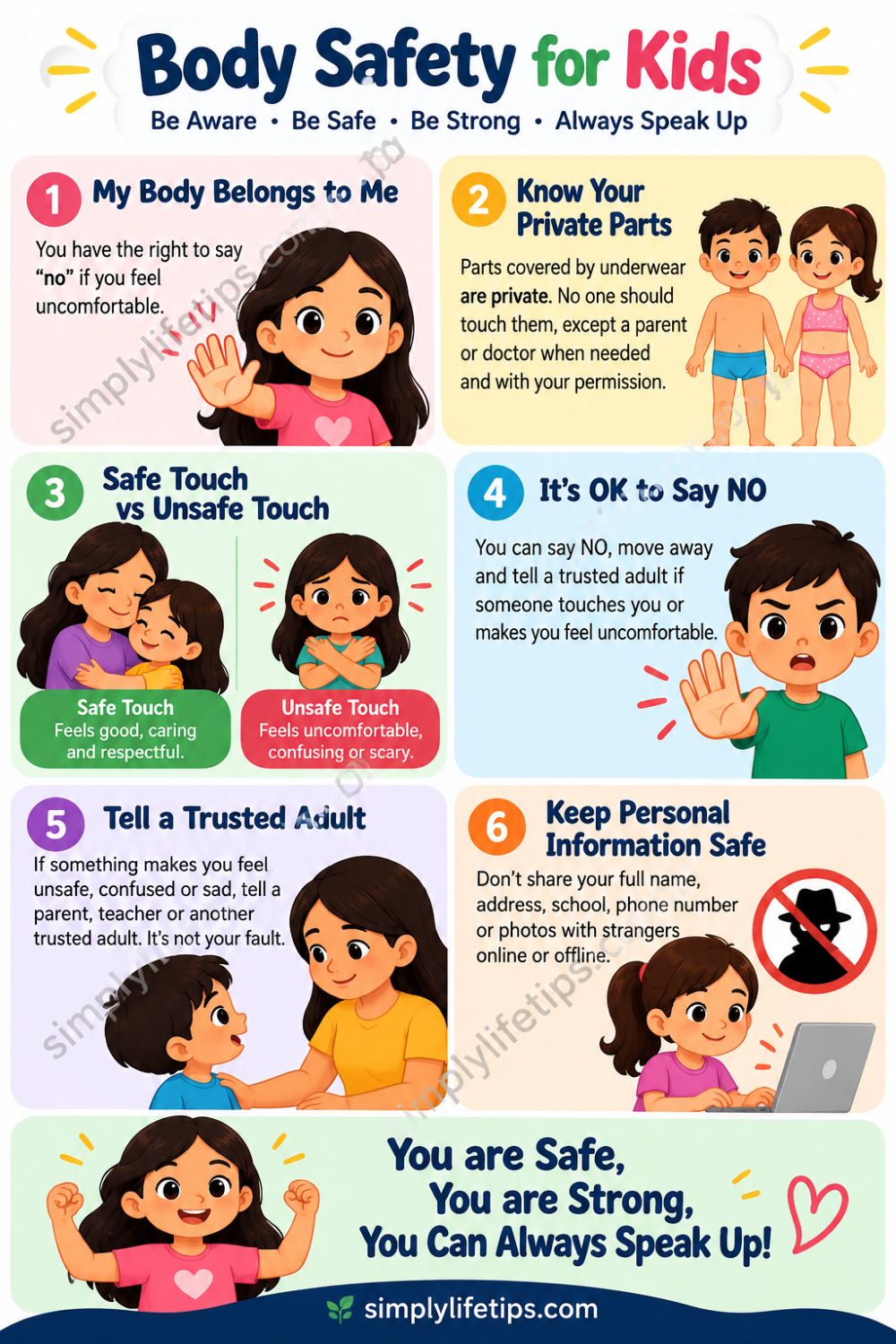
Use this infographic as a starting point for regular, age-appropriate conversations with your child. Ask what they would do if someone made them uncomfortable, help them identify trusted adults, and reassure them that they can always ask for help without fear or shame.
Remember, children are never responsible for preventing another person’s inappropriate behaviour. Adults must listen, take concerns seriously, and act to protect them.
Teach Children About Body Safety Online
Body safety also includes digital privacy. Children may receive inappropriate messages, be asked to share private photographs, or experience pressure from someone they meet online.
Teach children these simple rules:
- Never share private photographs or personal information with someone who makes them uncomfortable.
- Tell a trusted adult if someone requests inappropriate pictures or sends disturbing messages.
- Do not agree to keep uncomfortable online conversations secret.
- Ask for help if someone threatens, pressures, or tries to manipulate them online.
Avoid blaming children if they make a mistake or respond to an inappropriate message. Encourage them to come to you for help, even if they are embarrassed or worried about losing access to a device.
How to Teach Body Safety Without Creating Fear
Body safety education should help children feel informed and confident rather than frightened or suspicious of everyone around them.
Here are practical ways to make these lessons part of everyday family life.
- Start early: Introduce simple concepts about privacy, personal space, and saying no when children are young.
- Use everyday situations: Discuss boundaries during dressing, bathing, playtime, and family gatherings.
- Use clear language: Answer questions honestly with words children can understand.
- Practise through examples: Role-play how to respond to unwanted touching, uncomfortable requests, or unsafe secrets.
- Keep communication open: Revisit these lessons as children grow and encounter new situations.
- Avoid fear-based warnings: Do not teach children that everyone is dangerous. Help them recognise inappropriate behaviour and identify supportive adults.
- Respect individual needs: Adapt conversations for the child’s age, communication style, developmental stage, and understanding.
Parents can also reinforce these skills through positive parenting techniques, which emphasise respectful communication, empathy, and consistent guidance.
What Parents Should Remember About Child Body Safety
No single conversation can guarantee a child’s safety. Body safety education works best when children receive consistent guidance and adults take responsibility for creating safe environments.
Children should know that they can speak up, refuse unwanted affection, ask questions, and seek help without being blamed or shamed. They should also understand that medical care and necessary personal hygiene assistance can be appropriate when handled respectfully and with suitable safeguards.
Above all, parents must remember that teaching children safety skills complements adult responsibility; it never transfers responsibility for abuse onto the child.
Conclusion
Teaching body safety for kids is an essential part of helping children grow into confident individuals who understand their rights, respect other people’s boundaries, and recognise when they need help. Through age-appropriate conversations, practical examples, and calm reassurance, parents can make personal safety a natural part of everyday life.
Children should never feel ashamed of speaking up or afraid of asking for help. When they share a concern, adults must listen carefully, take them seriously, and act to protect them.
Remember, the goal is not to make children fearful of the world. It is to help them understand that their bodies deserve respect, their voices matter, and trusted adults are responsible for helping keep them safe.
Are you making body safety and personal boundaries a regular, comfortable conversation in your family?
FAQs About Body Safety for Kids
1. What is body safety for kids?
Body safety for kids means teaching children about personal boundaries, privacy, appropriate and inappropriate touching, and how to seek help when something makes them uncomfortable. It also includes respecting other people’s bodies and boundaries.
2. At what age should parents teach children about body safety?
Parents can begin teaching simple concepts during early childhood. Start with body-part names, privacy, personal space, and the right to refuse unwanted affection. Adapt the discussion as children mature and become ready for more detailed information.
3. How can I teach my child about safe and unsafe touch?
Use simple, age-appropriate examples to explain that some touching is welcome, while other touching is unwanted or inappropriate. Teach children that private body parts deserve protection, they can speak up when uncomfortable, and they can always seek help from a trusted adult.
4. What should I do if my child tells me someone touched them inappropriately?
Stay calm, listen without judgment, reassure your child that they are not to blame, and take their concern seriously. Avoid leading questions or conducting your own investigation. Protect the child from further harm and seek appropriate professional or child-protection assistance.
5. How can I teach body safety without frightening my child?
Use calm conversations, everyday examples, and simple practice scenarios. Focus on personal rights, respectful relationships, recognising inappropriate behaviour, and knowing whom to approach for help. Reassure children that most everyday interactions can be positive and that adults are responsible for protecting them.

Mathukutty P. V. is the founder of Simply Life Tips. He shares practical advice and useful insights on personal growth, health, well-being, technology, and everyday living. His goal is to help readers build positive habits and make informed decisions. He believes in continuous learning and sharing knowledge to help people live healthier, happier, and more meaningful lives.