Life After 60 is often portrayed as a time to slow down, step aside, and quietly accept the limitations that come with age. Many of us grew up believing that people in their fifties and sixties had already entered old age. I believed the same during my younger years. Anyone above 50 seemed elderly, with little left to look forward to except retirement and declining health. However, as I now stand close to my 65th birthday, my perspective has changed completely. I’ve come to realize that age is merely a number. What truly determines whether we feel young or old is not the date on our birth certificate but the condition of our mind, body, and spirit.
Life has taught me that youth is an attitude rather than an age. A person who continues to dream, learn, laugh, love, and serve others remains young, regardless of how many years they have lived. On the other hand, someone who loses hope, curiosity, and purpose may feel old long before retiring. This simple truth has transformed the way I view aging and inspired me to embrace every new day with gratitude instead of fear.
Unfortunately, society often paints a gloomy picture of growing older. The word aging immediately brings thoughts of weakness, illness, loneliness, dependence, and loss. While physical changes are a natural part of life, they do not define the quality of our later years. Every stage of life has its own purpose, and the years after sixty can become some of the richest and most meaningful if we choose to embrace them with a positive mindset.
Instead of seeing this season as life’s sunset, think of it as the sunrise of a new chapter. These are the years when experience becomes your greatest wealth, faith becomes your strength, relationships become more meaningful, and the opportunity to positively influence others becomes greater than ever before. Life After 60 is not about counting the years that have passed; it is about making every remaining year count.
Whether you have recently retired, are approaching retirement, or are simply looking for ways to make your later years more fulfilling, this guide will help you discover practical ways to live with joy, purpose, confidence, and hope. The best chapters of your story may still be waiting to be written.
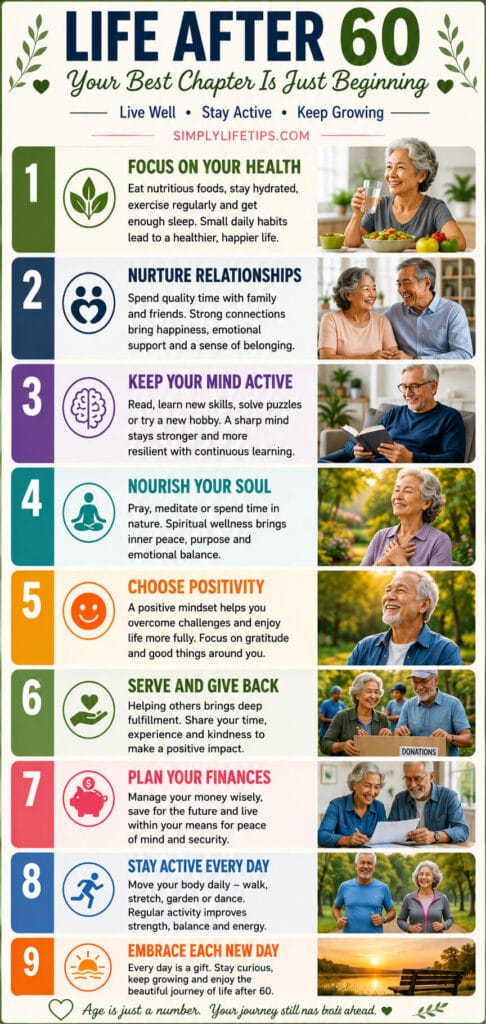
Infographic Life After 60
Growing older doesn’t mean slowing down—it means embracing a new chapter filled with wisdom, purpose, and opportunity. Life after 60 can be one of the most rewarding stages of life when you prioritize your physical health, nurture meaningful relationships, maintain a positive mindset, and continue learning. The infographic below summarizes the essential habits that can help you enjoy a healthier, happier, and more fulfilling life after 60.
Life After 60 Is a New Beginning
One of the biggest misconceptions about aging is the belief that life begins to lose its purpose after retirement. Many people spend decades working hard, raising children, paying bills, and fulfilling countless responsibilities. When those responsibilities gradually decrease, they often wonder, “What comes next?” For some, retirement feels like the end of productivity rather than the beginning of freedom. In reality, nothing could be further from the truth.
Retirement simply marks the end of one role in life—it does not signal the end of your purpose. In fact, many people discover their true calling only after they have more time to pursue what genuinely matters. Freed from demanding schedules and career pressures, they begin investing their energy in family, faith, hobbies, travel, volunteering, or mentoring younger generations. This season offers a rare opportunity to focus less on making a living and more on making a difference.
One of the greatest gifts of Life After 60 is wisdom. Unlike knowledge, which can be learned from books, wisdom is earned through experience. Every challenge you’ve overcome, every mistake you’ve learned from, every relationship you’ve nurtured, and every hardship you’ve endured has shaped you into the person you are today. Those experiences are treasures that no university can teach. Younger generations often seek advice from those who have walked the path before them, making your life lessons more valuable than you may realize.
Another blessing of this stage is the freedom to choose how you spend your time. During your younger years, your calendar may have been filled with deadlines, school events, family responsibilities, and financial commitments. Now, you have the opportunity to invest your time in activities that nourish your mind, body, and soul. You might decide to learn a new language, write your memoir, join a community group, volunteer at a local charity, travel to places you’ve always dreamed of visiting, or simply spend more meaningful time with your grandchildren. These choices not only enrich your own life but also leave a lasting legacy for others.
Many older adults also discover that relationships become more meaningful with age. The desire to impress others gradually fades, replaced by a deeper appreciation for genuine conversations, lasting friendships, and quality time with loved ones. The small moments—a shared meal, a heartfelt conversation, a family gathering, or an afternoon spent playing with grandchildren—often become the memories we cherish most. Life slows down just enough for us to appreciate what truly matters.
Perhaps the greatest realization of all is that purpose has no expiration date. History is filled with people who made remarkable contributions well beyond the age of sixty. Some wrote bestselling books, others founded charities, mentored future leaders, or dedicated their lives to serving their communities. Their achievements remind us that meaningful work is not limited by age but driven by passion and commitment.
Instead of asking yourself what you can no longer do, ask what you are now uniquely qualified to do. Your experience, patience, compassion, and resilience have prepared you for opportunities that younger people may not yet be ready to embrace. Every season of life carries its own assignment, and Life After 60 may be the season in which your greatest impact is made.
Loneliness: The Greatest Hidden Challenge
While growing older brings wisdom and freedom, it can also introduce emotional challenges that are often overlooked. Among them, loneliness has become one of the most significant issues affecting older adults around the world. Contrary to popular belief, loneliness is not simply about living alone. Many people live by themselves and feel perfectly content, while others are surrounded by family members yet experience a deep sense of emotional isolation.
As children grow up and build lives of their own, they may move to different cities or countries in search of education or career opportunities. Friends who once shared daily conversations may relocate or gradually drift apart. Retirement removes the daily interactions that once came naturally through the workplace. Health issues may also limit social activities, making it easier to withdraw from the world. Over time, many older adults quietly begin asking themselves painful questions: Does anyone still need me? Does anyone think about me? Have I become a burden?
These thoughts can slowly erode self-confidence and emotional well-being if left unaddressed. Research has consistently shown that prolonged loneliness can increase the risk of depression, anxiety, sleep disorders, memory problems, high blood pressure, and even heart disease. Emotional health and physical health are deeply connected, which is why loneliness should never be dismissed as a normal part of aging.
The encouraging news is that loneliness is not inevitable, and it is certainly not permanent. Human beings are created for connection, regardless of age. Often, overcoming loneliness begins with a single step—the willingness to reach out rather than wait for others to make the first move. A simple phone call to an old friend, a visit to a neighbor, participation in a church gathering, or joining a local community group can gradually rebuild meaningful relationships.
Serving others is another powerful way to overcome feelings of isolation. Visiting someone who is ill, encouraging a young family, mentoring students, volunteering in community projects, or participating in charitable work shifts the focus away from our own struggles and toward making a positive difference in someone else’s life. It is remarkable how often we discover our own healing while helping another person find hope.
One of the greatest psychological truths is that we begin to experience light in our own lives when we become a source of light for someone else. Instead of asking, “Who will help me?” consider asking, “Whose life can I brighten today?” That simple change in perspective can transform not only your relationships but also your outlook on Life After 60.
A healthy diet rich in anti-aging foods can strengthen your immune system, support healthy skin, and improve both your physical and mental well-being. Discover 9 powerful anti-aging foods to include in your diet after 40 to help you stay healthy, energetic, and youthful as you age.
Life After 60 Is Still Beautiful
Many people quietly convince themselves that their best years are behind them. They look back on their youth with nostalgia and assume that the excitement, opportunities, and happiness they once enjoyed can never be experienced again. While it is natural to miss certain seasons of life, dwelling on the past can prevent us from appreciating the blessings of the present.
The truth is that Life After 60 has a unique beauty that younger years often lack. In our youth, we are busy building careers, raising children, paying bills, and constantly chasing goals. Life moves quickly, leaving little room to pause and reflect. As we grow older, however, we gain something priceless—perspective. We begin to understand that success is not measured by the size of a house or the balance in a bank account but by the quality of our relationships, the peace in our hearts, and the impact we have on others.
Your younger years may have been defined by physical strength, but your later years are defined by emotional strength, wisdom, patience, and compassion. These qualities make you an invaluable source of encouragement for your family, friends, and community. The experiences you’ve gathered over decades have prepared you to offer guidance that no textbook or online course can provide.
Retirement should never be viewed as retirement from life. Instead, it is freedom from routine, allowing you to spend more time doing what truly matters. Some people discover a passion for gardening, painting, writing, photography, or music. Others become active volunteers, mentors, or community leaders. Many deepen their spiritual lives and find joy in helping those who are struggling.
Every morning is another opportunity to create meaningful memories. Every conversation has the potential to encourage someone. Every act of kindness leaves a lasting impression. The years after sixty are not about watching life pass by—they are about living intentionally and appreciating the gift of each new day.
One of the greatest gifts of aging is the ability to focus on what truly matters. The desire to impress others fades, while gratitude for life’s simple pleasures grows stronger. A quiet morning with a cup of tea, laughter shared with grandchildren, a heartfelt conversation with an old friend, or the beauty of a sunrise can bring a level of contentment that many younger people spend years searching for.
A healthy morning routine for seniors can support natural healing, promote healthy aging, and improve strength, balance, memory, and overall well-being when practiced consistently. Starting each day with positive habits can help you stay active, independent, and energized as you age.
Life remains beautiful when we choose to see beauty in it.
The Power of Communication
Strong relationships do not happen by accident—they are built through honest, respectful, and meaningful communication. Unfortunately, many family conflicts arise not because love has disappeared but because communication has broken down. People stop listening, misunderstand one another, or allow assumptions to replace conversations.
As we grow older, our words carry tremendous influence. Younger family members often look to parents and grandparents for wisdom, encouragement, and emotional stability. The way we communicate can either strengthen relationships or create unnecessary distance.
One of the most valuable habits we can develop is learning to listen before speaking. In today’s fast-paced world, many people listen only to respond rather than to understand. Genuine listening communicates respect and makes others feel valued. Whether you are speaking with your spouse, children, grandchildren, or friends, giving someone your full attention is one of the greatest gifts you can offer.
Encouragement is another powerful form of communication. It costs nothing to tell someone they are doing well, express appreciation for their efforts, or simply say, “I’m proud of you.” Positive words have the power to lift spirits, restore confidence, and strengthen relationships.
Criticism, on the other hand, often creates walls instead of bridges. While constructive advice has its place, constant criticism can discourage family members and make meaningful conversations more difficult. Before offering correction, ask yourself whether your words will inspire growth or simply create hurt.
It is equally important to practice forgiveness in our conversations. Holding onto old misunderstandings or repeating past mistakes during every disagreement prevents relationships from healing. Healthy communication focuses on finding solutions rather than assigning blame.
A simple rule can transform every relationship: listen more, judge less, appreciate often, and speak with kindness. People may not remember every word you say, but they will always remember how your words made them feel.
Bridging the Generation Gap
Every generation grows up in a different world. The technologies, opportunities, and challenges faced by today’s young people are vastly different from those experienced by previous generations. This difference often creates misunderstandings between parents, grandparents, and younger family members.
Rather than viewing these differences as problems, we should see them as opportunities for learning. Younger generations may possess greater technological knowledge, while older generations bring wisdom, patience, and life experience. Together, these strengths create balanced and resilient families.
One common mistake many older adults make is assuming that younger people are unwilling to listen. In reality, many young adults appreciate guidance when it is offered with humility and understanding rather than criticism. Sharing personal experiences instead of giving lectures often opens the door to meaningful conversations.
Grandparents, in particular, have a unique opportunity to influence future generations. Spending time with grandchildren, telling family stories, teaching life lessons, or simply being present creates memories that last a lifetime. Children may forget expensive gifts, but they rarely forget the warmth, attention, and unconditional love of a grandparent.
Technology can also become a bridge rather than a barrier. Instead of resisting new tools, consider learning how to use video calls, messaging apps, or social media to stay connected with loved ones. Many grandparents now enjoy regular conversations with children and grandchildren living overseas thanks to technology. Learning these skills not only strengthens relationships but also builds confidence and independence.
Families become stronger when every generation values what the other has to offer. Young people need wisdom, and older adults benefit from staying open to new ideas. Mutual respect creates lasting harmony.
Developing a Positive Mindset
Life presents challenges at every age, but our response to those challenges determines whether we become stronger or discouraged. A positive mindset does not mean pretending that problems do not exist. Instead, it means believing that every difficulty carries an opportunity for growth, learning, or renewed faith.
There are generally two kinds of people. One group sees obstacles in every opportunity, while the other finds opportunities within every obstacle. The circumstances may be identical, but their attitudes lead them toward completely different outcomes.
As we enter Life After 60, maintaining a positive outlook becomes even more important. Health concerns, retirement, financial adjustments, or the loss of loved ones can easily lead to discouragement if we focus only on what has changed. However, when we choose gratitude over complaint, hope begins to replace fear.
Positive thinking also influences physical health. Research has shown that optimistic individuals often cope better with stress, recover more quickly from illness, and enjoy stronger emotional well-being. While positive thinking cannot eliminate every problem, it can change the way we experience those problems.
One practical way to develop optimism is by focusing on what remains rather than what has been lost. Instead of saying, “I can’t do what I used to do,” ask yourself, “What can I do today that brings joy and purpose?” This simple shift in perspective encourages growth rather than regret.
Surrounding yourself with positive people also plays a significant role. Spending time with encouraging friends, participating in community activities, reading uplifting books, and engaging in meaningful conversations all contribute to a healthier outlook on life.
The Life-Changing Power of Gratitude
Gratitude is one of the simplest habits we can practice, yet it has the power to transform our perspective completely. When we focus only on our problems, they tend to grow larger in our minds. When we intentionally notice our blessings, hope begins to replace disappointment.
Every day offers countless reasons to be thankful. Good health, even if imperfect. Loving family members. A comfortable home. Food on the table. Friends who care. The beauty of nature. Another sunrise. Another opportunity to make a difference. These blessings often become so familiar that we overlook them.
A helpful habit is to begin each morning by identifying three things you are grateful for. They do not have to be extraordinary. Even simple joys—a peaceful night’s sleep, a warm cup of coffee, or a kind message from a friend—can remind you that life is still filled with goodness.
Gratitude also changes the atmosphere within families. People who regularly express appreciation create stronger relationships than those who constantly complain. A sincere “thank you” can brighten someone’s day and strengthen emotional bonds.
When gratitude becomes a daily practice, happiness gradually follows. Rather than waiting for perfect circumstances to feel joyful, grateful people discover joy in the ordinary moments of everyday life.
As the saying goes, happiness doesn’t make us grateful; gratitude makes us happy.
The Freedom of Forgiveness
Every person carries memories of disappointment, hurt, or betrayal. Some wounds are small and fade with time, while others remain hidden deep within the heart for years. As we grow older, it becomes even more important to let go of emotional burdens that steal our peace. Life After 60 should not be weighed down by regrets, bitterness, or unresolved conflicts. Instead, it should be a season marked by emotional freedom and inner peace.
Forgiveness is often misunderstood. Many people believe that forgiving someone means approving of what they did or pretending that the pain never happened. In reality, forgiveness is neither of those things. It is a personal decision to stop allowing past hurts to control your present happiness. It is choosing peace over resentment and healing over bitterness.
Holding onto anger is like carrying a heavy backpack every day. The longer we hold it, the more exhausting it becomes. Resentment affects not only our emotional well-being but also our physical health. Studies have shown that chronic stress and unresolved anger can contribute to high blood pressure, anxiety, depression, sleep problems, and a weakened immune system. Forgiveness, on the other hand, reduces emotional stress and allows the heart to heal.
This does not mean every broken relationship will be restored, nor does it mean you must forget painful experiences. It simply means refusing to let yesterday’s pain rob you of today’s joy. Some people may never apologize, and some situations may never be fully resolved. Yet your peace does not have to depend on another person’s actions. You have the power to release the burden and move forward.
For those with a strong spiritual foundation, forgiveness is also an expression of faith. Just as we have all experienced grace and compassion in our own lives, we are called to extend the same mercy to others. Forgiveness is not a sign of weakness; it is one of the greatest demonstrations of emotional strength.
Caring for Your Mental Health
For many years, people openly discussed physical illnesses but rarely spoke about emotional struggles. Fortunately, attitudes toward mental health are changing. Today, we understand that emotional well-being is just as important as physical fitness. A healthy body alone does not guarantee a happy life. True wellness includes a healthy mind, healthy relationships, and a healthy spirit.
As people enter Life After 60, they may encounter challenges that test their emotional resilience. Retirement can change daily routines and personal identity. Children moving away may leave the home feeling quieter than ever before. The loss of lifelong friends or a spouse can create overwhelming grief. Health concerns may bring uncertainty about the future. These experiences are deeply personal, and it is perfectly natural to feel sadness, worry, or loneliness from time to time.
However, emotional pain should never be ignored or hidden behind a smile. Many older adults believe they must handle everything on their own, but asking for help is a sign of wisdom, not weakness. Talking openly with trusted family members, close friends, spiritual leaders, or professional counselors can provide comfort, guidance, and practical support.
Maintaining good mental health also requires healthy daily habits. Staying socially connected, engaging in enjoyable activities, exercising regularly, eating nutritious meals, and getting enough sleep all contribute to emotional well-being. Reading, solving puzzles, learning new skills, and exploring creative hobbies keep the mind active and reduce the risk of cognitive decline.
Equally important is permitting yourself to express emotions. Tears are not a sign of failure. Grief is not something to be ashamed of. Healing begins when we acknowledge our feelings instead of suppressing them.
If feelings of sadness, hopelessness, anxiety, or isolation persist for several weeks and begin interfering with daily life, seeking professional support is one of the most courageous decisions you can make. Just as you would visit a doctor for physical pain, it is equally important to seek help when your emotional health needs attention.
Your mental health deserves the same care and compassion that you give to every other aspect of your life.
Happiness Is a Choice You Make Every Day
Many people spend years chasing happiness, believing it depends on wealth, success, or perfect circumstances. Yet some of the happiest individuals have very little, while others who appear to have everything still struggle to find joy. This teaches us an important lesson: happiness is not found in possessions—it is cultivated within the heart.
One of the greatest discoveries in Life After 60 is that genuine happiness often comes from life’s simplest moments. A heartfelt conversation with a lifelong friend, watching grandchildren laugh together, enjoying a peaceful walk at sunrise, tending a small garden, reading a favorite book, or sharing a meal with loved ones can bring a deep sense of contentment that money can never buy.
Choosing happiness does not mean pretending life is perfect. Challenges will continue to arise, and difficult days are unavoidable. Instead, happiness comes from deciding not to allow temporary problems to define your entire outlook on life. It is the ability to appreciate what remains rather than constantly focusing on what has been lost.
People who find joy in everyday moments often develop habits that support emotional well-being. They smile more, laugh more, express gratitude more often, and look for opportunities to encourage others. Their happiness grows because it is rooted in perspective rather than circumstances.
Every morning presents a choice. You can begin the day dwelling on disappointments, or you can focus on the opportunities waiting ahead. This simple decision influences not only your own emotional health but also the atmosphere you create for everyone around you.
Stay Active, Stay Young
Growing older does not mean becoming inactive. In fact, maintaining an active lifestyle is one of the most effective ways to enjoy better health, greater independence, and a higher quality of life. While our bodies naturally change with age, regular movement helps us remain stronger, healthier, and more energetic.
Physical activity does not require expensive gym memberships or intense workout routines. Consistency matters far more than intensity. A brisk walk through the neighborhood, gentle stretching, yoga, swimming, cycling, gardening, or light strength training can all improve flexibility, balance, and cardiovascular health. Even everyday activities such as climbing stairs, playing with grandchildren, or working in the garden contribute to overall fitness.
Regular exercise also benefits the mind. Physical activity stimulates the release of endorphins, often called the body’s natural “feel-good” chemicals. These help reduce stress, improve mood, and promote better sleep. Many people find that a simple daily walk clears their thoughts and leaves them feeling refreshed both physically and emotionally.
Keeping the mind active is just as important as exercising the body. Reading books, learning a musical instrument, solving crossword puzzles, taking online courses, or learning new technology stimulates the brain and helps maintain cognitive function. Lifelong learning reminds us that growth never ends, regardless of age.
Perhaps the most important exercise of all is laughter. A cheerful heart reduces stress, strengthens relationships, and reminds us that joy is available at every stage of life. Spending time with positive people, enjoying humor, and refusing to take every situation too seriously can be surprisingly beneficial for both mental and physical health.
Remember, age may influence your physical abilities, but it should never diminish your enthusiasm for life. Staying active keeps both the body and the spirit youthful.
Healthy Aging Is About More Than Physical Health
When people think about healthy aging, they often focus only on avoiding illness. While maintaining good physical health is important, true wellness is much broader. A fulfilling Life After 60 requires balance in every area of life—physical, emotional, mental, spiritual, and social.
Physical wellness begins with healthy daily habits. Eating a balanced diet rich in fruits, vegetables, whole grains, and lean proteins provides the body with essential nutrients. Drinking enough water, getting quality sleep, and attending regular medical check-ups help prevent many common health problems. Simple lifestyle choices made consistently often have a greater impact than dramatic changes made occasionally.
Emotional wellness involves learning to manage stress, practicing gratitude, forgiving past hurts, and maintaining meaningful relationships. Strong emotional health enables us to navigate life’s inevitable challenges with resilience and hope.
Mental wellness requires keeping the brain engaged through continuous learning, creative activities, reading, writing, and social interaction. An active mind remains curious and adaptable regardless of age.
Spiritual wellness provides inner peace and purpose. Whether through prayer, meditation, worship, or quiet reflection, nurturing your spiritual life strengthens your ability to face uncertainty with confidence. Many older adults discover that their faith becomes an even greater source of comfort and direction during this stage of life.
Finally, social wellness reminds us that we were never meant to journey through life alone. Spending time with family, maintaining friendships, participating in community events, and serving others create a strong support system that enriches every aspect of life.
Healthy aging is not simply about adding years to your life. It is about adding life to your years. When these different dimensions of wellness work together, they create a foundation for lasting happiness, resilience, and fulfillment.
Discover the essential truths about ageing and learn how to build emotional resilience, achieve financial stability, strengthen meaningful relationships, and find lasting inner peace for a happier, more fulfilling life in your later years.
Embracing Life’s Changes with Grace
Change is one of the few things we can always expect in life. From childhood to adulthood, from building a career to raising a family, every stage brings new opportunities and new challenges. Life After 60 is no different. It introduces changes that may feel unfamiliar at first, but they also open the door to growth, wisdom, and renewed purpose.
Many older adults experience significant transitions during this season. Retirement changes daily routines that have been followed for decades. Children become independent and establish families of their own. Physical strength may not be what it once was, and the loss of loved ones can leave an emptiness that is difficult to describe. These experiences are real, and it is perfectly natural to grieve what has changed.
However, resisting every change often creates more stress than the change itself. Acceptance does not mean giving up or lowering expectations. It means recognizing that every stage of life has its own beauty and opportunities. Instead of asking why life has changed, ask what this new season is inviting you to become.
Many people discover entirely new passions after sixty. Some begin writing books they have always dreamed of creating. Others start small businesses, travel to places they had postponed visiting, learn musical instruments, or dedicate themselves to community service. What initially seemed like an ending becomes the beginning of something deeply rewarding.
Flexibility is one of the greatest strengths we can develop as we age. Those who remain open to learning, adapting, and embracing new experiences often enjoy greater happiness and resilience. Life may not unfold exactly as planned, but it can still be incredibly meaningful.
Rather than fearing change, welcome it as another chapter in the story God is writing through your life.
The Joy of Serving Others
One of the greatest discoveries many people make in their later years is that happiness grows when it is shared. While achievements and possessions may bring temporary satisfaction, lasting fulfillment often comes from making a positive difference in someone else’s life.
Service has no retirement age.
In fact, Life After 60 provides more opportunities than ever to serve others because experience, compassion, and patience are qualities that become stronger with time. You may no longer work full-time, but your influence can continue growing through simple acts of kindness and generosity.
Consider the countless ways you can serve:
Mentor a young couple who are beginning married life.
Encourage a student preparing for exams or entering the workforce.
Visit elderly neighbors who rarely receive visitors.
Volunteer at your church, local charity, hospital, or community center.
Support families going through difficult seasons.
Offer practical help to someone recovering from illness.
Share your knowledge through teaching, writing, or public speaking.
Sometimes, the smallest acts leave the deepest impact. A warm smile, a listening ear, a handwritten note, or a phone call can brighten someone’s entire day. These moments remind people that they are valued and loved.
Service also benefits the giver. Studies consistently show that volunteering improves emotional well-being, reduces stress, strengthens social connections, and creates a greater sense of purpose. When we focus only on our own problems, they often seem overwhelming. But when we begin helping others, we gain perspective and discover renewed joy.
Your greatest legacy may not be what you owned, but the lives you touched.
You Are Still Valuable
One of the saddest thoughts an older adult can have is, “Nobody needs me anymore.” Unfortunately, many people begin believing this after retirement or when family members become busy with their own lives. They quietly assume their most meaningful years are over.
Nothing could be further from the truth.
Your value has never depended on your job title, income, physical strength, or age. It comes from who you are and the wisdom you have gained throughout your life.
Your experience is a living library.
Your advice can guide someone through a difficult decision.
Your prayers can strengthen an entire family.
Your encouragement can restore someone’s confidence.
Your presence can bring comfort during painful moments.
Think about the people who influenced your own life. Chances are, many of them were older individuals who offered guidance, encouragement, or simply believed in you when you needed it most. Today, you have the opportunity to become that person for someone else.
Every conversation you have, every story you share, and every act of kindness you perform contributes to a legacy that extends far beyond your own lifetime.
Never underestimate the power of your influence.
As long as you are alive, your life still has purpose.
Simple Daily Habits That Make Life After 60 More Meaningful
Living well after sixty does not require dramatic changes. Small, consistent habits often produce the greatest transformation over time.
Start each morning with gratitude by thanking God for another day and identifying three blessings in your life. This simple practice shifts your focus from what is missing to what you already have.
Take care of your body through regular physical activity, nutritious meals, and adequate rest. Even a thirty-minute walk each day can improve your health, energy, and mood.
Keep your mind active by reading books, learning new skills, solving puzzles, or exploring hobbies you’ve always wanted to try. Lifelong learning keeps the brain healthy and life interesting.
Stay connected with people who encourage and inspire you. Schedule regular phone calls, family visits, or community activities instead of waiting for others to make the first move.
Practice forgiveness whenever possible. Letting go of old hurts creates space for peace and emotional healing.
Look for one opportunity every day to encourage someone else. It could be as simple as offering a compliment, sending a thoughtful message, praying for someone, or helping a neighbor.
Finally, make time for quiet reflection and prayer. Spiritual growth provides strength during life’s uncertainties and reminds us that every stage of life has meaning.
Small daily choices shape extraordinary lives.
Discover simple daily habits for healthy aging that boost physical and mental well-being, lower the risk of chronic diseases, and help you enjoy a longer, healthier life.
Conclusion
Life After 60 is not the end of your journey—it is the beginning of one of its most meaningful chapters. Although aging brings changes, it also offers remarkable opportunities to grow in wisdom, strengthen relationships, deepen your faith, and leave a lasting legacy for future generations.
The years ahead are not defined by limitations but by possibilities. Your experience is your greatest asset. Your compassion is your strength. Your resilience is your testimony. Every challenge you have overcome has prepared you to encourage, guide, and inspire others.
Do not allow society’s definition of aging to determine how you live. Choose to remain curious, active, grateful, and hopeful. Continue learning, serving, loving, and dreaming. Invest in your health, nurture your relationships, and never stop believing that your life still has incredible value.
Remember, growing older is a privilege that not everyone receives. Every new day is a precious gift filled with fresh opportunities to make a difference.
Smile often.
Forgive freely.
Love generously.
Serve wholeheartedly.
Live courageously.
Because Life After 60 is not life’s sunset—it is the sunrise of a season filled with wisdom, purpose, faith, and joy. Your story is far from over. In many ways, the very best chapter is only just beginning.
As we grow older, caring for our ageing parents can become increasingly challenging. Balancing their needs while building our own lives, raising a family, or working far from home often creates emotional and practical difficulties. Although we want to provide the love and support they deserve, distance, busy schedules, and daily responsibilities can make it difficult to be there as often as we’d like.
Frequently Asked Questions
Is life after 60 the beginning of old age?
Not necessarily. While aging brings natural physical changes, many people remain active, healthy, and productive well beyond the age of 60. A positive mindset, healthy habits, and meaningful relationships play a major role in enjoying this stage of life.
How can I stay healthy after 60?
Focus on regular physical activity, a balanced diet, quality sleep, preventive healthcare, mental stimulation, and strong social connections. Caring for your emotional and spiritual well-being is equally important.
What is the biggest challenge people face after 60?
For many older adults, loneliness and loss of purpose are greater challenges than physical aging. Staying connected with family, friends, community groups, and volunteer opportunities helps maintain emotional well-being.
Why is having a purpose important after retirement?
Purpose provides motivation, improves mental health, and creates a sense of fulfillment. Whether through volunteering, mentoring, hobbies, or spending time with loved ones, having meaningful goals contributes to a happier and healthier life.
How can I make life after 60 more meaningful?
Embrace lifelong learning, stay physically active, nurture relationships, practice gratitude, forgive past hurts, serve others, and remain open to new experiences. Small daily actions can lead to a joyful and purposeful life.
External Resources
For additional guidance on healthy aging and senior well-being, consider these trusted resources:
- World Health Organization (WHO): Ageing and Health
- National Institute on Aging (NIA): Healthy Aging
- Centers for Disease Control and Prevention (CDC): Healthy Aging Program
- Harvard Health Publishing: Healthy Aging Resources

Mathukutty P V is a Blogger, YouTuber, and Content Writer and the founder of Simply Life Tips. After taking voluntary retirement in 2017, he embraced a free lifestyle focused on learning, personal growth, and sharing practical wisdom to help others live with more purpose and positivity.