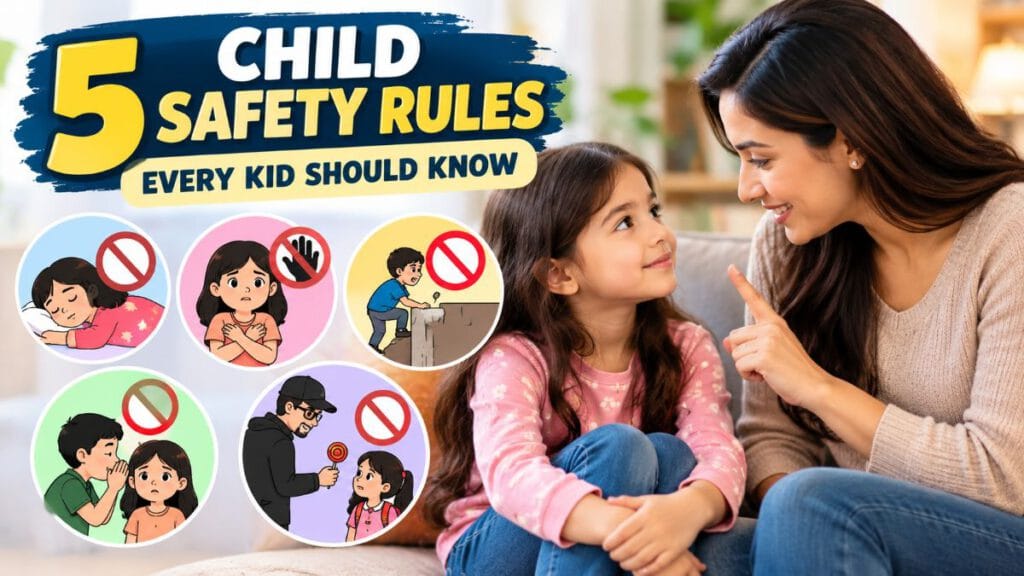
Child Safety Rules are important lessons that every child should learn early. Children are naturally curious, playful, and trusting, which can sometimes make it difficult for them to recognize an unsafe situation. Teaching children simple safety rules can help them understand when to say no, when to move away, and when to ask a trusted adult for help.
Safety education does not need to be frightening. A calm conversation between parents and children can make these lessons easier to understand and remember. Instead of teaching children to be afraid of everyone, we can teach them to recognize unsafe behavior and trust their instincts.
Parents can build on these basic lessons by teaching children more essential child safety rules for different situations and stages of childhood.
Here is a simple mother-and-daughter conversation that introduces five important safety rules every child should know.
A Mother Teaches Her Daughter Five Child Safety Rules
“Mom, do I really need to learn safety rules?”
“Yes, my dear. Knowing a few simple Child Safety Rules can help you make safe choices when I am not right beside you.”
“Okay, Mom. What should I remember?”
“There are five important rules I want you to know. They are easy to remember, but they are very important.”
1. Never Play the Pretend-to-Sleep Game in an Unsafe Place
“First, never play a pretend-to-sleep game in a place where you don’t feel safe.”
“What should I do if someone asks me to pretend to sleep somewhere?”
“You can clearly say no. You should sleep only in a safe place approved by your parents. If someone asks you to lie down, hide, or pretend to sleep somewhere that makes you uncomfortable, move away and tell a trusted adult.”
“So I don’t have to do something just because someone asks me?”
“Exactly. You are allowed to say no when something feels unsafe.”
Children should understand that they do not have to obey every request from another person, especially when the situation makes them uncomfortable. Teaching this early can help children respond more confidently when they encounter an unfamiliar or unsafe situation.
2. Never Play the Body-Check Game
“Second, never play a body-check game with someone who wants to touch your private parts.”
“What are private parts, Mom?”
“Private parts are the parts of your body covered by your underwear or swimsuit. Your body belongs to you. No one should touch those private parts in a way that makes you uncomfortable.”
Children should also know that there can be legitimate situations involving health or personal care. For example, a doctor may need to examine a child when necessary. Parents can explain that appropriate medical care is different from someone secretly or improperly touching a child.
“What should I do if someone tries to touch me?”
“Say no, move away, and tell another trusted adult or me immediately.”
“And what if they tell me not to tell anyone?”
“You should still tell. You will never be in trouble for telling a trusted adult about something that made you uncomfortable or unsafe.”
This is one of the most important Child Safety Rules because children need to know that they have the right to speak up about inappropriate touching.
3. Never Take Dangerous Dares or Challenges
“Third, never play a dare or challenge game if someone asks you to do something dangerous.”
“What if they call me a coward because I don’t do it?”
“You should still say no. Being brave does not mean doing something that could hurt you.”
For example, a child might be challenged to jump from a high wall, climb onto a dangerous roof, cross a busy road without proper care, enter an unsafe place, or perform another risky stunt.
A child should never feel pressured to prove courage by putting themselves in danger.
“You can simply say, ‘No, I’m not doing that,’ and walk away,” Mom explains.
Children sometimes worry more about being laughed at than about the danger itself. Teaching them that walking away is a strong and sensible choice can help them handle peer pressure.
4. Be Careful About Secrets
“Fourth, be careful when someone asks you to keep a secret from Mom or Dad.”
“What if someone says, ‘Don’t tell your parents’?”
“That is a warning sign, especially if the secret involves touching, gifts, going somewhere, threats, or anything that makes you uncomfortable. Tell a trusted adult.”
Children can have harmless surprises, such as keeping a birthday present secret for a short time. The important difference is whether someone is using secrecy to make the child feel frightened, uncomfortable, or unable to ask for help.
“If someone says I will get into trouble if I tell?”
“You should still tell. A safe adult will listen and help you.”
Parents can also give children several trusted adults they can approach, such as a teacher, grandparent, school counselor, or another responsible adult. This is useful because children may sometimes feel uncomfortable talking to one particular person.
5. Never Follow Someone Without Permission
“And the fifth rule is the follow-me game.”
“What does that mean, Mom?”
“Never go somewhere with another person without your parents’ permission, especially if that person asks you to keep it secret.”
“What if they offer me candy or a gift?”
“You should still say no. Do not go with them.”
Children should understand that gifts, sweets, toys, money, or promises of something exciting should never be used to persuade them to leave a safe place or go somewhere without permission.
“If someone tells me that Mom sent them to take me somewhere?”
“Don’t assume that it is true. Stay where you are and check with another trusted adult or me first.”
The goal is not to make children afraid of every unfamiliar person. Instead, they should learn to stop, check, and ask a trusted adult before going anywhere with someone unexpectedly.
What Should a Child Do When Something Feels Unsafe?
“Mom, what if I don’t know whether something is safe?”
“Listen to that feeling. If something feels wrong, you can move away and ask for help.”
A simple safety response can be taught to children:
Say no. Move away. Get to a safe place. Tell a trusted adult.
For example, if someone pressures a child to do something uncomfortable, the child does not need to argue or explain. They can say “No,” create distance, and seek help.
Children should also know that if the first trusted adult does not listen or understand, they can tell another trusted adult. They should keep asking for help until someone takes their concern seriously.
Teach Children Without Creating Fear
Teaching Child Safety Rules should not mean telling children that the world is dangerous or that they should be afraid of everyone.
Instead, parents can focus on practical skills. Children can learn that their bodies belong to them, that they can say no, that they do not have to accept dangerous challenges, and that they should tell a trusted adult when something feels wrong.
Safety conversations are also connected with emotional development in children, because children need to feel secure enough to communicate their fears, discomfort, and concerns.
These conversations can be repeated naturally as children grow. Younger children may need very simple examples, while older children can learn about peer pressure, online safety, boundaries, and more complicated situations.
Parents can also use everyday situations to reinforce the lessons. For example, when a child receives an unexpected invitation from someone, ask, “What would you do before going with them?” This turns safety education into a practical skill rather than a frightening lecture.
Parents can also learn more about protecting children from violence and exploitation through UNICEF’s child protection resources.
Help Children Remember These Five Rules
The five rules can be summarized in a way that children can easily remember:
Don’t pretend to sleep somewhere unsafe.
Protect your personal boundaries.
Don’t accept dangerous dares.
Tell a trusted adult about unsafe secrets.
Never go somewhere with someone without permission.
Most importantly, children should know that asking for help is never something to be ashamed of.
As children spend more time using phones, tablets, games, and social media, parents should also teach them online safety for children and help them recognize unsafe digital interactions.
Children are more likely to remember safety lessons when the rules are simple and repeated regularly. This infographic brings the five Child Safety Rules together in one easy-to-remember guide that parents can discuss with their children.
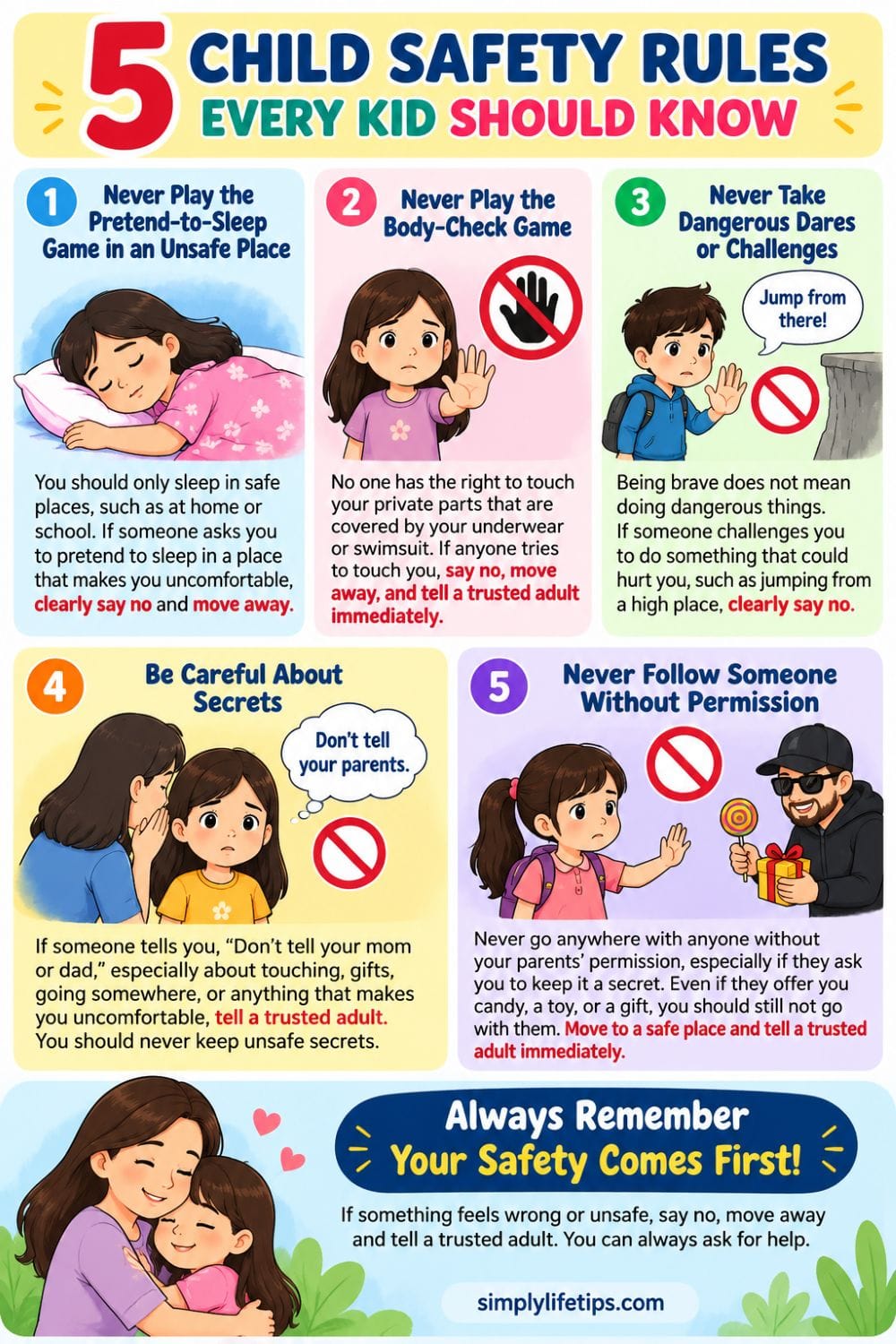
These simple reminders can help children understand what to do when something feels unsafe. Encourage your child to say no, move away, find a safe place, and tell a trusted adult whenever necessary.
Conclusion
These five Child Safety Rules give children simple tools for handling situations that may be unsafe or uncomfortable. The goal is not to make children fearful but to help them become more confident about setting boundaries, refusing dangerous requests, and seeking help.
A child who knows they can say no, move away, and tell a trusted adult has important skills for protecting themselves. Parents can continue these conversations as children grow and introduce new safety lessons when appropriate.
Above all, remind your child of one simple message: your safety comes first, and you can always ask a trusted adult for help.
Frequently Asked Questions
1. What are the most important Child Safety Rules for kids?
Important rules include knowing how to say no, protecting personal boundaries, avoiding dangerous challenges, being cautious about unsafe secrets, and never going somewhere with someone without parental permission.
2. How can I teach Child Safety Rules without frightening my child?
Use calm, age-appropriate conversations and everyday examples. Focus on what children can do rather than describing frightening situations in detail.
3. Should children be taught to say no to adults?
Yes. Children should understand that they can say no when an adult or another person asks them to do something unsafe, inappropriate, or uncomfortable. They should then move away and tell a trusted adult.
4. What should a child do if someone tells them to keep an unsafe secret?
The child should tell a trusted adult. Parents should reassure children that they will not be punished for speaking up about something that made them uncomfortable or afraid.
5. What should children do if they feel unsafe?
Teach children to say no, move away, get to a safe place, and tell a trusted adult. If the first adult does not listen, they should tell another trusted adult.

Mathukutty P. V. is the founder of Simply Life Tips. He shares practical advice and useful insights on personal growth, health, well-being, technology, and everyday living. His goal is to help readers build positive habits and make informed decisions. He believes in continuous learning and sharing knowledge to help people live healthier, happier, and more meaningful lives.