
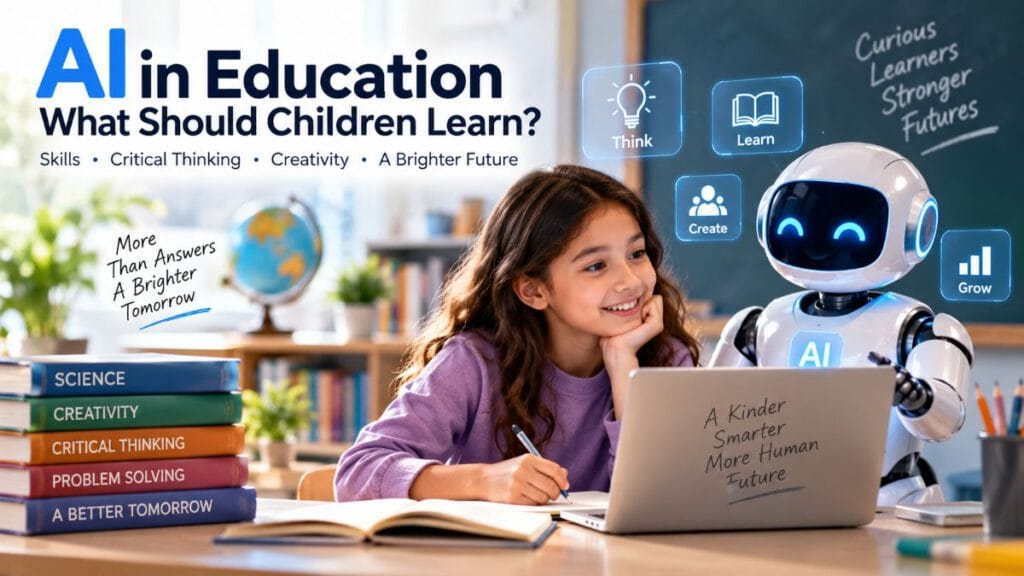
Artificial intelligence is changing the way people work, communicate, create, search for information and solve problems. It is also changing education. Children growing up today will enter a world where AI tools are increasingly present in classrooms, workplaces and everyday life. The important question is no longer whether students will encounter artificial intelligence. They will. The more important question is what children should learn when machines can already perform many tasks that schools traditionally asked students to practise.
For generations, education has placed considerable emphasis on memorisation, written exercises, standardised tests and the ability to reproduce information. Those abilities still have value, but they are no longer enough. A student can ask an AI system to explain a difficult concept, summarise a chapter, generate an essay, translate a paragraph or solve a mathematical problem within seconds. That convenience creates an opportunity, but it also creates a serious educational challenge: children must learn how to think rather than simply how to obtain answers.
The future of education therefore should not be about competing with AI. It should be about helping children develop the knowledge, judgement and character required to use powerful technology wisely.
Research and policy work increasingly support this direction. UNESCO’s AI Competency Framework for Students identifies competencies involving human-centred thinking, ethics, AI techniques and applications, and AI system design. The OECD similarly argues that AI literacy involves understanding AI, critically evaluating its outputs and using it ethically and creatively.
This makes AI in education much broader than teaching children how to operate an AI chatbot. It is about preparing young people to remain capable, curious and responsible when intelligent technology becomes part of almost every area of life.
What Is AI in Education?
AI in education refers to the use of artificial intelligence technologies to support teaching, learning, assessment, administration and educational decision-making. These technologies can analyse information, recognise patterns, generate content, answer questions, provide feedback and adapt learning experiences.
A student may use an AI tutor to receive another explanation of a difficult science concept. A teacher may use an AI tool to develop examples for a lesson. An educational platform may adjust practice questions according to a student’s performance. Schools may use technology to assist with administrative work or identify areas where students need additional support.
These are practical applications of AI in education, but the technology itself is not the most important part of the discussion. The educational value depends on how the technology is used.
An AI system can provide an answer without helping a child understand why that answer is correct. It can produce a polished essay without developing the student’s ability to organise an argument. It can solve a mathematical problem without strengthening mathematical reasoning.
That distinction is essential. Technology can make a task easier while making learning weaker if students stop doing the thinking themselves.
The OECD Digital Education Outlook 2026 highlights this concern. Generative AI can improve the performance of a task, but completing a task with AI assistance does not necessarily mean that genuine learning has taken place. When cognitive effort is outsourced too early or too often, students may become less engaged with the learning process.
Good AI in education should therefore support thinking rather than replace it.
How Is AI Used in Education?
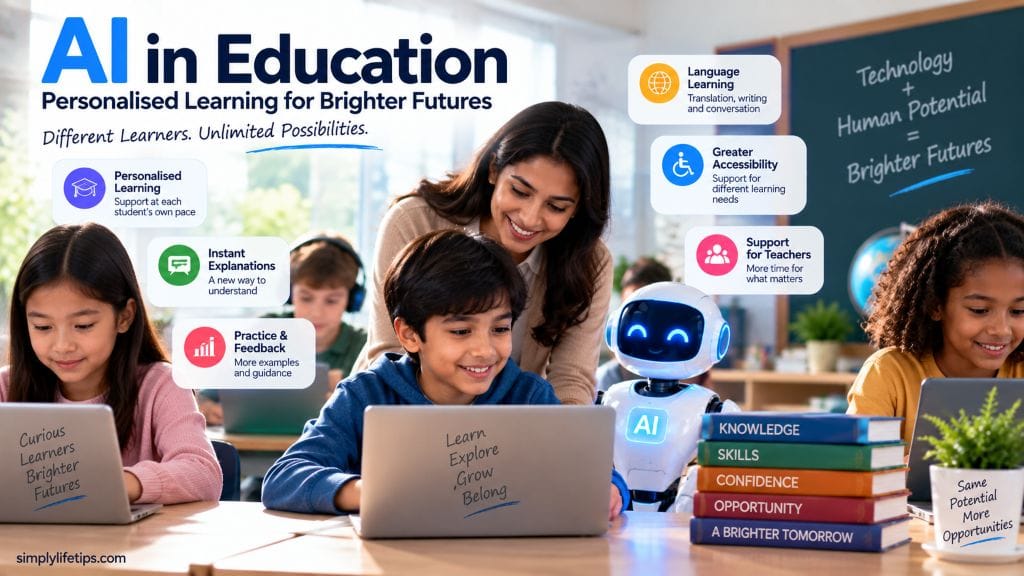
The use of artificial intelligence in education is expanding across several areas. Some applications are already familiar, while others are still developing.
One important application is personalised learning. Traditional classrooms often require one teacher to work with students who have different levels of understanding. AI-powered systems can analyse responses and provide additional practice or explanations based on individual performance. Used carefully, this can give students more opportunities to practise concepts at an appropriate level.
AI can also support teachers. Preparing lesson materials, generating examples, adapting reading passages and creating preliminary assessment questions can consume significant amounts of time. Appropriate AI tools may reduce some of that routine workload, allowing teachers to spend more time interacting with students.
Language learning provides another example. AI systems can support translation, vocabulary practice, pronunciation exercises, and conversational practice. Students can receive immediate feedback and practise repeatedly without feeling embarrassed about making mistakes.
Accessibility is another promising area. AI-powered technologies can assist students with different learning needs through speech recognition, text-to-speech, translation, summarisation and other adaptive features. The goal should not be to make every learner identical but to remove unnecessary barriers to participation.
At the same time, these applications require human oversight. An AI-generated explanation may be inaccurate. A recommendation may reflect bias in its underlying data. A generated answer may sound convincing while containing factual errors.
The question should therefore not simply be, “How is AI used in education?” It should also be, “When should AI be used, and when should a student be expected to work without it?”
AI in Education Examples: When Technology Supports Learning
Consider a student who is struggling to understand photosynthesis. Instead of receiving a single textbook explanation, the student can ask an AI system to explain the concept using simpler language, provide an analogy, and then create practice questions.
That can be useful because the technology becomes a learning assistant rather than an answer machine.
A similar approach can work with writing. A student may write an essay independently and then ask an AI tool to identify unclear sections or suggest questions that could strengthen the argument. The student still has to decide whether the suggestions are appropriate.
In mathematics, AI can provide hints rather than immediately displaying the final solution. In language learning, it can create conversations for practice. In programming, it can explain an error and encourage the student to diagnose the problem.
These examples demonstrate an important principle of AI in education: the student’s intellectual effort should remain central.
The strongest educational use of AI often involves asking students to compare, question, verify, and improve what the system produces. A teacher might show students two AI-generated explanations and ask them to identify which is more accurate and explain why. Such an exercise turns AI output into an object of critical analysis.
This approach is much more valuable than simply allowing students to copy generated answers.
AI in Education: How Does AI Help Students?
When used thoughtfully, AI can make learning more accessible, flexible and interactive.
A child who does not understand a classroom explanation can request another explanation. A student who needs additional practice can generate more examples. Someone learning a new language can practise conversation outside school hours. Students can explore topics that interest them and ask follow-up questions without waiting for the next lesson.
AI can also help students overcome the fear of asking questions. Some children hesitate to raise their hands because they worry that their classmates will judge them. A private digital learning assistant can provide an initial explanation that helps them return to the teacher with better questions.
However, convenience should not become dependency.
The best answer to “how AI helps in education” is therefore not simply that it gives students faster access to information. Its real value appears when it helps learners understand concepts, explore possibilities, receive useful feedback, and become more independent thinkers.
Students still need teachers, books, discussion, experimentation, and direct experience. AI should extend those experiences rather than replace them.
Why Is AI in Education Important?
The importance of AI in education comes from a fundamental change in the environment in which today’s children will live and work.
Many jobs will involve AI in some form. Some existing tasks will become automated, while entirely new roles will emerge. Workers will increasingly need to evaluate machine-generated information, collaborate with AI systems, communicate clearly, and make decisions in situations where technology cannot provide certainty.
Education cannot prepare children for this future by predicting every job they might eventually have. Instead, it must develop capabilities that remain useful even when technology changes.
That includes critical thinking, creativity, communication, collaboration, emotional intelligence, adaptability, financial understanding, ethical judgement, and the ability to learn continuously.
AI literacy belongs within this broader foundation.
UNESCO’s student competency framework describes AI education in terms of understanding, applying and creating, rather than merely operating software. That is an important distinction. Children should understand what AI systems can do, recognise their limitations, use them responsibly and eventually participate in shaping how AI is designed and used.
Advantages of AI in Education
One major advantage is personalisation. Students do not all learn at the same speed or in the same way. Technology can provide additional explanations and practice without requiring the entire class to move at one pace.
Another advantage is access to information and learning support. AI tools can help students explore subjects beyond the limits of a single textbook. They can explain ideas in different ways and encourage curiosity.
AI can also provide rapid feedback. Immediate feedback can help students identify mistakes while the subject is still fresh in their minds.
Teachers may benefit as well. If AI reduces some repetitive preparation and administrative work, teachers can potentially devote more attention to mentoring, discussion, creativity, and individual student needs.
There are also opportunities for accessibility. Speech, translation, and adaptive technologies can help more students participate in learning.
Yet none of these advantages automatically produces better education. The quality of the outcome depends on the educational design surrounding the technology.
Disadvantages of AI in Education
The greatest danger is not that children will use AI. It is that they will use it without developing the ability to think independently.
If a student asks AI to complete every assignment, the work may look excellent while the student’s understanding remains weak. Over time, the learner may become dependent on external assistance for tasks that should have become internal abilities.
Accuracy is another problem. AI systems can generate incorrect information with remarkable confidence. Students who have not learned how to verify sources may mistake fluency for truth.
Bias is also important. AI systems are trained and developed using data and human decisions that can contain limitations or biases. Children therefore need to understand that technology is not automatically neutral.
Privacy deserves attention too. Students should learn that entering personal information into online systems can have consequences. UNICEF’s Guidance on AI and Children emphasises children’s safety, privacy, fairness, transparency, accountability and well-being when AI systems affect them.
There is also the risk of reducing human interaction. Education is not merely the transfer of information. Children learn through conversation, cooperation, disagreement, encouragement, and relationships with teachers and classmates.
A classroom full of efficient technology can still be a poor learning environment if meaningful human interaction disappears.
AI and Homework: AI in Education
Homework has always been intended to provide practice. If AI performs the practice, the educational purpose can disappear.
A student who asks an AI system to write an essay may submit better-looking work but learn less about writing. A student who asks for every mathematics answer may finish quickly while failing to develop mathematical reasoning.
This does not mean AI should automatically be banned from homework. Instead, assignments may need to change.
Teachers can ask students to show their reasoning, explain why they rejected an AI-generated answer, compare different sources, or reflect on how they improved their own work. Such tasks make the thinking process visible.
The classroom can also establish clear rules about when AI is permitted. A student might be allowed to use AI for brainstorming but required to write the final response independently. Another assignment might deliberately prohibit AI so that the teacher can assess unaided understanding.
The objective is not to catch students using technology. It is to ensure that technology does not replace the learning that the assignment was designed to produce.
Should Schools Ban AI?
A complete ban is unlikely to be the best long-term solution.
Children will encounter AI outside school regardless of whether schools prohibit it. Avoiding the technology entirely may leave students less prepared to evaluate it responsibly.
Schools should instead teach appropriate use. That includes understanding limitations, checking information, protecting privacy, recognising bias, citing assistance when required and knowing when independent work is more valuable.
The OECD’s work on empowering learners for the age of AI similarly treats AI literacy as a combination of knowledge, skills and attitudes.
The goal should be responsible competence rather than unrestricted access or total prohibition.
From Memorisation to Critical Thinking
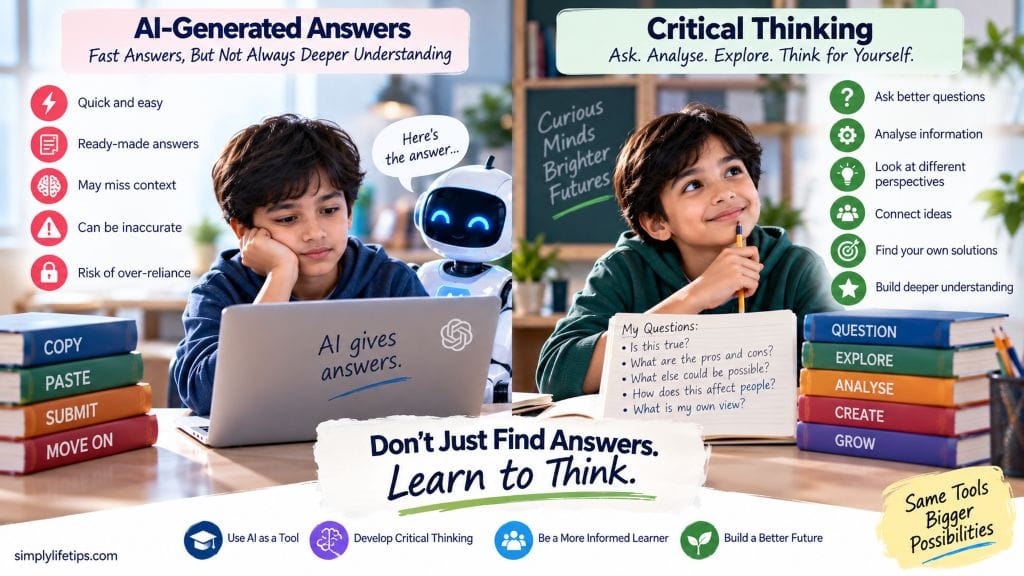
Memorisation will not become useless because AI exists. Children still need foundational knowledge. A student cannot critically evaluate an explanation without knowing enough about the subject to recognise what might be wrong.
The balance, however, needs to change.
Education should give students knowledge while also teaching them how to question it, connect ideas, and apply them to unfamiliar situations.
Critical thinking becomes especially important when information is abundant. The problem is no longer simply finding an answer. It is deciding whether the answer deserves to be trusted.
Students should learn to ask where information came from, what evidence supports it, whether another explanation is possible, and what assumptions may be hidden within an argument.
These habits matter far beyond school. They influence how adults evaluate news, advertisements, financial decisions, health information, and political claims.
The ability to think critically may therefore become more valuable as AI becomes more capable.
For students who want to strengthen their thinking habits, the Simply Life Tips article 7 Styles Of Thinking – How To Activate Your Full Brainpower provides a useful complementary resource.
Creativity in the Age of AI
AI can generate images, stories, music, designs, and ideas. That does not make human creativity irrelevant. It changes the nature of creative work.
Children should still be encouraged to draw, write, build, experiment, imagine and make mistakes. Creativity develops through exploration, not simply through receiving finished results.
If a child asks AI to create a story and submits it unchanged, the child has consumed creativity rather than practised it. A richer activity would be to create an original story, use AI for feedback or alternative ideas, and then decide what to accept or reject.
Creative education should preserve the messy part of the process. Children need opportunities to experience uncertainty, generate imperfect ideas, and discover unexpected solutions.
AI may become a powerful creative partner, but children should first develop the confidence to create without it.
Children Need to Understand How Their Minds Learn
One of the most important lessons in an AI-powered world is learning how learning itself works.
Students need to understand that memory strengthens through retrieval and practice. Difficult tasks often feel uncomfortable precisely because they require mental effort. Immediate access to an answer can remove that useful struggle.
This is why students should sometimes work without AI even when AI could make the task easier.
A child who struggles to solve a problem independently is not necessarily wasting time. That struggle may be where learning occurs.
Developing effective study habits remains important for the same reason. The Simply Life Tips guide How To Build Effective Study Habits For Students explores practical approaches students can use to make learning more effective.
The purpose of technology should be to support these habits, not undermine them.
Emotional Intelligence Still Matters
Artificial intelligence may become increasingly capable of producing language that sounds empathetic, but human relationships remain fundamentally important.
Children need to understand their own emotions and learn how to respond to the emotions of others. They need patience, empathy, self-awareness, and the ability to manage disagreement.
These skills influence friendships, teamwork, leadership and family life. They also matter professionally because most meaningful work involves cooperation with other people.
A machine can generate a polite response. That does not mean a child has learned how to listen to someone upset, apologise sincerely or resolve a conflict.
Education should therefore treat emotional intelligence as a core capability rather than an optional soft skill.
Emotional intelligence is especially important during childhood. Read our guide on emotional intelligence for kids to learn how children can develop self-awareness, empathy, and better emotional skills.
Financial Literacy Should Be Part of Education
Children are also entering a world of increasingly complex financial decisions.
Understanding saving, spending, budgeting, interest, debt, investing, taxation, insurance and financial risk can have lifelong consequences. AI may provide financial information, but students still need the judgement to evaluate recommendations.
A child should understand the difference between information and advice, between a possibility and a guarantee, and between short-term excitement and long-term financial value.
Financial literacy also teaches decision-making. Students learn that every choice involves trade-offs and that attractive outcomes often come with risks.
Those lessons become particularly important when AI makes personalised recommendations and persuasive financial content easier to produce.
Parents and teachers can introduce these concepts early through practical activities. Our guide on teaching financial literacy to kids offers practical ways to help children develop healthy money habits.
Communication and Collaboration Remain Essential
Technology may change how people communicate, but communication itself remains a human capability.
Students need to explain complex ideas clearly, listen carefully, ask useful questions and adapt their message to different audiences. They also need to collaborate with people who have different opinions and working styles.
AI may help draft an email or presentation, but it cannot take responsibility for the relationship behind the communication.
Schools should therefore continue to value discussions, presentations, debates, group projects and collaborative problem-solving.
The ability to work with others may become even more important when people increasingly work alongside intelligent systems. A future professional may need to coordinate a human team, evaluate AI-generated recommendations and communicate the final decision to clients or colleagues.
Failure Is Part of Learning
Modern technology often makes failure easier to avoid. AI can correct grammar, solve problems, suggest alternatives, and generate new attempts almost instantly.
Yet failure has educational value.
Children learn resilience when an idea does not work, and they have to try again. They develop patience when a difficult concept takes several attempts to understand. They become better problem-solvers when the first solution fails.
If technology removes every frustrating moment, it may also remove some of the experiences through which persistence develops.
Students should therefore be allowed to struggle productively.
The objective is not to make learning unnecessarily difficult. It is to distinguish between unhelpful frustration and the productive effort required to develop competence.
Childhood also needs space for unstructured experiences. Our article on the power of childhood boredom explores why boredom can encourage children to think, explore, and create on their own.
What Skills Will Students Need in the Age of AI?
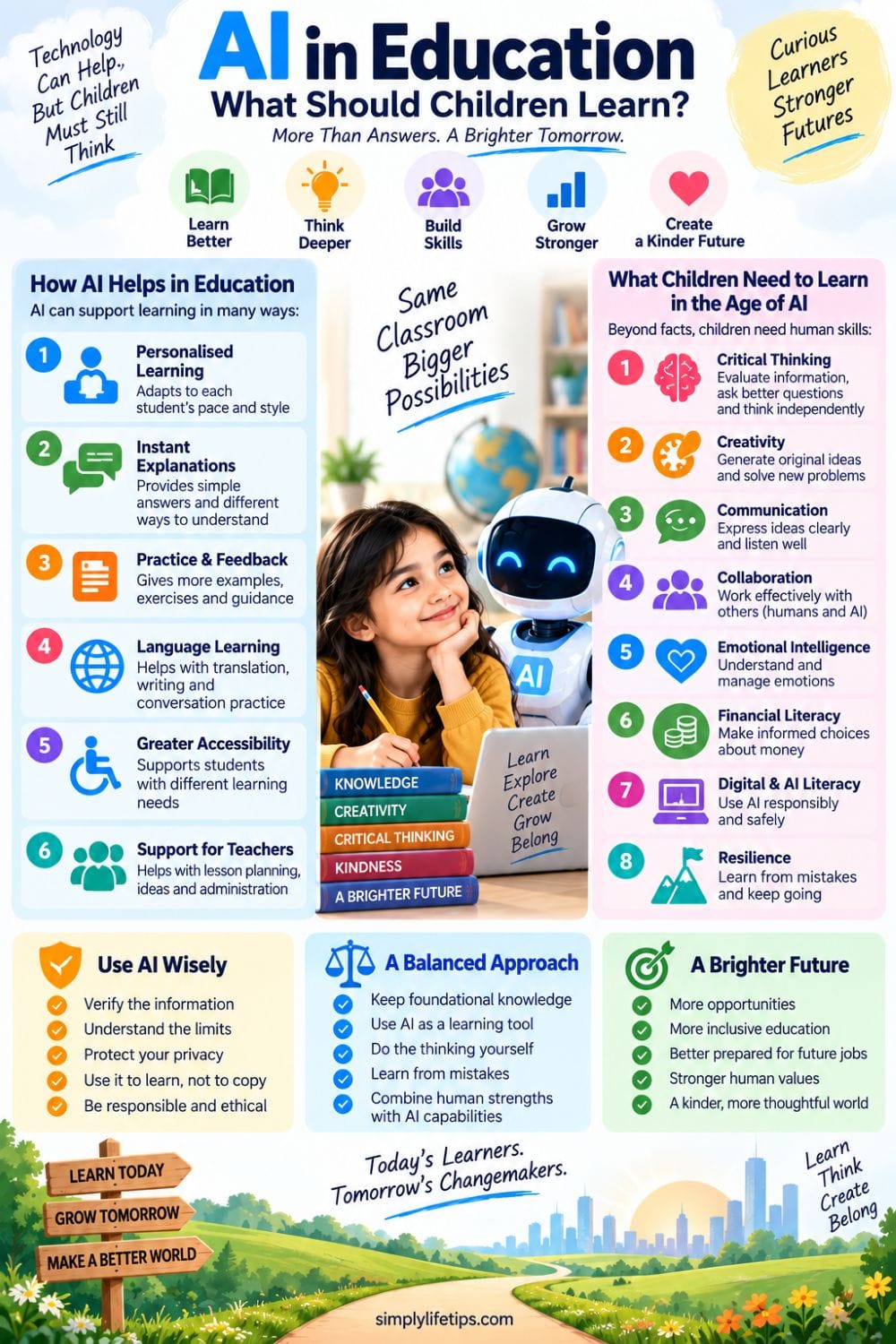
The future will reward people who can combine knowledge with judgement.
Students will need AI literacy so they understand how AI systems work at a practical level and where their limitations lie. They will need critical thinking so they can evaluate generated information instead of accepting it automatically.
Creativity will help them formulate original ideas and solutions. Communication will allow them to explain those ideas. Collaboration will help them work effectively with other people and intelligent systems.
Adaptability will matter because technologies and job requirements will continue to change. Students will need the confidence to learn new tools rather than assume that today’s software will remain dominant.
Ethical reasoning will become increasingly important as AI affects decisions involving privacy, employment, education, healthcare, and access to information.
Most importantly, children need to develop the habit of asking good questions.
AI is increasingly good at producing answers. Humans still need to decide which questions are worth asking.
What Can Teachers Do in an AI-Powered Classroom?
Teachers remain central to AI in education because good teaching involves far more than delivering information.
A teacher can help students distinguish between useful assistance and intellectual dependence. They can ask students to explain their reasoning, challenge AI-generated claims, and defend their conclusions.
Teachers can also redesign assignments so that the learning process matters. Instead of asking only for a final essay, an assignment might include research notes, an outline, a draft, a reflection and an explanation of how AI was or was not used.
Such approaches make learning visible.
Teachers themselves also need AI literacy. UNESCO’s AI Competency Framework for Teachers identifies competencies across areas including human-centred thinking, ethics, AI foundations and applications, AI pedagogy and professional learning.
The teacher’s role is not being eliminated by AI. In many ways, it becomes more important because students need guidance about when technology helps and when it gets in the way.
What Can Parents Do?
Parents do not need to become AI experts to help their children.
The most useful starting point is conversation. Ask children how they use AI, what they trust it to do, and whether they have ever found an answer that turned out to be wrong.
Parents can encourage children to attempt homework independently before turning to an AI tool. They can also ask children to explain what they learned rather than simply asking whether the assignment is finished.
Digital safety deserves equal attention. Children should know not to share sensitive personal information casually with online services. They should understand that generated content may be inaccurate, biased, or designed to persuade.
Most importantly, parents should model curiosity and responsible technology use themselves.
Children learn not only from rules but from observing how adults respond to technology.
AI Literacy Is More Than Prompting
Much public discussion about AI education focuses on prompt writing. Knowing how to communicate effectively with an AI system can certainly be useful, but prompt engineering alone is not AI literacy.
A student can write an excellent prompt and still accept a completely false answer.
Real AI literacy includes understanding what AI systems are designed to do, recognising that generated content can contain errors, evaluating evidence, protecting personal information, and understanding ethical implications.
Students should also learn that different AI systems may produce different answers. They need to compare information and recognise uncertainty.
UNESCO’s framework is useful here because it treats AI competence as broader than tool operation. Students should progress from understanding AI to applying it and eventually creating or contributing to AI systems.
That approach prepares children for a world in which today’s particular tools may eventually disappear.
The Human Qualities AI Cannot Replace
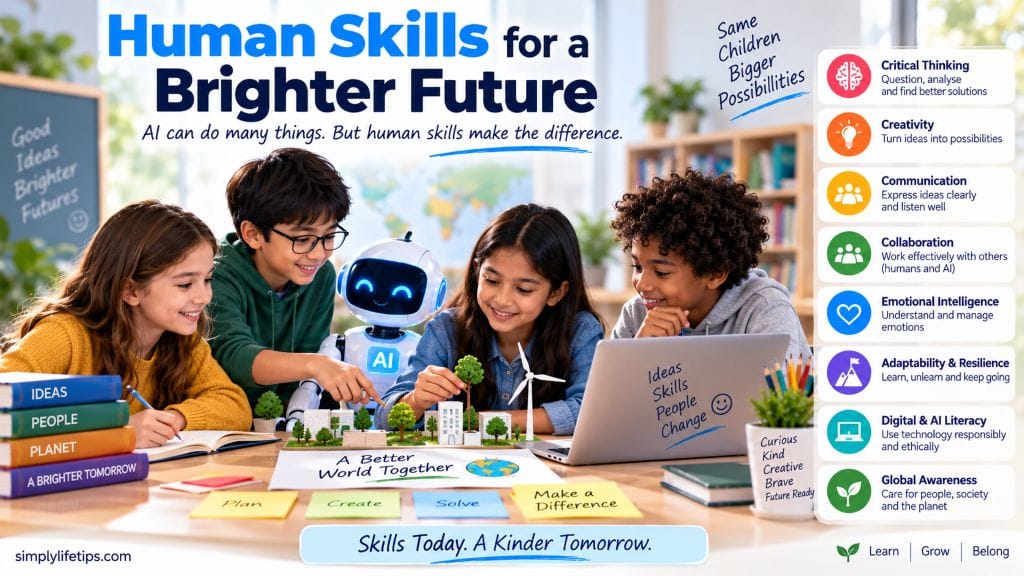
It is tempting to ask which human skills AI cannot perform. A better question is which human qualities education should deliberately strengthen.
Curiosity is one. Children should want to understand how things work rather than simply ask a machine for an explanation.
Judgement is another. A machine can provide possibilities, but people must decide what is appropriate.
Responsibility matters because someone must remain accountable for decisions.
Empathy matters because relationships cannot be reduced to information processing.
Courage matters because meaningful decisions sometimes require acting despite uncertainty.
Integrity matters because powerful technology can be used for both constructive and harmful purposes.
These qualities will remain important regardless of how advanced AI becomes.
The Future of Education Is Human and AI
The future of education should not be framed as humans versus machines.
A better model is human judgement supported by intelligent technology.
AI may help a student explore a subject, but the student should still develop understanding. It may help a teacher prepare material, but the teacher remains responsible for educational judgement. It may provide feedback, but students still need to reflect on that feedback.
The OECD Digital Education Outlook 2026 makes an important distinction: AI should enrich learning rather than replace cognitive effort and human relationships.
That principle can guide schools, teachers and parents.
The purpose of education is not to produce children who can operate every available technology. It is to develop people who can use technology without surrendering their ability to think.
Preparing Children for a Future We Cannot Predict
Nobody can accurately describe every job today’s children will have as adults. Some occupations will change dramatically. Others may emerge that do not yet have familiar names.
Trying to predict every future skill is therefore less useful than developing the capacity to keep learning.
Children should leave school knowing how to learn unfamiliar subjects, evaluate information, solve new problems and work with others.
That is why foundational knowledge still matters. A person cannot reason about science without scientific knowledge. Critical thinking does not exist in a vacuum. Creativity also grows from knowledge, experience and exposure to different ideas.
The future-ready student is not the child who knows every AI tool.
It is the child who can encounter a new tool, understand its possibilities, recognise its limitations and decide how it should be used.
The Real Purpose of Education
AI in education forces society to reconsider what education is actually for.
If the primary purpose of school is to memorise information and reproduce it on an examination, increasingly capable machines will challenge that model.
If education is about developing knowledgeable, thoughtful, creative and responsible human beings, AI becomes a tool within a much larger mission.
Children still need to learn mathematics, science, language, history and other subjects. The solution is not to abandon traditional knowledge. Instead, students should learn to use knowledge in deeper ways.
They should be able to explain ideas, question assumptions, solve unfamiliar problems, communicate conclusions, and connect knowledge across different areas.
AI can assist, but it cannot take responsibility for the person a child eventually becomes.
That responsibility belongs to families, schools, communities and society.
Conclusion
AI is changing education, but the most important change may not be technological. It may be a change in what society values as learning.
When information is instantly available, education must place greater emphasis on understanding. When machines can generate answers, students need stronger judgement. When routine tasks become automated, creativity and problem-solving become more important. When digital systems influence everyday decisions, ethical reasoning and AI literacy become essential.
The future of AI in education should therefore not be measured by how many AI tools a school has installed. It should be measured by whether students are becoming better thinkers, learners, and human beings.
Children should learn how AI works, how AI is used in education, how to evaluate its outputs and how to use it responsibly. They should also learn things that no technology can outsource for them: how to think critically, communicate honestly, collaborate with others, manage emotions, handle failure, make responsible decisions, and continue learning throughout life.
AI will become more powerful.
That makes human education more important, not less.
FAQs About AI in Education
1. What is AI in education?
AI in education means using artificial intelligence technologies to support teaching, learning, assessment, and educational activities. Examples include personalised learning systems, AI tutors, language-learning tools, automated feedback and accessibility technologies. The educational value depends on whether AI supports genuine learning or simply completes tasks for students.
2. How is AI used in education?
AI is used for personalised learning, tutoring, feedback, language practice, content creation, accessibility, and teacher support. Students may use AI to receive explanations, practise concepts or explore ideas. Teachers can also use it to prepare educational materials and reduce some routine work, provided that human oversight remains in place.
3. How does AI help students?
AI can give students immediate explanations, additional practice, feedback, and opportunities to explore subjects independently. It can also support students who need alternative explanations or accessibility assistance. However, AI helps students most effectively when it strengthens understanding and reasoning rather than doing the intellectual work for them.
4. What are the disadvantages of AI in education?
Potential disadvantages include overdependence, reduced independent thinking, inaccurate information, bias, privacy risks, and reduced engagement with teachers and classmates. Excessive reliance on AI can allow students to complete assignments without actually learning the underlying material. Clear educational guidance is therefore essential.
5. What should children learn about AI?
Children should learn more than how to write prompts. They should understand the basic principles and limitations of AI, evaluate AI-generated information critically, protect their privacy, recognise bias, understand ethical responsibilities and use AI creatively and responsibly. These skills should complement strong foundations in knowledge, critical thinking, communication and human development.

Mathukutty P V is a Blogger, YouTuber, and Content Writer and the founder of Simply Life Tips. After taking voluntary retirement in 2017, he embraced a free lifestyle focused on learning, personal growth, and sharing practical wisdom to help others live with more purpose and positivity.



