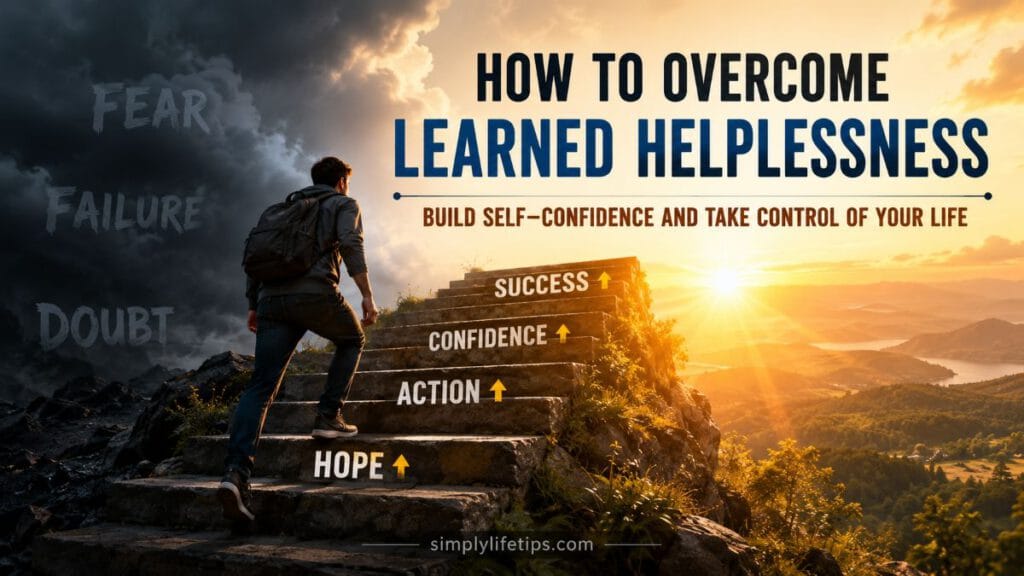
Have you ever felt that no matter how hard you try, nothing will change? Learning how to overcome learned helplessness is one of the most important steps toward achieving success and happiness. Many people unknowingly become trapped in a mindset where they believe failure is inevitable. Fortunately, this mindset can be changed.
The stories below demonstrate that success often begins with a decision to refuse defeat, even when circumstances seem impossible.
What Is Learned Helplessness?
Learned helplessness is a psychological condition in which a person believes they have no control over difficult situations because of repeated failures or negative experiences.
Instead of trying again, they stop making an effort, assuming that nothing they do will make a difference.
For example:
- A student who repeatedly fails exams may stop studying altogether.
- An employee who is constantly criticised may stop sharing ideas.
- Someone rejected several times during job interviews may stop applying for better opportunities.
In reality, opportunities still exist, but their mindset prevents them from seeing them.
The Soldier Who Refused to Accept Defeat
One inspiring story from the book Success in 30 Days tells of a soldier who was critically wounded during battle. Doctors believed he had no chance of survival and called a chaplain to prepare him for his final moments.
Instead of accepting death, the soldier asked the chaplain to take out his diary. Inside was a ten-rupee note.
The soldier smiled and said,
“Let’s make a bet. Ten rupees. I am not going to die.”
His confidence surprised everyone around him.
While medical treatment played its role, the soldier’s unwavering determination reflected a powerful truth: belief in oneself can become an extraordinary source of strength.
Although positive thinking alone cannot cure illness, research shows that optimism and resilience often improve a person’s ability to cope with adversity and continue fighting. Positive thinking becomes more effective when combined with practical daily habits.
The following illustration captures the soldier’s unwavering determination to reject hopelessness and hold on to self-belief, even in the face of overwhelming odds.

Why Self-Confidence Matters During Difficult Times?
Self-confidence does not mean believing that life will always be easy.
It means believing that you can face whatever comes your way.
People with strong self-confidence usually:
- Continue trying after setbacks.
- Learn from mistakes instead of fearing them.
- Focus on solutions rather than problems.
- Remain hopeful during uncertainty.
This attitude often becomes the difference between giving up and eventually succeeding.
The Psychology Behind Learned Helplessness
Psychologists have long studied why some people stop trying even when escape or success becomes possible.
A famous experiment by researchers at the University of Pennsylvania involved dogs that repeatedly experienced unavoidable electric shocks.
Eventually, the animals stopped attempting to escape, even after they were placed in a situation where escape was easy.
They had learned that nothing they did mattered.
This phenomenon became known as learned helplessness.
Although later animal research involving electric shocks would not meet today’s ethical standards, the concept remains an important part of modern psychology and has been supported through many subsequent human studies.
The lesson applies to everyday life.
Repeated disappointments can train people to expect failure, even when new opportunities appear.
Signs of Learned Helplessness
You may be experiencing learned helplessness if you frequently think:
- “Nothing will ever change.”
- “I always fail.”
- “There’s no point trying.”
- “I’m just unlucky.”
- “Success is only for other people.”
These thoughts often become self-fulfilling because they discourage action.
How to Overcome Learned Helplessness?
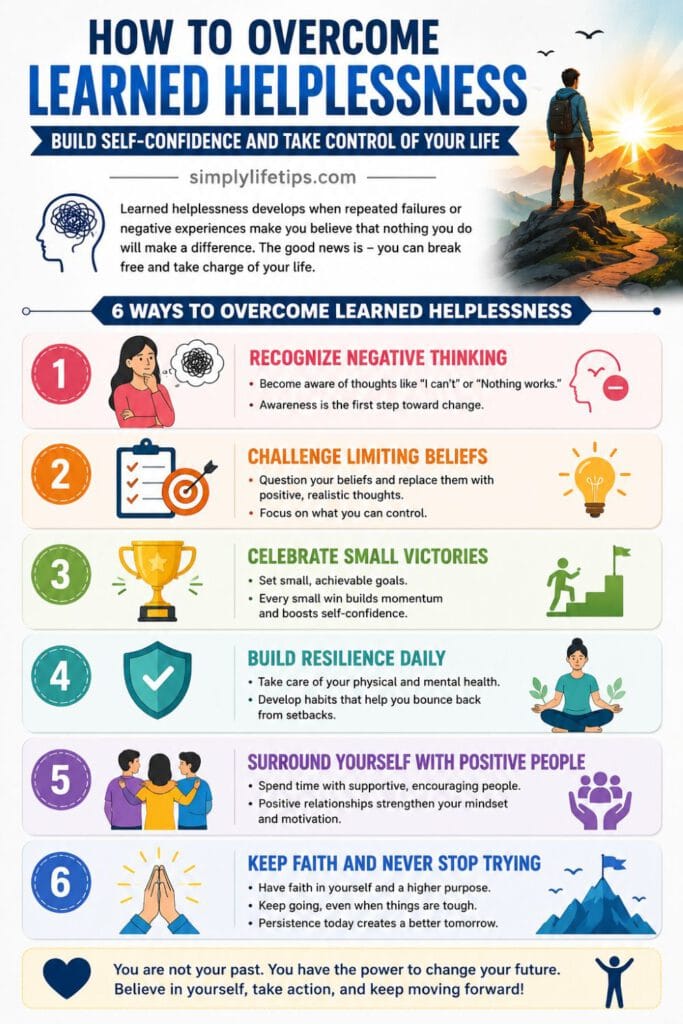
1. Challenge Negative Self-Talk
Pay attention to the stories you tell yourself.
Replace:
“I can’t do this.”
with
“I haven’t mastered this yet.”
Small language changes create healthier thinking patterns.
Understanding different thinking styles can help you develop a more positive and resilient mindset. Learn about the different types of thinking that shape your decisions, confidence, and success.
2. Focus on Small Wins
Success doesn’t happen overnight.
Set achievable daily goals.
For example:
- Read ten pages.
- Exercise for fifteen minutes.
- Apply for one job.
- Learn one new skill.
Each success builds confidence.
3. Accept That Failure Is Part of Growth
Every successful person has experienced setbacks.
Rather than seeing failure as proof that you’re incapable, view it as valuable feedback.
Each attempt teaches something new.
4. Surround Yourself With Positive People
Your environment shapes your mindset.
Supportive friends, mentors, and family members encourage perseverance instead of reinforcing hopelessness. Surrounding yourself with successful people can transform your mindset, expand opportunities, and help you grow personally and professionally.
Positive influences help you keep moving forward.
5. Develop Resilience
Resilience is the ability to recover after setbacks.
You can strengthen resilience by:
- Maintaining healthy routines.
- Exercising regularly.
- Getting enough sleep.
- Practising gratitude.
- Learning stress-management techniques.
Resilience grows stronger each time you overcome a challenge.
6. Keep Faith in Yourself
Self-belief doesn’t require certainty.
It requires commitment.
Even when others doubt your abilities, continue investing in your personal growth.
Confidence develops through consistent action, not perfect outcomes.
Success Begins With Your Mindset
Many people surrender before the real battle even begins.
They convince themselves that failure is unavoidable.
Successful individuals think differently.
Instead of asking,
“Why does this always happen to me?”
They ask,
“What can I do next?”
That simple shift transforms helplessness into hope.
Need a quick summary? Save or share this infographic highlighting the six practical ways to overcome learned helplessness and build lasting self-confidence.
The Role of Faith and Optimism
Whether your faith is rooted in religion, spirituality, or personal values, hope provides emotional strength during difficult times. Emotional maturity helps you respond to challenges without giving up.
Optimism doesn’t ignore reality.
It helps you face reality with courage.
Combining faith, perseverance, and practical action creates a powerful foundation for long-term success.
Conclusion
Learning how to overcome learned helplessness begins with recognising that past failures do not determine your future. Confidence is not something people are born with—it develops through repeated acts of courage, persistence, and self-belief.
Like the wounded soldier who refused to accept defeat, your greatest strength may lie not in your circumstances but in your mindset. Instead of surrendering to fear, choose to take one positive step today. Small actions, repeated consistently, can gradually replace helplessness with confidence and open the door to lasting success.
Frequently Asked Questions
What is learned helplessness in simple words?
Learned helplessness is a mindset where repeated failures make a person believe that nothing they do can improve their situation, even when opportunities exist.
Can learned helplessness be overcome?
Yes. With self-awareness, positive thinking, practical action, and consistent effort, people can gradually replace helplessness with confidence.
What causes learned helplessness?
Repeated failures, constant criticism, traumatic experiences, or situations where people feel powerless can contribute to learned helplessness.
How does self-confidence help overcome helplessness?
Self-confidence encourages people to keep trying despite setbacks, making them more likely to recognise opportunities and achieve success.
Is learned helplessness a mental illness?
No. It is a psychological pattern of thinking rather than a mental illness, although it can contribute to conditions such as anxiety or depression if left unaddressed.
References:
American Psychological Association (APA) – Explains learned helplessness and related psychological concepts. https://www.apa.org
Simply Psychology – Detailed explanation of learned helplessness, Martin Seligman’s experiments, criticisms, and applications. https://www.simplypsychology.org/learned-helplessness.html
PositivePsychology.com – Practical strategies for building resilience and overcoming helplessness. https://positivepsychology.com

Mathukutty P V is a Blogger, YouTuber, and Content Writer and the founder of Simply Life Tips. After taking voluntary retirement in 2017, he embraced a free lifestyle focused on learning, personal growth, and sharing practical wisdom to help others live with more purpose and positivity.