
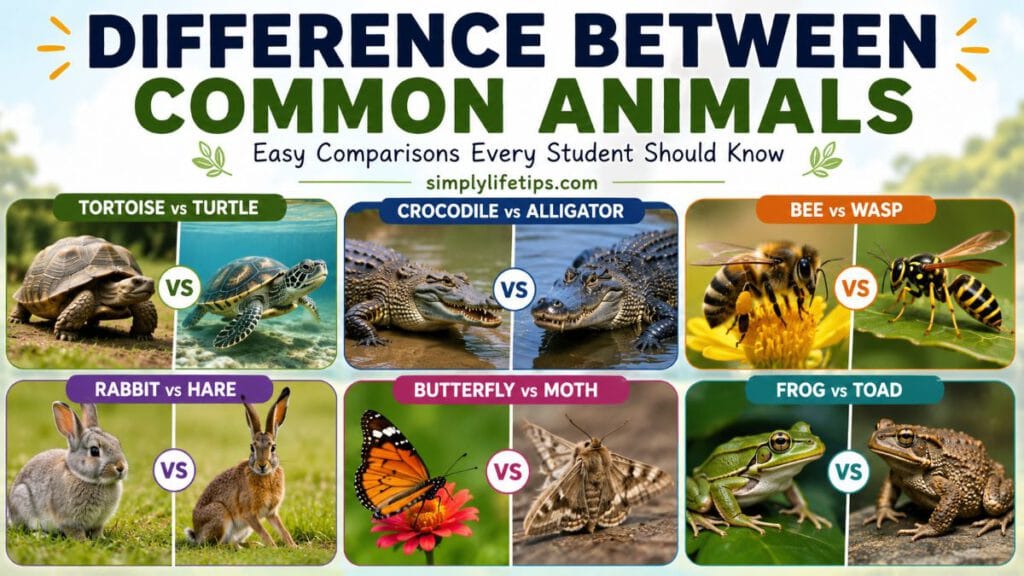
The differences between common animals are an interesting topic that helps students observe nature more carefully. Many animals look similar, making them easy to confuse. Is a tortoise the same as a turtle? How can you tell a crocodile from an alligator? What’s the difference between a bee and a wasp?
Learning these differences between common animals improves observation skills and makes science more enjoyable. This guide explains the most common animal comparisons using simple language and real-life examples.
What Are The Differences Between Common Animals?
Animals differ from one another in many ways, including their habitat, body structure, size, diet, behaviour, movement, and physical features. Some animals live on land, while others live in water or both. They may have different types of skin, shells, fur, feathers, or scales. For example, a tortoise has a heavy shell and lives mainly on land, whereas a turtle has a flatter shell and spends most of its life in water. Similarly, a bee has a fuzzy body that helps with pollination, while a wasp has a smooth, slim body. Learning these differences helps students identify animals correctly and better understand the diversity of the natural world.
6 Differences Between Common Animals
Many animals may look alike, but they have unique characteristics that make them easy to identify. In this guide, you’ll learn the key differences between common animals pairs—tortoise and turtle, crocodile and alligator, bee and wasp, rabbit and hare, butterfly and moth, and frog and toad. These simple comparisons will help students understand animal features, habitats, and behaviours more easily.
Tortoise vs Turtle
Although both belong to the reptile family, tortoises and turtles live very different lives.
Tortoise
- Lives mainly on land
- Has a heavy, dome-shaped shell
- Strong, sturdy legs for walking
- Eats grasses, leaves, and fruits
Example: A tortoise is commonly seen in zoos and dry habitats.
Turtle
- Lives mostly in water
- Has a flatter, lighter shell
- Webbed feet or flippers for swimming
- Eats plants, fish, and small aquatic animals
Easy Tip:
Tortoise = Land
Turtle = Water
Tortoises, turtles, crocodiles, alligators, frogs, and toads are all vertebrate animals, meaning they have a backbone.
Crocodile vs Alligator
These reptiles look alike but have several noticeable differences.
Crocodile
- Narrow, V-shaped snout
- Teeth remain visible even when the mouth is closed
- Usually found in saltwater and freshwater
- More aggressive in general
Alligator
- Broad, U-shaped snout
- Upper jaw hides most lower teeth when closed
- Mostly lives in freshwater
- Generally less aggressive than crocodiles
Easy Tip:
V = Crocodile
U = Alligator
Bee vs Wasp
Both insects can sting, but they play different roles in nature.
Bee
- Fuzzy body
- Thicker appearance
- Excellent pollinator
- Helps flowers produce fruits and seeds
Wasp
- Smooth body
- Slim waist
- Less hairy
- Hunts insects and also helps control pests
Example: Bees are commonly seen collecting nectar, while wasps often build paper-like nests.
Rabbit vs Hare
Rabbits and hares belong to the same family but are different animals.
Rabbit
- Smaller ears
- Shorter legs
- Born blind and without fur
- Lives in underground burrows
Hare
- Longer ears
- Longer, stronger legs
- Born with fur and open eyes
- Lives above ground
Easy Tip:
Hare = Higher jump and longer legs.
If you’re curious about other species with large ears, explore these animals with big ears and discover how their ears help them survive.
Butterfly vs Moth
Butterflies and moths are beautiful insects with different habits.
Butterfly
- Thin body
- Bright colours
- Active during the day
- Holds wings upright while resting
Moth
- Furry body
- Often dull brown or grey
- Active mostly at night
- Holds wings flat or roof-like while resting
Example: Most butterflies visit flowers during the day, while moths are attracted to lights at night.
Frog vs Toad
Frogs and toads are amphibians but differ in appearance.
Frog
- Smooth, wet skin
- Long legs for jumping
- Usually found near water
- Makes long jumps
Toad
- Dry, rough, bumpy skin
- Shorter legs
- Can live farther from water
- Usually walks or makes short hops
Easy Tip:
Smooth skin = Frog
Bumpy skin = Toad
Quick Comparison Table
| Animals | First Animal | Second Animal |
|---|---|---|
| Tortoise vs Turtle | Land animal, heavy shell | Water animal, flatter shell |
| Crocodile vs Alligator | Narrow V-shaped snout | Broad U-shaped snout |
| Bee vs Wasp | Fuzzy bodies help flowers | Smooth, slim body |
| Rabbit vs Hare | Smaller ears, shorter legs | Longer ears, longer legs |
| Butterfly vs Moth | Thin body, wings upright | Furry body, wings flatter |
| Frog vs Toad | Smooth, wet skin | Dry, bumpy skin |
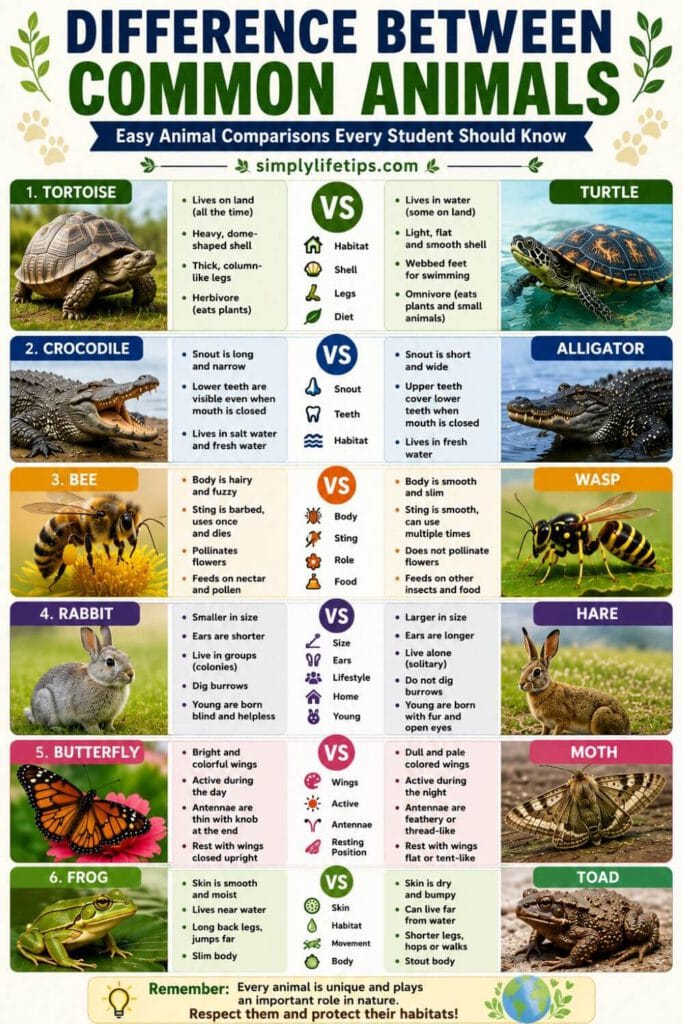
The infographic below provides a quick visual summary of the key differences between these common animals, making it easy for students to remember each comparison.
Why Is Learning Animal Differences Important?
Understanding animal differences helps students:
- Improve observation skills
- Learn biology more easily
- Identify animals correctly
- Build curiosity about wildlife
- Perform better in science quizzes and exams
Even small differences, such as ear length or shell shape, help identify animals correctly.
Conclusion
Many animals appear similar at first glance, but careful observation reveals important differences. Whether it’s the heavy shell of a tortoise, the fuzzy body of a bee, or the smooth skin of a frog, every feature helps us understand nature better. Learning these comparisons makes science enjoyable and encourages students to explore the amazing diversity of the animal kingdom.
After learning how to identify different animals, it’s also fun to learn the correct animal group names, such as a swarm of bees or a colony of rabbits.
FAQs
Is a tortoise a turtle?
No. A tortoise lives mainly on land, while a turtle spends most of its life in water.
Which insect is better for pollination?
Bees are the primary pollinators and are essential for many flowering plants.
How can I quickly identify a crocodile?
Look for its narrow V-shaped snout and visible lower teeth.
Are rabbits and hares the same?
No. Hares have longer ears and legs and are born more developed than rabbits.
Which has smooth skin, a frog or a toad?
A frog has smooth, moist skin, while a toad has dry, bumpy skin.
References.
- National Geographic – How to Tell a Turtle From a Tortoise
- National Geographic – Sea Turtles Facts and Information
- National Geographic – Reptile Pictures & Facts

Mathukutty P V is a Blogger, YouTuber, and Content Writer and the founder of Simply Life Tips. After taking voluntary retirement in 2017, he embraced a free lifestyle focused on learning, personal growth, and sharing practical wisdom to help others live with more purpose and positivity.



