Thinking skills shape every decision we make, every problem we solve, and every goal we achieve. Understanding the different types of thinking helps you become a better learner, communicator, leader, and decision-maker. While the image provides a quick overview, each thinking style has a unique purpose and can be developed with practice.
Whether you’re a student, professional, entrepreneur, or lifelong learner, mastering these thinking styles will improve your personal and professional life.
What Are Thinking Skills?
Thinking skills are mental processes that help us understand information, solve problems, make decisions, and create new ideas. No single thinking style is best in every situation. Successful people know when to use the right type of thinking. The different types of thinking work together to help us analyze information, generate ideas, and respond effectively to everyday challenges.
For example:
- A doctor diagnosing an illness uses analytical and critical thinking.
- An artist designing a logo uses creative and divergent thinking.
- A business owner planning future growth relies on strategic thinking.
If you’re interested in exploring broader cognitive approaches, our guide on Styles of Thinking explains how different thinking patterns influence learning, creativity, and decision-making.
The 12 Types of Thinking at a Glance
Before exploring each thinking style in detail, take a look at this visual overview. The wheel below illustrates the 12 essential types of thinking and how each contributes to better problem-solving, creativity, analysis, planning, and decision-making. It provides a quick reference that makes the differences between thinking styles easy to understand.
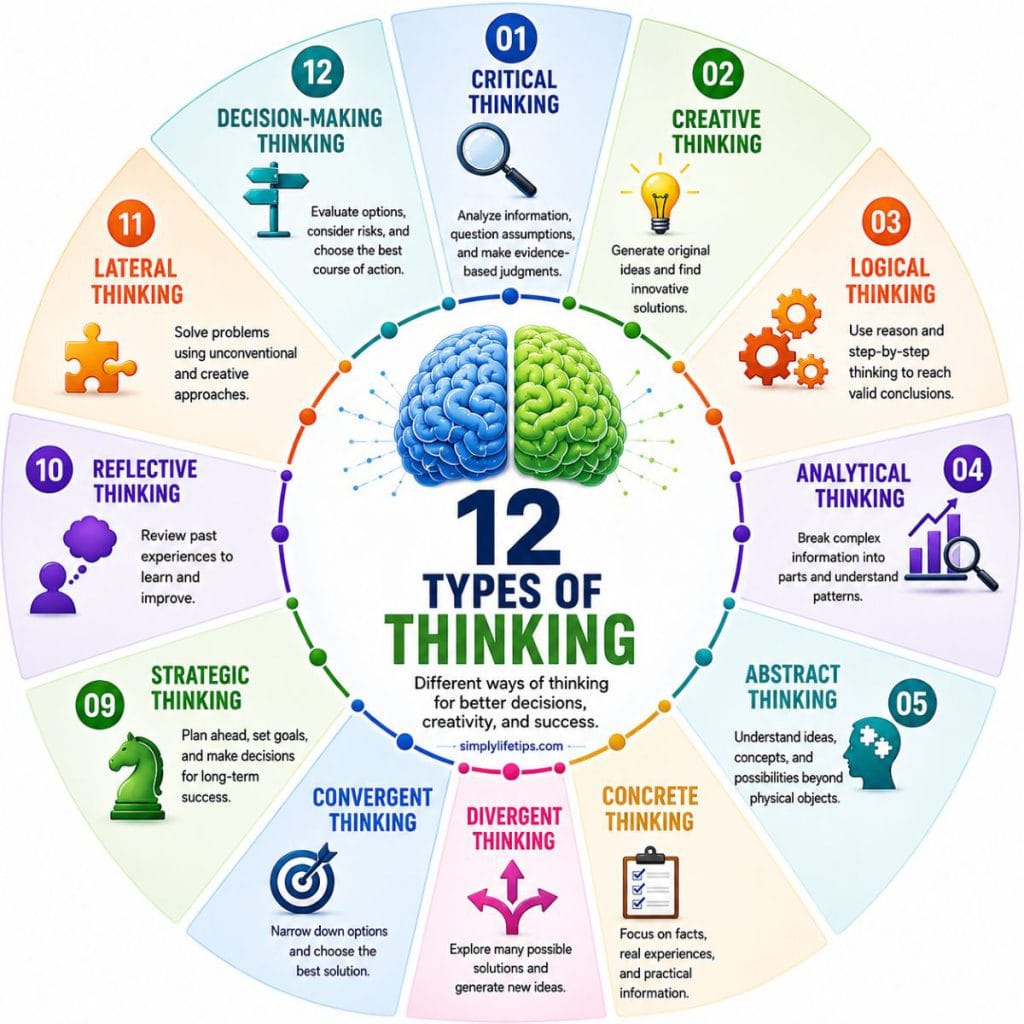
This overview demonstrates that effective thinkers don’t rely on just one mental approach. Instead, they switch between different thinking styles depending on the situation. In the following sections, we’ll explore each type in greater detail, including its purpose, real-world applications, and practical ways to develop it.
Critical Thinking
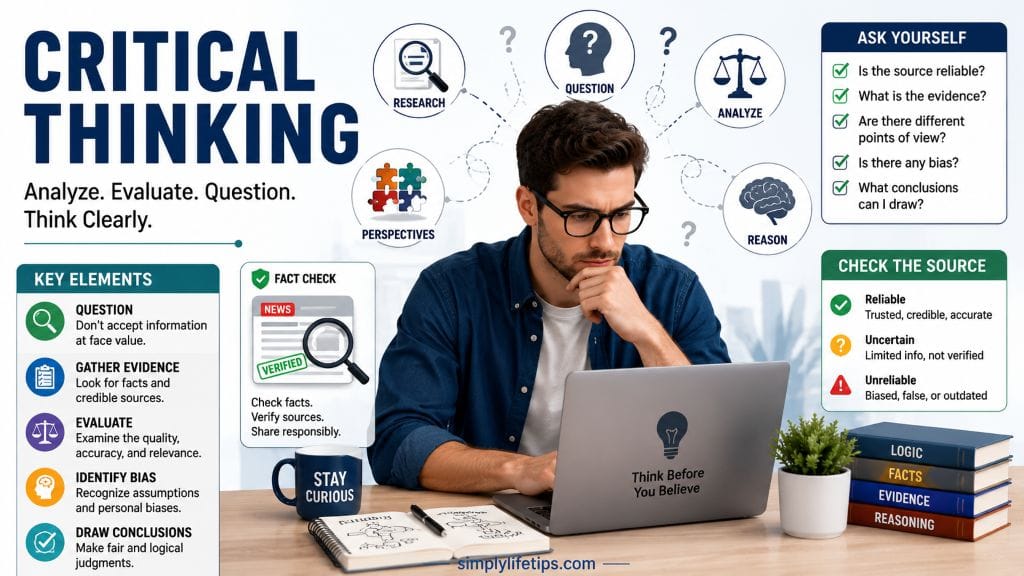
Critical thinking involves evaluating facts, questioning assumptions, and making logical judgments based on evidence.
Characteristics
- Question information instead of accepting it blindly.
- Look for evidence.
- Identifies bias.
- Makes informed decisions.
Example
Before sharing a news article on social media, you verify the source, check supporting evidence, and compare multiple reports.
How to Improve?
- Ask “Why?”
- Verify information.
- Read from different perspectives.
- Practice solving complex problems.
If you’d like to strengthen your reasoning and avoid common thinking errors, explore our detailed guide on Rules of Critical Thinking.
Creative Thinking
Among the various types of thinking, creative thinking is essential for innovation and discovering original solutions. Creative thinking means generating original ideas and finding innovative solutions.
Characteristics
- Imagination
- Innovation
- Curiosity
- Flexibility
Example
Instead of advertising a business traditionally, you create engaging short-form videos that attract customers.
How to Improve?
- Brainstorm regularly.
- Learn new skills.
- Explore different hobbies.
- Keep an idea journal.
Logical Thinking
Logical thinking follows clear reasoning and established rules to reach valid conclusions.
Characteristics
- Cause-and-effect reasoning
- Structured thinking
- Pattern recognition
- Rational conclusions
Example
A software developer identifies why a program crashes by testing one possibility at a time.
How to Improve?
- Solve puzzles.
- Learn basic logic.
- Practice coding or mathematics.
- Break problems into smaller steps.
Creative Thinking vs Logical Thinking
Creative thinking and logical thinking are often seen as opposites, but they work best when used together. Creative thinking helps generate original ideas and explore new possibilities, while logical thinking evaluates those ideas using reason, structure, and evidence. Innovation usually begins with creativity and succeeds through logical execution.
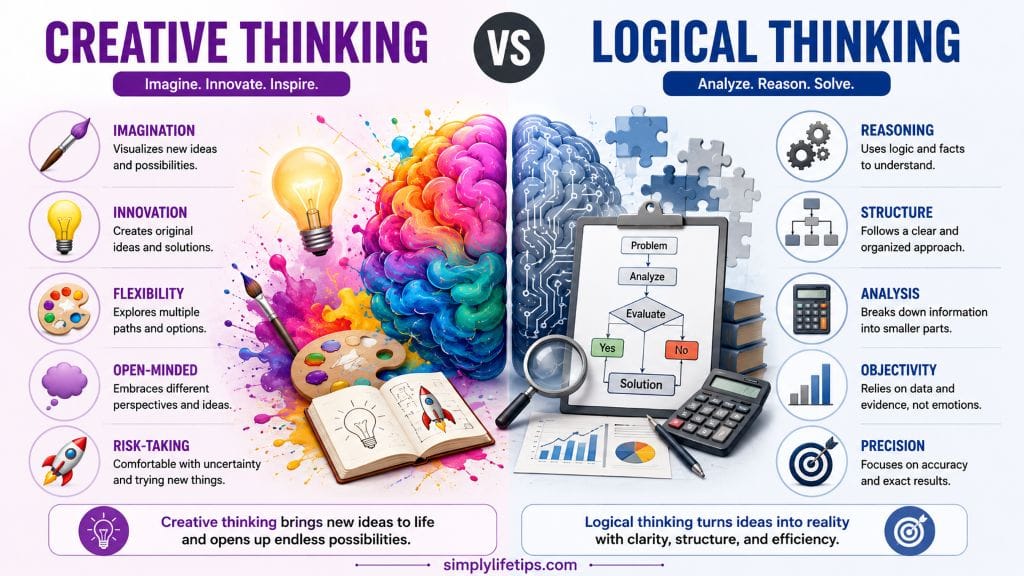
The comparison above shows that creative thinking encourages imagination, experimentation, and innovation, whereas logical thinking focuses on analysis, organization, and accuracy. Successful entrepreneurs, scientists, designers, engineers, and leaders combine both approaches—using creativity to develop ideas and logic to refine and implement them effectively.
Analytical Thinking
Analytical thinking is one of the most practical types of thinking because it helps break down complex information into manageable parts. Analytical thinking involves breaking complex information into smaller parts to understand relationships.
Characteristics
- Detailed examination
- Data interpretation
- Comparison
- Pattern analysis
Example
A marketing manager studies customer data to determine which campaign generated the highest sales.
Difference from Critical Thinking
Analytical thinking focuses on breaking information apart, while critical thinking focuses on evaluating whether conclusions are valid.
Abstract Thinking
Abstract thinking is the ability to understand ideas, concepts, and possibilities beyond physical objects.
Characteristics
- Understanding symbolism
- Conceptual reasoning
- Seeing the bigger picture
- Imagining possibilities
Example
Understanding concepts like justice, freedom, or love requires abstract thinking.
How to Improve?
- Read philosophy.
- Learn metaphors.
- Explore scientific theories.
- Practice visualization.
Concrete Thinking
Concrete thinking focuses on facts, real experiences, and practical information.
Characteristics
- Literal understanding
- Practical approach
- Clear instructions
- Observable facts
Example
Following a recipe exactly without modifying ingredients.
Best Used When
- Learning new tasks
- Following procedures
- Safety instructions
- Technical work
Divergent Thinking
Divergent thinking generates multiple possible solutions to one problem.
Characteristics
- Brainstorming
- Exploring possibilities
- Creativity
- Open-mindedness
Example
Finding twenty different uses for an empty cardboard box.
Benefits
- Encourages innovation.
- Increases creativity.
- Helps solve complex problems.
Divergent Thinking vs Convergent Thinking
Although divergent and convergent thinking are different approaches, they complement one another during effective problem-solving. Divergent thinking encourages exploring multiple ideas and possibilities without immediate judgment, while convergent thinking evaluates those ideas to identify the most practical and effective solution. Using both methods together leads to better innovation, smarter decisions, and stronger outcomes.
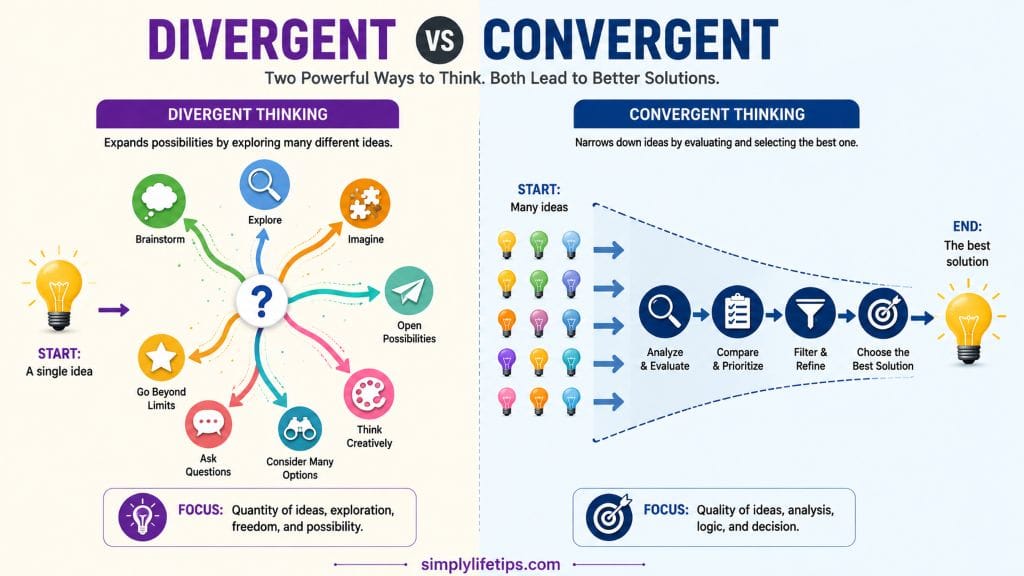
The illustration demonstrates how divergent thinking expands a single idea into many possibilities through creativity and exploration. Convergent thinking then narrows those possibilities by analyzing, comparing, and selecting the most suitable solution. Whether you’re brainstorming, designing a product, writing content, or solving business challenges, balancing both thinking styles helps you move from inspiration to successful execution.
Convergent Thinking
Convergent thinking narrows multiple ideas into one practical solution.
Characteristics
- Decision-making
- Evaluation
- Prioritization
- Accuracy
Example
After brainstorming ten marketing ideas, choosing the one with the highest expected return.
Difference from Divergent Thinking
Divergent thinking creates options.
Convergent thinking selects the best option.
Strategic Thinking
Of all the types of thinking, strategic thinking focuses most on long-term planning and future success. Strategic thinking focuses on long-term planning and achieving future goals.
Characteristics
- Goal-oriented
- Risk assessment
- Planning
- Resource management
Example
A business owner creating a five-year expansion plan.
How to Improve?
- Set long-term goals.
- Anticipate challenges.
- Study successful strategies.
- Review progress regularly.
Strategic Thinking: Your Roadmap to Long-Term Success
Strategic thinking goes beyond solving today’s problems—it focuses on creating a clear vision for the future. It involves setting meaningful goals, evaluating opportunities and risks, prioritizing actions, and adapting to changing circumstances. Whether you’re planning your career, growing a business, or managing personal finances, a strategic roadmap helps turn long-term goals into achievable results.
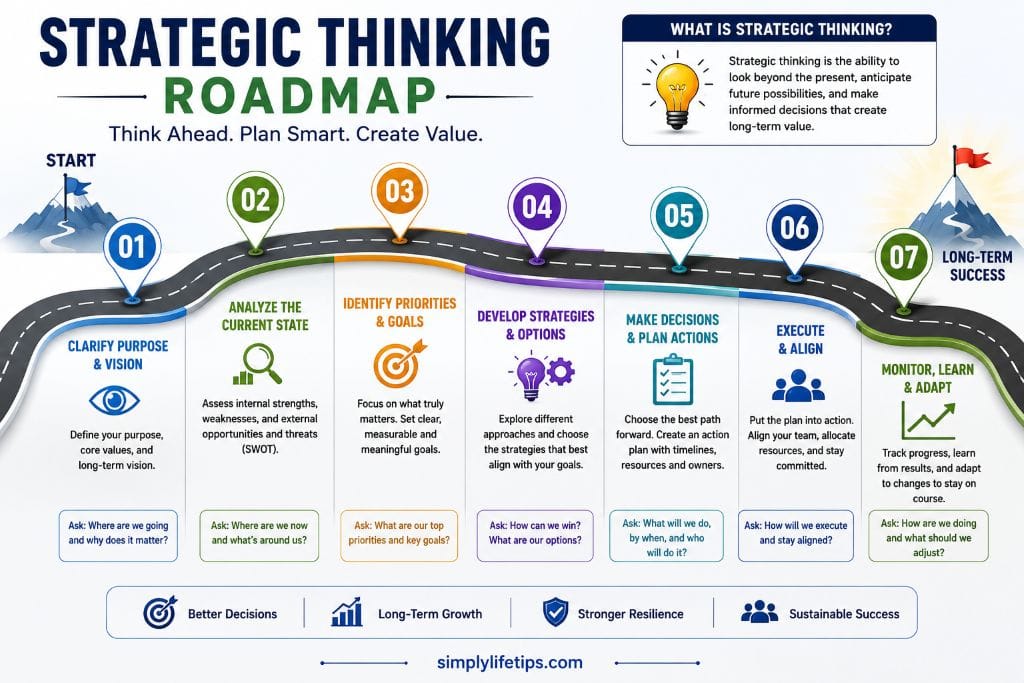
The roadmap above illustrates the key stages of strategic thinking, from defining your vision and analyzing the current situation to setting priorities, developing strategies, executing plans, and reviewing progress. By following a structured approach, you can make better decisions, overcome challenges, and stay focused on long-term success while remaining flexible enough to adapt when circumstances change.
Leaders often rely on critical thinking to evaluate complex situations, manage risks, and make informed decisions. Our article on Critical Thinking for Leaders explains how these skills contribute to effective leadership.
Reflective Thinking
Reflective thinking means learning from past experiences to improve future performance.
Characteristics
- Self-awareness
- Honest evaluation
- Continuous learning
- Personal growth
Example
After giving a presentation, review what went well and what could be improved next time.
Benefits
- Builds confidence.
- Improves performance.
- Reduces repeated mistakes.
Lateral Thinking
Lateral thinking solves problems using unconventional methods.
Characteristics
- Looking beyond obvious answers
- Creative problem-solving
- Challenging assumptions
- Thinking differently
Example
Instead of lowering prices, a company increases perceived value by adding free services.
Famous Example
Edward de Bono introduced lateral thinking techniques that encourage looking at problems from unexpected angles.
Decision-Making Thinking
Decision-making combines several thinking styles to choose the best course of action.
Characteristics
- Comparing options
- Evaluating risks
- Predicting outcomes
- Taking responsibility
Example
Choosing between two job offers by comparing salary, career growth, work-life balance, and company culture.
Good Decision Makers
- Gather information.
- Consider consequences.
- Think objectively.
- Learn from previous decisions.
You can further improve your choices by learning practical, effective decision-making strategies.
If you’re making decisions in a professional environment, explore our guide to successful decision-making in the workplace. Leaders and managers can also benefit from tactical decision-making techniques, while anyone looking to build confidence can learn more about making better decisions to unlock their full potential.
How do these thinking types work together?
Real-life situations rarely require just one thinking style.
Imagine launching a new business:
- Use Creative Thinking to generate ideas.
- Apply Analytical Thinking to study the market.
- Use Critical Thinking to evaluate risks.
- Apply Strategic Thinking for long-term growth.
- Use Decision-Making Thinking to choose the best plan.
- Reflect afterward using Reflective Thinking to improve future strategies.
The more thinking styles you develop, the better equipped you’ll be to face challenges.
Applying Thinking Skills in Everyday Life
The types of thinking discussed in this guide can be applied at home, at work, in education, and in personal relationships. Thinking skills aren’t limited to classrooms or workplaces—they influence nearly every decision we make. From solving family problems and managing finances to succeeding at work and making healthier lifestyle choices, the ability to think clearly helps us respond wisely instead of reacting impulsively. The more you develop different thinking styles, the more confident and effective you’ll become in everyday situations.
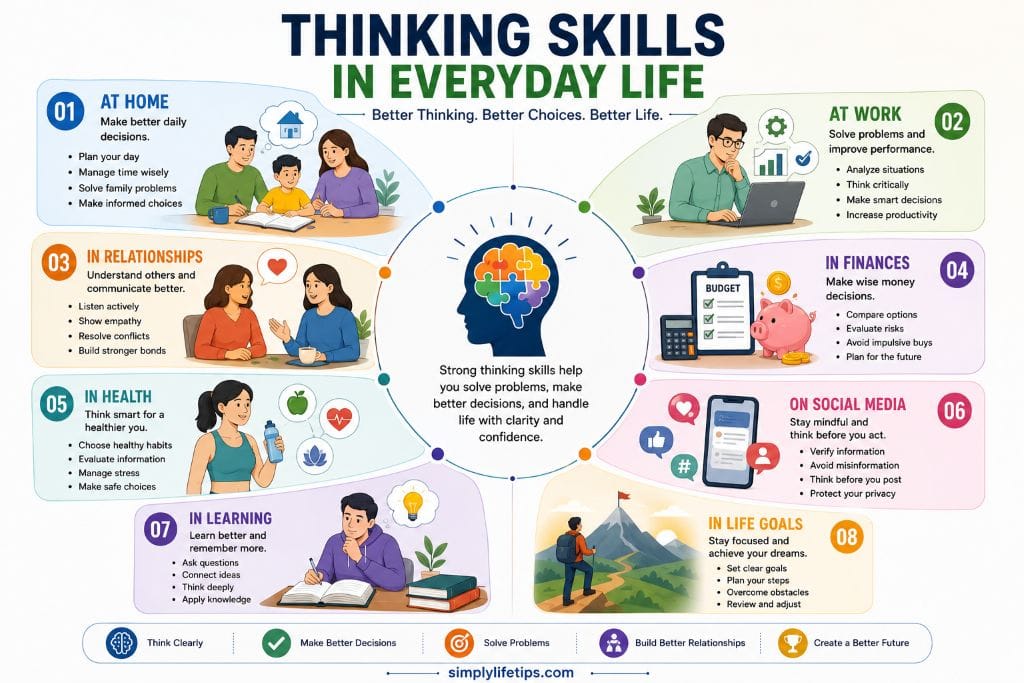
The illustration above demonstrates how different thinking skills support daily life across multiple areas, including home, work, relationships, health, learning, finances, social media, and long-term goals. Rather than relying on a single thinking style, successful people combine creativity, logic, critical analysis, strategic planning, and thoughtful decision-making to handle life’s challenges with confidence and clarity.
Tips to Develop Better Thinking Skills
Practicing different types of thinking regularly strengthens your ability to solve problems and make confident decisions.
- Read books from different subjects.
- Solve puzzles and brain teasers.
- Ask thoughtful questions.
- Practice mindfulness and reflection.
- Learn from failures.
- Discuss ideas with others.
- Stay curious.
- Keep a journal of lessons learned.
- Challenge your own assumptions.
- Continuously seek new experiences.
Developing a positive mindset makes it easier to approach challenges with confidence. Read our guide on Positive Thinking Tips to learn practical habits that strengthen optimism and resilience.
Common Mistakes That Limit Thinking
- Jumping to conclusions.
- Ignoring evidence.
- Believing the first answer is always correct.
- Fear of making mistakes.
- Avoiding different opinions.
- Letting emotions override facts.
- Thinking only in one way.
Recognizing these habits is the first step toward becoming a more effective thinker.
Conclusion
Understanding the types of thinking is more than an academic exercise—it is a practical life skill. Every challenge, whether personal or professional, requires a different way of thinking. By developing critical, creative, analytical, logical, strategic, reflective, and other thinking skills, you can solve problems more effectively, make wiser decisions, and unlock your full potential. Great thinkers are not born; they continuously practice and refine how they think. By understanding and practicing these types of thinking, you can become a more effective learner, communicator, leader, and decision-maker.
Every decision you make shapes your future. By strengthening your thinking skills and making better decisions to unlock your full potential, you can build greater confidence, achieve your goals, and navigate life’s challenges more effectively.
Save This Visual Guide for Future Reference
You’ve now explored the twelve essential types of thinking and how they apply to everyday life. The infographic below brings everything together in one easy-to-read visual, making it simple to remember the key concepts. Save it to Pinterest, bookmark it for later, or share it with friends, students, colleagues, or anyone looking to improve their thinking skills.
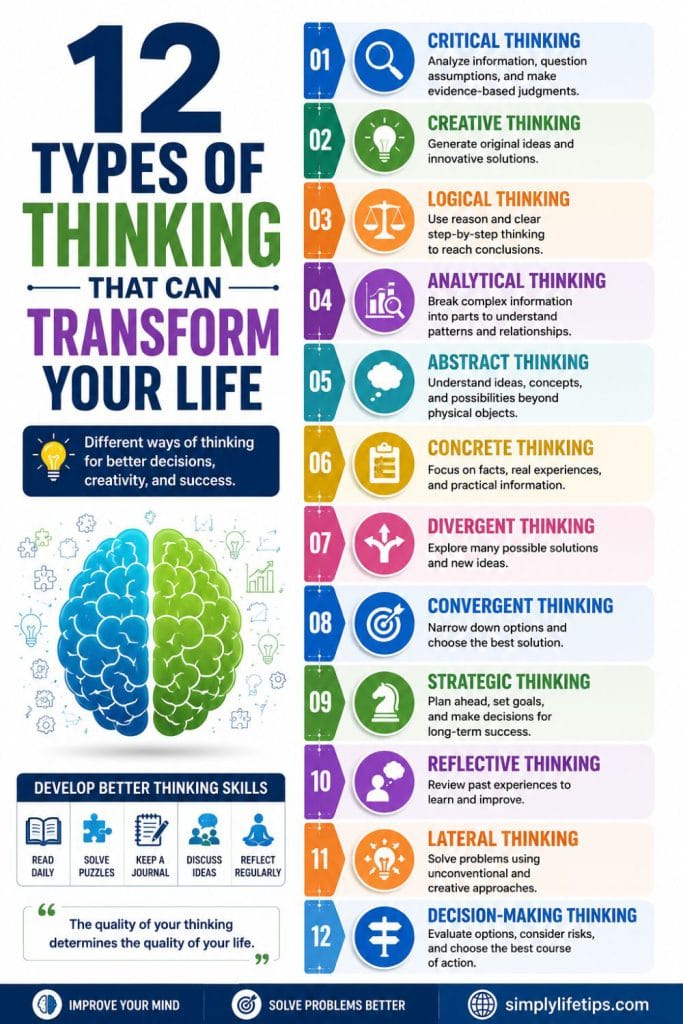
Whether you’re solving problems at work, making important life decisions, or looking for new ideas, stronger thinking skills can help you achieve better outcomes. Keep this visual guide as a quick reference whenever you need a reminder of the different thinking styles and how they work together to improve decision-making, creativity, and personal growth.
Keep this guide bookmarked whenever you need a quick reminder of the different types of thinking and their practical applications.
Frequently Asked Questions
What is the most important type of thinking?
There isn’t a single most important type. Different situations require different thinking styles, and successful people learn to combine them.
What is the difference between critical thinking and analytical thinking?
Analytical thinking breaks information into smaller parts, while critical thinking evaluates the quality, accuracy, and reliability of that information.
Can thinking skills be improved?
Yes. Reading, problem-solving, reflection, and continuous learning can significantly improve thinking skills over time.
Which thinking style is best for innovation?
Creative thinking, divergent thinking, and lateral thinking are particularly valuable for innovation and generating new ideas.
Why is strategic thinking important?
Strategic thinking helps individuals and organizations prepare for future opportunities, manage risks, and achieve long-term goals.
Related Articles

Mathukutty P V is a Blogger, YouTuber, and Content Writer and the founder of Simply Life Tips. After taking voluntary retirement in 2017, he embraced a free lifestyle focused on learning, personal growth, and sharing practical wisdom to help others live with more purpose and positivity.