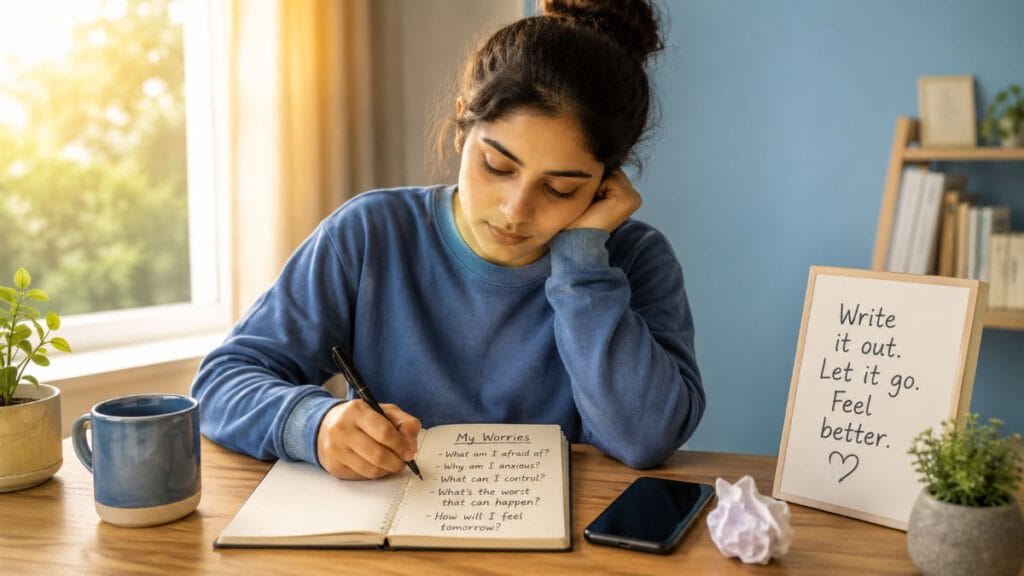
Writing down worries is one of the simplest yet most effective techniques for calming an anxious mind. When stress, fear, and uncertainty take over, our thoughts often become tangled and overwhelming. Instead of endlessly replaying problems in your head or reaching for your phone to distract yourself, try putting your thoughts on paper to regain clarity and emotional balance. This simple exercise takes only a few minutes but can make a significant difference in reducing anxiety and helping you think more rationally.
Writing Down Worries
Writing down worries is a practical self-help technique that helps you slow racing thoughts and gain a clearer perspective on stressful situations. Instead of allowing anxious thoughts to keep circling in your mind, putting them on paper makes them easier to examine objectively. This simple habit of writing down worries encourages self-reflection, reduces emotional overwhelm, and helps you identify what you can control and what you need to let go. Whether you’re dealing with work pressure, relationship concerns, financial uncertainty, or everyday stress, spending just a few minutes writing down worries can calm your mind and make even difficult situations feel more manageable.
Why does anxiety feel bigger in your minds?
Anxiety often grows because our brain keeps repeating fearful thoughts without finding solutions. Since these worries remain invisible, they feel much larger than they really are.
Common situations that trigger anxiety include:
Financial difficulties
Relationship conflicts
Health concerns
Work pressure
Academic stress
Fear of failure
Uncertainty about the future
For example, someone worried about an upcoming job interview may imagine dozens of worst-case scenarios. The more they think, the more anxious they become, even though nothing has actually happened.
Understanding how our thoughts influence emotions is equally important. Learn more about the types of thinking that shape our decisions and emotional responses:
Why Does Writing Down Worries Work?
Writing transforms abstract thoughts into concrete words. Instead of thoughts constantly spinning inside your mind, they become visible on paper.
Psychologists often recommend expressive writing because it helps people:
Organise their thoughts
Recognise irrational fears
Reduce emotional overload
Improve problem-solving
Feel more in control
Once worries become visible, they often appear smaller and more manageable.
A Simple 5-Minute Writing Exercise
You don’t need a journal or any special notebook.
Simply take:
A sheet of paper
A pen
Five quiet minutes
Start writing answers to questions like:
What am I afraid of right now?
Why is this making me anxious?
What is the worst thing that could realistically happen?
Will this matter tomorrow?
How serious will this feel after one hour?
Is there something I can do immediately?
Don’t worry about grammar or handwriting. No one else needs to read it.
The goal is to move your thoughts from your mind onto paper.
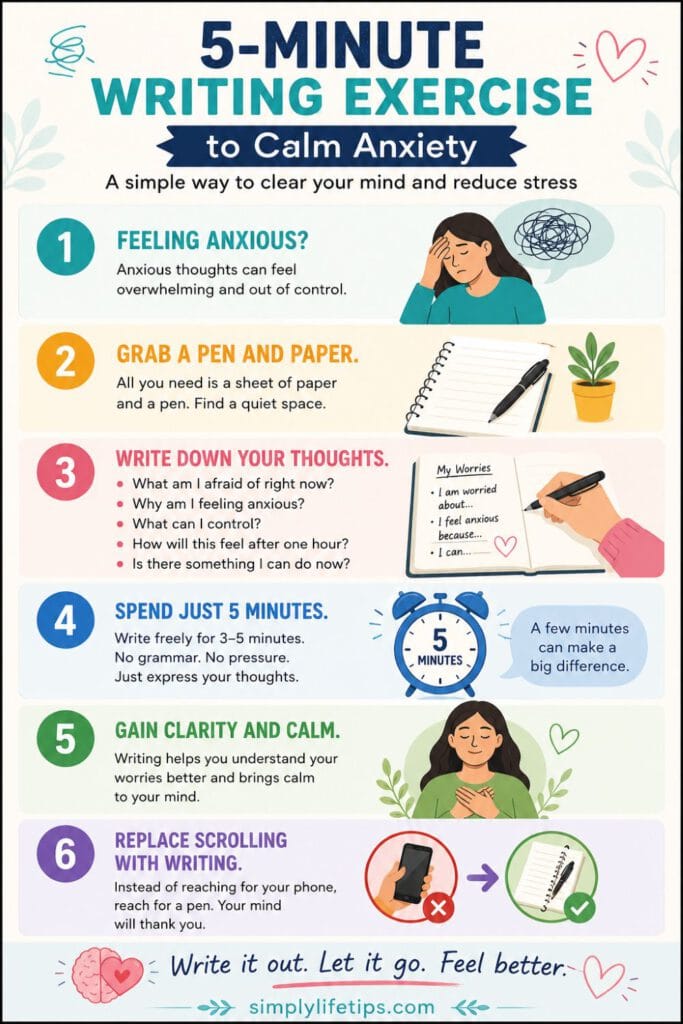
Save or share this infographic to remember the simple 5-minute writing exercise whenever anxiety or stress feels overwhelming.
This infographic shows a simple five-minute writing technique that can help reduce anxiety, organise thoughts, and improve mental clarity.
Quick Reference: Save or share this infographic to remember the simple 5-minute writing exercise whenever anxiety or stress feels overwhelming.
What Happens While You Write?
Many people notice that after just three to five minutes, their emotions begin to settle.
This happens because writing slows racing thoughts and engages the logical part of the brain.
Imagine a pot of boiling milk. As soon as the heat is turned off, the boiling gradually stops.
Similarly, when you stop feeding anxious thoughts and instead write them down, your mental agitation begins to calm naturally.
The Difference Between Writing and Overthinking
Overthinking keeps your brain trapped in a loop.
Writing breaks that loop.
Overthinking
Writing
Thoughts stay inside your head
Thoughts become visible
Anxiety grows
Anxiety often reduces
Hard to see solutions
Easier to identify solutions
Emotions dominate
Logic becomes stronger
Creates confusion
Creates clarity
Why Scrolling Your Phone Doesn’t Help?
Many people respond to stress by opening social media or endlessly scrolling through short videos.
While this may temporarily distract you, it rarely solves the problem.
In fact, excessive scrolling can:
Increase comparison with others
Add more information overload
Delay problem-solving
Make anxiety return even stronger
Writing, on the other hand, encourages reflection rather than distraction.
When to Use This Technique?
This exercise is especially helpful before:
Sleeping
Important meetings
Exams
Job interviews
Difficult conversations
Medical appointments
Major decisions
Even if your anxiety doesn’t disappear completely, you’ll often feel calmer and more prepared.
Make It a Daily Habit
You don’t have to wait until you’re overwhelmed.
Spending five minutes each evening writing about your day can help you:
Release emotional tension
Notice recurring worries
Appreciate positive moments
Build emotional resilience
Sleep more peacefully
When anxiety stems from misunderstandings in relationships, understanding the language of love can help improve communication and strengthen emotional connections.
Over time, you’ll begin recognising patterns in your thinking and responding more calmly to stressful situations.
If you often feel stuck or believe nothing you do will change your situation, learning how to overcome learned helplessness can help you regain confidence and take positive action.
Quote
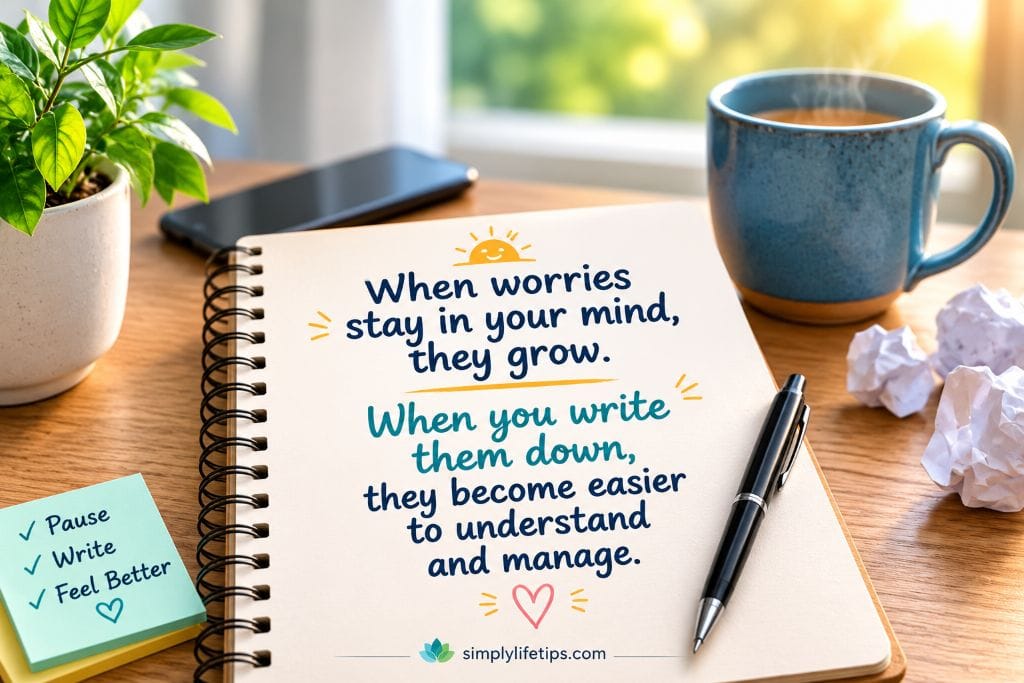
A simple reminder can make all the difference. Keep this quote in mind whenever anxiety starts to take over.
“When worries stay in your mind, they grow. When you write them down, they become easier to understand and manage.”
Writing your worries down can turn overwhelming thoughts into manageable solutions and bring peace to your mind.
Conclusion
Writing down worries is a simple habit that costs nothing but offers remarkable mental benefits. Instead of allowing anxious thoughts to remain trapped inside your mind, putting them on paper gives them structure, perspective, and clarity. The next time anxiety begins to overwhelm you, resist the urge to scroll through your phone. Pick up a pen instead. Just five minutes of honest writing may be enough to quiet your mind and help you see that many fears are smaller than they first appear.
FAQs
Does writing really reduce anxiety?
Yes. Research suggests that expressive writing can reduce stress, improve emotional regulation, and help organise overwhelming thoughts.
Should I write in a notebook or on loose paper?
Either works. The important part is expressing your thoughts honestly.
How long should I write?
Three to five minutes is often enough to experience a calming effect, although you can write longer if you wish.
Can I use this method every day?
Absolutely. Daily journaling can improve self-awareness and emotional well-being over time.
Should I write digitally or by hand?
Writing by hand is generally recommended because it slows your thinking and encourages deeper reflection, though digital writing can also be helpful.
Mathukutty P V is a Blogger, YouTuber, and Content Writer and the founder of Simply Life Tips. After taking voluntary retirement in 2017, he embraced a free lifestyle focused on learning, personal growth, and sharing practical wisdom to help others live with more purpose and positivity.