
How to improve brain health is a question worth asking long before memory problems become a concern. As we grow older, some changes in memory and thinking are natural, but aging does not automatically mean losing our ability to learn, remember, communicate, or live independently.
“Doctor, I am 60 now. Sometimes it takes me a little longer to remember something. Is this just because I am getting older?”
It is a question many people ask.
Perhaps you have experienced something similar. You walk into a room and suddenly cannot remember why you went there. You know someone’s name but need a few seconds before it comes back to you. You may occasionally forget where you placed your spectacles or keys.
These things can happen at any age and may become more noticeable as we get older.
But there is an important difference between occasional forgetfulness and memory or thinking problems that begin to interfere with everyday life.
The encouraging part is that there are things we can do to support brain health. Doctors have long advised us to exercise, eat well, sleep properly, control blood pressure and diabetes, avoid smoking, and stay socially active. Modern research continues to investigate how these everyday habits may influence cognitive health and the risk of cognitive decline.
The National Institute on Aging explains that brain health includes more than memory. It involves how well the brain supports thinking, learning, remembering, movement, senses, emotions, and our ability to interact with the world around us.
So, how can we take better care of our brains as we age?
9 Simple Habits for Better Brain Health
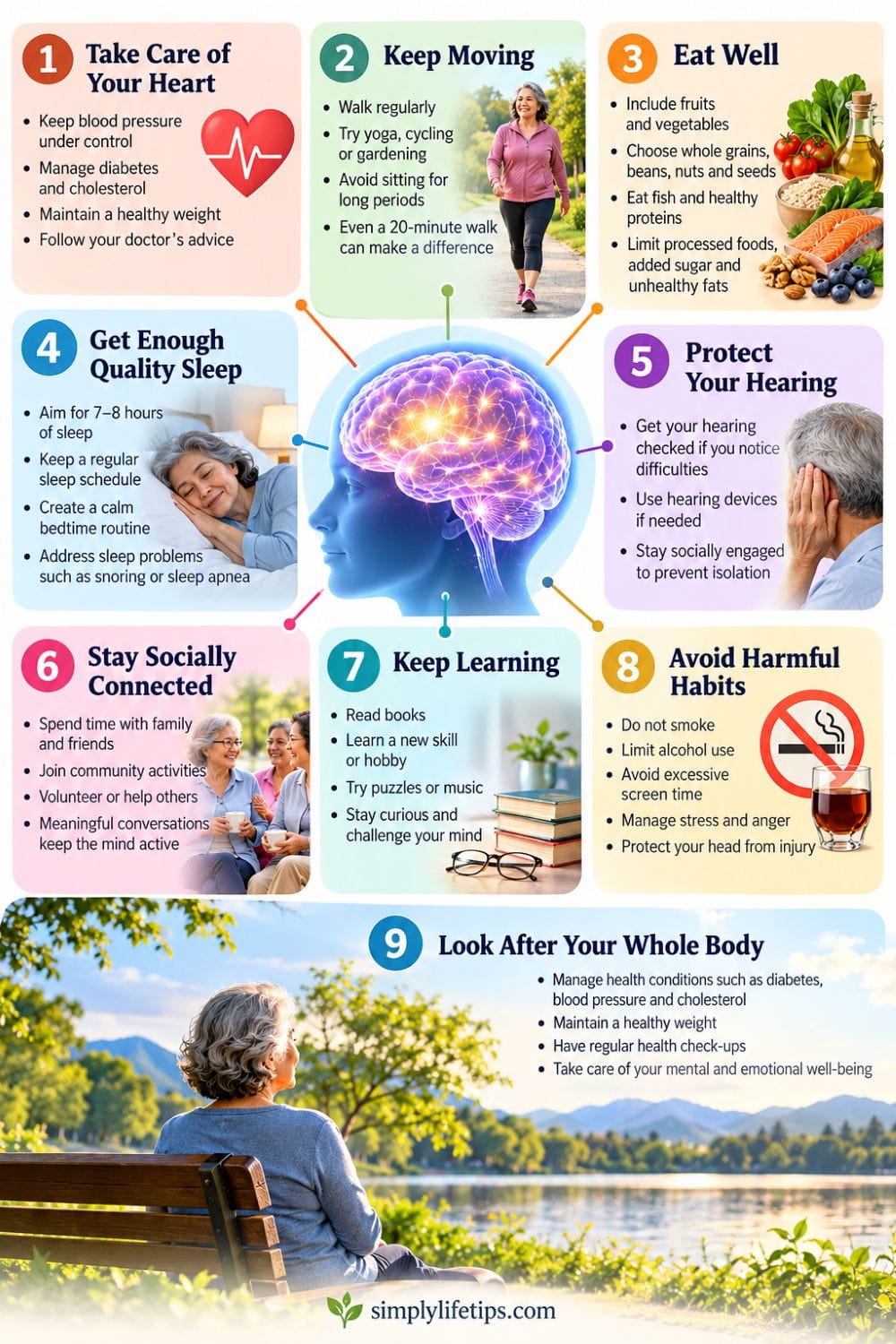
1. Take Care of Your Heart to Protect Your Brain
We often think of high blood pressure, diabetes, cholesterol, and obesity as problems for the heart. But the brain depends on a healthy blood supply too.
Years of poorly controlled high blood pressure can damage blood vessels. Diabetes and other cardiovascular risk factors can also affect blood-vessel health. These conditions are among the factors associated with a higher risk of cognitive decline and dementia. The World Health Organization recommends managing blood pressure, blood sugar, cholesterol, body weight, and other modifiable risk factors as part of reducing dementia risk.
Think about someone who has been told by their doctor for years, “Please control your blood pressure.” It may sound like routine advice. But that simple instruction can have implications far beyond the heart.
Checking your blood pressure, taking prescribed medication correctly, being physically active, eating a balanced diet, and attending regular medical check-ups are all practical ways of looking after your long-term health.
In other words, when you care for your cardiovascular health, you are also doing something important for your brain.
2. Keep Moving—Your Brain Benefits Too
“Walking is good for the legs, but what does it have to do with the brain?”
Quite a lot.
Regular physical activity supports cardiovascular health, improves sleep, and benefits mental and emotional well-being. Research also suggests that physical activity may help maintain some aspects of cognitive function. The National Institute on Aging notes that activities such as walking, cycling, dancing, swimming, and even gardening can contribute to healthy aging.
You do not necessarily need a sophisticated exercise program.
Imagine two people in their 60s. One spends most of the day sitting and rarely goes outside. The other takes a walk every morning, does some gardening, climbs a few stairs, and stays generally active throughout the day.
The second person is not necessarily “training their brain” directly, but they are doing something valuable for their overall health.
Even a 20-minute walk can be a practical starting point. You can read more about the benefits of a 20-minute walk and explore our article on exercise and brain health.
If you have a health condition or have been inactive for a long time, start gradually and ask your doctor what type and intensity of exercise are appropriate for you.
3. Eat Well Instead of Searching for a Miracle Food
The internet is full of claims about foods that supposedly “boost brain power.”
But brain health is not about finding one magical food.
A healthy eating pattern is much more sensible.
Vegetables, fruits, whole grains, beans, nuts, seeds, fish, and other nutritious foods can form part of a balanced diet. At the same time, reducing excessive amounts of highly processed foods, added sugar, salt, and unhealthy fats can support overall health.
The Alzheimer’s Association includes healthy eating among the everyday habits that can support brain health. It also cautions against assuming that supplements are a substitute for a healthy diet.
For example, instead of asking, “Which single food will improve my memory?” a better question is:
“What does my usual diet look like over an entire week?”
That change in thinking is important.
A breakfast of whole grains and fruit, vegetables included with lunch and dinner, sensible portions, and fewer highly processed snacks may be more meaningful than buying an expensive “memory supplement.”
You can also explore our guide to brain-healthy foods.
4. Give Your Brain Enough Good-Quality Sleep
Many people treat sleep as something they can sacrifice when life becomes busy.
“I will sleep properly after I finish this work.”
“I only need five hours.”
“I can catch up at the weekend.”
But sleep is not simply time when the brain switches off.
During sleep, important processes related to learning, memory, mood, and overall brain and body health take place. The National Institute on Aging notes that poor-quality sleep can affect thinking, learning, reaction time, and daily functioning.
Consider an ordinary example.
After a night of poor sleep, you may find yourself forgetting simple things, struggling to concentrate, becoming impatient, or making mistakes you normally would not make.
That does not necessarily mean your memory is deteriorating. You may simply be tired.
Try to maintain a regular sleep schedule, create a relaxing bedtime routine, and address persistent sleep problems rather than accepting them as an unavoidable part of aging.
If you snore heavily, stop breathing during sleep, wake repeatedly, or remain unusually sleepy during the day, discuss it with your doctor.
5. Do Not Ignore Hearing Loss
Hearing often receives less attention than blood pressure, blood sugar, or eyesight.
Someone may say, “I can hear well enough,” while gradually increasing the television volume and asking family members to repeat themselves.
Hearing loss is more than an inconvenience. The National Institute on Aging reports that hearing loss in older adults is associated with greater risk of cognitive decline and dementia. Hearing difficulties can also contribute to withdrawal and social isolation.
There is encouraging evidence here too. In the NIH-funded ACHIEVE trial, hearing intervention did not slow cognitive decline across the entire study population, but among participants at higher risk of dementia, those who received hearing aids had nearly a 50% lower rate of cognitive decline over three years compared with the health-education group. Researchers continue to study this relationship.
The practical lesson is simple: if you notice a hearing problem, do not ignore it.
A hearing test may be a small step, but it can make conversations, relationships, and everyday life easier.
6. Stay Connected With People
After retirement, children moving away, or the loss of close friends, life can gradually become quieter.
At first, staying home may feel comfortable. But over time, fewer conversations and less social activity can leave a person increasingly isolated.
Our brains are not designed to function completely apart from other people.
Talking with family, meeting friends, attending community activities, volunteering, joining a walking group, or learning something with others can provide mental and emotional stimulation.
The National Institute on Aging notes that loneliness and social isolation are associated with poorer health and higher risk of cognitive decline. Research is also exploring whether meaningful social engagement can help support cognitive health.
Consider an older person who begins each morning with a walk, stops to speak with neighbors, calls a child or friend, and attends a weekly community activity.
None of these activities look like a “brain exercise.”
Yet together, they keep the person moving, communicating, thinking, remembering, planning, and participating in life.
That matters.
7. Keep Learning Something New
The brain likes to be used.
You do not have to solve difficult mathematical problems every day. Learning a new recipe, reading about an unfamiliar subject, learning to use a smartphone feature, taking up gardening, learning an instrument, or trying a new hobby can provide mental stimulation.
Perhaps you have always wanted to learn basic photography. Or maybe you have never used a computer confidently and decide to learn.
The point is not to become an expert.
The point is to remain curious.
The Alzheimer’s Association recommends challenging the mind through activities such as learning new skills and doing something new.
This is also why I would not make Sudoku or crossword puzzles the centre of a brain-health plan.
A puzzle can be enjoyable and mentally stimulating. But brain health is much bigger than solving puzzles.
8. Avoid Habits That Work Against Brain Health
Some habits are easy to dismiss because their effects are not immediately visible.
Smoking is one example.
Another is spending most of the day sitting.
Another is repeatedly ignoring high blood pressure or diabetes because there are no obvious symptoms.
Harmful alcohol use, physical inactivity, smoking, poor diet, social isolation, and uncontrolled health conditions are among the modifiable factors associated with dementia risk. The WHO recommends addressing these factors as part of a broader approach to reducing the risk of cognitive decline and dementia.
Protecting your head is also important. Wearing a seat belt, using appropriate protective equipment, and taking steps to reduce falls can help prevent traumatic brain injuries.
You can read more about habits that can damage brain health.
The goal is not to live a perfect life.
It is to make better choices more consistently.
9. Look After Your Whole Body
One of the biggest lessons from modern brain-health research is that the brain cannot be separated completely from the rest of the body.
The WHO identifies physical inactivity, smoking, harmful alcohol use, unhealthy diet, high blood pressure, high blood sugar, obesity, hearing and vision loss, social isolation, poor sleep, and other factors as relevant to dementia risk.
This does not mean that following every healthy habit will guarantee that someone never develops dementia.
It does mean that there are areas of health we can influence.
That is an important distinction.
Genes, age, and some medical conditions are outside our control. But physical activity, smoking, diet, blood pressure management, sleep, social connection, and other lifestyle factors are areas where many of us can make changes.
Our article on how to protect your brain explores some of these practical steps in more detail.
Can Brain Games Alone Improve Brain Health?
This is where we need to be realistic.
Crosswords, Sudoku, chess, reading, learning a language, and other mentally stimulating activities can be enjoyable ways to keep the mind engaged. But no single activity should be treated as a guaranteed method of preventing dementia.
Researchers continue to study cognitive training, physical activity, diet, sleep, hearing, social engagement, and blood-pressure control. The evidence is strongest when we think about brain health as a combination of factors rather than searching for one magic solution.
For example, spending 20 minutes solving a puzzle after sitting for ten hours, eating poorly, sleeping badly, and never exercising is not a complete brain-health strategy.
A better approach is to combine mental stimulation with movement, healthy food, good sleep, social connection, and proper management of health conditions.
When Should You See a Doctor?
Some forgetfulness is common.
You may forget someone’s name and remember it ten minutes later. You may occasionally misplace your keys. You may walk into a room and briefly forget what you intended to do.
These experiences alone do not necessarily indicate a serious problem.
The concern is when memory or thinking problems become persistent or begin interfering with everyday life.
For example, repeatedly asking the same question, getting lost in a familiar neighborhood, struggling to manage money or medications, having noticeable difficulty finding words, or being unable to complete familiar tasks deserves medical attention.
Dementia is not a normal or inevitable part of aging. The WHO describes dementia as a condition that affects memory, thinking, and the ability to perform everyday activities.
If you or someone close to you notices a significant change in memory, thinking, behavior, or daily functioning, speak with a healthcare professional.
There may be many possible causes, and an appropriate evaluation can help identify what is happening.
Small Habits Can Make a Big Difference
We often imagine that improving brain health requires a dramatic lifestyle transformation.
It does not.
Start with something simple.
Can you take a walk today?
Can you choose a healthier meal?
Can you go to bed a little earlier?
Can you check your blood pressure?
Can you arrange that hearing test you have been postponing?
Can you call a friend?
Can you learn something you have always wanted to learn?
These may sound like small decisions.
But healthy aging is built from small decisions repeated over many years.
A doctor may tell us to walk more, eat better, control our blood pressure, sleep properly, and stay socially active. We may hear this advice so often that it begins to sound ordinary.
Yet research continues to show why these ordinary habits matter.
We cannot change our date of birth.
We cannot control every disease or every factor that affects the brain.
But we can influence many parts of the way we live.
And perhaps that is the most useful way to think about brain health.
Not as a race to keep ourselves “young,” but as an effort to remain as healthy, independent, connected, and mentally active as possible for as long as we can.
Life is not only about how many years we live.
It is also about how many of those years we can spend thinking clearly, remembering the people we love, making our own decisions, enjoying meaningful relationships, and taking part in everyday life.
Taking care of your brain is part of taking care of your life.
Conclusion
Learning how to improve brain health is not about finding one miracle food, one special exercise, or one perfect routine. It is about the small choices we make repeatedly throughout life.
Many of us have heard doctors advise us to walk regularly, eat a balanced diet, sleep well, control blood pressure and diabetes, avoid smoking, stay socially connected, and keep our minds active. These may sound like ordinary pieces of advice, but they can become powerful habits when we follow them consistently.
Think about someone who starts the day with a walk, eats a sensible breakfast, takes prescribed medicines regularly, spends time with family, learns something new, and goes to bed at a reasonable time. None of these actions seems extraordinary. Together, however, they represent a lifestyle that supports healthy aging.
We cannot stop getting older. We cannot control every factor that influences our brain. But we can take better care of the things that are within our control.
So perhaps the question is not simply, “How old is my brain?”
A better question may be:
“What am I doing today to give my brain the best chance of staying healthy tomorrow?”
Start small. Take the walk. Get the health check. Eat the healthier meal. Protect your hearing. Call a friend. Learn something new. Get enough sleep.
Small habits may not change everything overnight, but they can shape the way we age over many years.
Because living longer is important—but being able to think, remember, connect with others, make our own choices, and enjoy life along the way matters just as much.
Taking care of your brain is ultimately taking care of the life you want to keep living.
Frequently Asked Questions
What is the best way to improve brain health?
There is no single best method. Regular physical activity, a balanced diet, good-quality sleep, social connection, mental stimulation, and management of conditions such as high blood pressure and diabetes can all support brain health.
Can walking improve brain health?
Walking is a practical form of physical activity that supports cardiovascular health, sleep, mood, and some aspects of cognitive function. Even if you start with a short daily walk, consistency matters.
Can brain games prevent dementia?
Brain games can provide mental stimulation, but they should not be considered a guaranteed way to prevent dementia. A broader healthy lifestyle is more important.
Is forgetfulness a normal part of aging?
Some minor memory changes can occur with normal aging. However, memory problems that interfere with everyday activities are not something to simply dismiss as getting older. They should be discussed with a healthcare professional.
Can healthy habits prevent dementia?
Healthy habits may reduce the risk of cognitive decline and dementia, but they cannot guarantee prevention. Age, genetics, medical conditions, and other factors also influence dementia risk.
Sources and Further Reading
For readers who want to explore the evidence further, the National Institute on Aging, World Health Organization, and Alzheimer’s Association provide detailed information on brain health, healthy aging, and dementia risk reduction.

Mathukutty P V is a Blogger, YouTuber, and Content Writer and the founder of Simply Life Tips. After taking voluntary retirement in 2017, he embraced a free lifestyle focused on learning, personal growth, and sharing practical wisdom to help others live with more purpose and positivity.