
The benefits of a 20-minute walk go beyond simply adding more steps to your day. A short walk can give you a reason to leave your desk, move your body, change your surroundings, and return to work with a different mindset.
For people who spend much of the day sitting at a computer, the benefits of a 20-minute walk include a practical break from a mentally demanding routine.
The idea has also attracted attention from executive-health physician Andre Heeg, MD, who recently highlighted the potential value of a 20-minute walk as a reset during a demanding workday.
But what does science actually tell us about walking, brain health, focus, mood, and physical health?
And can a short walk really make a difference?
Why a 20-Minute Walk Can Be a Useful Break
Modern work often involves long periods of sitting, screen exposure, meetings, notifications, and sustained concentration.
When concentration starts to fade in the afternoon, many people respond by doing more of the same.
They open another email.
Make another cup of coffee.
Check another notification.
Or simply stare at the screen and try to force themselves to continue.
A short walk offers a different approach.
Instead of trying to produce more while feeling mentally tired, you temporarily step away from the task.
You move.
You change your surroundings.
And then you return.
That doesn’t mean a 20-minute walk is a magic treatment for mental fatigue. But it can become a simple way of incorporating physical activity and a meaningful break into an otherwise sedentary day.
10 Benefits of a 20-Minute Walk
1. A 20-Minute Walk Supports Physical Activity
Walking is one of the simplest ways to become more physically active.
The World Health Organization recommends that adults accumulate 150 to 300 minutes of moderate-intensity aerobic physical activity each week, or an equivalent amount of vigorous activity. Walking can contribute to that total, depending on its intensity.
A 20-minute walk every day would add up to 140 minutes a week.
That means one short daily walk gets you remarkably close to the lower end of the weekly recommendation.
You don’t have to complete all your activity in one long workout.
A walk before work, during lunch, or in the afternoon can become part of your overall weekly movement.
The World Health Organization recommends that adults aim for 150–300 minutes of moderate-intensity aerobic physical activity each week, making a 20-minute daily walk a practical way to work toward that goal.
2. A Walk Can Give Your Mind a Change of Pace
One reason a short walk can feel refreshing is that it changes what you are doing.
Consider an afternoon when you have spent three hours switching between spreadsheets, emails, video meetings, and browser tabs.
Your body may barely have moved.
Your eyes have remained focused on a screen.
Your attention has been repeatedly redirected.
Instead of continuing to force concentration, you can step outside for 20 minutes.
The walk creates a natural boundary between one period of work and the next.
When you return, the work itself has not changed.
But your relationship with the task may have.
3. Walking and Brain Health
Physical activity is increasingly studied in relation to cognitive health.
A large 2024 systematic review and meta-analysis found that physical activity was associated with better late-life cognition, although the association was weak and the researchers did not find a clear dose-response relationship. The findings included associations with episodic memory and verbal fluency.
That distinction matters.
It would be misleading to say that one 20-minute walk will improve your memory or prevent dementia.
The stronger evidence concerns physical activity as part of a broader lifestyle over time.
A 2024 systematic review and meta-analysis also examined the relationship between physical activity and cognitive decline in older adults, highlighting the importance of considering study design and potential reverse-causation bias when interpreting the evidence.
In other words, the benefits of a 20-minute walk are not necessarily about producing a dramatic immediate transformation.
It is that small amounts of movement can contribute to a more active lifestyle.
4. Walking May Support Focus and Cognitive Performance
The benefits of a 20-minute walk may also include support for attention when concentration begins to deteriorate.
Research examining short periods of walking has found effects on some measures of cognitive performance, although results vary according to the population, exercise intensity, duration, and cognitive task.
One study comparing 10-, 20-, and 30-minute walking sessions with sitting found improvements in selected cognitive measures after walking. In the 20-minute group, processing speed was significantly faster after walking than after sitting.
That doesn’t mean walking will automatically make every person more productive.
It does suggest that replacing a period of sitting with movement can be worth considering when your concentration is fading.
Research examining short bouts of physical activity and cognitive performance suggests that even a single session can influence some aspects of cognitive performance, although the effects vary across studies and tasks.
5. Walking Can Support Your Mood
Mental fatigue isn’t only about concentration.
A difficult meeting, stressful phone call, approaching deadline, or long list of unfinished tasks can affect how you feel as well as how you work.
Regular physical activity is associated with better mental well-being, and the WHO notes that physical activity can reduce symptoms of depression and anxiety and enhance overall well-being.
A walk also creates a temporary psychological separation from whatever was frustrating you.
You may leave your desk thinking about a difficult conversation.
Twenty minutes later, you return with a little more distance from it.
The problem may still be there.
But you may be ready to approach it differently.

6. A 20-Minute Walk Helps Break Up Sitting Time
A desk job can make prolonged sitting feel normal.
You sit while working.
You sit during meetings.
You sit while travelling.
And you may sit again when you get home.
A 20-minute walk interrupts that pattern.
This is important because sedentary behavior and physical inactivity are not the same thing. Someone can exercise regularly and still spend many hours sitting.
Research has found associations between high sedentary time and dementia risk, although observational research cannot establish that sitting itself directly causes dementia.
The practical lesson is simpler:
If you have been sitting for hours, getting up and moving is preferable to continuing to sit indefinitely.
7. Walking May Contribute to Long-Term Brain Health
The relationship between physical activity and dementia is more complicated than many social-media posts suggest.
Large observational studies and meta-analyses have found associations between higher physical activity and lower dementia risk.
One 2022 meta-analysis of prospective studies found physical activity was associated with lower incidence of all-cause dementia and Alzheimer’s disease.
More recent research continues to examine how the type, amount, and context of physical activity affect dementia risk.
However, these findings should not be turned into a claim that a particular 20-minute walk reduces dementia risk by a specific percentage.
The better conclusion is that regular physical activity is one of several modifiable lifestyle factors associated with brain health.
A 20-minute walk can be one small, realistic way to become more active.
Research has found an association between regular physical activity and dementia risk and Alzheimer’s disease, although this evidence does not establish that a specific 20-minute walk produces a particular percentage reduction in risk.

8. It Can Support Cardiovascular Health Too
Your brain is not the only organ that benefits from an active lifestyle.
Physical activity supports cardiovascular health and can help reduce the risk of several chronic conditions.
Walking is particularly accessible because it doesn’t necessarily require a gym, specialized equipment, or an elaborate exercise program.
The intensity matters, though.
A stroll and a brisk walk are not physiologically identical.
If your health allows it, walking at a pace that raises your breathing and heart rate moderately can help you accumulate moderate-intensity physical activity.
9. A 20-Minute Walk Can Fit Into a Busy Workday
One of the biggest advantages of a 20-minute walk is practicality.
You don’t necessarily need to reorganize your entire day.
You could walk:
- Before starting work
- After lunch
- Between meetings
- During a suitable phone call
- After completing a demanding task
- When your concentration begins to decline
- On the way to or from part of your daily routine
The best walking time is often the time you can repeat consistently.
10. What If You Don’t Have 20 Minutes?
Don’t let the number become a barrier.
Twenty minutes is a useful target, not a magical threshold.
If you have only 10 minutes, walk for 10.
If you have five minutes, move for five.
WHO specifically emphasizes that some physical activity is better than none and recommends that inactive people begin with smaller amounts and gradually increase duration, frequency, and intensity.
A few minutes today can be more useful than an ambitious exercise plan that never becomes a habit.
Benefits of a 20-Minute Walk: How to Make a Daily Habit
The easiest way to make walking consistent is to attach it to something you already do.
Walk after lunch
Instead of returning directly to your desk, take a 20-minute walk first.
Walk when your concentration drops
If you notice yourself rereading the same sentence or switching between tabs without accomplishing anything, use that moment as a cue to move.
Walk after a stressful meeting
Give yourself a transition period before moving on to the next task.
Walk without your phone when possible
A walk can become another screen-based activity if you spend the entire time scrolling.
Let your eyes and attention experience something different.
Start with a realistic routine
You don’t need to promise yourself that you’ll walk every day for the rest of your life.
Start with a routine you can actually maintain.
Consistency matters more than making the first week unnecessarily difficult.
A 20-Minute Walk Can “Reset” Your Brain
This is where it is important to separate an appealing social-media message from established science.
A walk can provide movement, a change of environment, and a break from prolonged sitting. Research also suggests that acute physical activity can influence some aspects of cognitive performance.
But there is no scientific basis for saying that every person’s brain literally “resets” after exactly 20 minutes of walking.
There is also no good reason to assume that everyone will experience the same effect.
The practical value of the idea is simpler:
When your mind feels stuck, changing what your body is doing may be more useful than continuing to force the same task.
How Much Walking Do You Need?
There is no universal requirement that everyone must walk for exactly 20 minutes.
The broader recommendation for adults is to accumulate 150 to 300 minutes of moderate-intensity aerobic physical activity each week, together with muscle-strengthening activities on at least two days a week.
A 20-minute daily walk would provide 140 minutes a week.
Add another 10 minutes of walking on some days, or combine walking with other forms of physical activity, and you can move closer to the recommended weekly amount.
Your personal needs may differ depending on age, fitness, medical conditions, mobility, and other factors.
The Bigger Lesson About Walking
The most useful lesson may not be about 20 minutes at all.
It is about recognizing that productivity does not always come from remaining at your desk.
Sometimes you need to stop.
Move.
Breathe.
Look somewhere other than a screen.
Then return to the work.
A 20-minute walk won’t solve every productivity problem.
It won’t replace sleep, a healthy diet, proper medical care, or a sustainable workload.
But it is simple enough to try and practical enough to become a habit.
And unlike many productivity strategies, it doesn’t require another app, subscription, or complicated system.
You just have to get up and walk.
If you want to explore the broader health effects of making walking part of your daily routine, read our guide to what happens to your body when you walk every day.
A 20-minute walk is simple, accessible, and easy to fit into a busy day. While its effects can vary from person to person, regular walking can contribute to several aspects of physical and mental well-being. Here are some of the potential benefits to keep in mind.
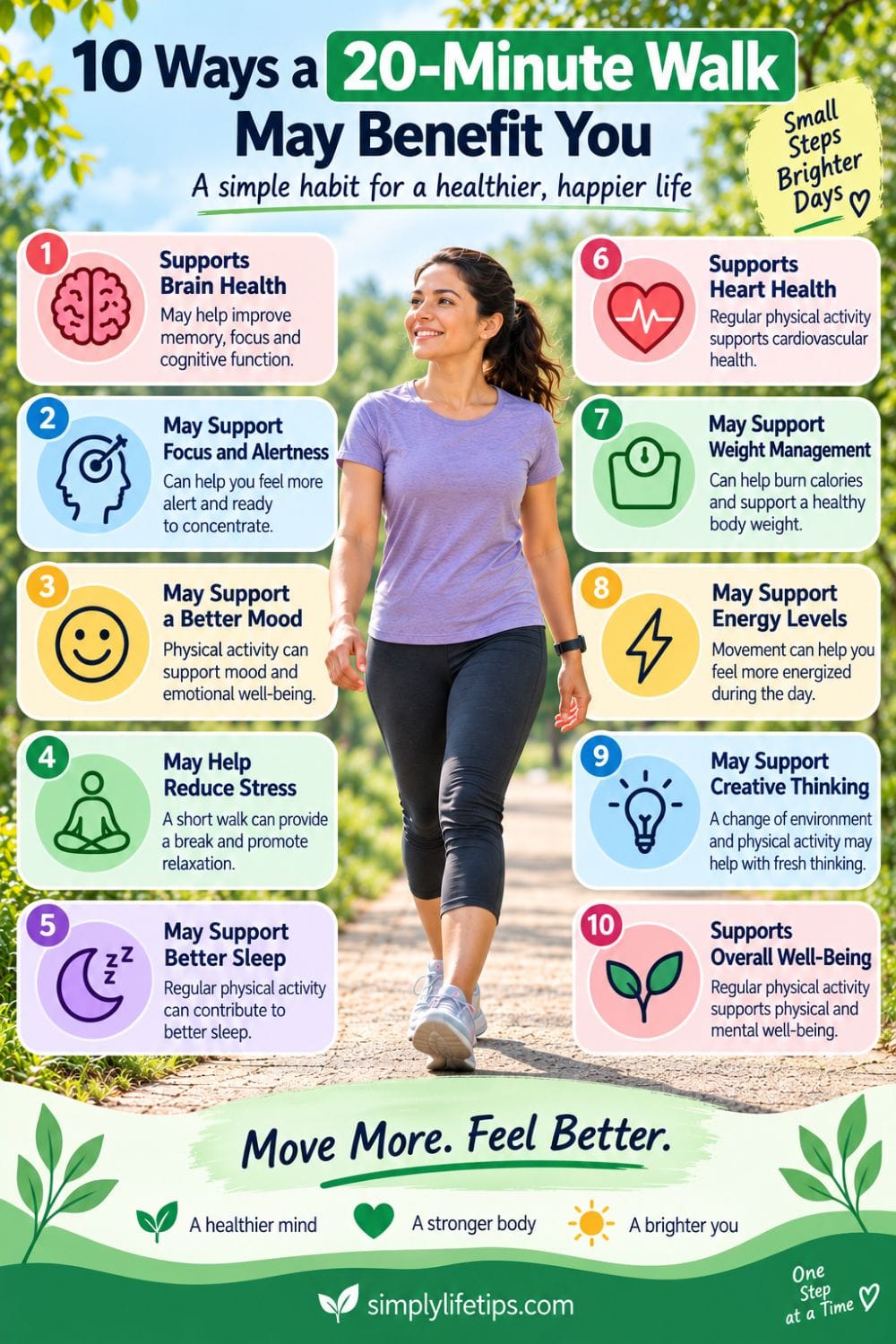
These benefits do not mean that every 20-minute walk will produce all of these effects. The strongest evidence relates to regular physical activity and walking as part of an active lifestyle. The important point is that a short walk can be a practical step toward moving more and sitting less.
Conclusion
The benefits of a 20-minute walk extend beyond the number of steps on your fitness tracker.
A short walk can help you accumulate physical activity, interrupt prolonged sitting, support cardiovascular health, provide a mental break, and potentially support aspects of cognitive performance and well-being.
The strongest evidence concerns regular physical activity rather than one specific 20-minute session.
So don’t think of the walk as something you have to earn after finishing your work.
Think of it as part of a healthier way to work.
The next time your afternoon concentration disappears, try something simple.
Close the laptop.
Put on your shoes.
Walk for 20 minutes.
Then come back and continue.
Sometimes, the break isn’t taking you away from the work.
It may be helping you return to it.
FAQs about Benefits of a 20-minute walk
Is a 20-minute walk good for your health?
Yes. A 20-minute walk contributes to your overall physical activity and can be part of a healthy routine. The benefits depend partly on walking intensity and how much other physical activity you do.
Can a 20-minute walk improve focus?
A short walk can provide a break from prolonged sitting and demanding mental work. Research suggests that short bouts of physical activity can influence some aspects of cognitive performance, although the effects vary between people and tasks.
Can walking reduce dementia risk?
Regular physical activity is associated with a lower risk of dementia in observational research. However, it is not accurate to claim that one 20-minute walk produces a specific reduction in dementia risk.
Is walking for 20 minutes a day enough exercise?
Twenty minutes a day equals 140 minutes per week. For adults, WHO recommends 150–300 minutes of moderate-intensity aerobic physical activity per week, plus muscle-strengthening activity on at least two days. A 20-minute daily walk can therefore make a meaningful contribution toward the weekly target.
Should I walk in the morning or afternoon?
There is no single best time for everyone. An afternoon walk can be particularly useful if you experience a drop in concentration after several hours of work. The most useful time is one that fits your routine and that you can maintain consistently.
Source/inspiration: Andre Heeg, MD’s LinkedIn post. Original LinkedIn post

Mathukutty P. V. is the founder of Simply Life Tips. He shares practical advice and useful insights on personal growth, health, well-being, technology, and everyday living. His goal is to help readers build positive habits and make informed decisions. He believes in continuous learning and sharing knowledge to help people live healthier, happier, and more meaningful lives.