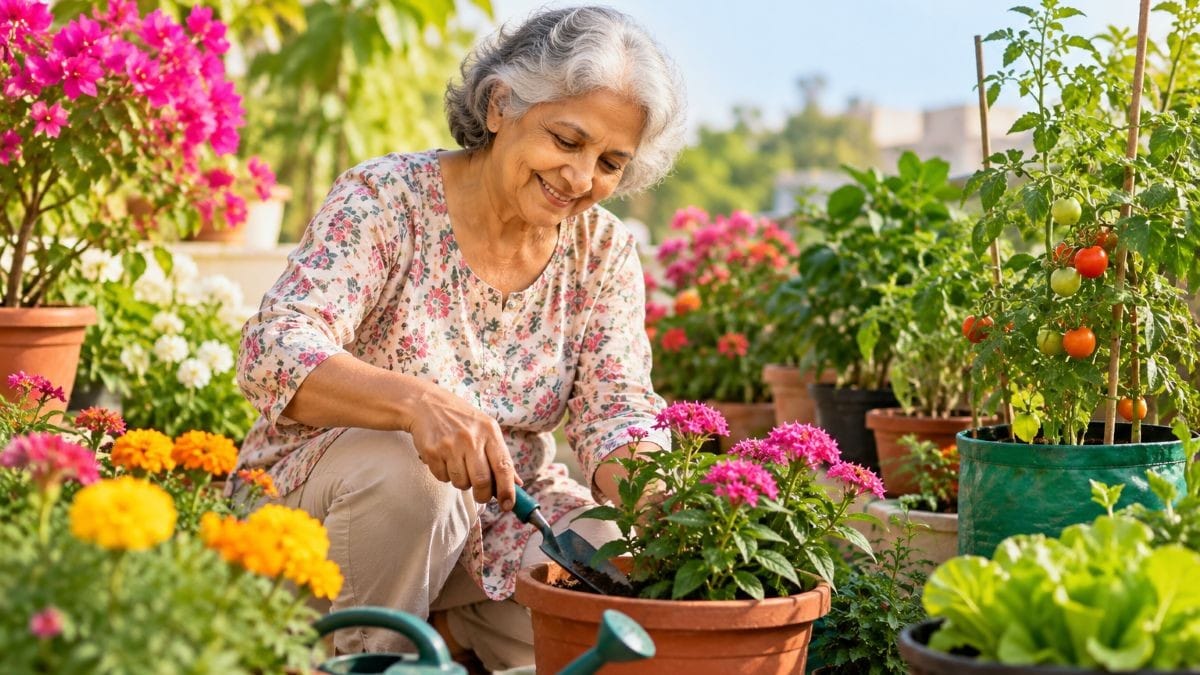
Gardening for seniors can be much more than a pleasant hobby. It can be a simple way to stay physically active, spend time outdoors, care for something living, and enjoy the small moments of happiness that come from watching a plant grow and flower.
I am 65, and I maintain flowers in pots and whatever small spaces I have available. I also grow a few vegetables in pots and grow bags. My garden is not large, but it gives me a reason to move, spend time outdoors, and stay engaged with something meaningful.
Research on horticultural therapy and gardening in older adults suggests potential benefits for physical function and psychological well-being. A 2024 systematic review and meta-analysis of 27 studies involving 1,629 older adults found potential improvements in areas such as aerobic endurance, agility, self-efficacy, and self-esteem, although the researchers emphasized that the certainty of the evidence was very low and that more rigorous studies are needed.
Earlier research has also reported potential benefits for physical function, quality of life, and mood among older adults participating in horticultural therapy. These findings suggest that gardening can be a valuable addition to an active and meaningful lifestyle as we grow older, without presenting it as a substitute for medical care or a guaranteed way to prevent disease.
Why Gardening for Seniors Supports Healthy Aging
Healthy aging is not simply about avoiding disease. It is also about maintaining independence, staying active, having interests, connecting with the world around us, and finding enjoyment in everyday life.
Gardening can bring several of these elements together in one simple activity.
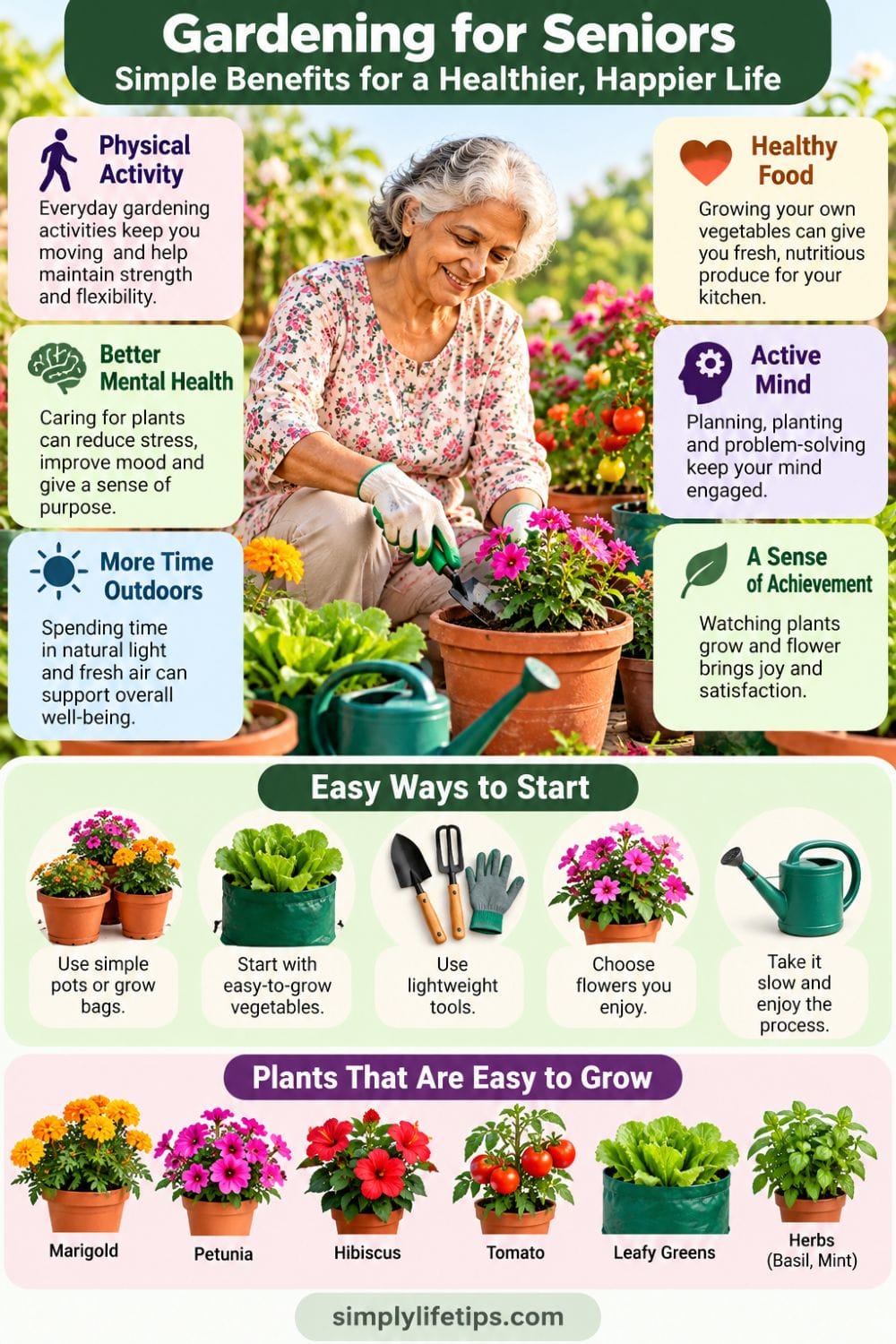
1. Gardening Keeps You Moving
Gardening may not feel like a formal workout, but many gardening activities involve continuous low- to moderate-intensity movement.
Depending on the task, gardening can involve:
- Walking around plants
- Bending and straightening
- Squatting or kneeling
- Digging and loosening soil
- Carrying small containers
- Watering plants
- Removing weeds
- Pruning and trimming
- Moving pots
- Reaching and stretching
A review of research involving older adults found that many gardening activities fall into the low-to-moderate intensity range of physical activity.
For gardening for seniors, these everyday movements can become a practical way to stay active without relying entirely on formal exercise.
This is particularly useful because movement does not always have to happen in a gym. An activity that has a practical purpose can sometimes feel easier to maintain as part of everyday life.
For older adults, however, gardening should be adapted to individual ability. Heavy pots, prolonged kneeling, awkward bending, or lifting beyond your capacity can cause injury. A raised container, lightweight pot, suitable gardening tools, or a comfortable chair can make the activity safer.
2. Gardening Gives You a Reason to Get Up
One of gardening’s simplest benefits is that plants need attention.
You may wake up and wonder:
Did the new flower open?
Does this plant need water?
Are there any dry leaves to remove?
Has a new bud appeared?
That small responsibility can turn an ordinary morning into something to look forward to.
This is one reason I enjoy maintaining plants myself. Seeing a plant grow from a small shoot into a healthy plant—and eventually seeing it produce beautiful flowers—creates a quiet sense of satisfaction.
Gardening is not only about producing something. It is also about observing the process.
3. Flowers Can Lift Your Mood
A simple happiness comes from seeing a plant respond to your care. A new leaf, a flower bud, or the first bloom after days of waiting can make an ordinary day feel a little brighter.
For me, this is one of the most enjoyable parts of gardening. I may go outside simply to water the plants, but I often end up spending a few extra minutes looking at them. When a flower opens, it feels like a small reward for the attention and care I have given the plant.
This does not mean that gardening can replace professional treatment for depression, anxiety, or other mental health conditions. But having something positive to care for and something beautiful to look forward to can add enjoyment and meaning to everyday life.
4. Gardening Gets You Outdoors
A small garden does not require a large yard.
You can grow plants on:
- A balcony
- A terrace
- A windowsill
- A small courtyard
- A doorstep
- A few containers beside your home
Even container gardening can give seniors a reason to step outside and interact with natural surroundings.
Research on residential green space and healthy aging has examined outcomes including mental health, cognitive function, physical capability, cardiometabolic health, and perceived well-being. The evidence is encouraging, although the quality and design of individual studies vary.
For many older adults, the important thing may simply be making nature part of everyday life rather than treating it as something that requires a special trip.
5. Gardening Can Support Healthy Eating
If you grow vegetables, herbs, or fruits, you have another reason to pay attention to what you eat.
Growing even a small amount of food can make fresh produce more visible and accessible in everyday life. Herbs such as mint, coriander, curry leaves, or other locally suitable plants can be grown in containers without requiring a large garden.
Gardening should not replace a balanced diet, but growing some of your own food can complement healthy eating habits.
Healthy aging is built from many small habits rather than one magic solution. You can explore more ideas in my article on small habits that support healthy aging.
6. Gardening Keeps the Mind Engaged
Gardening is also a form of gentle mental activity.
You have to notice what each plant needs. Some plants require more sunlight. Others need shade. Some need frequent watering, while others do better when the soil dries slightly between watering.
You learn from experience.
You observe.
You remember.
You adjust.
That ongoing attention gives the mind something meaningful to engage with.
Research on horticultural therapy in older adults has reported potential benefits involving psychosocial outcomes and physical functioning, although researchers caution that the certainty of evidence varies and stronger studies are still needed.
7. Gardening Can Reduce the Amount of Time Spent Sitting
Long periods of sitting can easily become part of daily life after retirement.
There is nothing wrong with resting. Rest is important, especially when you are tired or recovering from illness. The problem is remaining inactive for most of the day.
Gardening creates natural opportunities to interrupt sitting.
You might sit for a while, then get up to water the plants. Later, you may walk outside to check a flower or remove a few dry leaves.
These small movements add up across the day.
My own experience is simple: when I have plants to care for, I have a reason to get up and move instead of remaining seated for long periods.
For more ideas about maintaining an active and meaningful lifestyle after 60, see Life After 60.
8. Gardening Can Bring a Sense of Purpose
Purpose does not have to come from a job or a major achievement.
It can come from small responsibilities.
A plant depends on you for water and care. You notice when something is wrong. You take action. You watch the result.
That may sound simple, but meaningful daily activities can become particularly valuable when routines change after retirement.
A garden gives you something to nurture.
And sometimes, that is enough.
9. Gardening Can Be a Peaceful Break From Everyday Stress
Gardening allows you to step away from screens, household routines, and constant information.
Instead of looking at a phone, you may spend ten minutes looking at a flower.
Instead of sitting indoors, you may walk around your plants.
Instead of rushing, you may slow down and concentrate on one small task.
Research on gardening and horticultural therapy has reported positive effects on well-being and quality of life, although gardening should be viewed as one component of a healthy lifestyle rather than a substitute for medical care.
If you are interested in other simple habits that can make daily life healthier and more enjoyable, you may also like my article on a healthy morning routine for seniors.
10. You Do Not Need a Big Garden
Perhaps the biggest misconception about gardening for seniors is that you need a large garden.
You do not.
A few pots are enough.
One flowering plant is enough.
Even a small collection of herbs can give you something to care for.
For someone living in an apartment, container gardening can be particularly practical. Choose lightweight pots, place them where they receive appropriate sunlight, and keep frequently used plants at a comfortable height.
The goal is not to create a professional garden.
The goal is to create an enjoyable activity that fits your health, space, and lifestyle.
How to Make Gardening Safer After 60
Gardening is beneficial only when it is appropriate for your physical condition. There is no need to turn a relaxing activity into strenuous work.
A few simple precautions can help.
Start slowly
If you have not been physically active for a while, begin with short gardening sessions rather than spending hours working at once.
Avoid unnecessary heavy lifting
Use smaller containers or ask for help with heavy pots and bags of soil.
Protect your back
Avoid repeatedly bending from the waist. Where possible, use raised containers or work at a comfortable height.
Take breaks
Stop when you feel tired. Drink enough water, particularly in hot weather.
Protect yourself from the sun
A hat, suitable clothing, shade, and appropriate sun protection can make outdoor gardening more comfortable.
Listen to your body
Pain, dizziness, unusual breathlessness, chest discomfort, or other concerning symptoms should not be ignored. Stop the activity and seek appropriate medical advice.
And if your doctor has given you specific restrictions or exercise recommendations, follow those rather than assuming that gardening is automatically safe for you.
You Do Not Need to Garden Alone
Gardening can also become a social activity.
You can exchange cuttings with friends, give flowers to neighbors, discuss plants with family members, or help grandchildren learn how plants grow.
For older adults who experience loneliness, activities that create opportunities for connection can be particularly meaningful.
Gardening itself is not a guaranteed solution to loneliness, but it can provide a shared interest and a reason to interact with other people.
If loneliness has become part of your life, you may also want to read Loneliness in Old Age: The Silent Struggle.
My Small Garden, My Simple Exercise
At 65, I do not need a large garden to enjoy the benefits of gardening. I maintain flowers in pots and use the small spaces available to me. I also grow a few vegetables in pots and grow bags, which gives me the added satisfaction of having fresh vegetables available for my kitchen. Growing some of my own vegetables also allows me to have produce that I know has been grown with care, without depending entirely on vegetables bought from the market.
Gardening gives me regular movement, but that is only part of the story. When I water the plants, remove dry leaves, add soil, or tend to the vegetables, I am naturally moving my body instead of sitting idle. Rearranging a pot or walking around to check the plants gives me another reason to stand and move. These may seem like small activities, but they become part of my everyday routine.
The emotional benefit is just as important. When I see a new leaf or a flower bud appearing, it makes me happy. When a flower finally opens after days of waiting, there is a genuine sense of satisfaction. Watching vegetables grow from small plants to something that can be harvested for the kitchen brings another kind of reward.
Looking at my plants growing day after day also reminds me that life continues to change and grow. Gardening gives me something to care for, something to look forward to, and a simple reason to spend time outdoors. That connection with plants may be difficult to measure, but for me, it is an important part of why gardening has become such a meaningful habit.
Gardening Is a Small Habit With Many Benefits
Gardening for seniors should not be viewed as a miracle cure or a guaranteed way to live longer. The research is more nuanced than that.
But the evidence does suggest that gardening and horticultural activities can contribute to physical activity, psychological well-being, quality of life, and healthy aging.
And perhaps its greatest strength is that it does not feel like a medical intervention.
You are simply caring for plants.
You are moving your body.
You are spending time outdoors.
You are observing nature.
You are creating something beautiful.
You are giving yourself a reason to get up and do something.
That is why I believe gardening is particularly valuable as we grow older.
You do not need acres of land. You do not need expensive equipment. You do not even need a traditional garden.
Start with one pot.
Plant something you like.
Water it.
Watch it grow.
And when the first flower appears, take a moment to enjoy it.
Sometimes, healthy aging is not about doing something extraordinary. It is about finding small, meaningful activities that make you want to get up tomorrow.
Conclusion
Gardening for seniors is a simple activity that can bring together movement, fresh air, mental stimulation, healthy food, and enjoyment. You do not need a large garden or complicated equipment. A few pots of flowers or vegetables can be enough to encourage you to get up, move around, spend time outdoors, and care for something living.
At 65, I have found that gardening gives me much more than exercise. Seeing a new leaf, watching a flower open, or harvesting a few vegetables from my own pots and grow bags brings genuine happiness and satisfaction. These small moments may seem ordinary, but they can add meaning and enjoyment to everyday life.
Gardening for seniors does not require a large garden.
Healthy aging is not about following one perfect routine. It is about building simple habits that keep us active, engaged, and interested in life. For me, gardening is one of those habits—and even a small space can be enough to start.
Frequently Asked Questions
Is gardening good for seniors?
Gardening can be a useful form of low- to moderate-intensity physical activity and may support physical function, mood, quality of life, and well-being in older adults. The activity should be adapted to individual abilities and health conditions.
Can gardening count as exercise for older adults?
Many gardening activities involve walking, bending, reaching, lifting, digging, and other movements. Research has classified many gardening tasks as low- to moderate-intensity physical activity. However, gardening should complement rather than automatically replace a balanced exercise program.
Do seniors need a large garden?
No. Container gardening can work well in balconies, terraces, courtyards, windowsills, and other small spaces. A few pots can provide meaningful activity and enjoyment.
Can gardening improve mood?
Research on horticultural therapy and gardening has found associations with improved mood and psychological well-being in older adults. However, gardening should not be considered a replacement for professional treatment when someone has depression, anxiety, or another mental health condition.
How can seniors garden safely?
Start with short sessions, avoid heavy lifting, use comfortable working heights, stay hydrated, protect yourself from excessive sun, and take regular breaks. Anyone with medical restrictions should follow their healthcare professional’s advice.

Mathukutty P V is a Blogger, YouTuber, and Content Writer and the founder of Simply Life Tips. After taking voluntary retirement in 2017, he embraced a free lifestyle focused on learning, personal growth, and sharing practical wisdom to help others live with more purpose and positivity.