
How to protect your brain is a question worth asking long before a neurological problem appears. Your brain allows you to think, learn, remember, communicate, move, make decisions, experience emotions, and connect with other people.
We often pay attention to our heart, blood pressure, weight, and physical fitness. But the brain deserves the same daily attention.
The good news is that protecting your brain does not require complicated routines or expensive treatments. Many of the same habits that support overall health can also support brain health. Current guidance from the World Health Organization emphasizes a life-course approach to reducing the risk of cognitive decline and dementia by addressing multiple modifiable risk factors.
Research and clinical guidance also highlight practical areas such as physical activity, management of chronic health conditions, sleep, social engagement, and injury prevention.
Learning how to protect your brain is not about making one dramatic lifestyle change. It is about building several healthy habits that you can maintain over time.
Inspired by Dr. Arun Oommen
This article was inspired by a Facebook post shared by Dr. Arun Oommen, Neurosurgeon, about the simple everyday steps we can take to protect our brain.
The following article presents these ideas in English, with additional explanation and supporting references, for readers of Simply Life Tips.
How to Protect Your Brain Every Day
How to protect your brain starts with small habits practiced consistently. The infographic below summarizes 10 simple steps to support brain health and build a healthier daily routine.
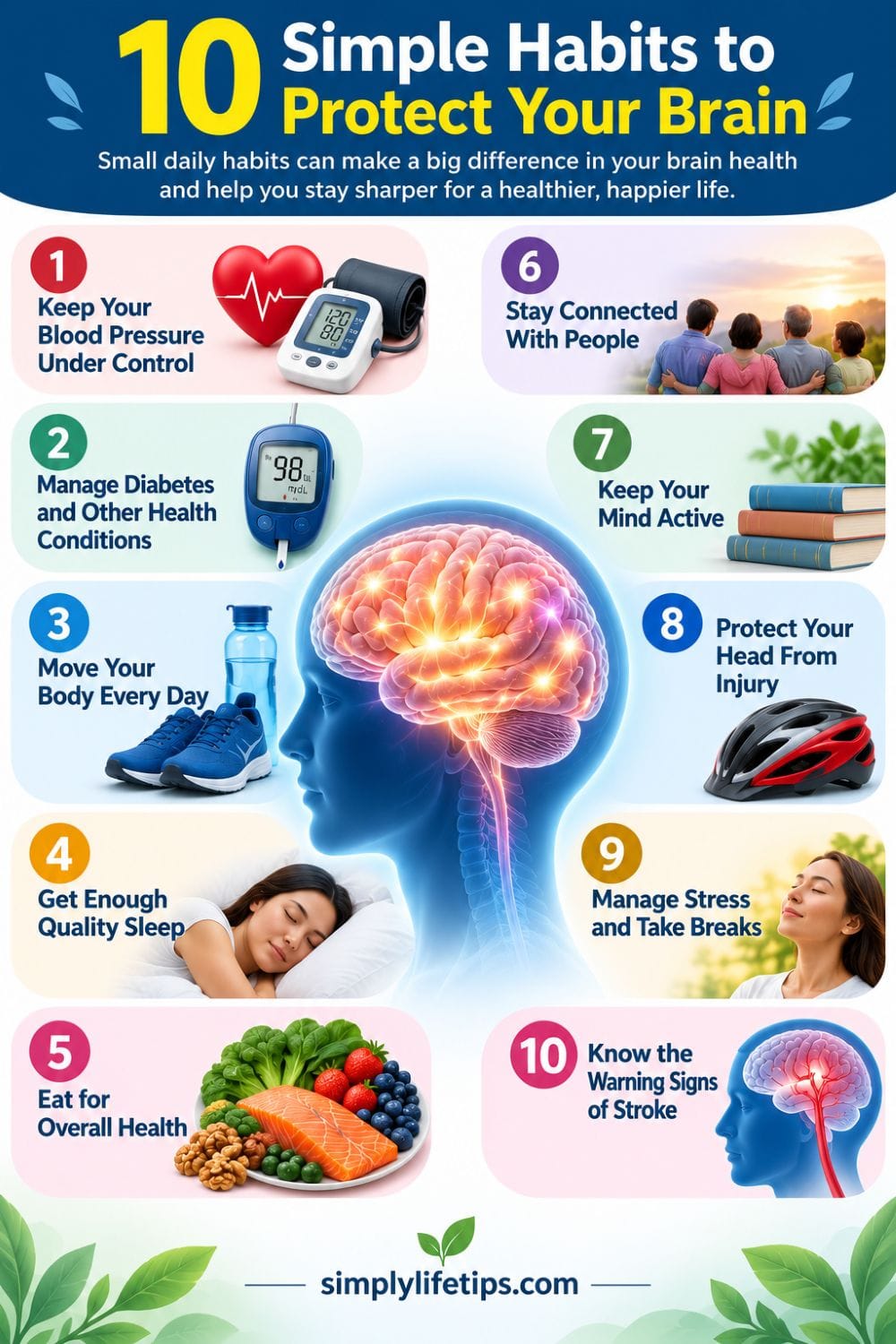
These 10 habits work together rather than separately. Let’s look at each one in more detail and see how simple daily choices can support your brain.
1. Keep Your Blood Pressure Under Control
High blood pressure can develop without obvious symptoms. Yet uncontrolled hypertension can damage blood vessels and increase the risk of stroke and other health problems that can affect the brain.
That is why blood pressure management is an important part of protecting your brain.
Do not wait for symptoms
Have your blood pressure checked as recommended by your healthcare professional.
If you have hypertension, follow your treatment plan and make appropriate lifestyle changes. Managing blood pressure is not only about protecting your heart. It is also about protecting the blood vessels that supply your brain.
The National Institute on Aging specifically recommends managing chronic health conditions such as high blood pressure, diabetes, and high cholesterol as part of supporting cognitive health.
2. Manage Diabetes and Other Health Conditions
Your brain does not work separately from the rest of your body.
Diabetes, high cholesterol, cardiovascular disease, and other chronic conditions can affect blood vessels and overall health. Stroke, for example, can damage blood vessels in the brain and increase the risk of vascular dementia.
Take your health conditions seriously
Keep recommended medical appointments.
Take prescribed medicines as directed.
Follow your healthcare professional’s advice about blood sugar, cholesterol, blood pressure, and other risk factors.
Do not stop prescribed medication simply because you feel well.
A healthy brain begins with taking care of the body that supports it.
The World Health Organization’s guidance on reducing the risk of cognitive decline and dementia emphasizes addressing multiple modifiable risk factors throughout life
3. Keep Your Body Moving
If you want to know how to protect your brain, do not overlook something as simple as walking.
Regular physical activity supports cardiovascular health and has been associated with several aspects of cognitive health. The National Institute on Aging notes that adults should generally aim for at least 150 minutes of physical activity each week, with walking being a practical place to start.
Movement does not have to be complicated
You can:
- Walk regularly
- Cycle
- Swim
- Garden
- Dance
- Do household activities
- Practice appropriate strength and balance exercises
If you spend many hours sitting, break up long periods of inactivity with movement.
You do not need to become an athlete.
You need to become more consistently active.
For more on the connection between physical activity and the brain, read Exercise and Brain Health
4. Make Sleep a Priority
Sleep is not simply a period when the body switches off.
During sleep, the brain and body carry out important processes that support normal functioning. Poor-quality or insufficient sleep can affect how well you think, learn, react, work, and interact with others.
Build better sleep habits
Try to go to bed and wake up at reasonably consistent times.
Create a relaxing bedtime routine.
Keep your bedroom comfortable for sleep.
Avoid excessive screen use close to bedtime.
Limit caffeine late in the day if it interferes with your sleep.
If persistent sleep problems are affecting your daily life, discuss them with a healthcare professional.
Good sleep is one of the simplest ways to support your overall health—and your brain is part of that picture.
5. Eat for Overall Health
There is no single miracle food that can guarantee lifelong brain health.
Instead, focus on your overall eating pattern.
Include a variety of vegetables, fruits, whole grains, beans and other legumes, nuts and seeds, and appropriate sources of protein.
At the same time, limit excessive amounts of highly processed foods, added sugars, salt, and unhealthy fats.
The goal is not to create a perfect diet.
It is to make healthier choices consistently.
Think beyond the next meal
A balanced diet supports cardiovascular and metabolic health, which are closely connected with brain health.
Rather than asking only:
“Will this taste good?”
also ask:
“Is this helping my long-term health?”
Small choices repeated over many years can matter more than occasional attempts at a perfect diet.
6. Stay Connected With People
Your brain does not exist in isolation.
Conversations, friendships, family relationships, hobbies, community activities, and meaningful social interaction all keep you engaged with the world around you.
The National Institute on Aging notes that social engagement is associated with cognitive health and recommends staying connected through family, friends, community activities, volunteering, and shared interests.
Do not let isolation become a habit
Call a friend.
Visit family.
Join a walking group.
Take part in a community activity.
Volunteer.
Learn something with other people.
You do not need a huge social circle.
A few meaningful relationships can make a difference to quality of life and help you remain mentally and socially engaged.
The National Institute on Aging’s guidance on cognitive health also highlights physical activity, healthy eating, managing chronic conditions, cognitive engagement, and social connection.
7. Keep Your Mind Engaged
Protecting your brain is not only about physical health.
The brain also benefits from being used.
Reading, learning a new skill, playing an instrument, writing, doing meaningful hobbies, and participating in mentally stimulating activities can keep you engaged.
Learning new skills is also connected to neuroplasticity, the brain’s ability to adapt in response to learning and experience. Explore our guide to 15 neuroplasticity exercises and everyday practices for practical ideas to support learning, build useful habits, and remain mentally engaged throughout life.
However, be cautious about exaggerated claims surrounding commercial “brain-training” programs. NIA notes that evidence for lasting cognitive benefits from commercially available brain-training applications is not sufficient.
Keep learning naturally
Read a book.
Learn a new language.
Try a new recipe.
Write.
Do puzzles if you enjoy them.
Learn how to use a new technology.
Take up a creative hobby.
The goal is not to turn every activity into a brain workout.
It is to remain curious and mentally engaged throughout life.
8. Protect Your Head From Injury
One of the most direct answers to how to protect your brain is also one of the most practical: protect your head from preventable injury.
Traumatic brain injuries can occur through road accidents, falls, sports, and other accidents.
Reduce avoidable risks
Wear a properly fitted helmet when riding a two-wheeler.
Use appropriate protective equipment during activities where head injury is possible.
Keep floors and walkways clear.
Improve lighting around stairs and other areas where falls may occur.
Take fall-prevention measures for older adults.
Children also need appropriate protection during cycling, sports, and other activities.
A few seconds spent taking a safety precaution can prevent an injury with consequences that may last much longer.
9. Pay Attention to Hearing, Vision, and Memory Changes
Brain health includes more than thinking and memory.
The National Institute on Aging describes brain health as involving cognitive, motor, emotional, tactile, and sensory functions, including seeing and hearing.
Therefore, new or worsening changes should not automatically be dismissed as an unavoidable part of aging.
Know when to seek advice
Have persistent hearing problems evaluated.
Do not ignore significant vision changes.
Talk with a healthcare professional about ongoing or worsening memory problems.
Occasionally forgetting a name or misplacing an item happens to many people. But changes that interfere with everyday activities, communication, decision-making, or independence deserve attention.
For more information, read our guide to 7 signs of memory loss you shouldn’t ignore.
Early evaluation does not necessarily mean that a serious neurological disease is present. There can be many different causes of changes in memory, thinking, hearing, or vision.
Finding the cause is what matters.
10. Know the Warning Signs of a Brain Emergency
Some neurological symptoms should never be ignored.
A sudden change in the face, arm, speech, vision, balance, or level of consciousness may indicate a medical emergency.
According to the CDC, stroke warning signs can include sudden numbness or weakness, especially on one side of the body; sudden confusion or trouble speaking; sudden trouble seeing; sudden difficulty walking or loss of balance; and a sudden severe headache with no known cause.
The CDC’s guide to stroke signs and symptoms explains the warning signs and why getting emergency treatment quickly matters.
Remember B.E. F.A.S.T.
B — Balance: Is there sudden dizziness or loss of balance?
E — Eyes: Is there sudden trouble seeing?
F — Face: Does one side of the face droop?
A — Arms: Is one arm suddenly weak or numb?
S — Speech: Is speech suddenly slurred or difficult to understand?
T — Time: Seek emergency medical help immediately.
The CDC emphasizes that during a stroke, every minute counts and rapid treatment can reduce brain damage.
Do not wait to see if the symptoms disappear.
If symptoms disappear after a few minutes, they still require medical attention because a transient ischemic attack (TIA) can be a warning of a more serious stroke.
A Simple Daily Checklist to Protect Your Brain
Knowing how to protect your brain is useful, but turning that knowledge into everyday habits is what matters.
Use this simple checklist:
Keep your blood pressure under control.
Manage diabetes and other chronic conditions.
Move your body regularly.
Get enough quality sleep.
Eat a balanced diet.
Stay socially connected.
Keep your mind engaged.
Protect your head from avoidable injuries.
Pay attention to changes in hearing, vision, and memory.
Know the warning signs of stroke and other neurological emergencies.
None of these habits can guarantee that a person will never develop a neurological disease or dementia.
Age, genetics, medical conditions, environmental factors, and other influences also matter.
However, current WHO guidance emphasizes addressing multiple modifiable risk factors across the life course rather than relying on a single intervention.
It is also important to recognize the everyday habits that can work against brain health. See Habits That Damage Brain Health for more information.
Protect Your Brain Before You Need To
We regularly maintain the things we value.
We service our cars.
We protect our phones.
We maintain our homes.
But what about the brain that allows us to remember our loved ones, make decisions, communicate, move, work, learn, and enjoy life?
Brain protection does not have to begin with a complicated program.
It can begin with a walk.
A good night’s sleep.
A healthier meal.
A blood pressure check.
A conversation with a friend.
A helmet before getting on a two-wheeler.
A medical appointment when something does not seem right.
And knowing when a sudden symptom requires emergency help.
The most important lesson is simple:
Protect your brain through small, healthy choices repeated throughout life.
Understanding how to protect your brain is only the first step; putting these habits into practice is what matters most.
Conclusion
Learning how to protect your brain is not about finding one magic food, supplement, exercise, or treatment.
It is about looking after your whole health.
Stay active. Sleep well. Eat sensibly. Manage chronic conditions. Avoid tobacco. Stay connected. Keep learning. Protect your head. Pay attention to changes. And learn the warning signs of neurological emergencies.
These habits cannot eliminate every risk, but they can become an important part of a healthier lifestyle.
Your brain works for you every moment of your life.
Give it the care it deserves.
For more practical ideas, see our guide to Brain Health Tips: Protect Your Brain.
FAQs About How to Protect Your Brain
What is the best way to protect your brain?
There is no single best habit. A combination of regular physical activity, healthy eating, adequate sleep, management of conditions such as high blood pressure and diabetes, social engagement, and injury prevention supports overall brain health.
Can exercise help protect the brain?
Regular physical activity supports overall cardiovascular and cognitive health. Walking is a practical way to become more active, and current guidance recommends regular physical activity as part of a healthy lifestyle.
Does sleep affect brain health?
Yes. Poor-quality sleep can affect thinking, learning, reaction, mood, and everyday functioning. Maintaining a regular sleep routine and addressing persistent sleep problems can support overall health.
Can social connection help protect the brain?
Social engagement is associated with cognitive health, and staying connected with family, friends, neighbors, and community activities can help reduce isolation and support overall well-being.
What sudden symptoms require emergency medical attention?
Sudden weakness or numbness, facial drooping, speech difficulty, vision problems, severe unexplained headache, dizziness, or loss of balance can be warning signs of stroke. Seek emergency medical help immediately rather than waiting for symptoms to disappear.
Medical disclaimer: This article is for general educational purposes and is not a substitute for individual medical advice, diagnosis, or treatment. If you experience sudden or serious neurological symptoms, seek emergency medical care immediately.
References
- World Health Organization (WHO) — Risk Reduction of Cognitive Decline and Dementia
- National Institute on Aging (NIA) — Cognitive Health and Older Adults
- CDC — Signs and Symptoms of Stroke

Mathukutty P. V. is the founder of Simply Life Tips. He shares practical advice and useful insights on personal growth, health, well-being, technology, and everyday living. His goal is to help readers build positive habits and make informed decisions. He believes in continuous learning and sharing knowledge to help people live healthier, happier, and more meaningful lives.