
Exercise and brain health are more closely connected than many people realize. When you exercise, you are not simply training your muscles, strengthening your heart, or improving your physical fitness—you are also giving your brain important biological signals that can support memory, attention, learning, mood, sleep, and healthy aging.
When people think about keeping the brain healthy, they often think about reading, solving puzzles, learning new skills, or challenging the mind. These activities can certainly be valuable. But there is another powerful form of brain support that is sometimes overlooked: physical movement.
So, what happens inside the brain when you exercise?
Can walking improve brain health? Does aerobic exercise support neuroplasticity? Can strength training benefit cognitive function? And why do scientists keep talking about BDNF when discussing exercise and the brain?
The answers involve blood flow, neuroplasticity, neurotrophic factors, cardiovascular health, stress regulation, sleep, and the complex relationship between the brain and the rest of the body.
Let’s look at the science behind the connection between exercise and brain health—and how you can use that knowledge in everyday life.
Exercise and Brain Health: How Does Exercise Support the Brain?
Exercise and brain health are connected through several biological and physiological pathways. Physical activity can influence cardiovascular function, blood flow, neuroplasticity, neurotrophic signaling, mood, sleep, and metabolic health.
Research reviews have associated physical exercise with changes in neuroplasticity-related processes and improvements in aspects of learning, memory, and brain function. However, the effects are not identical for everyone and can vary according to the type, intensity, duration, and frequency of exercise.
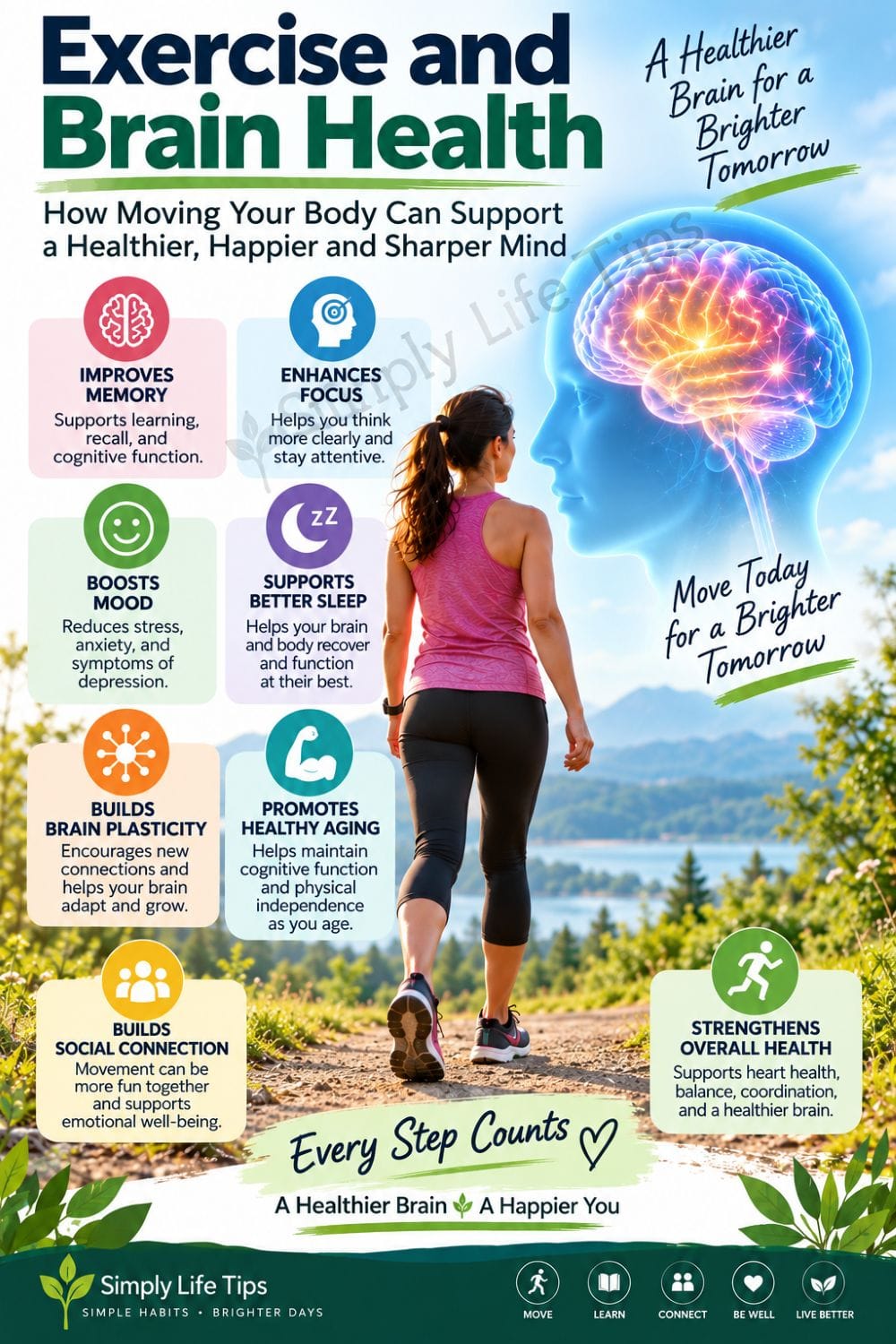
7 Ways Exercise Supports Brain Health
Here are some of the most important ways exercise can support your brain.
1. Exercise Supports Blood Flow to the Brain
Your brain is a highly active organ that requires a continuous supply of oxygen and nutrients.
When you exercise, your cardiovascular system becomes more active. Regular physical activity also helps maintain cardiovascular health, which is important because the brain depends on a healthy network of blood vessels.
This provides one important link between physical fitness and brain health.
A healthy cardiovascular system does not guarantee perfect cognitive function, but maintaining cardiovascular health is an important part of protecting the brain throughout life.
Think of it this way: your brain cannot be separated from the circulatory system that supports it.
Taking care of your heart and blood vessels is also part of taking care of your brain.
2. Exercise Supports Neuroplasticity
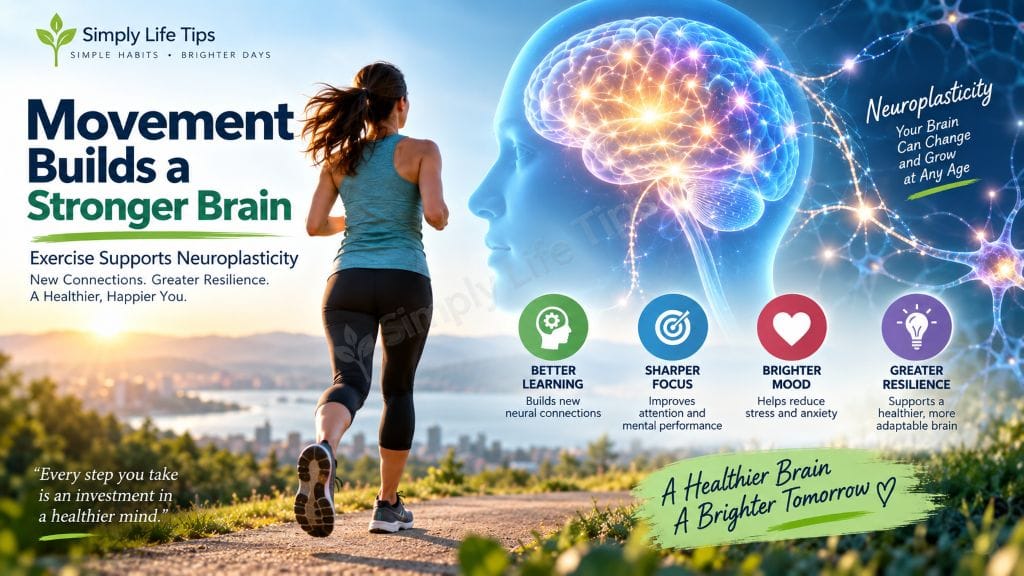
Neuroplasticity is the brain’s ability to change and adapt in response to experience, learning, and environmental demands.
Your brain is not a completely fixed structure. Neural connections can strengthen, weaken, reorganize, and adapt throughout life.
Learning a new language, practising a musical instrument, developing a new skill, and adapting to new experiences all involve forms of neural change.
Exercise appears to influence several biological processes associated with neuroplasticity. A systematic review of human and animal studies found evidence linking physical exercise with neurotrophic factors and neuroplasticity-related mechanisms, alongside effects on learning and memory.
This does not mean that one workout will “rewire” your brain overnight.
Neuroplasticity is a process.
Just as one workout does not transform your muscles, one exercise session does not permanently transform your brain. Consistent habits provide repeated opportunities for adaptation.
If you are interested in this fascinating ability of the brain to change and adapt, read our detailed guide on Neuroplasticity: How Your Brain Can Change and Adapt.
3. BDNF: Exercise and Brain Health
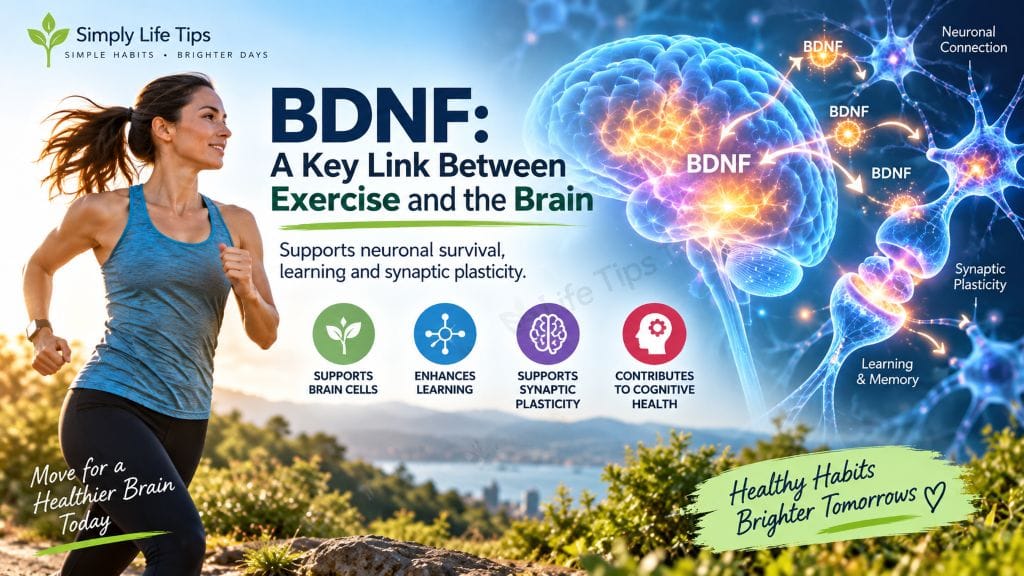
BDNF stands for Brain-Derived Neurotrophic Factor.
It is a protein involved in neuronal survival, growth, and synaptic plasticity—the processes that help neurons communicate and adapt.
Because of its role in learning and memory, BDNF has become one of the most studied biological mechanisms connecting physical activity with brain function.
Research suggests that exercise can influence BDNF, although the response depends on factors such as exercise type, intensity, duration, fitness level, and individual characteristics. A systematic review of human studies found that acute aerobic exercise can produce a transient increase in circulating BDNF, while evidence about long-term changes is more complex.
More recent research continues to investigate how different exercise intensities and training programs influence BDNF.
So, it is better to say that exercise supports biological pathways involving BDNF rather than claiming that every workout automatically produces a large or lasting increase in BDNF.
4. Exercise and Brain Health: Memory and Cognitive Function
Memory is one of the cognitive abilities most frequently discussed in research on exercise and the brain.
The hippocampus, a brain region involved in learning and memory, is particularly important in this context.
Physical activity may support the function and health of brain systems involved in memory, attention, executive function, and learning.
Executive functions include abilities such as:
- Planning
- Working memory
- Attention
- Cognitive flexibility
- Problem-solving
- Decision-making
- Inhibitory control
A 2026 systematic review examining exercise and cognitive function across the lifespan reported beneficial associations involving aerobic, resistance, and combined exercise, including cognitive abilities and neuroplasticity. The authors also noted substantial variation among exercise protocols and outcome measures, which is an important limitation when interpreting the evidence.
In simple terms, exercise is not a magic shortcut to becoming “smarter.” Instead, regular physical activity may help create biological conditions that support the brain’s ability to function and adapt.
5. Exercise May Help Regulate Stress and Mood
The connection between exercise and brain health also involves emotional well-being.
Physical activity can influence stress-related physiological systems and several neurochemical pathways involved in mood and emotional regulation.
This matters because prolonged stress can affect sleep, concentration, attention, and everyday cognitive performance.
A regular walk, workout, swim, or cycling session may provide a useful mental break from work and other daily pressures.
For example, imagine spending six hours sitting at a desk dealing with deadlines and difficult decisions. A 30-minute brisk walk may not solve the underlying problems, but it can provide movement, a change of environment, and physiological stimulation that may help you return with a clearer mind.
Exercise should not be considered a replacement for professional treatment when someone has a mental-health disorder. But physical activity can be an important part of a broader healthy lifestyle.
You may also find our practical guide on How to Reduce Mental Stress and Build Inner Clarity useful.
6. Exercise Can Improve Sleep
Sleep is essential for healthy brain function.
While you sleep, the brain remains active. Sleep plays an important role in memory consolidation, learning, emotional regulation, and recovery.
Regular physical activity can help support better sleep for many people.
This creates an interesting relationship:
Exercise → better physical and mental regulation → better sleep → better support for memory, attention, and mood.
The relationship works in both directions. Poor sleep can make it harder to exercise, while regular physical activity can contribute to healthier sleep patterns.
However, individual responses differ. Some people find that very intense exercise immediately before bedtime makes it harder to fall asleep, while others have no problem exercising later in the day.
The goal is to discover a routine that works for your body and schedule.
7. Exercise Supports Healthy Aging
The brain changes naturally as we age.
Some changes are normal, but maintaining physical activity throughout adulthood can support overall health and may contribute to better cognitive aging.
Exercise supports cardiovascular health, physical function, mobility, strength, and independence. These factors are particularly important later in life.
WHO notes that regular physical activity benefits both the body and the mind and can contribute to better thinking, learning, and overall well-being.
For older adults, WHO also recommends activities that emphasize balance and coordination in addition to aerobic and muscle-strengthening activity when appropriate.
This is why exercise should not be viewed only as something young people do to build muscles or lose weight.
It is a lifelong investment.
Which Exercises Are Best for Brain Health?
There is no single exercise that deserves the title of “the best brain exercise.”
A better strategy is to combine different forms of physical activity.
The goal is to challenge different systems of the body while maintaining a routine that you can perform safely and consistently.
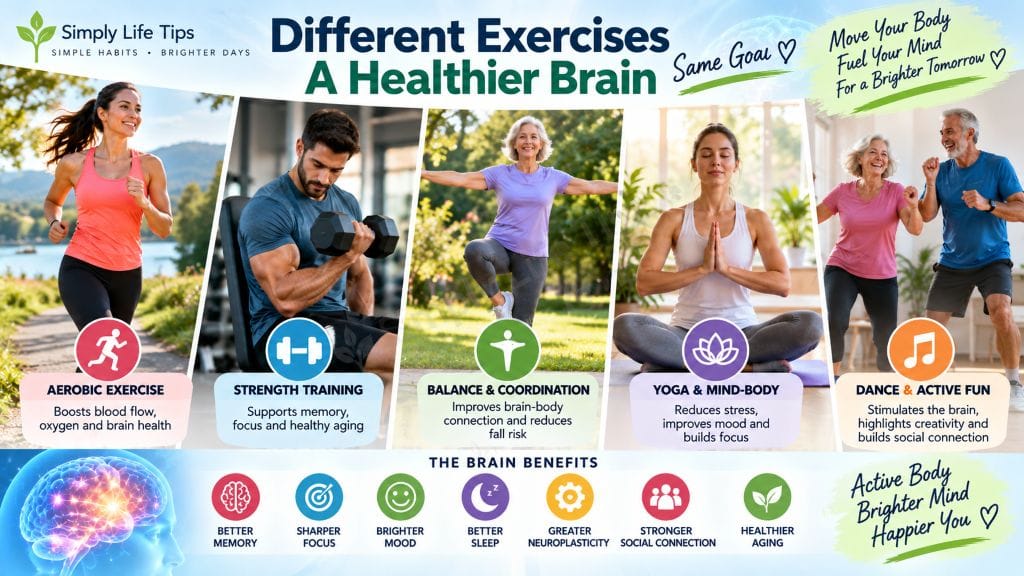
1. Aerobic Exercise and Brain Health
Aerobic exercise includes activities such as:
- Brisk walking
- Jogging
- Running
- Cycling
- Swimming
- Dancing
- Aerobic fitness exercises
Aerobic exercise and brain health are frequently studied together because aerobic activity places demands on the cardiovascular system and can influence several physiological processes relevant to brain function.
For many people, brisk walking is an excellent starting point.
You don’t need expensive equipment.
You don’t need to join a gym.
You simply need a safe place to walk and the willingness to begin.
If you currently do very little physical activity, starting with 10–15 minutes and gradually increasing the duration can be more realistic than immediately trying to complete long workouts.
2. Strength Training Exercise and Brain Health
Strength training includes:
- Weight training
- Bodyweight exercises
- Resistance-band exercises
- Functional strength exercises
Strength training is usually discussed in relation to muscles and bones, but it also contributes to overall physical function.
Maintaining strength becomes particularly important with aging because muscle loss and reduced physical capacity can affect mobility and independence.
Research has also investigated resistance exercise in relation to brain structure, function, neuroplasticity, and cognition.
This means your brain does not have to benefit only from running or cycling.
A well-rounded exercise routine can include resistance training too.
3. Balance and Coordination Exercises
Balance and coordination activities can make exercise more cognitively demanding.
Examples include:
- Yoga
- Dancing
- Tai chi
- Martial arts
- Racquet sports
- Balance exercises
- Team sports
Consider dancing.
You are not simply moving your body.
You may need to remember a sequence, follow rhythm, maintain balance, coordinate your limbs, monitor your surroundings, and respond to changes.
Sports can create similar demands by combining movement with attention, perception, timing, decision-making, and rapid responses.
This is one reason a varied exercise routine can be more interesting than repeating exactly the same movement every day.
Does Exercise Actually Make You Smarter?
This question needs a careful answer.
Exercise should not be described as a guaranteed way to increase intelligence.
Intelligence is complex, and cognitive abilities are influenced by genetics, education, environment, sleep, nutrition, health, socioeconomic factors, and many other variables.
However, physical activity is associated with several aspects of cognitive health.
Research has linked exercise with processes involving neuroplasticity, neurotrophic factors, memory, executive function, and healthy aging.
So rather than saying:
“Exercise makes you smarter.”
A more scientifically accurate statement is:
“Regular physical activity can support the biological and cognitive processes that help the brain function well.”
That may sound less dramatic, but it is much more defensible scientifically.
How Much Exercise Do You Need?
The World Health Organization recommends that adults get:
- 150–300 minutes of moderate-intensity aerobic physical activity per week, or
- 75–150 minutes of vigorous-intensity aerobic physical activity per week, or an equivalent combination of moderate and vigorous activity.
Adults should also perform muscle-strengthening activities involving all major muscle groups on at least two days per week.
For older adults, WHO additionally emphasizes balance and coordination activities when appropriate, particularly for those with reduced mobility.
But these numbers should not discourage someone who is currently inactive.
WHO emphasizes that some physical activity is better than none.
If you currently exercise very little, start with an amount you can manage.
For example:
Week 1: 10–15 minutes of walking most days.
Week 2: Gradually increase walking time.
Week 3: Add simple strength exercises if appropriate.
Later: Work toward the recommended weekly amount.
Consistency is more useful than trying to do too much too quickly.
Do You Need a Gym to Improve Brain Health?
No.
A gym can be an excellent place to exercise, but it is not a requirement.
You can support physical activity through:
- Walking
- Cycling
- Swimming
- Dancing
- Gardening
- Home-based strength exercises
- Yoga
- Recreational sports
- Climbing stairs
- Active household tasks
The WHO guidelines emphasize that physical activity includes movement during transportation, work, household tasks, leisure, sport, and planned exercise.
This is good news for people who dislike gyms.
You don’t need to become a gym enthusiast.
You need to become more physically active.
Our earlier article on the Importance of Exercise and How to Make Fitness a Daily Habit also explores practical barriers that prevent people from exercising consistently.
Exercise Your Brain and Body Together
One of the most interesting approaches is combining physical activity with activities that require cognitive engagement.
For example:
Walking + learning: Listen to an educational podcast while walking.
Dancing: Learn a new sequence rather than repeating movements you already know.
Sport: Play activities that require anticipation and decision-making.
Yoga: Combine movement, balance, breathing, and attention.
Walking with a friend: Combine physical activity with social interaction.
Learning a new physical skill: Challenge your coordination while learning something unfamiliar.
This doesn’t mean you need to turn every workout into a neuroscience experiment.
The simple principle is enough:
Move your body and keep your brain engaged.
Exercise Is Only One Part of Brain Health
Although exercise is an important part of brain health, physical activity does not work in isolation. Your brain also benefits from adequate sleep, nutritious food, mental stimulation, social connection, stress management, and continued learning. These factors are best understood as interconnected parts of a healthy lifestyle rather than separate solutions. Exercise supports physical and cardiovascular health, while sleep provides essential opportunities for recovery and memory consolidation.
Learning challenges and strengthens neural networks, social interaction engages cognitive and emotional processes, and good nutrition provides the nutrients required for normal physiological function. This is why a balanced lifestyle is generally more valuable than searching for a single “brain-boosting” trick. When these healthy habits work together, they can provide a stronger foundation for long-term brain health and overall well-being.
Our article 10 Daily Habits That Make the Brain Smarter explores several lifestyle habits—including exercise, sleep, learning, meditation, and focused attention—that can work together to support cognitive health.
Exercise and Brain Health: What Happens If You Stop Exercising?
The benefits of exercise depend partly on continued participation. A single workout can produce temporary physiological changes, but many of the long-term health benefits of physical activity depend on maintaining a regular routine. Think about strength training: if you lift weights once, you may feel the effects afterward, but you do not become significantly stronger overnight.
A similar principle applies to many aspects of brain health. Consistent physical activity provides repeated exposure to physiological and cognitive demands, creating opportunities for adaptation over time. That is why a moderate exercise routine you can maintain for months and years may be far more valuable than an extreme program that you follow for two weeks and then abandon. When it comes to exercise and brain health, consistency is more important than trying to do everything at once.
Exercise and Brain Health: A Simple Weekly Approach
You don’t need a complicated program to get started.
A simple week might look like this:
Monday: 30-minute brisk walk
Tuesday: Strength training
Wednesday: 30-minute walk or cycling
Thursday: Strength training
Friday: 30-minute brisk walk
Saturday: Dancing, swimming, sport, or another enjoyable activity
Sunday: Light movement, stretching, or an easy walk
This is only an example, not a medical prescription.
Your ideal routine depends on your current fitness level, age, health, preferences, and schedule.
If you have a medical condition or significant physical limitations, speak with an appropriate healthcare professional before beginning or substantially increasing exercise.
The Most Important Exercise Is the One You Will Actually Do
Scientific evidence can tell us which types of physical activity may benefit our health, but human behavior determines whether we actually perform them consistently. If you dislike running, forcing yourself to run every morning may not be a sustainable strategy. Instead, you might choose brisk walking, cycling, swimming, or another activity you enjoy. If weight machines aren’t appealing, resistance bands or bodyweight exercises can provide alternatives.
Those who find traditional workouts boring might enjoy dancing, while people who love being outdoors may prefer walking, cycling, gardening, or hiking. If social interaction motivates you, recreational sports can make physical activity more enjoyable. The best exercise routine is not necessarily the most impressive or demanding one; it is the one that is safe, appropriate for your abilities, enjoyable enough to maintain, and sustainable over time.
Exercise and Brain Health: The Bigger Picture
The relationship between exercise and brain health is not based on one magical molecule or one perfect workout. Instead, it involves a network of biological and behavioral effects that work together. Physical activity can support cardiovascular health, influence neuroplasticity-related pathways, affect BDNF and other neurotrophic factors, support mood and stress regulation, contribute to better sleep, and help maintain physical function as we age. Exercise can also create opportunities to combine movement with learning, coordination, social interaction, and new experiences, making physical activity beneficial for both body and mind.
The evidence continues to develop, and researchers are still working to understand exactly how different types, intensities, and durations of exercise affect different aspects of brain function. For that reason, it is better to think of exercise as one important component of lifelong brain health, rather than as a guaranteed way to prevent cognitive decline or a cure for cognitive problems. When combined with adequate sleep, a balanced diet, mental stimulation, social connection, and other healthy lifestyle habits, regular physical activity can become an important part of a long-term strategy for keeping both the body and brain healthy.
Conclusion
Exercise and brain health are connected in ways that go far beyond the simple idea of working out to stay fit. When you move your body regularly, you support cardiovascular health while influencing biological processes involved in neuroplasticity, neurotrophic signaling, mood, sleep, memory, and cognitive function. Aerobic exercise such as brisk walking, cycling, swimming, and running can be valuable, while strength training also plays an important role. Activities such as dancing, yoga, sports, and martial arts can add balance, coordination, attention, and skill learning to your routine.
You don’t need to become an athlete, spend hours in a gym, or follow a complicated exercise program to support your brain health. Start with what you can do and choose activities you can continue consistently. Walk more, strengthen your muscles, challenge your balance, learn a new physical skill, dance, play, and simply keep moving. Your next workout may not make you instantly smarter, but regular physical activity can help create the conditions in which your brain and body are better equipped to remain healthy, adaptable, and functional throughout life.
Every step you take is more than movement. It can be an investment in the brain you will depend on tomorrow. So, what small movement can you add to your day today—for the health of both your body and your brain?
FAQs about Exercise and Brain Health
Can exercise improve brain health?
Yes. Regular physical activity is associated with several processes relevant to brain health, including cardiovascular function, neuroplasticity, mood regulation, sleep, and cognitive function. The magnitude of benefit varies among individuals and exercise programs.
What is the best exercise for brain health?
There is no single best exercise for everyone. Aerobic activities such as brisk walking, cycling, swimming, and running are useful, while strength training and activities involving balance and coordination can complement them.
Does exercise increase BDNF?
Exercise can influence BDNF, a protein involved in neuronal function and synaptic plasticity. Research suggests that aerobic exercise can produce temporary increases in circulating BDNF, although responses vary and long-term effects are more complex.
How much exercise should I do for brain and overall health?
WHO recommends adults perform 150–300 minutes of moderate-intensity aerobic activity or 75–150 minutes of vigorous-intensity activity per week, together with muscle-strengthening activities on at least two days per week.
Can walking benefit the brain?
Yes. Brisk walking is a practical form of moderate aerobic physical activity and can contribute to overall physical and cardiovascular health. For people who are currently inactive, walking can be a realistic way to begin becoming more physically active.
References
- World Health Organization — Physical Activity Guidelines
WHO recommends 150–300 minutes of moderate-intensity aerobic activity or 75–150 minutes of vigorous activity per week for adults, plus muscle-strengthening activities on at least two days.
WHO Physical Activity Guidelines - World Health Organization — Guidelines on Physical Activity and Sedentary Behaviour
WHO summarizes the benefits of physical activity for the heart, body, mind, thinking, learning, and overall well-being.
WHO Guidelines on Physical Activity and Sedentary Behaviour - Effects of Physical Exercise on Neuroplasticity and Brain Function — Systematic Review
This systematic review examined evidence connecting physical exercise with neuroplasticity, neurotrophic factors, learning, memory, and brain function.
PubMed — Effects of Physical Exercise on Neuroplasticity and Brain Function - Exercise-Induced Response of Peripheral Brain-Derived Neurotrophic Factor — Systematic Review
This review examined the effects of exercise on BDNF in human studies and found evidence of transient BDNF responses following aerobic exercise.
PubMed — Exercise and BDNF Systematic Review - The Impact of Exercise on Cognitive Function and Brain Health Across the Lifespan — Systematic Review
A recent systematic review examined aerobic, resistance, and combined exercise in relation to cognition, neuroplasticity, and age-related cognitive decline.
PubMed — Exercise, Cognitive Function and Brain Health

Mathukutty P V is a Blogger, YouTuber, and Content Writer and the founder of Simply Life Tips. After taking voluntary retirement in 2017, he embraced a free lifestyle focused on learning, personal growth, and sharing practical wisdom to help others live with more purpose and positivity.


