
Dementia care is not simply about helping someone remember names, places or events. It is about helping a person feel safe, respected, connected, and valued when memory, thinking, communication, and everyday abilities gradually become more difficult.
Understanding how the brain works and protecting its long-term well-being are important at every stage of life, so learning practical ways to support brain health can benefit everyone.
Imagine someone who once remembered every birthday, every family story, and even the smallest details about your life. Then one day, that person looks at you and asks, “Who are you?”
For a family member, that moment can be heartbreaking.
Dementia is not one specific disease. It is a general term for a range of conditions that affect the brain and can change memory, thinking, communication, mood, and behaviour. Alzheimer’s disease is the most common cause of dementia, but there are several other forms. Dementia affects each person differently, and symptoms usually become more challenging as the condition progresses.
Yet one important truth should never be forgotten:
A person’s need for love, dignity, respect, comfort, and human connection does not disappear simply because their memories change. For families, dementia caregiving can be emotionally and physically demanding. But with patience, understanding, and compassion, caregivers can help replace fear with reassurance, confusion with comfort, and isolation with connection.
The following principles offer a simple reminder of what matters most when caring for someone with dementia.
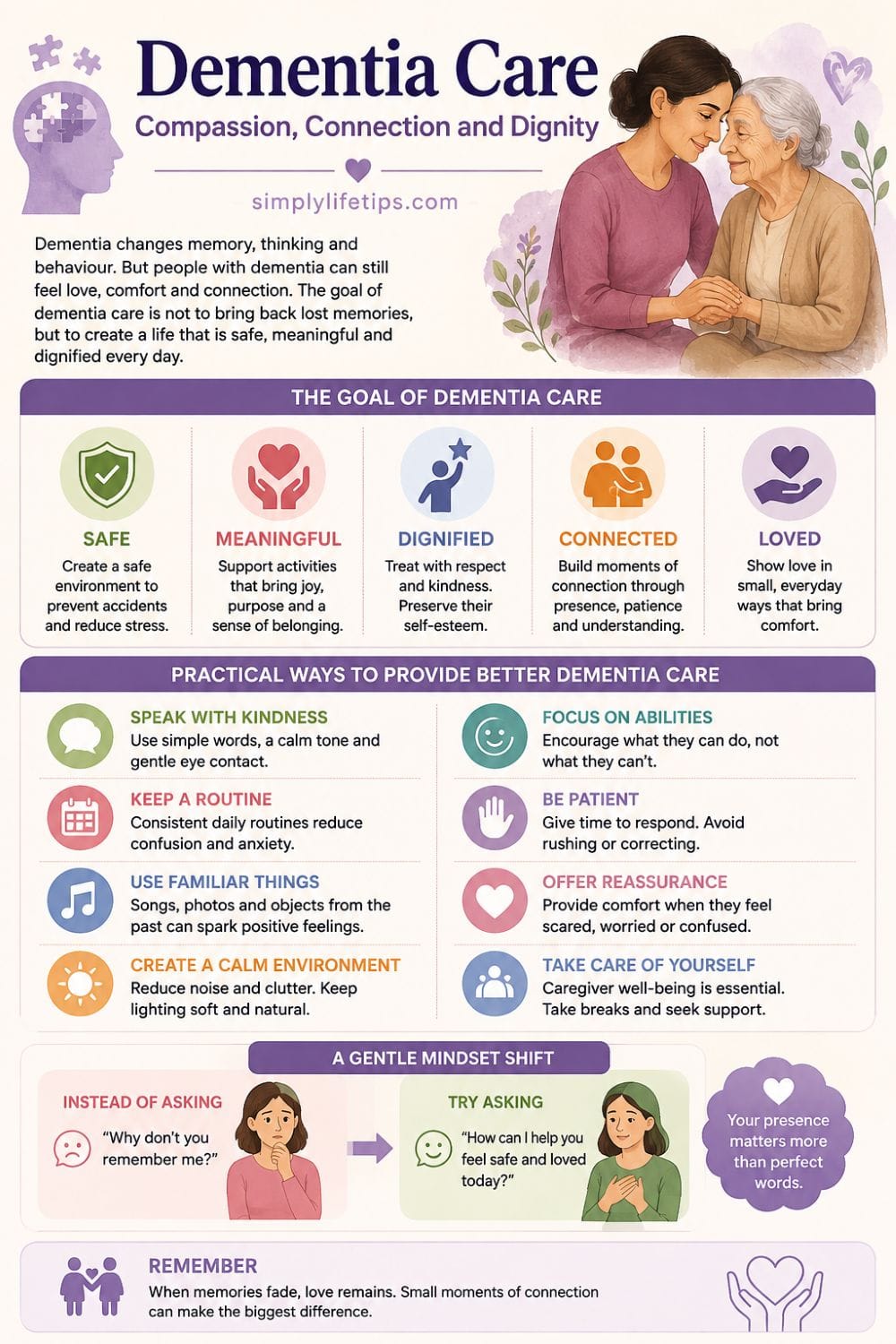
Dementia Is the Disease, Not Your Loved One
A person with dementia may ask the same question repeatedly.
They may accuse someone of taking something that they misplaced. They may become suspicious, angry, or frightened without an obvious reason. They may say something that does not match reality or behave in a way that seems completely different from the person you have always known.
These situations can be frustrating for caregivers.
But it is important to remember that dementia can affect how a person thinks, communicates, interprets situations, and responds emotionally. Behavioural and communication changes are common parts of dementia.
Instead of immediately thinking:
“Why are you behaving like this?”
try asking:
“What might you be feeling right now?”
They may be frightened.
They may be confused.
They may be tired.
They may be uncomfortable.
They may be unable to explain what they need.
Responding with anger or criticism can increase distress. A calm voice, reassuring expression, and patient response may be far more helpful.
Do Not Argue—Meet Them With Compassion
One of the hardest parts of dementia care is knowing what to do when your loved one believes something that is not true.
Imagine an elderly mother repeatedly saying:
“I have to go and pick up my children from school.”
Her children may actually be adults with families of their own.
You could respond:
“Your children are adults. You know that. Why do you keep saying this?”
But that may increase her confusion or distress.
A gentler response might be:
“They are safe. Don’t worry. You are here with me.”
The purpose is not to prove that she is wrong. The purpose is to understand the emotion behind her words and help her feel secure.
The National Institute on Aging recommends patience, empathy, allowing extra time to respond, and rephrasing communication when necessary. It also advises caregivers to avoid speaking to a person with dementia as though they are not present.
This does not mean agreeing with everything a person says. If there is a genuine safety concern, caregivers should intervene appropriately. But when the situation is harmless, unnecessary arguments often achieve very little.
Never ridicule, shame, or humiliate a person with dementia, especially in front of other people.
Correcting a memory is less important than protecting a person’s dignity.
Maintain a Familiar Daily Routine
A predictable routine can make everyday life easier for a person living with dementia.
Try to maintain reasonably consistent times for:
- Waking up
- Meals
- Bathing
- Medication
- Walking or other activities
- Rest
- Going to bed
A familiar routine can reduce the number of unexpected decisions a person has to make.
Consistent sleep and daily routines are also among the habits that can support healthy brain function. You can learn more about practical habits in 10 Daily Habits That Make the Brain Smarter.
For example, a morning routine might look like this:
Wake up → wash → get dressed → breakfast → medication → short walk → familiar activity.
The routine does not have to be rigid. Unexpected events will happen. The goal is simply to create a familiar rhythm that provides a sense of security.
Daily care plans and adapted routines are commonly recommended in dementia care because activities and support can be adjusted as a person’s abilities change.
Keep the Mind, Body and Emotions Engaged
Dementia cannot be cured simply by keeping someone busy. However, meaningful activities can support engagement, enjoyment and quality of life.
The activity does not need to be complicated.
Sometimes the simplest activities are the most meaningful.
Try:
- Looking through old family photographs
- Listening to favourite songs
- Singing familiar songs together
- Gardening
- Watering plants
- Folding clothes
- Setting the dining table
- Taking a short walk
- Drawing or colouring
- Doing a simple puzzle
- Preparing a familiar recipe with supervision
- Sorting household objects
- Spending time with grandchildren
- Reading familiar books or stories
The key is to match the activity to the person’s current abilities.
Keeping the mind engaged does not always require complicated activities; meaningful learning and mental stimulation can remain valuable throughout life. Read more about the importance of never stop learning at every age.
If a person once loved gardening but can no longer manage complicated gardening tasks, they might still enjoy watering plants or touching and sorting seeds.
If cooking has become unsafe, they might still enjoy helping measure ingredients or watching someone prepare a familiar dish.
The National Institute on Aging recommends adapting activities to what the person can comfortably do, helping them get started and watching for frustration. Activities such as exercise, music, gardening, and simple household tasks can be adapted for people with dementia.
The goal is participation, not perfection.
Communicate Simply, Slowly and Patiently
Communication can become increasingly difficult as dementia progresses.
A person may struggle to find the right word, follow a long conversation, understand complicated instructions or maintain their train of thought. Background noise can also make communication harder.
Caregivers can make conversations easier by:
- Speaking slowly and clearly
- Using short sentences
- Asking one question at a time
- Offering simple choices
- Making eye contact
- Using a warm and respectful tone
- Giving enough time for an answer
- Reducing background noise
- Rephrasing rather than repeatedly giving the same complicated explanation
These principles are useful beyond dementia care as well. Clear, respectful communication helps people feel heard and understood; see effective communication skills for more practical guidance.
For example, instead of asking:
“What would you like for dinner?”
try:
“Would you like rice or chapati?”
Instead of:
“Why did you put that there?”
try:
“Let’s put this here.”
Instead of asking several questions at once, ask one simple question and wait.
Do not rush to answer for them.
Do not finish every sentence.
And do not use a childish or humiliating tone.
The National Institute on Aging specifically recommends simple wording, one idea at a time, patience, eye contact, and allowing extra time for responses.
As speech becomes more difficult, facial expressions, gestures, tone and other forms of non-verbal communication can become increasingly important.
Make the Home Safer
Dementia can affect judgment, orientation and the ability to safely manage familiar household tasks.
A person may forget to turn off a stove, leave a tap running, take medication incorrectly or have difficulty recognizing a potential hazard.
Falls and wandering can also become concerns as dementia progresses.
A safer home can include:
- Removing loose rugs and unnecessary obstacles
- Keeping walkways clear
- Improving lighting
- Making stairs safer
- Installing appropriate grab bars
- Keeping medicines securely stored
- Locking away cleaning products and chemicals
- Securing sharp objects and dangerous tools
- Making kitchen appliances safer
- Using night-lights where appropriate
- Keeping important emergency contact information accessible
Go through the house room by room.
Look at the environment from the perspective of the person living with dementia.
Could they trip here?
Could they accidentally turn this on?
Could they mistake this object for something else?
Could they become confused if the lighting is poor?
The National Institute on Aging recommends regularly reviewing home safety as a person’s abilities and behaviours change.
The goal is not to remove every element of independence.
The goal is to create the safest possible environment while preserving as much independence as reasonably possible.
Pay Attention to Food, Fluids and Sleep
Eating, drinking and sleeping can become challenging for some people with dementia.
A person may forget to eat, have difficulty recognizing hunger or thirst, lose interest in food or need assistance during meals. Sleep patterns may also change.
Caregivers can help by:
- Offering nutritious meals in manageable portions
- Providing familiar foods when appropriate
- Encouraging regular fluid intake
- Keeping mealtimes reasonably predictable
- Reducing distractions during meals
- Watching for persistent changes in appetite
- Maintaining a regular sleep and wake schedule
- Encouraging appropriate daytime activity
Do not assume that every change in eating, drinking or sleep is simply part of dementia. Persistent or significant changes should be discussed with a healthcare professional.
Dementia care should always consider the person’s overall health, not just memory and behaviour.
Preserve Independence and Dignity
Dementia does not mean a person should automatically stop doing everything for themselves.
Whenever it is safe, allow the person to participate.
They may still be able to:
- Choose between two outfits
- Brush their hair
- Fold towels
- Water plants
- Set the table
- Choose a song
- Help prepare simple food
- Sort clothes
- Participate in familiar household activities
Give assistance where it is needed, but avoid taking over tasks unnecessarily.
For example, if your mother can still fold clothes but takes twice as long as you would, let her fold them if the activity is safe and enjoyable.
The finished pile does not matter as much as the feeling of being useful.
Maintaining participation in familiar activities can support engagement and quality of life.
When Behaviour Changes Suddenly, Look for a Reason
A sudden and significant change in behaviour should not automatically be dismissed as dementia progression.
If someone who is usually calm suddenly becomes extremely confused, unusually sleepy, highly agitated, or behaves very differently, there may be another problem that needs medical attention.
Pain, illness, medication-related problems, dehydration or other medical issues can affect behaviour and cognition.
If you notice a significant or sudden change, contact the person’s healthcare professional for appropriate assessment.
This is especially important when the change is new, severe or accompanied by other concerning symptoms.
Do Not Forget the Caregiver
There is another person who needs care during the dementia journey:
The caregiver.
Family caregivers can become so focused on their loved one’s needs that they gradually stop caring for themselves.
Sleep may suffer.
Work may become difficult.
Relationships may become strained.
Personal interests may disappear.
Emotional exhaustion can build quietly.
When prolonged pressure begins affecting concentration, energy, and emotional well-being, understanding mental exhaustion and its warning signs may help caregivers recognize when they need additional support.
Caregiving is important work, but it can also be stressful and demanding. The National Institute on Aging recommends that caregivers seek help, take regular breaks, and pay attention to their own health and well-being.
Whenever possible:
- Share responsibilities with family members
- Accept practical help from friends
- Arrange regular breaks
- Protect your own sleep
- Maintain meaningful relationships
- Continue activities that give you energy
- Talk to a healthcare professional if stress becomes overwhelming
- Consider caregiver support groups or counselling when appropriate
You do not have to do everything alone.
Family caregiving works better when responsibilities are shared according to people’s abilities, availability and circumstances.
Caring for an older family member can bring many emotional and practical challenges, and families may also benefit from our guide to caring for ageing parents.
Taking care of yourself is not selfish. It is part of taking care of your loved one.
Love May Remain When Memories and Words Fade
Perhaps the most painful part of dementia is watching someone gradually lose memories that once seemed permanent. They may eventually forget your name, where they live, family stories, or even struggle to recognize familiar faces. Yet the relationship can still contain moments of connection. A familiar song may bring a smile, an old photograph may encourage conversation, a familiar voice may provide reassurance, and a gentle hand held with permission may offer comfort. The person may not always be able to explain why they feel safe with you, but that does not make the connection meaningless. This is why dementia care is about much more than memory. It is about how a person feels in your presence.
The Real Goal of Dementia Care
The goal of dementia care is not to force every forgotten memory back into place. It is to make the life that remains as safe, meaningful, and dignified as possible. This means replacing unnecessary arguments with patience, fear with reassurance, shame with respect, and isolation with connection. Instead of constantly asking, “Why don’t you remember me?”, perhaps ask, “How can I help you feel safe and loved today?” That simple question can change the entire approach to caregiving.
Conclusion
Dementia can be an extraordinarily difficult journey. There will be days filled with repetition, confusion, frustration, and sadness, but there can also be moments of connection—a smile, a familiar song, a peaceful afternoon, a shared meal, a gentle touch, or a moment of laughter. When memories become fragile, these moments matter. The purpose of dementia care is not simply to preserve what the disease is taking away; it is also to protect what remains: dignity, comfort, connection, independence, and love. Because even when a person cannot remember your name, they may still experience the way you make them feel. And sometimes, that is where the deepest form of caregiving begins.
Medical Disclaimer
This article provides general educational information about dementia care and is not a substitute for diagnosis, treatment, or individualized medical advice. Dementia has many causes, and care needs differ from person to person. Families should consult a qualified healthcare professional for advice specific to their loved one’s condition. Any sudden or significant change in cognition, behaviour, eating, drinking or physical condition should be medically assessed.
References
- World Health Organization — Dementia
- NHS — Dementia: Overview
- NHS — Looking After Someone With Dementia
- Alzheimer’s Society — What Is Dementia?
Frequently Asked Questions
What is dementia care?
Dementia care refers to the practical, emotional, and safety support provided to a person living with dementia. It can include assistance with daily activities, communication, routines, nutrition, safety, meaningful activities and maintaining dignity.
How do you care for someone with dementia at home?
Start with a safe and familiar environment, a predictable routine, simple communication and meaningful activities suited to the person’s abilities. Medication management, nutrition, mobility and changes in behaviour should also be monitored with appropriate professional guidance.
Should you argue with someone who has dementia?
Generally, unnecessary arguments and repeated attempts to prove that the person is wrong can increase distress. When the situation is not dangerous, reassurance, empathy and gentle redirection may be more helpful.
What activities are good for people with dementia?
Familiar activities such as listening to music, gardening, walking, looking at photographs, folding laundry, simple cooking tasks, drawing and spending time with family can be adapted according to the person’s abilities and interests.
Why is caregiver self-care important in dementia care?
Dementia caregiving can be demanding and stressful. Taking breaks, sharing responsibilities, and seeking appropriate support can help caregivers protect their own well-being and continue providing compassionate care.

Mathukutty P V is a Blogger, YouTuber, and Content Writer and the founder of Simply Life Tips. After taking voluntary retirement in 2017, he embraced a free lifestyle focused on learning, personal growth, and sharing practical wisdom to help others live with more purpose and positivity.