
How to stop being self-conscious is a question many people quietly struggle with. Thoughts such as “What will others think of me?”, “Did I say something wrong?”, or “How do I look?” can sometimes become so persistent that they affect confidence and make social situations uncomfortable. While occasional self-consciousness is normal, constantly worrying about how others see you can become an unnecessary emotional burden.
The good news is that you can learn to respond differently to these thoughts. By questioning negative assumptions, letting go of past mistakes, building your abilities, and paying attention to what actually happens rather than what you fear might happen, you can gradually become more comfortable with yourself.
What Does It Mean to Be Self-Conscious?
Being self-conscious means becoming excessively aware of yourself and worrying about how other people may perceive you.
You may find yourself thinking:
- “Everyone is looking at me.”
- “They probably noticed my mistake.”
- “What if I say something embarrassing?”
- “Maybe they are judging the way I look.”
- “I should have handled that situation differently.”
These thoughts can occur occasionally without causing any serious problem. But when they become frequent, they can make you avoid conversations, social gatherings, public speaking, or other situations where you feel exposed.
One important thing to remember is that feeling self-conscious does not mean that something is wrong with you. It is a common human experience, and it can become easier to manage with practice.
How to Stop Being Self-Conscious?
If you are wondering how to stop being self-conscious, these seven practical strategies can help you challenge negative thoughts, build confidence, and become more comfortable with yourself.
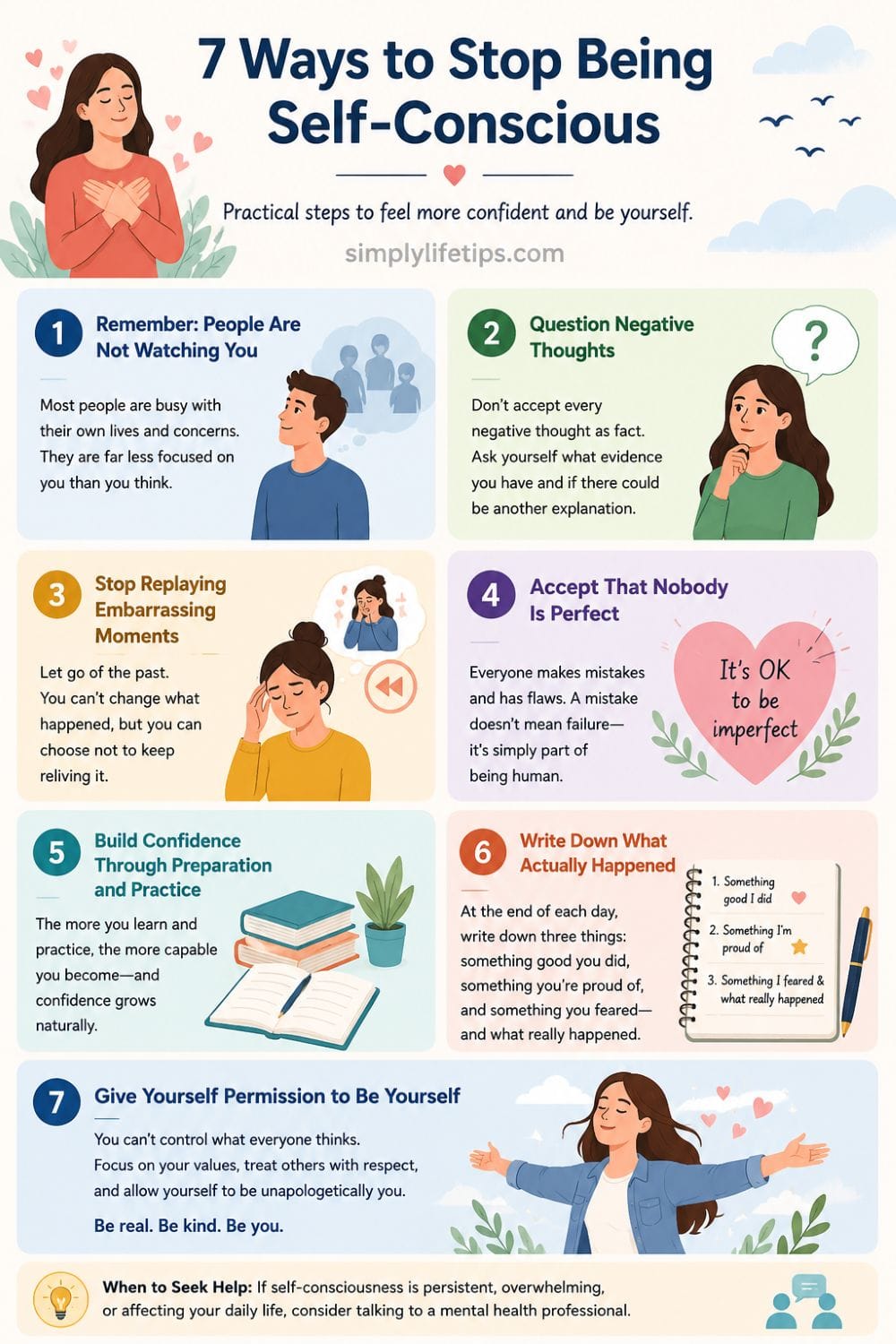
These steps are not about becoming completely free from self-conscious thoughts. They are about learning to recognize unhelpful thoughts, question them, and respond with greater confidence. Let’s look at each approach in more detail.
1. Remember That People Are Not Watching You as Much as You Think
One of the biggest misconceptions behind self-consciousness is the belief that everyone is constantly observing and judging you.
You may walk into a room and immediately think:
“Everyone is looking at me.”
But most people are busy thinking about their own lives.
They may be worrying about something they said earlier, thinking about their work, wondering what they need to do next, or simply focusing on their own conversations.
This does not mean that nobody ever notices you. It means that other people are generally far less focused on you than your anxious thoughts may suggest.
The next time you think everyone is watching you, remind yourself:
“People have their own lives and concerns. I don’t need to assume that they are evaluating everything I do.”
This simple shift in perspective can reduce unnecessary self-consciousness.
2. Question the Thoughts That Make You Feel Judged
When you feel that people are laughing at you, criticizing you, or judging you, don’t automatically accept the thought as fact.
Instead, pause and ask yourself:
- What evidence do I actually have?
- Did someone really say something negative?
- Am I assuming what they are thinking?
- Could there be another explanation?
- Would I judge another person as harshly as I am judging myself?
For example, imagine that you make a small mistake while speaking and someone smiles.
Your immediate thought might be:
“They are laughing at me.”
But there could be many other explanations. Perhaps the person smiled because they remembered something funny, were responding to someone else, or simply reacted naturally.
The important point is not to replace every negative thought with an unrealistically positive one. Instead, look for a more balanced interpretation.
3. Stop Replaying Embarrassing Moments
Self-consciousness often keeps the past alive.
You may spend hours replaying a conversation:
“Why did I say that?”
“I shouldn’t have said that.”
“What must they think of me now?”
The problem is that repeatedly reviewing an uncomfortable event rarely changes what happened. Instead, it can make the experience feel much more important than it actually was.
When you catch yourself replaying an old situation, acknowledge it and gently bring your attention back to the present.
You made a mistake? Learn from it.
You said something awkward? It happens.
You embarrassed yourself? You are not the first person to do so, and you certainly won’t be the last.
Learn what you can, then allow the moment to remain in the past.
4. Accept That Nobody Is Perfect
Self-conscious people can sometimes expect themselves to behave perfectly.
They want to say exactly the right thing, look their best, avoid mistakes, and always appear confident.
That standard is impossible.
Everyone makes mistakes. Everyone has weaknesses. Everyone occasionally says something awkward or does something they later wish they had handled differently.
A mistake does not automatically mean failure.
For example, if you give an incorrect answer during a discussion, you can correct yourself. If you make a mistake at work, you can learn from it. If you say something inappropriate, you can apologize.
The goal isn’t to become someone who never makes mistakes.
The goal is to become someone who can make a mistake without losing all confidence.
5. Build Confidence Through Preparation and Practice
Self-Confidence does not always appear simply because you tell yourself to “be confident.”
It often grows through knowledge, preparation, experience, and practice.
Suppose you are self-conscious about speaking in front of others. Instead of constantly worrying about how you will appear, prepare well and practise what you want to say.
The more familiar you become with a skill, the less mental energy you may need to spend worrying about whether you are capable.
This applies to many areas of life.
If you want to become better at:
- Public speaking
- Writing
- Communication
- A sport
- Your profession
- A creative skill
Keep learning and practising.
Competence can strengthen confidence because you have real evidence that you are improving.
6. Write Down What Actually Happened
A simple daily reflection can help you recognize the difference between what you feared and what actually happened.
At the end of the day, write down three things.
Something you did well
It could be something small.
Perhaps you helped someone, completed an important task, exercised, handled a difficult conversation calmly, or simply kept a promise you made to yourself.
Something you were proud of
It doesn’t have to be a major achievement.
Maybe you spoke up during a meeting even though you were nervous. Perhaps you introduced yourself to someone new or tried something you had been avoiding.
Something you feared—and what actually happened
This can be particularly useful.
For example:
Fear: “Everyone will notice if I make a mistake while speaking.”
What happened: “I made a small mistake, corrected it and continued. Nobody seemed particularly concerned.”
Keeping track of experiences like this can gradually help you recognize that your predictions are not always accurate.
7. Permit Yourself to Be Yourself
Trying constantly to control how other people see you can become exhausting.
You cannot control everyone’s opinion of you.
Some people will like you. Some may misunderstand you. Others may simply have different opinions.
That is part of life.
Instead of asking yourself:
“How can I make everyone think well of me?”
try asking:
“Am I behaving according to my values and treating others with respect?”
That is a much more realistic standard.
You don’t need to impress everyone. You need to become comfortable being yourself while continuing to learn, grow, and treat people well.
When Self-Consciousness Becomes Overwhelming
Occasional self-consciousness is normal. But if fear of judgment is persistent and begins interfering with work, relationships, studies, or everyday activities, it may be worth talking with a qualified mental-health professional.
Persistent fear of social situations can sometimes be associated with conditions such as social anxiety disorder, which is different from ordinary occasional self-consciousness.
Getting professional support is not a sign of weakness. It can be a practical step toward understanding what you are experiencing and learning effective ways to manage it.
Conclusiion
Learning how to stop being self-conscious does not mean eliminating every uncomfortable thought about yourself. Instead, it means learning not to automatically believe every thought that tells you other people are judging you.
People make mistakes. Conversations sometimes go awkwardly. You will occasionally feel embarrassed. None of these experiences define your worth.
Question your assumptions, stop repeatedly replaying the past, accept your imperfections, develop your abilities, and pay attention to what actually happens rather than what you fear might happen.
With practice, you can become less concerned with constantly watching yourself through other people’s imagined eyes—and more comfortable simply living your life.
FAQs – How to Stop Being Self-Conscious
Is it normal to feel self-conscious?
Yes. Most people occasionally worry about how they look, speak or behave. It becomes more concerning when self-consciousness is persistent or significantly interferes with everyday life.
How can I stop worrying about what others think of me?
Start by questioning your assumptions. Ask yourself whether you actually have evidence that someone is judging you or whether you are predicting what they might be thinking.
How can I stop being self-conscious when speaking?
Preparation and repeated practice can help. Focus on communicating your message rather than monitoring every word, facial expression or movement.
Does making mistakes make people think less of me?
Not necessarily. Most people understand that mistakes are part of being human. A small mistake is often much less memorable to others than it feels to the person who made it.
When should I seek professional help for self-consciousness?
Consider speaking with a qualified mental-health professional if fear of judgment or social situations becomes persistent, causes significant distress, or interferes with work, education, relationships or everyday activities.

Mathukutty P V is a Blogger, YouTuber, and Content Writer and the founder of Simply Life Tips. After taking voluntary retirement in 2017, he embraced a free lifestyle focused on learning, personal growth, and sharing practical wisdom to help others live with more purpose and positivity.