
Habits that damage brain health are not always obvious. Some are everyday routines that gradually become part of our lives without us stopping to consider how they may affect our sleep, concentration, mood, memory, and overall well-being.
The brain works continuously. It helps us think, learn, remember, make decisions, control movement, manage emotions, and respond to everything happening around us. It therefore needs more than mental stimulation. It also needs adequate sleep, physical activity, healthy social connection, and regular periods of recovery.
Modern life can make this balance difficult. We may spend hours sitting at a desk, remain glued to our phones, consume a constant stream of negative news, worry about tomorrow, or continue working long after our minds need a break.
Not every habit discussed here directly causes brain damage. Some are better understood as behaviors that may affect cognitive, emotional, or overall brain health, particularly when they become excessive or persistent. Research also shows that some relationships are complex and can vary according to age, health, and other lifestyle factors.
The good news is that many of these habits are modifiable.
Let’s look at some common habits that may put unnecessary strain on brain health and what we can do differently. Understanding these habits that damage brain health can help us make better daily choices.
9 Habits That Damage Brain Health
1. Getting Too Little Sleep
Sleep is one of the most important foundations of good brain health.
When we regularly sleep too little, the effects can show up during the day. We may feel tired, find it harder to concentrate, become more irritable, or struggle to think clearly.
An occasional late night is unlikely to be a major concern for most people. The bigger problem is allowing insufficient sleep to become a regular pattern.
An irregular sleep schedule can also make it harder to establish a healthy sleep routine. Going to bed at very different times from one day to another may leave you feeling as though your body never quite knows when it is time to rest.
For most adults, getting at least seven hours of sleep is an important starting point, although individual sleep needs vary.
Poor sleep is one of the habits that can damage brain health when it becomes a persistent pattern.
A better habit: Try to maintain reasonably consistent bedtimes and wake-up times. Give yourself enough time to sleep rather than treating sleep as whatever time remains after everything else is finished.
Most adults need at least seven hours of sleep each night, although individual sleep needs can vary. The CDC provides guidance on how much sleep adults need and why adequate sleep matters for overall health.
2. Sitting for Long Periods Without Moving
Many people spend a large part of the day sitting.
You may sit while working, eat while sitting, travel while sitting, and then spend the evening sitting in front of the television or using your phone.
Working from home can make this particularly easy because there may be fewer natural opportunities to walk between meetings, speak with colleagues, or move around the workplace.
The concern, however, is not working from home itself. It is prolonged sedentary behavior and insufficient movement.
Research into sedentary behavior and brain health is still developing, but recent reviews generally point toward an association between greater sedentary behavior and poorer cognitive or brain-health outcomes, while also emphasizing that the evidence is not completely uniform.
Breaking up long periods of sitting may be a simple way to improve your daily routine. A short walk, standing while making a phone call, stretching, or simply getting up from your chair can create useful movement breaks.
A better habit: Do not wait until the end of the working day to move. Build short movement breaks into your routine.
3. Avoiding Regular Physical Activity
Lack of regular movement is another lifestyle pattern worth considering when looking at habits that damage brain health.
Sitting for too long and avoiding physical activity often go together, but they are not the same thing.
Someone may sit for several hours at work and still exercise in the evening. Another person may spend most of the day moving around but never engage in purposeful physical activity.
Regular physical activity is associated with several aspects of brain and cognitive health. Reviews have found that physical activity can benefit cognitive function and emotional well-being, although the size and consistency of these effects vary across studies.
The National Institute on Aging explains the health benefits of exercise and physical activity.
Even more encouraging is that physical activity does not have to mean intense exercise.
Walking, cycling, swimming, gardening, dancing, household activities, and other forms of movement can all contribute to a more active lifestyle.
Research has found associations between high levels of sedentary behavior and less favorable cognitive and health outcomes, although the strength of the evidence varies. A systematic review of sedentary behavior and health outcomes provides useful context on the subject.
A better habit: Find an activity you enjoy and make it part of your normal week instead of viewing exercise as something you must do only when you have extra time.
4. Listening to Very Loud Music
Music can make us feel relaxed, energized, happy, or connected to memories.
The problem is not music itself. The concern is listening at excessively high volume, particularly for long periods.
This point needs an important clarification: the strongest established health concern from excessive noise exposure is hearing damage, not direct brain damage. Very loud or prolonged sounds can damage sensitive structures in the inner ear and lead to noise-induced hearing loss.
High-volume headphones, loud concerts, and repeatedly turning the television or speakers up to uncomfortable levels can increase exposure to potentially harmful sound.
Protecting your hearing is also relevant to healthy aging because hearing problems can affect communication and social engagement.
A better habit: Keep your headphone and speaker volume at a comfortable level. If you regularly need to raise your voice to talk over the sound, it may be too loud.
Excessively loud sound is an established risk to hearing, particularly when exposure is loud, prolonged, or repeated. The NIDCD explains how excessive noise can cause noise-induced hearing loss
5. Spending Excessive Time on Screens
Excessive and poorly balanced screen use is often discussed among habits that damage brain health. Smartphones, computers, tablets, and televisions are not automatically harmful to the brain.
They are tools.
The problem begins when screen use becomes excessive and starts replacing activities that support a healthier lifestyle.
Excessive screen use can also encourage poor posture and prolonged periods of sitting. Read more about text neck syndrome and why taking regular breaks matters.
For example, scrolling through social media late at night may take time away from sleep. Spending an entire weekend watching videos may replace physical activity. Constantly checking notifications may make it difficult to concentrate on one task.
The issue is therefore not simply screen time. It is what excessive screen use displaces.
Ask yourself what happens during the hours you spend on your phone or computer.
Are you learning something useful? Working? Talking with someone? Relaxing intentionally?
Or are you simply moving from one notification, video, headline, and post to another without really feeling rested?
A better habit: Create periods during the day when you deliberately put your phone away. Give your attention to walking, reading, conversation, hobbies, or simply being present.
6. Constantly Consuming Negative News
Staying informed is valuable. Constantly consuming distressing information is another matter.
News can help us understand what is happening in the world. But repeatedly checking alarming headlines throughout the day may leave some people feeling stressed, worried, or mentally exhausted.
This does not mean that reading negative news directly damages the brain. The concern is the pattern of continuous exposure, emotional stimulation, and difficulty switching off.
For example, someone may check the news after breakfast, during work, while eating lunch, during an afternoon break, and again before going to bed.
Instead of becoming better informed, the person may simply become increasingly anxious about events they cannot control.
A better habit: Choose specific times to catch up on reliable news rather than constantly refreshing news feeds.
Being informed is useful. Being overwhelmed is not.
7. Constantly Worrying About the Future
Thinking about the future is a normal and useful human ability. Persistent worry is another behavior that deserves attention when discussing habits that damage brain health.
We plan our finances, careers, family responsibilities, health, travel, and countless other aspects of life.
The problem arises when planning turns into endless worrying.
There is an important difference between:
“What can I do to prepare for this possibility?”
and:
“What if everything goes wrong?”
The first question encourages action. The second can keep the mind trapped in an endless cycle of imagined problems.
Persistent worry may also interfere with sleep, concentration, and emotional well-being.
A better habit: When you notice yourself repeatedly worrying about the future, separate what you can control from what you cannot.
Write down the problem. Identify one practical action. Take that action if possible. Then return your attention to the present.
Planning can be productive. Constant worrying rarely is.
Constantly worrying about how others perceive you can also consume considerable mental energy. Learning how to stop being self-conscious can help you develop a calmer and more balanced mindset.
8. Becoming Socially Isolated
Solitude is not the same as isolation. Prolonged social isolation can also become relevant when considering habits that may damage brain health.
Spending time alone can be healthy. You may need quiet time to read, think, pray, rest, work on a hobby, or simply escape the noise of daily life.
The concern is prolonged social isolation or loneliness.
Human beings are social creatures, and meaningful relationships provide opportunities for conversation, emotional support, shared experiences, and a sense of belonging.
Research has found associations between social isolation, loneliness, and several health risks, including cognitive decline. These relationships are complex, however, and do not mean that being alone automatically causes cognitive problems.
The quality of relationships can matter more than the number of people in your social circle.
You do not need dozens of friends.
A regular conversation with a close friend, time with family, participation in a community, or simply having someone you can talk to can help maintain meaningful connection.
A better habit: Protect your important relationships. Do not allow work, screens, or daily responsibilities to completely replace human connection.
Meaningful social connection is important for overall well-being, and prolonged loneliness or social isolation has been associated with cognitive and other health risks. The National Institute on Aging discusses the health risks of loneliness and social isolation.
9. Never Giving the Brain Time to Recover
One of the most overlooked habits that damage brain health is treating constant activity as a virtue.
Some people move from work to messages, from messages to social media, from social media to news, and from news to television without giving themselves any genuine downtime.
Others continue working long after they have become mentally exhausted.
The brain can handle demanding tasks, but that does not mean it should be pushed continuously without recovery.
Think about a washing machine.
If you put far more clothes into it than it is designed to handle, the machine may still turn on. But that does not mean it is operating under ideal conditions.
Our minds can be similar.
We may continue working while tired, distracted, stressed, and overloaded. But continuing to function does not necessarily mean we are functioning at our best.
Constantly making decisions, switching between tasks, and responding to endless demands can leave you mentally exhausted. This is closely related to decision fatigue, which can affect how we think and make choices.
Mental fatigue is not proof that the brain has been permanently damaged. It is a reminder that rest, recovery, and balance are important parts of a sustainable lifestyle.
A better habit: Give yourself genuine breaks. Step away from the screen. Take a walk. Sit quietly. Read something enjoyable. Talk to someone you care about. Let your mind shift away from constant demands.
The habits we repeat every day can gradually influence our overall brain health. The infographic below summarizes nine habits that may place unnecessary strain on the brain and healthier alternatives worth considering.
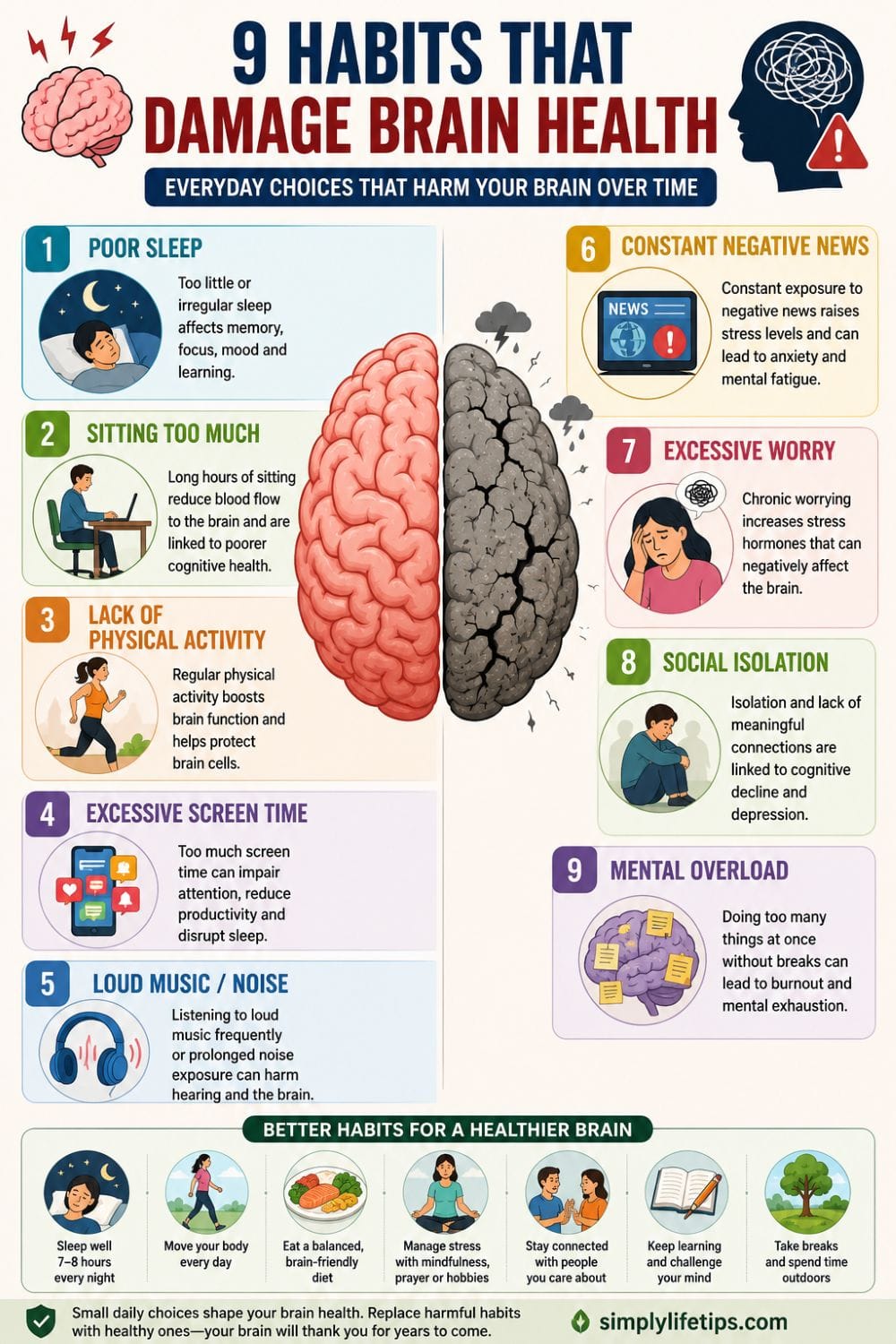
The good news is that many of these habits can be changed. Small, consistent improvements in sleep, movement, stress management, social connection, and daily recovery can help create a healthier routine.
What Can You Do to Protect Brain Health?
Understanding habits that damage brain health is only the first step; changing them is what matters. You do not have to change your entire life overnight to protect your brain health. In fact, trying to change too many things at once can become another source of stress. A better approach is to look at your daily routine, identify the habits that may be placing unnecessary strain on your mind and body, and make small, realistic adjustments that you can maintain over time.
Prioritize Sleep
Give yourself enough time to sleep each night and try to maintain a reasonably consistent sleep schedule. Going to bed and waking up at approximately the same time can help establish a predictable routine. Instead of treating sleep as something that can be sacrificed whenever work or entertainment takes longer than expected, consider it an important part of your daily health routine. If you regularly stay up late scrolling through your phone, watching videos, or working, try creating a simple wind-down period before bedtime.
Move Regularly
If your work requires you to sit for long periods, make an effort to get up and move throughout the day. You could stand while taking a phone call, walk around during a short break, stretch after completing a task, or take a brief walk instead of remaining at your desk continuously. You do not have to wait until you have time for a full workout. Regular movement throughout the day can help break up prolonged sitting and make an otherwise sedentary routine more active.
Protect Your Hearing
Avoid unnecessarily loud music and prolonged exposure to excessive noise. If you use headphones, keep the volume at a comfortable level rather than turning it up simply to block out surrounding sounds. The same applies to televisions, speakers, and other audio devices. Protecting your hearing is important because repeated exposure to excessively loud sound can cause hearing damage. A simple habit such as lowering the volume and taking listening breaks can reduce unnecessary exposure.
Use Screens Intentionally
Technology is an important part of modern life, so completely avoiding screens is neither realistic nor necessary for most people. The goal is to use them intentionally rather than allowing endless scrolling to consume your time. For example, you might decide to keep your phone away while eating, stop scrolling shortly before bedtime, or take regular breaks during long periods of computer work. The time saved can be used for sleeping, walking, reading, talking with family, enjoying a hobby, or simply allowing your mind to rest.
Manage Your News Consumption
Staying informed is useful, but you do not need to follow every developing story throughout the day. Constantly checking negative headlines can leave you feeling overwhelmed, particularly when the information concerns events you cannot control. Instead, choose a few reasonable times to catch up on reliable news and then move on with your day. This allows you to remain informed without allowing negative information to dominate your attention from morning until night.
Turn Worry Into Action
Thinking about the future can be helpful when it leads to preparation and sensible decisions. The problem begins when thinking becomes endless worrying without any constructive action. When something concerns you, ask yourself whether there is something you can actually do about it. If there is, identify one practical step and take it. If there is nothing you can control at the moment, repeatedly imagining every possible negative outcome is unlikely to solve the problem. Learning to distinguish between useful planning and unproductive worry can help create a healthier mental routine.
Maintain Social Connections
Make time for family, friends, neighbors, colleagues, community activities, or other meaningful relationships. You do not need a large social circle to maintain connection. A regular conversation with someone you trust, having a meal with family, meeting a friend for a walk, or participating in a community activity can provide valuable human interaction. When life becomes busy, social connection can easily be pushed aside, but maintaining meaningful relationships is an important part of overall well-being.
Permit Yourself to Rest
Rest is not laziness, and being productive every minute of the day is not a requirement for a healthy life. If you constantly move from work to messages, social media, news, household responsibilities, and entertainment without allowing yourself genuine downtime, you may eventually feel mentally exhausted. Give yourself periods when you are not required to achieve anything. Take a quiet walk, sit outside, read something enjoyable, listen to relaxing music at a safe volume, or simply spend a few minutes without constant notifications. Recovery is part of maintaining a sustainable routine.
Why Small Changes Matter for Brain Health?
Understanding habits that damage brain health is important, but recognizing them is only the first step. The real benefit comes from gradually replacing unhealthy patterns with habits that support better brain health. The good news is that many habits that damage brain health are lifestyle patterns we can modify. Protecting brain health does not require a perfect lifestyle. Nobody follows every healthy habit perfectly every day. You may occasionally sleep late, spend too much time on your phone, sit through an entire movie without moving, or have a stressful day when worrying feels difficult to control. An occasional lapse does not mean that you have damaged your brain.
The greater concern is when unhealthy patterns become persistent and leave little room for adequate sleep, physical activity, meaningful relationships, and recovery. A habit that happens occasionally is very different from a routine that continues day after day for months or years.
Instead of trying to change everything at once, choose one habit that you can realistically improve. If you sit for long periods, begin by taking short movement breaks. If your sleep schedule is inconsistent, work toward a more regular bedtime. If you constantly check negative news, limit yourself to a few designated times each day. If you spend too much time scrolling, put your phone away for part of the evening.
Once one change becomes easier, you can gradually work on another. Small improvements may seem insignificant on a single day, but repeated consistently, they can become part of a healthier lifestyle.
Protecting brain health is not about living a perfect life. It is about making better choices more often and giving your brain enough sleep, movement, connection, and recovery to function well.
Conclusion
Habits that damage brain health are often ordinary behaviors that become excessive over time. Poor sleep, prolonged sitting, physical inactivity, excessive noise exposure, uncontrolled screen use, constant negative news, persistent worry, social isolation, and a lack of mental recovery can all deserve closer attention. Recognizing habits that damage brain health allows us to replace them with healthier routines.
At the same time, it is important not to turn every unhealthy habit into a claim of permanent brain damage. Brain health is influenced by many factors, and research often shows associations rather than proving that one everyday behavior directly causes a particular brain condition.
The practical message is simpler.
Sleep well. Move regularly. Protect your hearing. Use technology wisely. Stay connected. Manage unnecessary worry. Take breaks. Give your mind time to recover.
When the mind is repeatedly pushed without adequate recovery, you may begin to experience mental exhaustion, making ordinary tasks feel unnecessarily difficult.
Your brain works for you every day. Isn’t it worth giving it the care it needs?
Frequently Asked Questions
What are the main habits that damage brain health?
Common lifestyle habits that may negatively affect brain and cognitive health include inadequate sleep, prolonged sedentary behavior, physical inactivity, excessive noise exposure, excessive or poorly balanced screen use, persistent stress or worry, social isolation, and insufficient recovery time.
Can lack of sleep affect brain health?
Yes. Regularly getting too little sleep can affect attention, mood, memory, and daytime functioning. Most adults need at least seven hours of sleep, although individual needs vary.
Does sitting too long damage brain health?
Prolonged sedentary behavior has been associated with poorer cognitive and brain-health outcomes in some research, particularly among older adults. However, the evidence is still developing and does not mean that sitting for a certain number of hours automatically causes brain damage.
Can loud music damage the brain?
The clearest established risk from excessively loud music is hearing damage. Very loud or prolonged sound exposure can cause noise-induced hearing loss, which is why protecting your hearing is important.
Is spending time alone bad for brain health?
No. Healthy solitude can be beneficial. The concern is prolonged social isolation or loneliness. Research has associated social isolation with several health risks, including cognitive decline, although the relationship is complex.

Mathukutty P V is a Blogger, YouTuber, and Content Writer and the founder of Simply Life Tips. After taking voluntary retirement in 2017, he embraced a free lifestyle focused on learning, personal growth, and sharing practical wisdom to help others live with more purpose and positivity.