
How your brain tricks you is more fascinating than you might imagine. You may trust your eyes, feel confident about your memories, and believe your instincts are usually right. But what if your brain sometimes makes you see things differently, remember events incorrectly, or believe something simply because it supports your existing opinions?
Imagine walking along a dimly lit road and suddenly seeing what looks like a snake. Your heart races, your body becomes alert, and you prepare to move away. A moment later, you realize it was only a rope on the ground.
The rope never changed. Your interpretation did.
Similar experiences happen in everyday life. We overlook things right in front of us, remember conversations differently from others, and jump to conclusions without checking the facts.
This does not mean that the human brain is defective. Our brains must interpret enormous amounts of information, often quickly and with incomplete evidence. The shortcuts that help us navigate daily life can sometimes produce mistakes.
Let’s explore seven ways your brain tricks you, why these experiences happen, and what you can do to make better judgments.
7 Everyday Examples of How your Brain Tricks You
Our brains interpret visual information, reconstruct memories, and rely on mental shortcuts. The infographic below highlights seven ways these processes can sometimes mislead us.
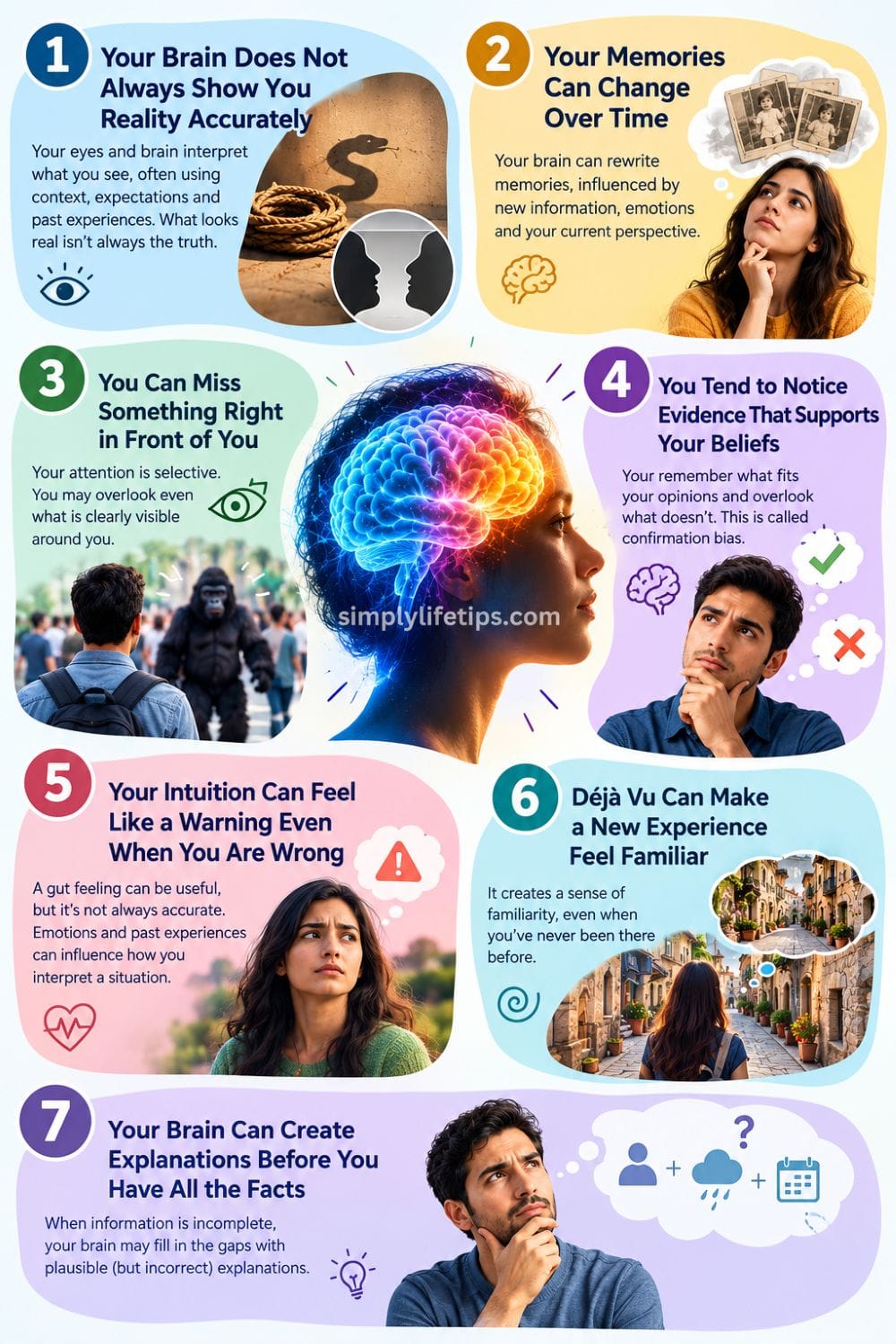
As you can see, the brain does not always give us a completely accurate picture of reality. Sometimes, it fills gaps in information, overlooks important details, or favours what we already believe.
Understanding these mental shortcuts can help us question our first impressions, evaluate information more carefully, and make better decisions. Let’s explore each of these seven psychological phenomena and discover how they influence our everyday lives.
1. Your Brain Does Not Always Show You Reality Accurately
Have you ever looked at an optical illusion and wondered how two people could see the same image differently? Or mistaken a shadow for a person when walking alone at night?
These experiences demonstrate that seeing is not simply a matter of recording everything around us. The brain interprets visual information using context, expectations, previous experiences, and other available clues.
Imagine seeing a coiled rope in a dark corner. Because you cannot clearly identify its shape, your brain may interpret it as a snake. When you switch on the light, you recognise the object correctly.
The initial interpretation was mistaken, but the experience illustrates how perception works under uncertain conditions.
Optical illusions provide another example. Lines of equal length can appear different because of the surrounding shapes and visual context. The physical image remains unchanged, but the brain interprets it differently.
This is one reason the phrase seeing is believing can be misleading. Our perceptions are useful, but they are not infallible.
What can you learn from this?
When something looks suspicious, frightening, or surprising, avoid immediately treating your first impression as fact. Check the lighting, context, and other available evidence before deciding what you saw.
For example, if you think you recognise someone in a crowded place, look again before waving or calling out. A quick first impression is not always accurate.
2. Your Memories Can Change Over Time
Have you ever argued with a friend about something that happened several years ago? You both remember the same event, yet each person is convinced that their version is correct.
This is possible because human memory does not work like a video recording.
When you remember an event, your brain retrieves information about it. That recollection can be influenced by details you learned later, your current perspective, your expectations, and the way you interpret the past.
Psychologists have studied this phenomenon extensively. The American Psychological Association explains the misinformation effect, in which misleading information can influence a person’s later recollection of an event.
Consider a simple example. You remember attending a family gathering where a relative made an embarrassing comment. Later, another family member repeatedly tells you that the comment was directed at you. Over time, your recollection may become influenced by that person’s account, even if the original details were different.
This does not mean every memory is unreliable. Many memories are accurate in important respects. The problem is that feeling certain about a memory does not guarantee that every detail is correct.
Memory can also be influenced by emotion. An upsetting experience may remain vivid, while small details about the timing or exact words become less certain.
What can you learn from this?
When discussing a disagreement, distinguish between what you clearly remember and what you have inferred or learned from others.
Instead of saying, “I know exactly what you said,” consider saying, “This is how I remember the conversation.”
That small change leaves room for clarification without dismissing your experience.
3. You Can Miss Something Right in Front of You
Imagine searching for your phone while it is lying on your desk. You check the same area several times before finally noticing it.
Or imagine concentrating on a difficult task so intensely that someone walks into the room without you noticing.
These experiences are related to a phenomenon called inattentional blindness. It occurs when people fail to notice an unexpected object or event because their attention is occupied elsewhere.
In a well-known 1999 study, psychologists Daniel Simons and Christopher Chabris investigated inattentional blindness using a video in which participants had to pay attention to a particular task. Some participants failed to notice an unexpected person dressed in a gorilla costume passing through the scene.
The research was published in the journal Perception. You can read the original study, Gorillas in Our Midst: Sustained Inattentional Blindness for Dynamic Events.
The important lesson is that having something within your field of vision does not guarantee that you will consciously notice it.
Your attention is selective. When you concentrate on one task, you may miss other information, even when it is clearly visible.
This matters in everyday situations. A driver concentrating on navigation may fail to notice a pedestrian. A student reading a message during a conversation may miss an important detail. Someone searching for a particular item may overlook an object that does not match their expectations.
What can you learn from this?
Give important tasks your full attention, particularly when safety is involved. Reduce distractions when driving, crossing roads, or handling equipment.
When searching for something, pause and deliberately scan the surrounding area instead of repeatedly looking at the same spot without changing your approach.
4. You Tend to Notice Evidence That Supports Your Beliefs
Suppose you believe that a particular brand makes the best mobile phones. Whenever someone praises that brand, you remember the comment. When someone reports a problem with it, you dismiss the complaint as an exception.
This is an example of confirmation bias.
Confirmation bias is the tendency to seek, interpret, or remember information in ways that support existing beliefs while giving less attention to contradictory evidence.
The American Psychological Association’s definition of confirmation bias explains this tendency in the context of how people evaluate evidence and expectations.
Confirmation bias can influence almost every area of life.
On social media, people may follow accounts that share their existing opinions. During disagreements, they may collect examples that prove the other person is wrong while ignoring their own mistakes. When making predictions, they may remember the occasions when they were correct and forget the times they were mistaken.
Imagine you believe that a particular news source always tells the truth. You remember the stories that support your opinion but dismiss reports that reveal errors or contradictions. Over time, you may become more convinced of your belief without fairly examining the evidence on both sides.
Repeated over time, this selective attention can create an exaggerated sense of accuracy.
The danger is not simply believing something that is wrong. It is becoming less willing to examine whether the belief is wrong.
What can you learn from this?
Whenever you strongly believe something, ask yourself two questions:
- What evidence supports my belief?
- What evidence would make me reconsider it?
Look for reliable information that challenges your assumptions, not just information that agrees with them.
You can also develop this habit through the practical methods explained in our guide to Rules of Critical Thinking.
The aim is not to doubt everything. It is to make sure your confidence is supported by evidence rather than familiarity or personal preference.
5. Your Intuition Can Feel Like a Warning Even When You Are Wrong
Have you ever entered a room and immediately felt uncomfortable without knowing why? Perhaps you sensed that something was wrong or felt certain that an unfamiliar situation would end badly.
Intuition can sometimes be useful. Your brain learns from previous experiences and may recognise patterns before you can consciously explain them.
For example, an experienced driver may notice subtle signs of danger in traffic. A teacher may recognise that a student is struggling before the student asks for help. A person familiar with a workplace may sense that an unusual situation needs closer attention.
However, intuition is not always accurate.
Fear, anxiety, previous disappointments and incomplete information can influence how you interpret a situation. A delayed message from a friend may trigger the thought that the friendship is ending, even though the person may simply be busy.
The feeling can be genuine without the explanation being correct.
This distinction matters because people sometimes treat a strong emotion as proof that their interpretation must be true.
A feeling of danger deserves attention when there are plausible warning signs, but a feeling alone cannot establish what is happening or predict the future.
What can you learn from this?
Treat intuition as a signal to examine a situation, not as a final verdict.
Ask yourself whether you have concrete evidence, whether a previous experience is influencing your judgment, and whether a more ordinary explanation is possible.
Developing self-awareness can help you recognise the difference between what you feel and what you know. Our guide to cultivating self-awareness for personal growth explores this skill in greater detail.
6. Déjà Vu Can Make a New Experience Feel Familiar
You visit a place for the first time, yet suddenly feel certain that you have been there before. The arrangement of the furniture, the conversation or the surrounding scenery seems strangely familiar.
This experience is called déjà vu, a French expression meaning “already seen.”
Déjà vu is common and is generally brief. It creates a feeling of familiarity even when you cannot identify a genuine previous experience that explains it.
Researchers have proposed several explanations involving memory and familiarity, but the precise mechanisms are not fully settled. One possibility is that familiarity and conscious recollection do not always align perfectly, making a present experience feel as though it belongs to the past.
The Cleveland Clinic explains the experience and discusses possible causes in its article, That Strange Feeling of Déjà Vu — Explained.
For example, you might enter an unfamiliar building and suddenly feel that you have seen the same hallway before. The sensation can be surprisingly convincing, but it does not prove that you visited the location previously or predicted the event.
Déjà vu is not evidence of supernatural foresight. It is an unusual experience of familiarity that can occur during ordinary life.
What can you learn from this?
You do not need to panic when you experience occasional déjà vu. Recognise the feeling without assuming that it reveals hidden knowledge about the future.
If episodes become frequent, prolonged or are accompanied by other concerning symptoms, seek medical advice, because déjà vu can occasionally occur in association with neurological conditions.
7. Your Brain Can Create Explanations Before You Have All the Facts
Human beings naturally look for reasons why things happen.
If a colleague does not greet you in the morning, you might conclude that they are angry with you. If a plan succeeds, you may believe that your decision was entirely responsible for the outcome.
But what if the colleague was distracted? What if several factors contributed to the success?
When information is incomplete, people sometimes fill the gaps with explanations that feel reasonable but have not been verified.
For example, you notice that a friend has stopped responding to messages. You immediately conclude that you have offended them. You replay recent conversations and interpret ordinary remarks as possible signs of a problem.
Later, you discover that your friend was dealing with a personal emergency.
The original explanation felt convincing because it offered a clear story. It was not necessarily supported by the available evidence.
This tendency is related to broader patterns of reasoning, including jumping to conclusions and assuming that one event caused another simply because they occurred together. It is not always a clinical memory problem; it is an everyday risk when we interpret incomplete information.
The same mistake occurs when we judge other people’s motives. We may interpret a short reply as rudeness, a missed appointment as disrespect or an unexpected result as proof that our original theory was correct.
What can you learn from this?
Separate facts from interpretations.
For instance:
- Fact: Your friend has not replied to your message.
- Interpretation: Your friend is angry with you.
- Other possibilities: They may be busy, tired, distracted or dealing with an unexpected problem.
Before accepting an explanation, consider whether other possibilities fit the facts. When appropriate, ask the person directly rather than relying on assumptions.
This approach is also useful when making important choices. Our article on the different types of thinking explains how critical, analytical, and reflective thinking can help you evaluate situations more carefully.
How Can You Stop Your Brain from Misleading You?
You cannot eliminate every perceptual error, memory distortion, or thinking bias. However, you can develop habits that reduce the chances of making avoidable mistakes.
Pause before accepting your first impression
When something surprises or upsets you, give yourself time to examine it. Your initial interpretation may be useful, but it should not automatically become your conclusion.
Check facts before drawing conclusions
Look for reliable evidence, particularly when making important decisions or sharing information online. Do not treat a repeated claim as true simply because many people believe it.
Consider alternative explanations
Ask yourself whether the same facts could support another reasonable interpretation. This is particularly helpful during disagreements and emotionally difficult situations.
Be willing to correct yourself
Changing your mind after receiving better evidence is a sign of sound reasoning, not weakness. The goal is to understand what is true rather than to defend every previous opinion.
Recognise the influence of emotions
Fear, anger, excitement and embarrassment can affect how you interpret events. Recognising these feelings can help you avoid treating an emotional reaction as conclusive evidence.
Practise critical thinking
Regularly question assumptions, examine evidence and distinguish observations from interpretations. These habits become especially valuable when evaluating news, social media claims and personal disagreements.
Conclusion
How your brain tricks you reveals an important fact about human psychology: our experiences are shaped not only by what happens around us but also by how we perceive, remember and interpret those events.
Your eyes can misinterpret an object, your memory can change over time, your attention can overlook something obvious, and your beliefs can influence which evidence you notice. Even intuition and familiar feelings can sometimes lead you towards an incorrect conclusion.
These experiences do not mean that you should distrust every thought or memory. They remind us that confidence and accuracy are not always the same thing.
The next time you feel certain that you are right, pause for a moment. Ask yourself what you actually observed, what your brain may have added, and whether the available evidence supports your conclusion.
Understanding how the brain tricks you is not about fighting against your own mind. It is about learning to use its remarkable abilities more thoughtfully, recognise its limitations, and make wiser decisions in everyday life.
FAQs About How Your Brain Tricks You
1. How does your brain trick you?
Your brain interprets information using perception, memory, attention, previous experiences, and expectations. These processes usually help you understand the world, but they can sometimes produce visual misinterpretations, inaccurate memories, or biased judgments.
2. Can your brain create false memories?
Yes. Memory can be influenced by misleading information, suggestions and later experiences. A person may confidently remember details incorrectly, although this does not mean that all memories are unreliable.
3. What is confirmation bias?
Confirmation bias is the tendency to favour information that supports existing beliefs while overlooking or discounting contradictory evidence. It can influence decisions, arguments, product choices and the way people consume news.
4. Why do I sometimes experience déjà vu?
Déjà vu is a feeling that a present experience has happened before. It is generally brief and harmless, although researchers have not established one complete explanation for every occurrence.
5. How can I avoid being misled by my own brain?
Pause before making judgments, verify important information, consider alternative explanations, and remain open to evidence that challenges your beliefs. Practising critical thinking and self-awareness can help you make more balanced decisions.

Mathukutty P V is a Blogger, YouTuber, and Content Writer and the founder of Simply Life Tips. After taking voluntary retirement in 2017, he embraced a free lifestyle focused on learning, personal growth, and sharing practical wisdom to help others live with more purpose and positivity.