
Multitasking is often considered a valuable skill, but does doing several things at once actually make us more productive? Consider a woman preparing breakfast, helping her child get ready for school, answering a phone call, and remembering her work commitments—all in a short period. We may admire her ability to manage so many responsibilities. But what is happening inside her brain?
Is multitasking the result of a special brain ability, years of practice, or the demands of everyday life? And are women naturally better at multitasking than men?
The science of multitasking reveals a fascinating truth: doing more things at once does not necessarily mean getting more done. Understanding how the brain manages attention can help us work more effectively, make better decisions, and recognise the effort involved in managing multiple responsibilities.
Does the Human Brain Really Multitask?
When we appear to perform several activities simultaneously, our brains are often switching attention rapidly between tasks. This process is known as task switching.
For example, imagine writing an important email while checking WhatsApp messages and answering occasional phone calls. You may feel that you are handling three activities at once. However, your attention frequently moves from writing to reading messages and then back to writing.
Each switch requires your brain to adjust to the demands of the new activity. You may need to remember where you stopped, recover your train of thought, and decide what to do next.
According to the American Psychological Association’s explanation of multitasking and switching costs, switching between tasks can reduce efficiency, particularly when the activities are complex or unfamiliar.
This does not mean that every combination of activities is ineffective. Walking while talking to a familiar person, for example, may be relatively easy for many people. However, writing a detailed report while participating in a demanding conversation requires competing mental resources.
The important distinction is between performing compatible activities and repeatedly switching between tasks that require concentration.
Why Can Multitasking Reduce Efficiency?
Frequent task switching can have several consequences:
- Time loss: Returning to a previous task may require time to recover your train of thought.
- More mistakes: Divided attention can make it easier to overlook important details.
- Reduced concentration: Repeated interruptions can make sustained focus more difficult.
- Mental effort: Managing competing demands requires attention and cognitive control.
Consider a blogger researching a scientific topic. Every time the blogger switches from reading a research paper to checking social media, the flow of thought may be interrupted. When returning to the article, the blogger may need to reread the material before continuing.
The lesson is not that multitasking is always bad. It is that the brain works differently depending on the demands of the tasks involved.
Is Focused Attention More Powerful Than Multitasking?
Focused attention is the ability to concentrate on relevant information while limiting distractions. It plays an important role in activities such as studying, writing, analysing information, and solving complicated problems.
The prefrontal cortex and other interconnected brain networks contribute to executive functions, including planning, working memory, attention regulation, and decision-making.
Imagine a student preparing for an important examination. Studying a difficult chapter requires understanding concepts, remembering information, and connecting different ideas. If the student repeatedly checks notifications, concentration may be interrupted, making the learning process less efficient.
Similarly, a surgeon performing a complex operation needs to pay close attention to the procedure and respond appropriately to changing circumstances.
Focused attention does not automatically make someone more intelligent than a person who manages several responsibilities. Different activities demand different skills.
The real advantage lies in recognising when a task requires uninterrupted concentration and when switching between activities is appropriate.
For more practical ideas about improving your thinking and concentration, read Practical Strategies to Think Smarter.
Are Women Better at Multitasking Than Men?
The belief that women are naturally better multitaskers than men is widespread. Women often manage household responsibilities, childcare, professional commitments, and family needs, sometimes within the same period. Their ability to coordinate these responsibilities can be impressive.
But does scientific evidence establish that women have a universal biological advantage in multitasking?
Research does not support such a broad conclusion.
A 2019 study published in PLOS ONE examined gender differences in both task switching and simultaneous multitasking. The researchers tested 96 participants and assessed several measures of performance. They found substantial multitasking costs but no statistically significant gender differences across the ten performance measures examined.
You can read the original peer-reviewed research: Putting a Stereotype to the Test: Gender Differences in Multitasking.
This finding challenges the popular assumption that women are universally better at multitasking than men. However, it does not prove that every individual performs identically or that no differences could appear in other tasks or circumstances.
Multitasking performance can depend on the type of activity, familiarity, training, working memory, processing speed, and individual differences.
Therefore, it is more accurate to say that scientific evidence has not established a consistent, universal female advantage in multitasking ability.
Understanding how the brain handles multitasking helps explain why doing several things at once does not always improve productivity. The infographic below summarises what happens when we switch between tasks, why focused attention matters, and what research reveals about gender differences in multitasking.
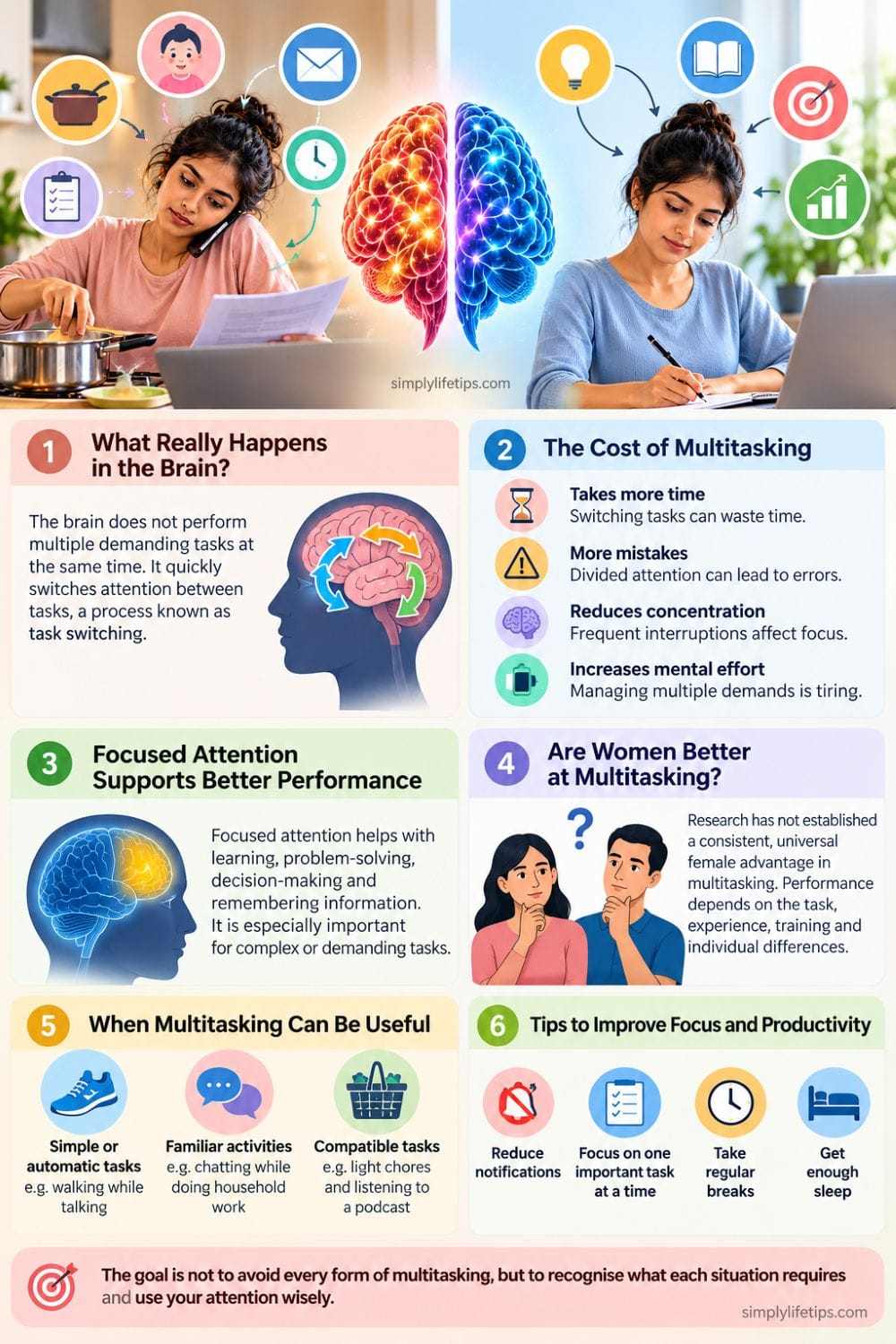
As the infographic illustrates, the goal is not to avoid multitasking completely, but to understand when it is useful and when it can interfere with concentration. Reducing unnecessary interruptions, prioritising important tasks, and allowing time for focused work can help us use our attention more effectively. Individual abilities vary, and multitasking should not be judged by gender alone.
Why Do Women Often Appear Better at Managing Multiple Responsibilities?
If women do not have a clearly established universal biological advantage, why does the belief persist?
One possible explanation is the difference in everyday experiences and social expectations.
In many households, women are expected to coordinate cooking, childcare, household management, family appointments, and professional responsibilities. Repeatedly handling these demands may provide experience in planning, prioritising, anticipating needs, and shifting attention.
However, experience managing multiple responsibilities should not be confused with proof of a special biological ability.
Social expectations also influence how we interpret these behaviours. When a woman manages several responsibilities successfully, people may describe her as naturally gifted at multitasking. They may overlook the time, effort, and practice involved.
Men can also develop strong organisational and multitasking skills through experience and training.
Most importantly, being capable of managing several responsibilities does not mean someone should be expected to carry every burden. Household work, childcare, and caregiving should be shared fairly.
Recognising someone’s ability should go hand in hand with recognising their effort and their need for rest.
What Happens in the Brain When We Switch Tasks?
Three cognitive processes help explain why managing multiple demanding activities can be difficult.
1. Task Switching
Task switching occurs when attention moves from one activity to another. The brain must adjust its goals and retrieve the information needed for the new task.
For example, a person writing a report may stop to answer a message and then return to the report. The interruption may be brief, but recovering the original line of thought can take additional time.
2. Working Memory
Working memory allows us to hold and use information temporarily. It helps us remember instructions, organise ideas, and follow a sequence of steps.
When interruptions occur during a demanding activity, some of the information needed to continue may become harder to keep in mind. This can make it necessary to reread, reconsider, or repeat part of the task.
3. Executive Control
Executive control helps us maintain goals, manage competing demands, and regulate attention.
Suppose you are writing an article when an urgent family call arrives. You need to decide whether to pause your work, respond to the call, or finish a particular section first.
Executive control helps you evaluate the situation and choose an appropriate response.
These processes show why productivity is not simply about the number of activities we attempt to perform. It also depends on how effectively we manage our attention and priorities.
How Can You Improve Concentration and Productivity?
You do not need to eliminate every form of multitasking to work more effectively. The goal is to reduce unnecessary interruptions and use your attention wisely.
1. Focus on One Important Task at a Time
Choose one demanding task and give it your attention before moving to the next.
If you are studying, writing, or analysing information, temporarily set aside unrelated activities. Completing one meaningful section of work can be more useful than repeatedly starting several tasks without finishing them.
2. Reduce Unnecessary Notifications
Phone alerts, messages, and social media updates can interrupt your concentration.
Silence nonessential notifications during important work. You can still remain available for urgent calls while reducing interruptions that do not require immediate attention.
3. Break Large Tasks into Smaller Steps
A large task may feel overwhelming when you attempt to manage every part simultaneously.
If you are writing a blog post, divide the process into research, outlining, drafting, fact-checking, and editing. Completing these stages in a sensible sequence can make the work easier to manage.
4. Prioritise Your Responsibilities
Not every task requires immediate action.
Identify what is urgent, what is important, and what can wait. For example, completing an important assignment may deserve priority over checking social media.
Prioritisation helps you make deliberate choices instead of responding to every demand as it appears.
5. Get Enough Sleep
Sleep supports attention, learning, memory, and decision-making. Insufficient sleep can make it harder to concentrate and manage demanding activities.
Maintaining a regular sleep routine and allowing enough time for rest can support your ability to focus.
6. Take Appropriate Breaks
Sustained concentration requires effort. Short breaks can help you manage fatigue and return to your work with renewed attention.
You might try working for 25 minutes and then taking a five-minute break. Adjust the duration to suit the task and your working style; this is a practical technique, not a universal scientific rule.
7. Learn to Switch Tasks Deliberately
Some situations genuinely require you to manage competing demands. Parents, caregivers, and professionals often need to respond to changing priorities.
When switching tasks is necessary, decide what needs attention first. Before returning to your previous activity, remind yourself where you stopped and what remains to be done.
The goal is not to avoid every interruption. It is to make task switching purposeful rather than habitual.
Try This Simple 25-Minute Focus Experiment
Would you like to discover whether interruptions affect your own productivity? Try this simple experiment.
- Choose one meaningful task, such as reading a chapter or writing an article.
- Set a timer for 25 minutes.
- Put your phone aside and silence nonessential notifications.
- Work only on the selected task.
- At the end, note what you completed, how often your attention wandered, and whether you made avoidable mistakes.
Repeat the exercise on another occasion under your usual working conditions and compare your experience.
This is an informal self-observation exercise, not a scientific test. Nevertheless, it can help you recognise which working habits support your concentration.
Conclusion
Multitasking can help us manage everyday responsibilities, but doing several things at once does not always make us more productive. Research suggests that frequently switching between demanding tasks can reduce efficiency, interrupt concentration, and increase the risk of mistakes. Focused attention is especially valuable when learning, solving problems, or making important decisions.
Although women are often considered better multitaskers than men, scientific research has not established a consistent, universal female advantage. Experience, training, individual differences, and social expectations all influence how people manage multiple responsibilities. We should appreciate women’s efforts without assuming that they must carry every burden alone.
Ultimately, the real strength of the brain lies in knowing when to divide our attention and when to concentrate on one important task. Being busy is not the same as being productive; what matters is how effectively we use our attention.
For more practical ways to support your cognitive health, explore our guide to 10 Daily Habits That Make the Brain Smarter.
What do you think matters more: managing several tasks at once or giving your full attention to one important task? Share your experience in the comments.
FAQs About Multitasking
1. Can the human brain multitask?
The brain can coordinate certain activities simultaneously, especially when they are simple or familiar. However, demanding tasks often compete for attention, and switching between them can reduce efficiency.
2. Are women naturally better at multitasking than men?
Research has not established a consistent, universal female advantage in multitasking. Individual performance varies according to the task, experience, training, and other factors.
3. Why does task switching affect productivity?
Switching tasks requires the brain to adjust its goals and retrieve relevant information. Repeated switching can consume time, interrupt concentration, and increase the chance of mistakes.
4. Is single-tasking always better than multitasking?
No. Single-tasking is often helpful for complex work requiring sustained concentration, while combining simple or compatible activities can be practical. The best approach depends on the situation.
5. How can I improve my concentration?
Reduce unnecessary notifications, prioritise important tasks, divide large projects into smaller steps, take appropriate breaks, and get enough sleep. Experiment with focused work sessions to identify what works best for you.
References
- American Psychological Association. Multitasking: Switching Costs.
- Hirsch, P., Koch, I., & Karbach, J. (2019). Putting a stereotype to the test: The case of gender differences in multitasking costs in task-switching and dual-task situations. PLOS ONE, 14(8), e0220150.
- Stoet, G., O’Connor, D. B., Conner, M., & Laws, K. R. (2013). Are women better than men at multi-tasking?. BMC Psychology, 1, 18.
This article was inspired by a Facebook post by Dr Arun Oommen, a neurosurgeon, about multitasking and the brain. The article develops the topic independently and includes links to scientific research. It should not be interpreted as a direct quotation or formal endorsement by the doctor.

Mathukutty P V is a Blogger, YouTuber, and Content Writer and the founder of Simply Life Tips. After taking voluntary retirement in 2017, he embraced a free lifestyle focused on learning, personal growth, and sharing practical wisdom to help others live with more purpose and positivity.