
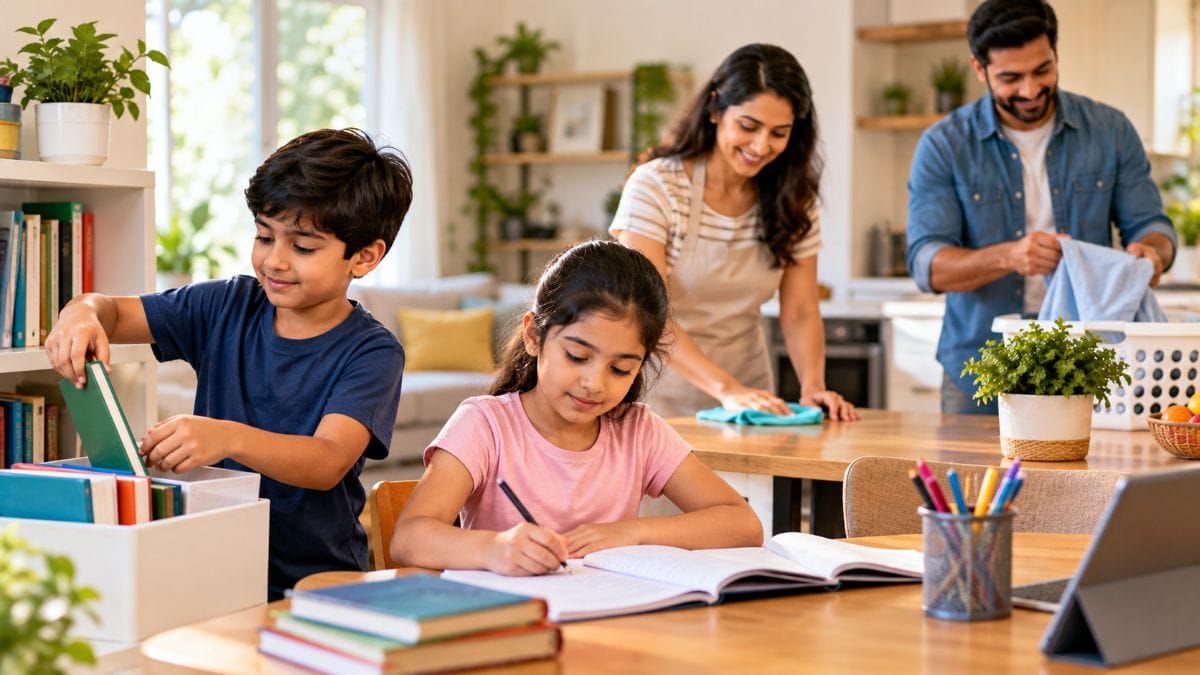
Teaching children responsibility starts with everyday habits at home. Children do not automatically become responsible adults when they grow older; they gradually develop responsibility through routines, expectations, choices, and experience.
Parents naturally want to protect their children and make life easier for them. However, doing everything for a child can sometimes prevent them from learning how to manage everyday responsibilities independently.
The goal is not to make childhood unnecessarily difficult. Instead, children need age-appropriate opportunities to contribute, make decisions, solve problems, and learn from mistakes.
Parenting children in today’s changing world can bring challenges that previous generations did not face, so parents may also find these parenting tips for the modern generation helpful.
Here are seven important rules that can help parents raise more responsible and independent children.
7 Rules for Teaching Children Responsibility
1. Teach Children to Develop a Healthy Routine
A consistent daily routine can help children learn discipline and time management.
This does not mean every child needs to wake up extremely early. Children need adequate sleep, and sleep requirements vary with age. The important lesson is developing a predictable routine and learning to manage the day responsibly.
Depending on their age, children can learn to:
- Wake up at a consistent time
- Make their bed
- Brush their teeth
- Get dressed independently
- Eat breakfast
- Prepare their school bag
- Complete morning tasks without constant reminders
Parents can gradually transfer responsibility to the child rather than managing every step.
For example, instead of repeatedly saying, “Get your school bag ready,” parents can establish a routine in which the child prepares it the night before.
These small habits teach children that they have responsibilities to manage.
Establishing healthy routines and age-appropriate expectations is an important part of supporting children’s development, as explained in the CDC’s Positive Parenting Tips
2. Don’t Clean Up Every Mess They Make
One of the simplest ways of teaching children responsibility is allowing them to take responsibility for their own belongings and messes.
If children leave toys scattered around the room, parents do not always need to clean everything themselves.
Instead, teach them to put their toys away.
As children grow, their responsibilities can increase. They might organize their room, put dirty clothes in the laundry basket, arrange books, or help keep shared spaces tidy.
For example, if a child spills water, an adult can help if necessary but also teach the child to get a cloth and participate in cleaning it up.
The lesson is simple:
Actions have consequences, and everyone has responsibilities at home.
Household chores are not merely work. They can teach children independence, cooperation, and accountability.
3. Teach Them to Take Schoolwork Seriously
School is another important area for teaching children responsibility.
Parents should know what their children are learning and encourage them to complete their schoolwork. However, there is a difference between supporting a child and doing the work for them.
Children should gradually learn to:
- Keep track of assignments
- Complete homework
- Organize school materials
- Prepare for tests
- Manage their study time
- Ask for help when necessary
- Finish tasks they have started
Parents can provide guidance without taking complete control.
For example, if a child struggles with homework, instead of giving them every answer, ask questions that help them understand the problem.
The objective is not simply getting homework finished.
It is developing the habit of taking responsibility for learning.
Teaching responsibility works best when children receive consistent guidance and encouragement, and these guidelines for being good parents can provide additional ideas for parents.
4. Teach Practical Life Skills
Children need more than academic knowledge to become independent adults.
They also need practical skills.
Parents can involve children in everyday activities such as:
- Preparing simple meals
- Washing dishes
- Folding clothes
- Organizing shelves
- Watering plants
- Cleaning their study area
- Helping with groceries
- Looking after personal belongings
Tasks should always be appropriate for the child’s age and abilities, particularly when cooking, using tools, or handling potentially dangerous objects.
For example, a younger child might help wash vegetables, while an older child may learn to prepare a simple meal.
These activities teach children that useful work is part of everyday life.
They also provide opportunities to develop confidence and independence.
5. Give Children Opportunities to Learn Different Skills
Children discover their abilities through experience.
Give them opportunities to explore different activities instead of expecting them to excel at everything immediately.
Depending on their interests and age, children can try:
- Reading
- Drawing
- Sports
- Music
- Gardening
- Cooking
- Public speaking
- Craft activities
- Simple repairs
- Team activities
Not every activity will become a lifelong interest.
That is perfectly fine.
The purpose is exploration.
A child who tries different activities may discover an unexpected talent or interest. Even when they do not become particularly skilled at something, the experience can teach persistence, creativity, concentration, and confidence.
Parents should focus more on effort and learning than on constant achievement.
6. Don’t Give Children Everything They Want
This is one of the most important rules.
Children naturally want things. They may ask for new toys, gadgets, games, treats, or other things they see their friends enjoying.
Parents do not have to satisfy every request immediately.
Teaching children to wait can help them develop patience and self-control.
For example, if an older child wants an expensive toy, parents might encourage them to save part of their allowance or wait for a suitable occasion.
This does not mean deliberately depriving children of things they need.
It means helping them understand the difference between needs and wants.
While parents naturally want to make their children happy, avoiding common parenting mistakes that can affect children’s development can help them develop greater independence and self-control.
Children who learn that every desire does not have to be fulfilled immediately may become better prepared to handle disappointment and delayed gratification.
They can also learn that some rewards require effort and patience.
Why Rule Six Matters
Instant gratification can make it difficult for children to appreciate what they have.
When children occasionally have to wait, save, work, or make a choice between competing wants, they have opportunities to develop:
- Patience
- Gratitude
- Self-control
- Financial awareness
- Appreciation
- Perseverance
These are valuable skills far beyond childhood.
Setting appropriate boundaries while responding to children’s needs with warmth and understanding is an important part of positive parenting
7. Let Children Face Small, Age-Appropriate Struggles
This may be the most important rule of all.
Parents naturally want to protect their children from difficulties. But solving every problem immediately can prevent children from developing problem-solving skills.
When a child faces a safe and manageable challenge, give them an opportunity to think before stepping in.
For example, if a child cannot solve a puzzle, don’t immediately show them the answer.
Ask:
“What could you try next?”
If a child forgets where they put something, encourage them to think about where they last used it.
If children have a minor disagreement, allow them to communicate and find a solution when it is safe and appropriate.
Of course, parents should intervene when there is danger, serious conflict, bullying, abuse, or a situation beyond the child’s ability to manage.
The goal is not to leave children alone with serious problems.
The goal is to allow them to experience manageable challenges.
Why Rule Seven Matters
Small struggles can provide opportunities to develop:
- Resilience
- Problem-solving skills
- Decision-making
- Patience
- Independence
- Confidence
A child who is never allowed to struggle may become dependent on others to solve every problem.
A child who is guided through manageable challenges can gradually learn, “I can figure this out.”
That confidence can become extremely valuable later in life.
Parents can support children’s growing independence by giving them appropriate responsibilities while providing guidance and support when needed, as the American Academy of Pediatrics notes.
These seven simple rules can help children gradually develop responsibility, independence, patience, and confidence in everyday life.
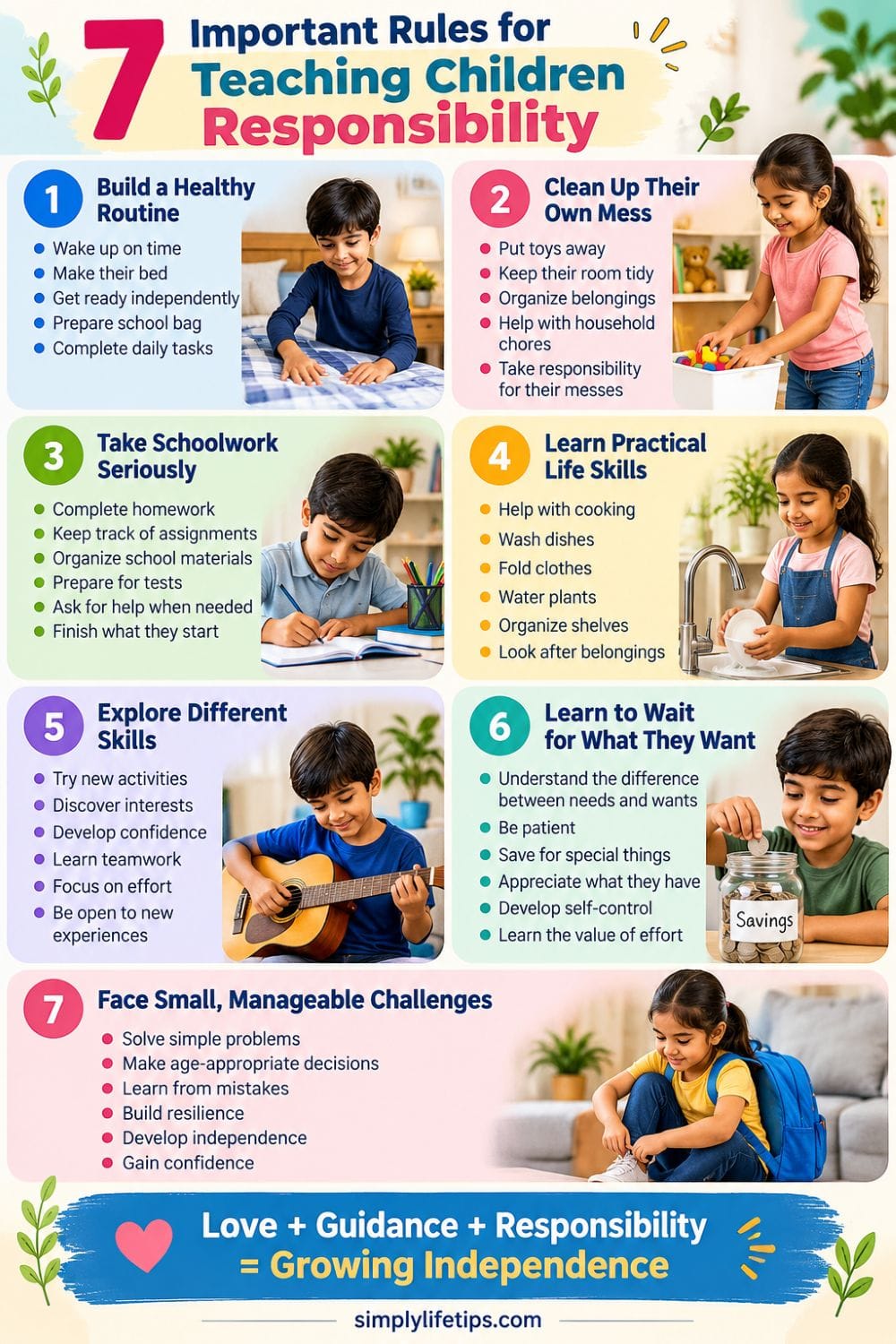
Remember: Teaching children responsibility is a gradual process. Give them age-appropriate responsibilities, allow them to learn from manageable mistakes, and provide guidance without doing everything for them.
Love and Responsibility Should Go Together
Teaching children responsibility does not mean being harsh or demanding.
Children need love, encouragement, emotional security, and guidance.
At the same time, they need reasonable boundaries and opportunities to take responsibility for their actions.
A balanced approach might look like this:
Love without responsibility can sometimes lead to dependence.
Responsibility without love can feel harsh.
Love combined with guidance and responsibility can help children develop independence while knowing they have support when they genuinely need it.
Parents should therefore avoid two extremes: doing everything for children and expecting children to handle everything alone.
The goal is gradual independence.
How Parents Can Start Today
Parents do not need to introduce seven new rules at once.
Start with one small responsibility.
For example:
Week 1: Put toys and belongings away.
Week 2: Prepare the school bag independently.
Week 3: Add one household chore.
Week 4: Encourage the child to solve a small problem before asking for help.
As children become comfortable with one responsibility, another can gradually be introduced.
The process should be appropriate for their age and personality.
These small responsibilities can gradually help children become more independent, and you can also learn more about raising responsible children.
Conclusion
Teaching children responsibility is a gradual process built through everyday experiences.
Children learn responsibility when they participate in household tasks, manage schoolwork, develop routines, explore new skills, wait for things they want, and face manageable challenges.
Rules six and seven deserve particular attention because learning to delay gratification and handle small struggles can help children develop patience, resilience, and problem-solving abilities.
Parents do not need to make childhood difficult to raise responsible children.
They simply need to avoid making everything too easy.
Give children love.
Guide them.
Give them responsibility.
And give them opportunities to discover that they are capable of doing things for themselves.
The habits children develop today can help shape the adults they become tomorrow.
FAQs About Teaching Children Responsibility
How can parents start teaching children responsibility?
Start with small, age-appropriate tasks such as putting away toys, organizing belongings, helping with household chores, and completing simple routines independently.
What are good responsibilities for children?
Good responsibilities include cleaning up after themselves, organizing personal belongings, helping with household tasks, caring for pets or plants, and managing age-appropriate schoolwork.
Should parents give children everything they ask for?
No. Children can benefit from learning that some wants require patience, saving, effort, or waiting. Parents should still provide everything children genuinely need for their health, safety, and development.
Why should children be allowed to struggle?
Safe, manageable struggles can provide opportunities to develop problem-solving skills, patience, resilience, and confidence. Parents should intervene when a situation is dangerous or beyond the child’s ability to manage.
How do you raise a responsible child?
Give children age-appropriate responsibilities, establish reasonable routines, encourage independence, allow them to make appropriate choices, teach them practical skills, and guide them through manageable challenges rather than solving every problem for them.
References
- CDC — Positive Parenting Tips
- UNICEF — Parenting
- American Academy of Pediatrics — HealthyChildren.org

Mathukutty P V is a Blogger, YouTuber, and Content Writer and the founder of Simply Life Tips. After taking voluntary retirement in 2017, he embraced a free lifestyle focused on learning, personal growth, and sharing practical wisdom to help others live with more purpose and positivity.



