
Text Neck Syndrome is a term commonly used to describe neck and upper-body discomfort associated with prolonged smartphone or other digital device use.
How many hours a day do you look down at your phone?
You check your phone as soon as you wake up. You look at it while having breakfast. You use it while travelling, during breaks at work, and sometimes even when you are lying in bed.
The smartphone has become an important part of everyday life. But while the phone may be making our lives easier, could the way we use it be putting unnecessary strain on our neck?
The problem is not simply using a phone. It is often the combination of long periods of use, limited movement, and staying in an awkward position for too long.
Children, teenagers, and young adults may spend many hours using smartphones and tablets. Office workers may spend even longer periods sitting in front of computers and laptops. When these habits continue day after day, the neck and shoulders may begin to complain.
What Is Text Neck Syndrome?
Text Neck Syndrome is a commonly used term for neck pain, stiffness, and other discomfort associated with prolonged use of smartphones and similar devices, particularly when a person keeps the head bent forward for a long time.
A particularly useful reference is the 2023 scoping review “Defining text neck: A scoping review.” It reviewed 41 articles and found that definitions of “text neck” vary considerably. Importantly, it concluded that there was no scientific evidence establishing a direct link between text neck and neck pain.
It is worth remembering that Text Neck Syndrome is not a universally accepted medical diagnosis. Neck pain can have many causes, and smartphone posture is only one possible contributing factor.
Still, the way we use our phones matters.
When you repeatedly sit with your head bent forward and your shoulders rounded while looking at a screen, the muscles around your neck and shoulders must work continuously to maintain that posture.
That can leave the muscles tired, tight, and uncomfortable.
A systematic review examined biomechanical evidence related to smartphone use and found changes in head and neck posture and muscle activity during smartphone use, while noting that the evidence should be interpreted carefully because study quality was moderate.
Our Brain May Love the Phone, But Our Neck May Not!
Our head is naturally balanced over the neck when we look straight ahead.
But when we bend our head forward to look down at a phone, the position of the head changes. The muscles around the neck and shoulders have to work differently to support it.
Think about carrying a bag.
Holding it close to your body is generally easier than holding it away from your body for a long time. A similar principle applies when the head moves forward from its natural position.
The longer you stay in that position without moving, the more uncomfortable your neck and shoulders may become.
This is why the problem may not be the phone itself.
It may be the way, the duration, and the frequency of phone use.
Can Poor Posture Change the Natural Curve of the Neck?
The neck has a natural curve that helps support the head and allow normal movement.
Poor posture maintained for long periods may affect how the neck and upper body are positioned. Some people may develop changes in the normal alignment of the neck over time.
However, we should not assume that every change in the curve of the neck means permanent damage.
Neck pain can occur for many reasons, including muscle strain, injury, joint problems, disc problems, and nerve irritation. Stress, poor sleep, and lack of physical activity can also influence how the body feels.
So, if you develop neck pain, it is better not to simply blame your phone.
Symptoms You Should Not Ignore
Your neck may give you several warning signs when it is under strain.
You may notice neck pain or stiffness after spending a long time on your phone. Your shoulders may feel tight, or you may develop discomfort across the upper part of your back.
Some people may experience headaches or difficulty turning the neck comfortably.
Other symptoms may include pain travelling from the neck towards an arm, tingling, numbness or a feeling of weakness in the hand or arm.
These symptoms do not necessarily mean that you have Text Neck Syndrome. They can occur with several different neck and nerve conditions.
That is why persistent or significant symptoms should not simply be ignored.
Can Smartphone Use Really Cause Neck Pain?
This is an important question because it is easy to blame every neck problem on smartphone use.
Research has found associations between smartphone use, prolonged neck positions, and musculoskeletal symptoms. However, research does not show that looking down at a smartphone automatically causes neck pain in everyone.
Neck pain is influenced by many factors.
How active you are, how long you sit, how well you sleep, your stress level, previous injuries, and other health factors may all play a role.
A 12-month longitudinal study published in 2025 found that cervical flexion during smartphone use was not a risk factor for developing neck pain, while insufficient physical activity and poor sleep quality were associated with neck pain. Cervical flexion posture during smartphone use and neck pain – PMC
So the better message is not “phones cause neck damage.”
The better message is:
Long periods in the same awkward position are not good for your body.
A 2025 scoping review found that the available literature did not establish a causal relationship between text neck and neck pain. Neck pain and text neck using Hill’s criteria of causation – PubMed
You Don’t Have to Give Up Your Phone!
The good news is that you do not have to stop using your smartphone. A few simple changes can make your phone habits more comfortable.
Using your phone more responsibly can help you develop healthier screen habits and reduce some of the problems associated with excessive phone use.
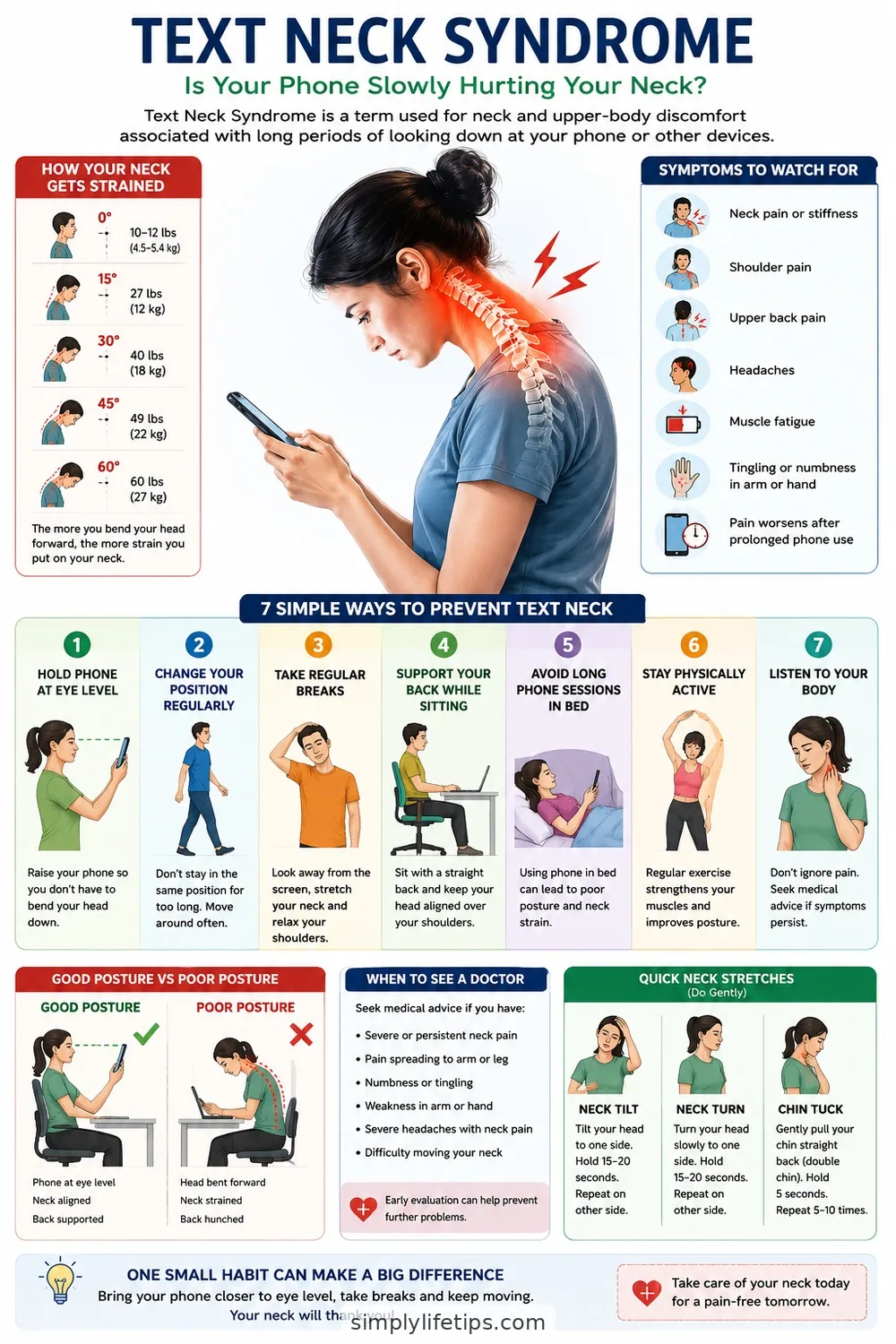
Keep Your Phone Closer to Eye Level
Instead of constantly looking down, try bringing your phone higher.
You do not have to hold it directly in front of your eyes all the time. The idea is simply to reduce the amount of time you spend with your head deeply bent forward.
Don’t Stay in One Position for Too Long
Even a comfortable position can become uncomfortable if you stay there for hours.
Get up.
Walk around.
Relax your shoulders.
Move your neck gently.
Change your sitting position.
Your body needs movement.
Take Regular Breaks
If you spend a lot of time using your phone, tablet, or computer, make it a habit to take regular breaks. Put the device down for a while, look away from the screen, stand up, and move around. Even a short break can give your neck and shoulders a chance to relax and recover from staying in the same position for too long.
The good news is that you do not have to stop using your smartphone.
If you spend a lot of time using your phone, tablet, or computer, make it a habit to take regular breaks. Put the device down for a while, look away from the screen, stand up and move around. Even a short break can give your neck and shoulders a chance to relax and recover from staying in the same position for too long.
When sitting, try to give your back adequate support. Keep your shoulders relaxed and avoid constantly pushing your head forward. If you work on a computer for several hours, arrange your screen and chair so that you can work without continually bending your neck. A comfortable working position is much better than spending the entire day leaning towards the screen.
Give Your Back Proper Support
When sitting, try to give your back adequate support. Keep your shoulders relaxed and avoid constantly pushing your head forward. If you work on a computer for several hours, arrange your screen and chair so that you can work without continually bending your neck. A comfortable working position is much better than spending the entire day leaning towards the screen.
Avoid Long Phone Sessions While Lying in Bed
Using your phone in bed can easily turn into a long session.
You may bend your neck, support your head with several pillows, and continue scrolling without realizing how long you have been in that position.
Try to avoid keeping your neck bent for long periods while using your phone in bed.
Your body also needs proper rest and sleep.
Stay Physically Active
Your neck is not separate from the rest of your body.
If you spend most of your day sitting, make an effort to include regular physical activity.
Walking, general exercise, and activities that strengthen the shoulders and upper back can help you maintain overall physical fitness.
If you already have significant neck pain, numbness or weakness, speak with a healthcare professional before starting specific neck exercises.
Listen to Your Body
Do not ignore pain simply because you believe your phone is responsible.
If your symptoms continue, become worse, or interfere with your daily activities, seek medical advice.
Especially pay attention to symptoms such as numbness, tingling, weakness, or pain travelling into an arm.
What Lifestyle Habits Can Help Protect Your Neck?
Looking after your neck is not only about changing the way you hold your phone.
It is about developing better daily habits.
Try not to spend the entire day sitting in one position. Get up regularly and move.
If you work on a computer or laptop, arrange your workstation so that you do not have to keep your neck bent down.
If you drive for long periods, take appropriate breaks when possible and change your position when it is safe to do so.
Regular physical activity can help keep your muscles strong and your body mobile.
Be careful when lifting heavy objects. Avoid unnecessary heavy loads and use proper lifting techniques.
Sleep also matters. Choose a comfortable sleeping position and a pillow that supports your neck without forcing it into an awkward position.
There is no need to search endlessly for a “perfect” posture.
The better goal is to avoid staying in the same uncomfortable position for too long.
How Is Neck Pain Treated?
Treatment depends on what is actually causing the neck pain.
Sometimes the cause may be simple muscle strain or prolonged poor posture. In other cases, the problem may involve a joint, disc, or nerve.
For mild discomfort, changing the activity that is causing the strain, staying gently active, and using appropriate heat or other simple measures may help.
Depending on the cause, a doctor may recommend medicines, physiotherapy, stretching or strengthening exercises.
Do not assume that strong massage or forceful neck manipulation is suitable for every type of neck pain.
If you have pain travelling into an arm, numbness, tingling or weakness, it is particularly important to have the problem properly assessed.
An X-ray, MRI or other investigation is not required for every episode of neck pain. A healthcare professional will decide whether testing is necessary based on your symptoms and examination.
Surgery is generally considered only for selected problems, particularly when there is significant nerve or structural involvement and other treatments have not provided sufficient relief.
When Should You See a Doctor?
Most occasional neck discomfort does not mean that something serious is wrong.
But you should not ignore persistent or severe symptoms.
Seek medical advice if you have severe or continuing neck pain, pain spreading into an arm or leg, numbness, tingling, weakness, or significant difficulty moving your neck.
If neck symptoms occur after a serious injury, medical assessment is also important.
The important point is simple:
Don’t assume every neck problem is just Text Neck Syndrome. Find out what is actually causing it.
For practical advice and warning signs, Mayo Clinic is a good patient-friendly reference. It specifically discusses prolonged smartphone/computer positioning, neck pain symptoms, posture, and when medical attention is appropriate. Mayo Clinic – Neck pain: Symptoms and causes
One Small Habit Can Make a Big Difference
You do not have to throw your smartphone away to protect your neck.
Start with one simple habit.
“Don’t keep your phone down. Bring it closer to eye level.”
Then remember to move.
Put the phone down.
Relax your shoulders.
Stand up.
Walk around.
Give your neck a break.
Our phones need charging every day.
Our bodies need care every day too.
Technology is supposed to make our lives easier. It should not become a reason for us to stop moving or ignore what our bodies are telling us.
So the next time you find yourself sitting with your head bent over your phone, pause for a moment.
Raise the phone.
Straighten up comfortably.
Relax your shoulders.
And move.
Don’t make looking down at your phone for hours a daily habit.
Conclusion
Text Neck Syndrome reminds us of something very simple: the way we use technology can affect the way we use our bodies.
You do not have to stop using your phone.
Just don’t spend hours looking down at it without moving.
Bring the phone closer to eye level, take regular breaks, stay physically active and listen to your body’s warning signs.
A small change in your phone habit today may help you take better care of your neck tomorrow.
And once again, remember the simple message:
“Don’t keep your phone down. Bring it closer to eye level.”
This article was inspired by a Facebook post shared by Dr. Arun Oommen, Neurosurgeon. The content has been independently researched, rewritten, and supplemented by Simply Life Tips for general public education.
Frequently Asked Questions
What is Text Neck Syndrome?
Text Neck Syndrome is a commonly used term for neck and upper-body discomfort associated with prolonged smartphone or device use, particularly when the head remains bent forward for extended periods. It is not a universally accepted medical diagnosis.
What are the symptoms of Text Neck Syndrome?
Commonly reported symptoms include neck pain, stiffness, shoulder discomfort, upper-back pain, and headaches. Some people may also experience tingling, numbness, or pain travelling into an arm, which may require medical evaluation.
Can looking down at a phone damage your neck?
Spending long periods in an awkward position can place additional strain on the muscles and structures around the neck. However, smartphone use should not automatically be considered the cause of every neck problem.
How can I prevent Text Neck Syndrome?
Hold your phone closer to eye level, avoid staying in one position for long periods, take regular breaks, stay physically active, and arrange your computer workstation comfortably.
When should I see a doctor for neck pain?
Seek medical advice if neck pain is severe, persistent, or associated with numbness, tingling, weakness, or pain spreading into an arm or leg. Neck pain following a significant injury should also be medically assessed.

Mathukutty P V is a Blogger, YouTuber, and Content Writer and the founder of Simply Life Tips. After taking voluntary retirement in 2017, he embraced a free lifestyle focused on learning, personal growth, and sharing practical wisdom to help others live with more purpose and positivity.