The science of spirituality is opening a fascinating conversation about the human mind, emotional resilience, meaning, purpose, and well-being. For centuries, people have turned to prayer, meditation, contemplation, compassion, nature, and spiritual traditions to understand themselves and cope with life’s deepest challenges. Today, neuroscience and psychology are beginning to investigate some of the same questions from a scientific perspective.
Could spirituality contribute to a healthier mind, greater emotional resilience, inner peace, and a deeper sense of purpose?
And in an age when artificial intelligence can process enormous amounts of information in seconds, what will make human beings truly remarkable?
Perhaps the answer is not simply a higher IQ.
Perhaps it is the ability to understand ourselves, regulate our emotions, live according to meaningful values, and remain compassionate when life becomes difficult.
This is where the science of spirituality becomes particularly interesting.
What Happens When Two People Face the Same Crisis?
Imagine two people experiencing a devastating event.
Both lose someone they love.
Both receive a serious diagnosis.
Both experience financial hardship.
Both face uncertainty about the future.
Yet their responses may be dramatically different.
One person may feel completely defeated and unable to imagine a meaningful future. Another may experience the same grief and fear but eventually begin asking:
“What can I learn from this?”
“How can I move forward?”
“What still matters to me?”
“How can I use this experience to become stronger or help someone else?”
This does not mean the second person feels less pain.
It means that human beings can differ greatly in how they interpret, process, and respond to suffering.
Psychology has long studied resilience, coping, meaning-making, and emotional regulation. Spirituality is increasingly being studied as another factor that may interact with these processes.
Recent research suggests that spirituality and spiritual well-being can be associated with mental-health outcomes, although the relationship is complex and depends on the individual’s beliefs, circumstances, and type of spiritual coping.
What Is Spirituality?
Spirituality is a broad concept, and there is no single definition accepted by everyone.
For some people, spirituality is deeply connected with God, faith, prayer, or religious tradition.
For others, it may involve meditation, nature, philosophy, gratitude, compassion, service, self-reflection, or a search for meaning.
At its heart, spirituality often involves questions such as:
- Who am I?
- What gives my life meaning?
- What truly matters to me?
- How should I live?
- How can I remain hopeful during difficult times?
- What is my relationship with other people?
- How am I connected to the world around me?
- What kind of person do I want to become?
Spirituality, therefore, is not necessarily about having all the answers.
Sometimes it is about learning how to ask deeper questions.
Is Spirituality the Same as Religion?
No.
Religion and spirituality can overlap, but they are not identical.
Religion generally involves an organized system of beliefs, traditions, rituals, practices, teachings, and community.
Spirituality can exist within religion, but it can also exist outside formal religious structures.
A religious person may experience spirituality through prayer, worship, scripture, service, and community.
Someone without a formal religious affiliation may experience spirituality through meditation, nature, philosophy, compassion, ethical living, or contemplation.
Neither approach automatically guarantees spiritual maturity.
A person can perform religious rituals while struggling with anger, hatred, arrogance, or intolerance. Conversely, a person without religious affiliation may live with extraordinary compassion, humility, honesty, and concern for others.
This does not diminish religion. It simply highlights an important distinction:
Religion can be a pathway to spirituality, but spirituality is ultimately reflected in how a person understands life and lives it.
What Does Science Say About Spirituality and the Brain?
This is where we need to be careful.
Science has not demonstrated that spirituality itself produces one universal neurological change.
“Spirituality” includes many different experiences and practices, from prayer and religious worship to meditation, mindfulness, contemplation, gratitude, and experiences of awe.
Researchers therefore often study particular practices rather than attempting to scan “spirituality” itself.
Meditation and mindfulness have received considerable scientific attention.
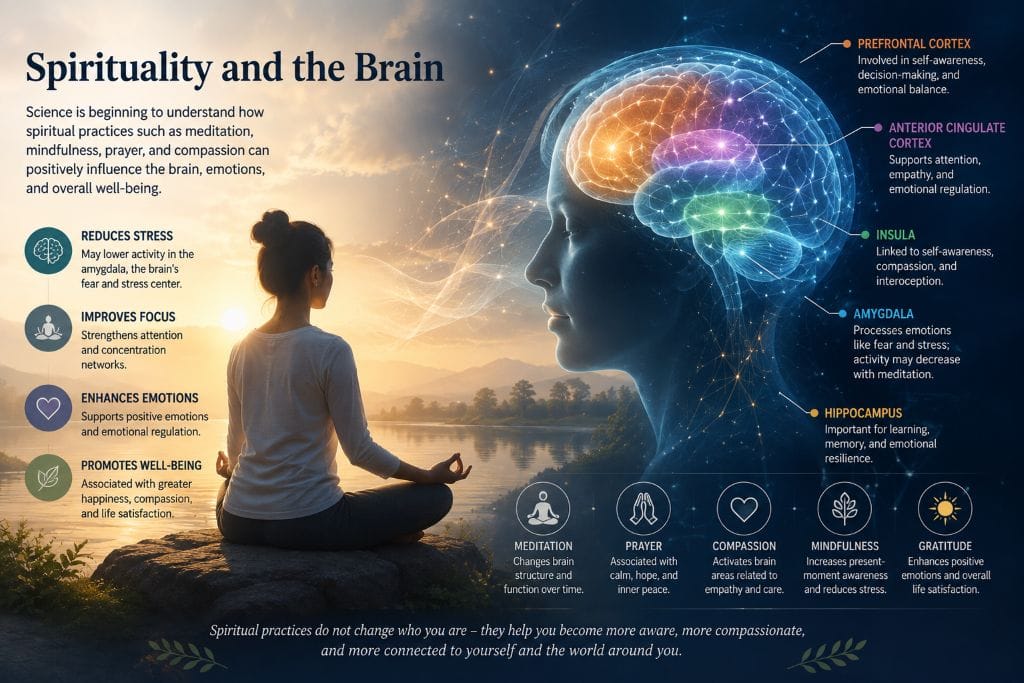
Neuroimaging studies have reported changes associated with meditation in brain regions and networks involved in attention, self-awareness, emotional regulation, interoception, and stress processing. A systematic review of mindfulness and meditation research reported evidence involving areas such as the prefrontal cortex, cingulate cortex, insula, hippocampus, and amygdala.
Research on mindfulness and brain function has identified changes associated with areas involved in attention, self-awareness, emotional regulation, and stress processing. Research on mindfulness and brain function
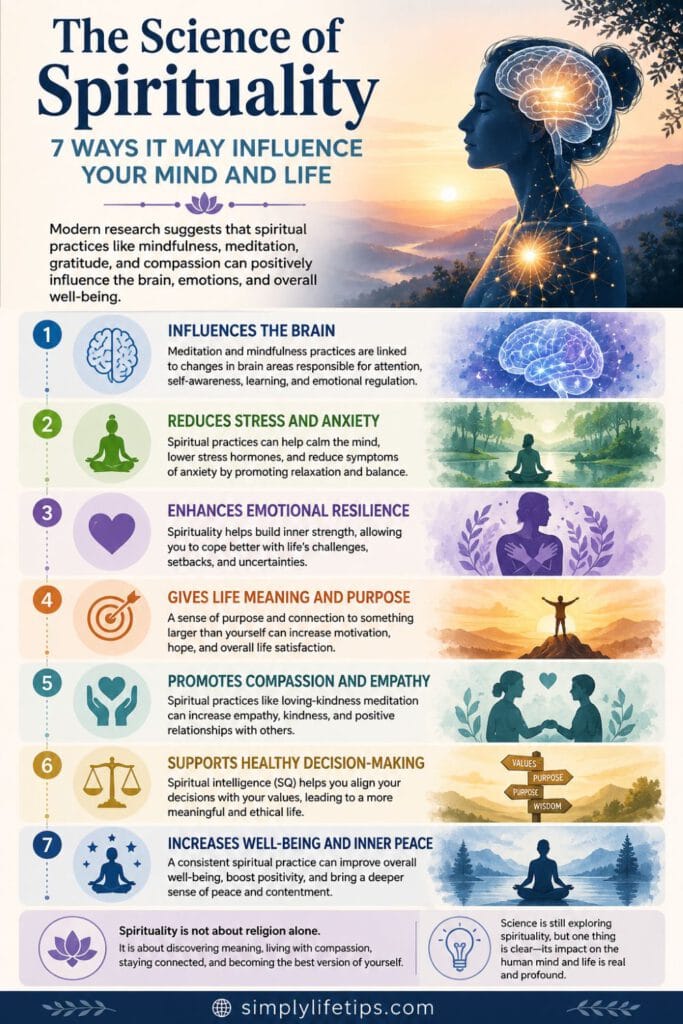
Earlier neuroimaging research also found structural differences in several brain regions among meditation practitioners, although researchers cautioned that methodological limitations and publication bias made stronger conclusions premature.
That distinction matters.
The scientific conclusion is not:
“Spirituality magically changes your brain.”
A more accurate conclusion is:
Certain contemplative and spiritual practices are associated with measurable changes in brain activity, connectivity, or structure, but the mechanisms and long-term effects are still being investigated.
Earlier research has also investigated the relationship between meditation and brain structure, although researchers have cautioned that methodological limitations require careful interpretation of the findings. Meditation and brain structure research
How Meditation May Influence Emotional Regulation?
One reason meditation has attracted so much scientific interest is its potential relationship with emotional regulation.
The amygdala plays an important role in processing emotionally significant and potentially threatening information.
The prefrontal cortex and related networks contribute to cognitive control, attention, decision-making, and regulation of emotional responses.
Research on mindfulness-based interventions has reported changes involving these systems. A systematic review of mindfulness-based stress reduction studies found changes involving the prefrontal and cingulate cortices, insula, hippocampus, and amygdala.
Learning to recognize the difference between an emotional response and an actual threat is also important when understanding phobias and anxiety.
Think about the difference between these two responses:
Immediate reaction:
“Someone criticized me. I need to fight back.”
Mindful response:
“I feel angry. Let me understand why before I respond.”
The situation has not necessarily changed.
The person has changed the space between the emotional trigger and the response.
That space can be powerful.
When the mind remains under pressure for too long, constant emotional and cognitive demands can contribute to mental exhaustion, making rest and recovery increasingly important.
Can Spirituality Improve Mental Well-Being?
Research increasingly suggests that spirituality and spiritual well-being can be relevant to mental health, but the relationship is not always positive or straightforward.
A 2026 systematic review examining spirituality in relation to depression, anxiety, and PTSD found that higher spiritual well-being was generally associated with fewer symptoms of depression and anxiety across the studies reviewed. However, the researchers also found that spiritual conflict and unmet spiritual needs could be associated with greater psychological distress.
Research on spirituality and mental health suggests that spiritual well-being may be associated with better psychological outcomes, although the relationship is complex and depends on the type of spiritual experience. Research on spirituality and mental health
This is an important lesson.
Spirituality is not automatically beneficial simply because it is called spirituality.
How a person understands and uses spirituality matters.
For example, spirituality may help someone develop:
- Hope during difficult circumstances
- A stronger sense of meaning
- Greater self-awareness
- Acceptance of uncertainty
- Compassion toward others
- A sense of connection
- A framework for personal values
- Emotional resilience
But spiritual beliefs can also become sources of distress when they involve intense guilt, fear, conflict, isolation, or harmful interpretations.
A balanced understanding is therefore more useful than simply claiming that spirituality is always good.
Understanding this relationship is important because spirituality can interact with many aspects of mental health, including emotional well-being, coping, resilience, and a person’s sense of meaning.
Spirituality and the Search for Meaning
One of the most important connections between spirituality and psychology may be the human need for meaning.
People do not merely experience events.
We interpret them.
Consider someone who loses a career after twenty years.
The event itself is painful.
But the meaning attached to it can vary.
“I have failed, and my life is over.”
Or:
“This is one of the most difficult periods of my life, but I can decide what I do next.”
The second interpretation does not deny the loss.
It creates a possibility for moving forward.
Spirituality can provide a framework for this kind of meaning-making.
It can encourage people to look beyond immediate circumstances and ask what their experiences mean in the context of their values, relationships, responsibilities, and purpose.
That may be one reason spirituality is often discussed alongside resilience.
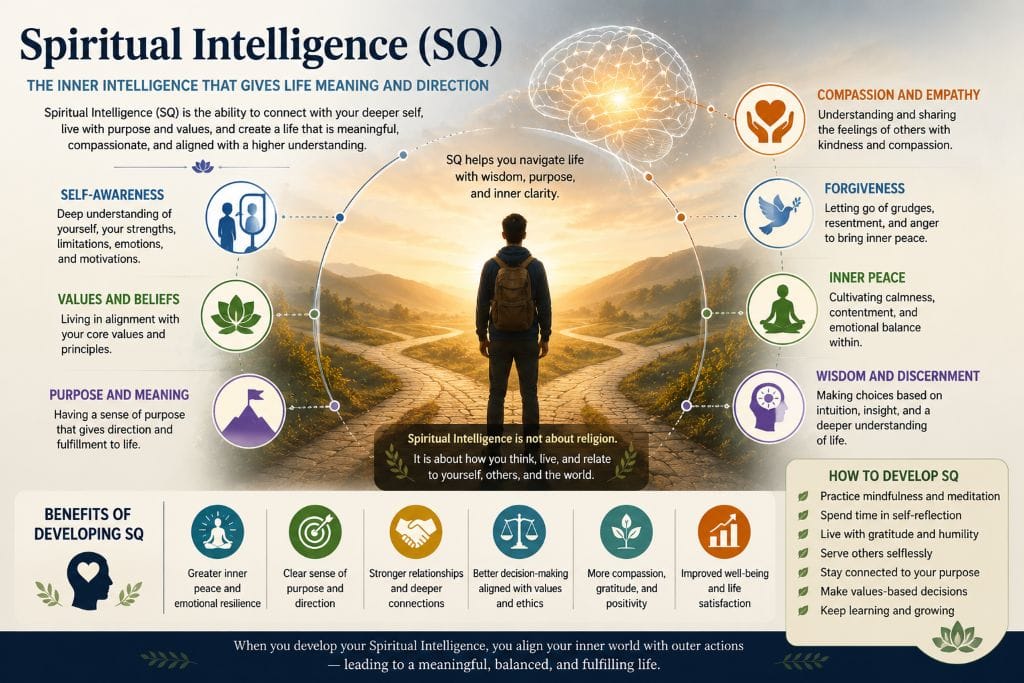
What Is Spiritual Intelligence or Spiritual Quotient (SQ)?
For decades, intelligence was primarily discussed through the concept of IQ.
Later, emotional intelligence brought greater attention to abilities involving emotions, relationships, empathy, and self-regulation.
Spiritual Intelligence, often referred to as SQ, is another proposed framework.
It generally describes capacities such as:
- Searching for meaning and purpose
- Reflecting on existential questions
- Understanding personal values
- Developing self-awareness
- Responding to adversity with perspective
- Connecting actions with deeper principles
- Demonstrating wisdom and compassion
However, there is an important scientific qualification.
Recent research on Spiritual Intelligence examines concepts such as meaning and purpose, higher awareness, adaptive cognition, problem management, and personal growth. Research on Spiritual Intelligence
Spiritual growth is also closely connected with curiosity and personal development because never stop learning is not simply a principle for career success; it can also be a way of continually understanding ourselves and the world around us.
SQ is not a universally accepted intelligence measurement equivalent to IQ.
Researchers continue to debate its definition, measurement, and relationship to other psychological constructs.
A recent scoping review identified spiritual intelligence as a developing construct involving areas such as adaptive cognition, higher awareness, meaning and purpose, problem management, and personal growth.
Another scoping review found associations between spiritual intelligence and resilience, mental and spiritual health, emotional intelligence, and positive social behaviors, while also reporting negative associations with burnout, stress, depression, and anxiety in some studies.
These findings are interesting, but association does not automatically mean causation.
SQ is best understood as an emerging framework for discussing certain human capacities rather than as a scientifically settled numerical intelligence.
Why Could Spiritual Intelligence Matter in the Age of AI?
This question becomes increasingly important as artificial intelligence becomes more capable.
AI can process information.
AI can recognize patterns.
AI can generate text, images, music, and code.
AI can assist with complex decisions.
But human life involves another category of questions.
Not simply:
“Can I do this?”
But:
“Should I do this?”
Not simply:
“Can I become successful?”
But:
“What kind of success is worth pursuing?”
Not simply:
“Can technology make this possible?”
But:
“Should we use technology this way?”
These questions involve values, responsibility, ethics, meaning, compassion, and wisdom.
That is where concepts such as emotional intelligence and spiritual intelligence become interesting.
The more powerful our technology becomes, the more important it may be to develop the human capacity to use that technology responsibly.
In a world filled with constant choices, learning to pause and make thoughtful decisions can also help reduce the mental burden associated with decision fatigue.
Can an Atheist Be Spiritual?
Absolutely.
Spirituality does not necessarily require belief in God.
An atheist may experience profound awe while looking at the universe.
They may find meaning in relationships.
They may dedicate their life to helping others.
They may practice meditation.
They may care deeply about nature.
They may live according to strong ethical principles.
They may spend considerable time reflecting on mortality, consciousness, existence, and the meaning of life.
All of these experiences can fit within broader definitions of spirituality.
At the same time, religious belief does not automatically make someone spiritually mature.
The deeper question is not simply:
“What do I believe?”
It is:
“What does my belief make me become?”
If spirituality makes someone more compassionate, honest, humble, responsible, forgiving, and aware, it has a meaningful influence on character.
Does Spirituality Make People More Compassionate?
Compassion is frequently associated with spiritual traditions, but scientific evidence is more nuanced than simply saying that meditation makes everyone kinder.
Some studies have reported increases in prosocial behavior following meditation, while meta-analytic research has also found that the effects can depend on the type of practice and methodological quality.
This is another reason to avoid exaggerated claims.
Spiritual practice may create opportunities to develop compassion.
But compassion still requires practice.
It is demonstrated through behavior.
A person who meditates for an hour every morning but treats others with cruelty has not necessarily developed spiritual maturity.
Likewise, someone who quietly helps others every day may demonstrate profound compassion without ever using the word “spiritual.”
What Does Spiritual Maturity Look Like?
Spiritual maturity is not necessarily about knowing more religious texts, attending more ceremonies, or talking more about spirituality.
It may appear in ordinary moments.
A spiritually mature person may:
- Pause before reacting in anger.
- Admit when they are wrong.
- Forgive without becoming naïve.
- Accept uncertainty without losing hope.
- Treat vulnerable people with dignity.
- Resist the temptation to judge everyone.
- Live according to values rather than convenience.
- Find meaning even during difficult periods.
- Recognize that success without inner peace may feel empty.
- Understand that other people’s lives matter too.
These qualities overlap with psychological concepts such as emotional regulation, self-awareness, resilience, empathy, and prosocial behavior.
Perhaps that is why spirituality cannot be completely separated from everyday life.
It is ultimately expressed through the way we live.
A strong sense of purpose can also influence how we respond to prolonged pressure, which is particularly relevant when understanding the causes and warning signs of burnout.
Spirituality Is Not a Replacement for Medical Treatment
This point deserves particular attention.
Spirituality may provide meaning, hope, community, reflection, and emotional support.
But it should not be presented as a replacement for appropriate medical treatment or evidence-based psychological care.
Someone experiencing severe depression, anxiety, trauma-related symptoms, suicidal thoughts, psychosis, or another serious health condition may require professional assessment and treatment.
Spirituality can sometimes complement professional care, but it should not be used as an excuse to avoid necessary treatment.
Research itself shows that spiritual experiences can be associated with both positive and negative mental-health outcomes depending on circumstances and the nature of spiritual coping.
A healthy approach leaves room for science, medicine, psychology, relationships, and spirituality to work alongside one another.
How Can You Develop Your Spiritual Side?
Spiritual growth does not necessarily require a dramatic lifestyle change.
It can begin with small practices.
Practice 1: Spend a Few Minutes in Silence
Put away your phone and sit quietly for five or ten minutes.
Notice your thoughts without immediately reacting to them.
The goal is not to stop thinking.
It is to become more aware of your thoughts.
Practice 2: Practice Gratitude
Before going to bed, identify three things you genuinely appreciate.
They do not have to be extraordinary.
A conversation with a friend, a meal, good health, sunlight through a window, or simply having another day to live can be enough.
Practice 3: Spend Time in Nature
Walk without constantly checking your phone.
Observe trees, clouds, birds, sounds, and changing light.
Experiences of awe and connection can encourage reflection and shift attention away from constant self-focus.
Practice 4: Serve Someone
Spirituality becomes more meaningful when it moves from thought into action.
Help someone without expecting recognition.
Listen to someone who needs to talk.
Share your knowledge.
Offer your time.
Small acts of service can transform abstract values into real behavior.
Practice 5: Examine Your Values
Ask yourself:
“What matters most to me?”
Then ask a harder question:
“Does the way I spend my time reflect those values?”
The gap between what we claim to value and how we actually live can reveal a great deal about us.
Practice 6: Learn to Pause Before Reacting
When something triggers anger, fear, or frustration, pause.
Take a breath.
Identify the emotion.
Then choose your response.
This simple habit can gradually strengthen self-awareness and emotional regulation.
Practice 7: Ask Better Questions
Instead of asking only:
“Why is this happening to me?”
Try:
“What can I learn from this?”
“What can I control?”
“Who can I help?”
“What kind of person do I want to be through this experience?”
Sometimes a better question can change the direction of an entire life.
The Greatest Journey May Be the Journey Within
We often measure life through external achievements.
The degree.
The job.
The house.
The bank balance.
The business.
The followers.
The awards.
The destination.
There is nothing wrong with ambition.
But external success does not automatically produce inner peace.
A person can have everything society considers successful and still feel empty.
Another person may have a relatively simple life and experience profound contentment.
This is where the inner journey begins.
The human brain is remarkable because it allows us not only to understand the external world but also to reflect on ourselves.
We can examine our thoughts.
Question our assumptions.
Change our behavior.
Develop compassion.
Learn from suffering.
Choose our values.
And consciously decide what kind of person we want to become.
Prayer may be the path for one person.
Meditation may be the path for another.
Nature may inspire someone else.
Philosophy, music, service, contemplation, or quiet solitude may provide another route.
There does not have to be one universal doorway.
What matters is where the journey leads.
Does it make us wiser?
Does it make us kinder?
Does it make us more responsible?
Does it help us handle suffering without losing our humanity?
Does it help us appreciate life while we have it?
What the Science of Spirituality Really Teaches Us
The science of spirituality is still developing.
Researchers are investigating meditation, mindfulness, spiritual well-being, religious and non-religious practices, meaning-making, compassion, and their relationships with the brain and mental health.
The evidence is promising in several areas, but it is not a license for exaggerated claims.
Science cannot currently prove that spirituality is a universal cure for suffering.
It cannot establish that every spiritual practice produces the same neurological effects.
And it cannot reduce the enormous diversity of human spiritual experience to a single brain scan.
What it can do is help us understand how particular practices and psychological processes may influence attention, emotional regulation, stress, meaning, and well-being.
Perhaps that is enough to make the subject fascinating.
Because spirituality does not necessarily mean escaping reality.
It may mean learning to experience reality more consciously.
Conclusion
The science of spirituality sits at an interesting intersection of neuroscience, psychology, philosophy, religion, and human experience.
Research suggests that practices such as meditation and mindfulness can influence brain activity and processes related to attention and emotional regulation, while spiritual well-being and meaning-making have been associated with important aspects of mental health. But the evidence remains complex, and spirituality should never be reduced to a simple formula or treated as a substitute for professional healthcare.
Perhaps the deepest lesson is not that spirituality gives us every answer.
Perhaps it teaches us to ask better questions.
In a world where artificial intelligence can increasingly provide information, humans may need to become better at deciding what that information means, how it should be used, and what kind of future is worth creating.
IQ may help us understand.
EQ may help us relate.
Technology may help us accomplish.
But wisdom, values, compassion, and a sense of meaning may determine why we do what we do.
And perhaps the greatest measure of spirituality is not how much we know about the invisible world.
It is how we behave in the visible one.
People may eventually forget our wealth, position, qualifications, and achievements.
But they may remember how they felt around us.
They may remember whether we helped them when they were struggling.
They may remember whether our presence brought peace or fear, kindness or judgment, hope or discouragement.
Perhaps that is the deepest promise of spiritual growth:
not simply to understand life better, but to become a better human being while living it.
Frequently Asked Questions
What is the science of spirituality?
The science of spirituality is an emerging interdisciplinary field that examines the relationships among spirituality, contemplative practices, meaning, mental health, well-being, and brain function. Researchers often study specific practices, such as meditation and mindfulness, rather than spirituality as a single, measurable phenomenon.
Can spirituality affect the brain?
Research on meditation and mindfulness has identified changes in brain activity, connectivity, and, in some studies, brain structure. Areas studied include networks associated with attention, self-awareness, emotional regulation, and stress processing. However, the findings vary, and researchers continue to investigate the underlying mechanisms.
Is spirituality the same as religion?
No. Religion generally involves organized beliefs, traditions, rituals, and communities, while spirituality is a broader concept involving meaning, purpose, connection, values, and inner experience. A person can be religious and spiritual, but spirituality can also exist outside organized religion.
What is Spiritual Intelligence or SQ?
Spiritual Intelligence, or SQ, is a proposed psychological construct involving capacities such as meaning-making, existential reflection, self-awareness, values, purpose, and personal growth. It is an emerging concept and is not a universally standardized intelligence measurement equivalent to IQ.
Can an atheist be spiritual?
Yes. Spirituality does not necessarily require belief in God. An atheist can experience spirituality through compassion, ethical living, meditation, nature, philosophy, relationships, service, or reflection on meaning and existence.
Disclaimer
This article is intended for general informational and educational purposes only. It discusses research and ideas related to spirituality, neuroscience, meditation, mindfulness, mental health, and Spiritual Intelligence (SQ). It is not intended to provide medical, psychological, psychiatric, religious, or other professional advice.
Research on spirituality and the brain is still developing, and scientific findings do not establish that spirituality is a cure for mental or physical health conditions. Spiritual practices should not be used as a substitute for appropriate medical treatment or professional mental health care. If you are experiencing significant physical or psychological symptoms, consult a qualified healthcare professional.

Mathukutty P. V. is the founder of Simply Life Tips. He shares practical advice and useful insights on personal growth, health, well-being, technology, and everyday living. His goal is to help readers build positive habits and make informed decisions. He believes in continuous learning and sharing knowledge to help people live healthier, happier, and more meaningful lives.