
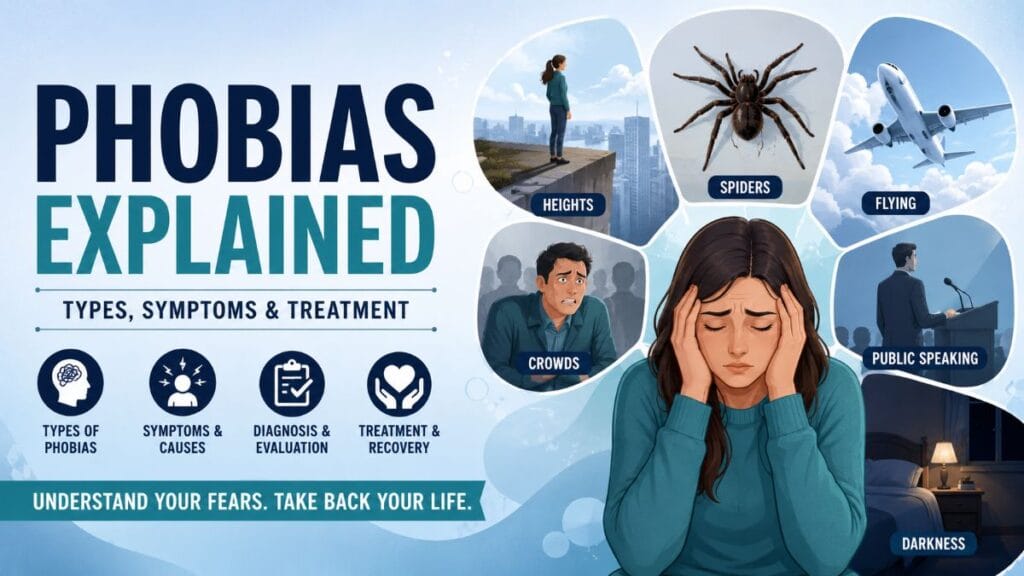
Phobias are among the most common anxiety disorders, affecting millions of people worldwide. While everyone experiences fear from time to time, a phobia is an intense, persistent, and overwhelming fear of a specific object, situation, activity, or living creature. Unlike normal fear, which helps protect us from genuine danger, a phobia can develop even when little or no actual threat exists.
According to a 2021 review published in The Lancet, anxiety disorders—including specific phobias—are among the most common mental health conditions worldwide, affecting people of all ages.
According to the National Institute of Mental Health (NIMH), specific phobias are anxiety disorders that cause excessive fear and avoidance of particular objects or situations. Although people with phobias often recognize that their fear is disproportionate, controlling their emotional response can be extremely difficult.
Someone with a phobia may go to great lengths to avoid the source of their fear. For some, this means avoiding heights or spiders, while for others, it may involve avoiding airplanes, hospitals, social gatherings, or even routine daily activities. Over time, these avoidance behaviors can affect education, employment, relationships, and overall quality of life.
The good news is that phobias are highly treatable. Mayo Clinic notes that cognitive behavioral therapy (CBT) and exposure therapy are among the most effective treatments for helping people reduce fear and regain confidence in everyday situations.
In this comprehensive guide, you’ll learn what phobias are, how they differ from ordinary fears, the various categories of phobias, their causes, symptoms, treatment options, and a detailed A–Z list of common and rare phobias.
What Are Phobias?
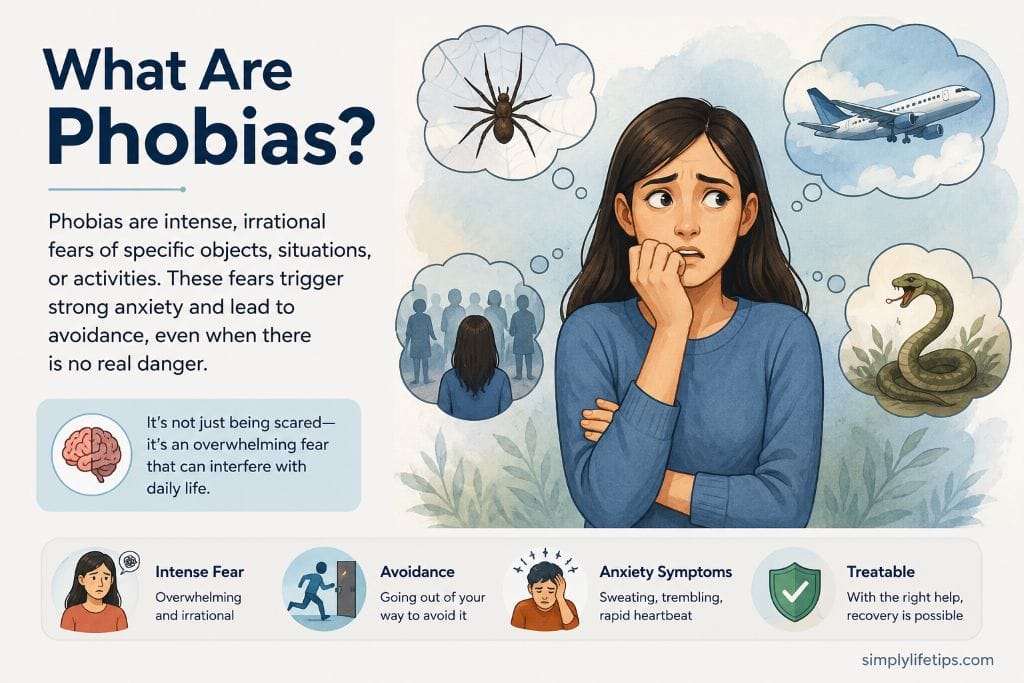
A phobia is a type of anxiety disorder characterized by an excessive, irrational, and persistent fear of a specific object, place, activity, situation, or living thing.
According to the National Institute of Mental Health (NIMH), a specific phobia is an intense, persistent fear of a particular object or situation that is out of proportion to the actual danger and often leads to avoidance behaviors.
The American Psychiatric Association (APA) explains that people with specific phobias experience fear that is far greater than the actual danger posed. Even when they understand that their fear is unreasonable, they may still experience intense anxiety or panic when confronted with the trigger.
For example, most people feel cautious when standing near the edge of a very tall building. This is a normal protective response. However, someone with acrophobia (fear of heights) may experience overwhelming panic simply by looking out of a second-floor window or seeing photographs taken from high places.
One of the defining characteristics of a phobia is avoidance. Individuals frequently change their routines or avoid certain places and situations entirely to prevent encountering what they fear. While avoidance may provide temporary relief, it often strengthens the phobia over time.
Key Characteristics of Phobias
Most phobias share several common characteristics:
- Persistent and excessive fear.
- Immediate anxiety when exposed to the trigger.
- Recognition that the fear is disproportionate to the actual risk.
- Avoidance of the feared object or situation whenever possible.
- Significant interference with work, education, relationships, or daily activities.
- Symptoms that continue for several months or longer.
Examples of Common Phobias
Some of the most common phobias include:
- Acrophobia – Fear of heights.
- Arachnophobia – Fear of spiders.
- Claustrophobia – Fear of enclosed spaces.
- Aerophobia – Fear of flying.
- Glossophobia – Fear of public speaking.
- Trypanophobia – Fear of needles.
- Cynophobia – Fear of dogs.
- Ophidiophobia – Fear of snakes.
Each of these phobias exists on a spectrum. Some individuals experience mild anxiety, while others may have severe panic attacks simply by anticipating contact with the feared object or situation.
Importance of understanding phobias
Untreated phobias can gradually affect nearly every aspect of life.
For example:
- A fear of flying may prevent someone from accepting career opportunities that require travel.
- A fear of driving can reduce personal independence.
- Social phobia may interfere with friendships, education, and professional advancement.
- A fear of medical procedures may lead people to postpone important healthcare appointments.
The encouraging news is that many people experience significant improvement through evidence-based treatments and appropriate professional support.
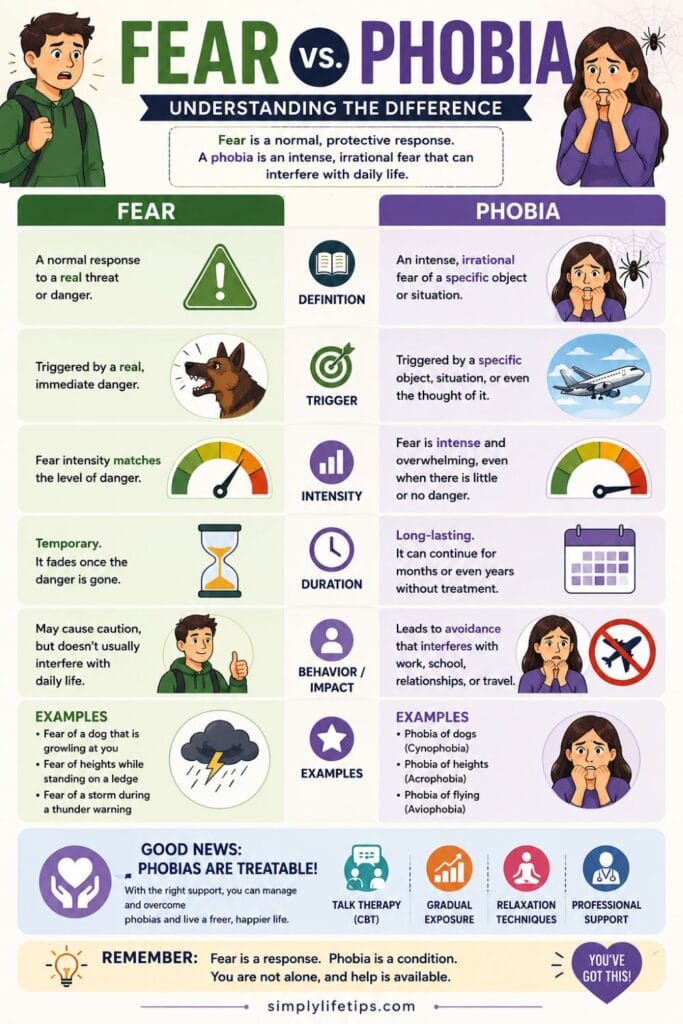
Fear vs. Phobia
Although the words fear and phobia are often used interchangeably, they have very different meanings.
Fear is a normal emotional response that helps protect us from genuine danger. A phobia, however, is an anxiety disorder in which the emotional response is far greater than the actual threat.
What Is Normal Fear?
Fear is part of the body’s natural survival system.
When the brain detects danger, it activates the “fight-or-flight” response, preparing the body to react quickly.
Examples include:
- Moving away from a speeding vehicle.
- Being cautious near a cliff.
- Staying alert during severe weather.
- Avoiding a wild animal.
These reactions are healthy because they help reduce the risk of harm.
What Is a Phobia?
According to the American Psychiatric Association, a phobia involves excessive fear that persists even when the actual danger is minimal or nonexistent.
For example, someone with a phobia may:
- Refuse to enter a room because a spider was once seen there.
- Avoid elevators despite understanding they are safe.
- Experience intense anxiety simply by watching an airplane on television.
- Feel panic before speaking to a small group of familiar colleagues.
Although the danger may be low, the physical and emotional reactions are very real.
Fear vs. Phobia Comparison
| Fear | Phobia |
|---|---|
| Natural protective response | Anxiety disorder |
| Matches the level of danger | Disproportionate to the actual risk |
| Usually temporary | Persistent and recurring |
| Rarely disrupts daily life | Can interfere with work, education, and relationships |
| Easy to manage | Difficult to control without treatment |
| Does not usually cause avoidance | Frequently results in avoidance behaviors |
When Does Fear Become a Phobia?
A fear may be considered a phobia when it:
- Persists over time.
- Causes significant emotional distress.
- Leads to avoidance of normal activities.
- Interferes with work, school, travel, healthcare, or relationships.
- Triggers symptoms such as rapid heartbeat, sweating, trembling, dizziness, or panic attacks.
Recognizing these signs is the first step toward seeking appropriate support. With proper treatment, many people successfully manage or overcome their phobias and regain confidence in everyday life.
Types of Phobias
Not all phobias are the same. While every phobia involves an intense and persistent fear, mental health professionals classify them into different categories based on the nature of the fear. Understanding these categories makes it easier to recognize symptoms and identify appropriate treatment options.
According to the American Psychiatric Association (APA), specific phobias are generally grouped into several major categories. Each category shares similar triggers and behavioral patterns, although the severity varies from person to person.
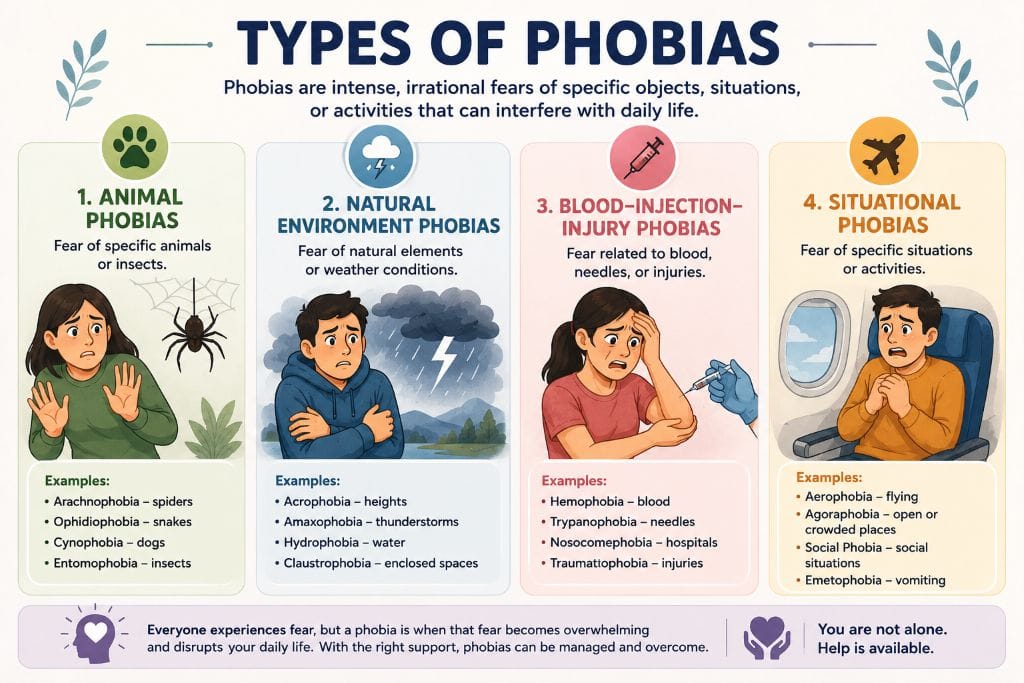
Specific Phobias
Specific phobias involve an overwhelming fear of a particular object or situation. They are the most common type of phobia and often begin during childhood or adolescence.
A person with a specific phobia usually knows that the fear is excessive, yet simply encountering—or even anticipating—the feared object can trigger intense anxiety.
Examples include:
- Fear of spiders (Arachnophobia)
- Fear of heights (Acrophobia)
- Fear of dogs (Cynophobia)
- Fear of snakes (Ophidiophobia)
- Fear of needles (Trypanophobia)
- Fear of flying (Aerophobia)
- Fear of enclosed spaces (Claustrophobia)
Without treatment, many people gradually expand their avoidance behaviors, making daily life increasingly challenging.
Animal Phobias
Animal phobias are among the most common specific phobias. These fears may develop after a frightening experience, by observing someone else’s fear, or even through repeated exposure to negative stories about certain animals.
Common examples include:
- Arachnophobia – Fear of spiders
- Cynophobia – Fear of dogs
- Ophidiophobia – Fear of snakes
- Ornithophobia – Fear of birds
- Entomophobia – Fear of insects
- Musophobia – Fear of mice and rats
Someone with arachnophobia, for example, may avoid basements, gardens, or camping trips because they worry about encountering spiders.
Natural Environment Phobias
Natural environment phobias involve fear of naturally occurring situations or events.
These fears often relate to personal safety but become overwhelming and disproportionate to the actual risk.
Examples include:
- Acrophobia – Fear of heights
- Aquaphobia – Fear of water
- Astraphobia – Fear of thunder and lightning
- Nyctophobia – Fear of darkness
- Pyrophobia – Fear of fire
A person with astraphobia may become extremely anxious whenever storms are forecast, even while safely indoors.
Blood, Injection, and Injury Phobias
This category involves fear associated with blood, injuries, injections, or medical procedures.
According to Mayo Clinic, people with these phobias sometimes experience a unique physical response in which blood pressure and heart rate suddenly drop, occasionally leading to fainting. This reaction differs from many other phobias, where heart rate typically increases.
Examples include:
- Trypanophobia – Fear of needles
- Hemophobia – Fear of blood
- Dentophobia – Fear of dentists
- Nosocomephobia – Fear of hospitals
- Tomophobia – Fear of surgery
Because of these fears, some individuals postpone vaccinations, dental care, blood tests, or essential medical treatment, potentially affecting their long-term health.
Situational Phobias
Situational phobias involve fear triggered by specific environments or circumstances.
These fears often interfere with work, travel, education, and daily routines because many situations cannot always be avoided.
Examples include:
- Claustrophobia – Fear of enclosed spaces
- Aerophobia – Fear of flying
- Amaxophobia – Fear of driving
- Gephyrophobia – Fear of bridges
- Elevatophobia – Fear of elevators
For instance, someone with aerophobia may choose lengthy road journeys instead of short flights, while another person may avoid career opportunities that require business travel.
Modern Phobias
Although not all modern fears are formally classified as specific phobias, increasing reliance on technology has introduced new anxiety-related conditions.
One widely discussed example is Nomophobia, the fear or anxiety of being without a mobile phone or losing access to it. While it is not currently recognized as a distinct diagnosis in the DSM-5-TR, research suggests it can significantly affect daily life, particularly among younger adults.
Social Anxiety Disorder (Social Phobia)
Although commonly referred to as social phobia, Social Anxiety Disorder is considered a separate anxiety disorder rather than a specific phobia.
According to the National Institute of Mental Health (NIMH), people with social anxiety disorder experience intense fear of being judged, embarrassed, criticized, or negatively evaluated in social or performance situations.
Common triggers include:
- Public speaking
- Meeting new people
- Job interviews
- Classroom presentations
- Eating in public
- Participating in group discussions
Many people mistakenly assume that social anxiety is simply shyness. In reality, it can significantly interfere with education, employment, relationships, and overall quality of life.
One of the most common examples is Glossophobia, the fear of public speaking. While many people feel nervous before giving a speech, glossophobia can cause intense anxiety that interferes with work, education, and daily life. Learn more in our detailed guide to Glossophobia.
Agoraphobia
Agoraphobia is another condition that differs from specific phobias.
The American Psychiatric Association describes agoraphobia as intense fear or anxiety about situations where escaping may be difficult or where help might not be available if panic symptoms occur.
People with agoraphobia may avoid:
- Crowded shopping malls
- Public transportation
- Large open spaces
- Busy streets
- Movie theaters
- Standing in long queues
In severe cases, individuals may become largely homebound because leaving home causes overwhelming anxiety.
Can Someone Have More Than One Phobia?
Yes. It is entirely possible to experience multiple phobias simultaneously.
For example, a person may have:
- Fear of heights
- Fear of flying
- Fear of public speaking
Because these fears can overlap, they may create additional challenges in both personal and professional life.
Mental health professionals evaluate each person’s symptoms individually before recommending the most appropriate treatment plan.
What Causes Phobias?
Researchers do not believe that phobias develop from a single cause. Instead, they usually result from a combination of biological, psychological, and environmental factors.
According to the National Institute of Mental Health and the American Psychiatric Association, genetics, life experiences, brain function, and learned behaviors can all contribute to the development of a phobia.
Researchers continue to investigate why phobias develop. A comprehensive Lancet review suggests that genetic factors, brain function, life experiences, and environmental influences all contribute to anxiety disorders.
Understanding these causes helps explain why two people can experience the same event but respond very differently.
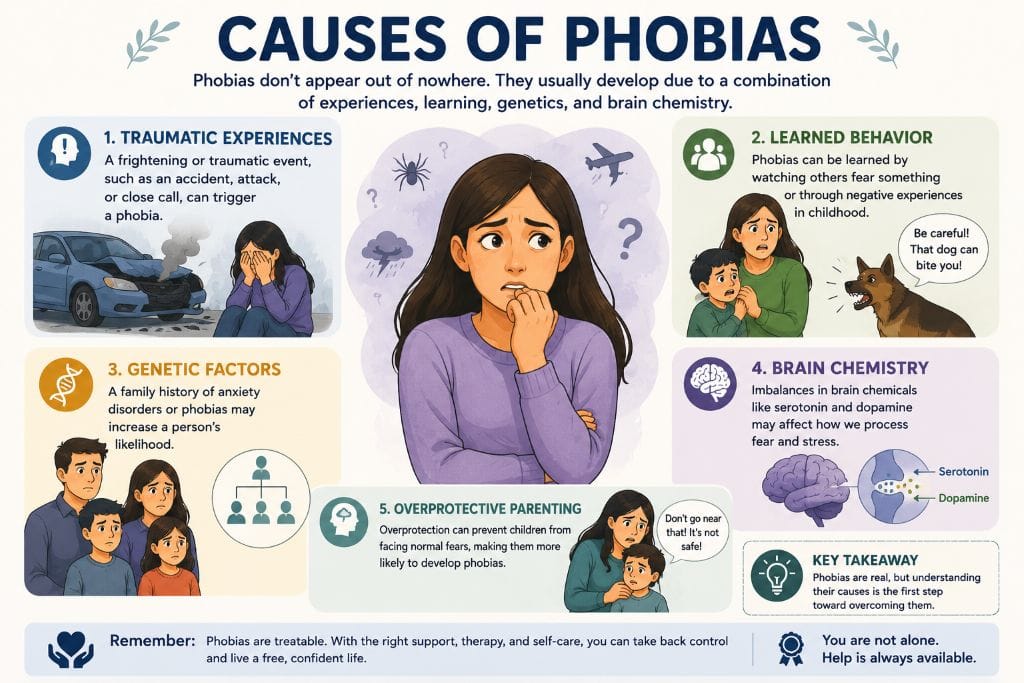
Traumatic Experiences
Many phobias begin after a frightening or traumatic event.
For example:
- Being bitten by a dog may contribute to cynophobia.
- Nearly drowning may increase the risk of aquaphobia.
- Experiencing severe turbulence may contribute to aerophobia.
Not everyone develops a phobia after a traumatic event, but such experiences can increase the likelihood in susceptible individuals.
Learned Behaviors
Children sometimes develop fears by observing parents, siblings, or caregivers.
If a child repeatedly sees a parent panic whenever a spider appears, they may gradually associate spiders with danger, even without a negative personal experience.
This process is known as observational learning.
Genetics and Family History
Research suggests that anxiety disorders can run in families.
Having a close relative with a phobia or another anxiety disorder does not guarantee that someone will develop a phobia, but it may increase susceptibility when combined with environmental factors.
Brain Function
Scientists believe that certain areas of the brain, particularly those involved in processing fear and emotional memories, may contribute to the development and persistence of phobias.
The brain can sometimes continue responding to harmless situations as though they represent genuine danger, even after repeated reassurance.
Information and Media Exposure
Fear can also develop through repeated exposure to alarming information.
Examples include:
- Sensational news reports.
- Graphic online videos.
- Social media misinformation.
- Disturbing childhood stories.
Although these experiences do not affect everyone equally, they may contribute to anxiety in vulnerable individuals.
Stress and Major Life Changes
Periods of prolonged stress may increase vulnerability to anxiety disorders, including phobias.
Examples include:
- Bereavement
- Divorce
- Serious illness
- Job loss
- Natural disasters
- Major accidents
Stress does not directly cause every phobia, but it may make existing fears more intense or contribute to the development of new ones.
Most Phobias Have Multiple Causes
In many cases, there is no single explanation for why a phobia develops.
Instead, several factors often interact, including:
- Genetic predisposition
- Childhood experiences
- Learned behaviors
- Traumatic events
- Brain processing of fear
- Environmental influences
Recognizing these contributing factors helps mental health professionals develop individualized treatment plans that address both the fear itself and the underlying anxiety.
Symptoms of Phobias
Phobias affect people differently. Some individuals experience only mild anxiety, while others may develop intense fear or panic attacks simply by thinking about the object or situation they fear.
According to the National Institute of Mental Health (NIMH), symptoms usually appear immediately before or during exposure to the feared trigger. In some cases, even imagining the situation can produce significant anxiety.
Symptoms generally fall into three categories: physical, emotional, and behavioral.
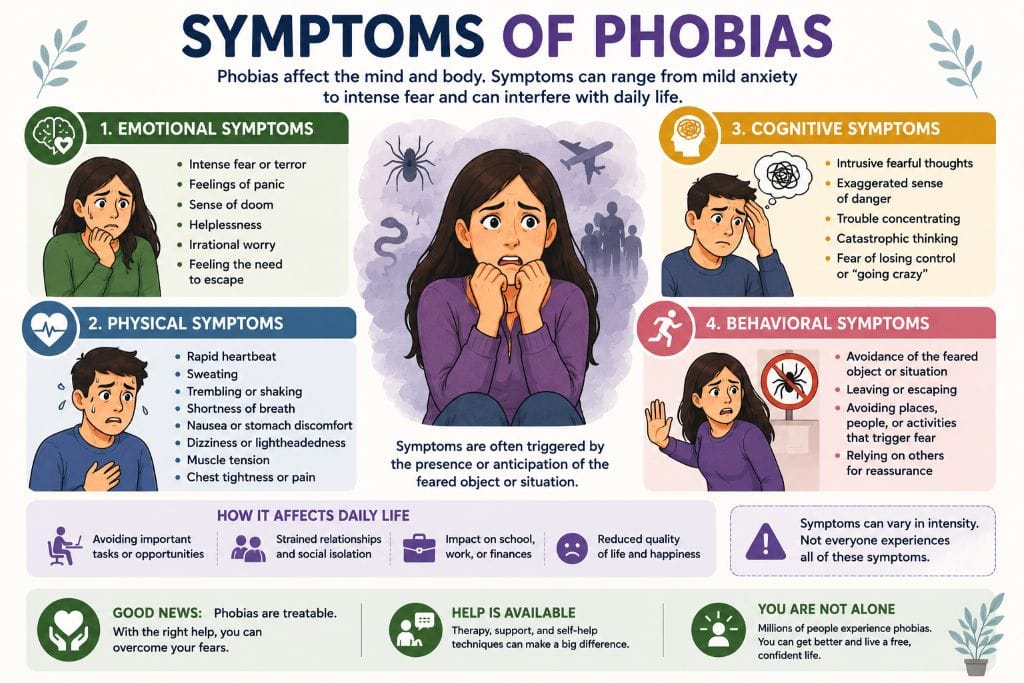
Physical Symptoms
When confronted with a feared object or situation, the body’s fight-or-flight response is activated. The brain mistakenly interprets the trigger as a serious threat, causing the release of stress hormones such as adrenaline.
Common physical symptoms include:
- Rapid heartbeat
- Chest tightness
- Shortness of breath
- Sweating
- Trembling or shaking
- Dry mouth
- Dizziness or lightheadedness
- Nausea or stomach discomfort
- Chills or hot flashes
- Tingling sensations
- Feeling faint
People with blood-injection-injury phobias may experience a temporary drop in blood pressure, which can sometimes lead to fainting. Mayo Clinic notes that this response differs from many other anxiety disorders, where heart rate and blood pressure usually increase.
Emotional Symptoms
The emotional effects of a phobia often extend beyond the moment of exposure.
People may experience:
- Intense fear
- Persistent worry
- Feelings of helplessness
- A sense of losing control
- Embarrassment about their fear
- Anticipatory anxiety before an event
- Constant concern about encountering the trigger
For example, someone with aerophobia may begin worrying several weeks before an upcoming flight.
Behavioral Symptoms
Behavioral changes are often the most noticeable sign of a phobia.
These may include:
- Avoiding certain places
- Canceling travel plans
- Declining invitations
- Refusing medical appointments
- Leaving situations abruptly
- Asking others for reassurance
- Depending on family or friends to avoid feared situations
Although avoidance reduces anxiety temporarily, it often reinforces the phobia over time by preventing people from learning that the feared situation is usually safe.
Cognitive Symptoms
Phobias don’t only affect emotions and physical reactions—they can also influence the way a person thinks. These cognitive symptoms often involve exaggerated perceptions of danger and persistent fearful thoughts that make it difficult to think clearly when confronted with the feared object or situation.
Common cognitive symptoms include:
- Intrusive fearful thoughts
- Exaggerated perception of danger
- Difficulty concentrating
- Catastrophic thinking
- Fear of losing control
- Constant anticipation of the feared situation
- Persistent worry about encountering the trigger
For example, someone with aerophobia may repeatedly imagine an airplane crashing despite knowing that air travel is statistically very safe. Similarly, a person with arachnophobia may believe that even a small, harmless spider poses a serious threat.
These thought patterns can intensify anxiety and reinforce avoidance behaviors, making the phobia more difficult to overcome. According to the American Psychiatric Association (APA), identifying and challenging these unhelpful thinking patterns is an important part of cognitive behavioral therapy (CBT), one of the most effective treatments for specific phobias.
Panic Attacks
Some phobias can trigger panic attacks.
During a panic attack, a person may experience:
- Racing heartbeat
- Difficulty breathing
- Chest pain
- Feeling detached from reality
- Fear of dying
- Fear of losing control
- Severe dizziness
A panic attack can be frightening, but it is not the same as a heart attack. Even so, anyone experiencing sudden chest pain or severe symptoms for the first time should seek immediate medical evaluation to rule out other medical conditions.
Symptoms in Children
Children often express fear differently from adults.
Common signs include:
- Crying
- Clinging to parents
- Tantrums
- Freezing in place
- Refusing to enter certain environments
- Avoiding school or activities
Young children may struggle to explain why they are afraid, making their behavior an important clue for parents and caregivers.
When Should You Seek Professional Help?
Feeling nervous occasionally is a normal part of life. However, a phobia may require professional evaluation when it begins interfering with daily activities.
According to the American Psychiatric Association (APA), seeking help is appropriate if fear:
- Persists for several months.
- Causes significant emotional distress.
- Interferes with work or education.
- Affects relationships.
- Prevents necessary healthcare.
- Leads to constant avoidance.
- Triggers frequent panic attacks.
Early treatment often produces better outcomes and may prevent the phobia from becoming more severe over time.
How Are Phobias Diagnosed?
There is no blood test, brain scan, or laboratory examination that can diagnose a phobia.
Instead, diagnosis is based on a detailed psychological evaluation performed by a qualified healthcare professional, such as a psychologist or psychiatrist.
During the assessment, the clinician may ask questions about:
- Your symptoms
- The situations that trigger fear
- How long has the fear been present
- Whether the fear affects daily life
- Your medical history
- Family history of anxiety disorders
- Previous traumatic experiences
The American Psychiatric Association’s Diagnostic and Statistical Manual of Mental Disorders (DSM-5-TR) provides standardized criteria that mental health professionals use when diagnosing specific phobias and related anxiety disorders.
Conditions That May Resemble Phobias
A healthcare professional will also consider whether symptoms are better explained by another condition, such as:
- Panic disorder
- Social anxiety disorder
- Obsessive-compulsive disorder (OCD)
- Post-traumatic stress disorder (PTSD)
- Generalized anxiety disorder (GAD)
An accurate diagnosis helps ensure that treatment is appropriate for the individual’s specific needs.
Treatment for Phobias
The encouraging news is that phobias are among the most treatable anxiety disorders.
According to the Mayo Clinic and the National Institute of Mental Health, many people experience substantial improvement with evidence-based psychological therapies. Treatment depends on the severity of symptoms, the type of phobia, and how much it affects daily life.
Mayo Clinic notes that cognitive behavioral therapy (CBT) and exposure therapy are considered first-line treatments for most specific phobias because they help reduce avoidance behaviors and improve long-term coping skills.
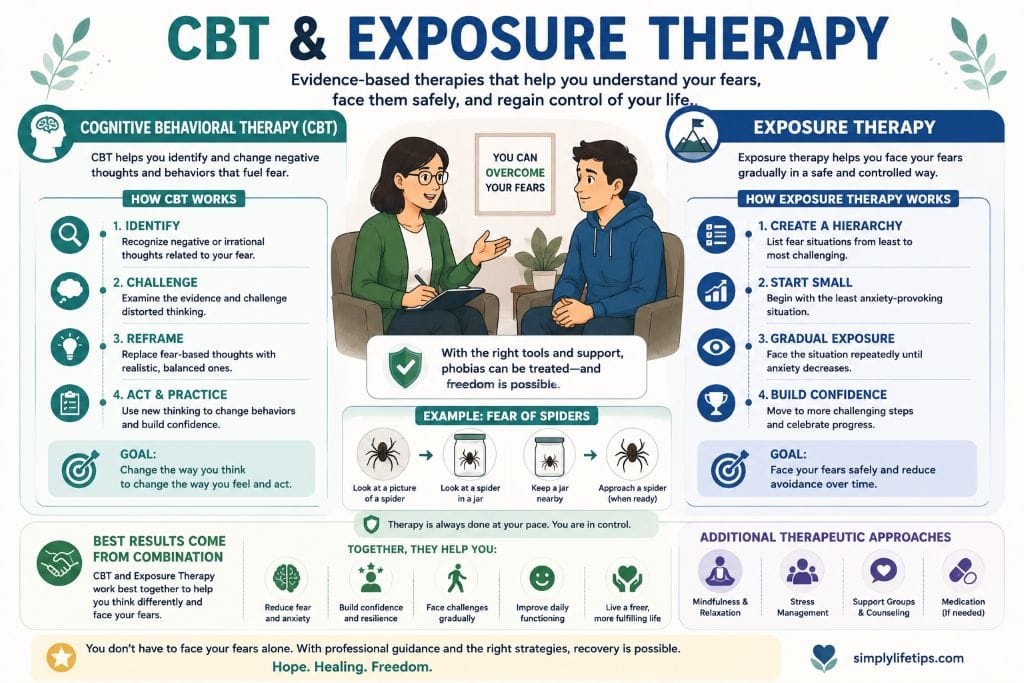
Cognitive Behavioral Therapy (CBT)
CBT is widely regarded as one of the most effective treatments for specific phobias.
The goal of CBT is to help individuals:
- Recognize unhelpful thought patterns.
- Challenge unrealistic beliefs.
- Develop healthier responses to fear.
- Reduce avoidance behaviors.
- Build confidence through gradual practice.
Over time, many people learn to respond more calmly to situations that previously caused intense anxiety.
Exposure Therapy
Exposure therapy is a specialized form of CBT that gradually introduces a person to the feared object or situation in a safe and controlled manner.
For example, someone with a fear of dogs might progress through stages such as:
- Looking at pictures of dogs.
- Watching videos.
- Observing a dog from a distance.
- Standing near a calm dog.
- Eventually, interact with the dog under professional guidance.
According to the Mayo Clinic, gradual exposure helps the brain learn that the feared situation is less dangerous than initially believed.
Medication
Medication is not usually the first treatment for specific phobias, but it may be recommended in certain situations.
A healthcare provider may prescribe medication to help manage severe anxiety associated with:
- Flying
- Public speaking
- Medical procedures
- Panic symptoms
Medication decisions should always be made in consultation with a qualified healthcare professional.
Relaxation Techniques
Learning relaxation skills can help reduce physical symptoms of anxiety.
Useful techniques include:
- Deep breathing exercises
- Progressive muscle relaxation
- Mindfulness meditation
- Guided imagery
- Grounding exercises
While these methods may not eliminate a phobia, they can make symptoms more manageable during treatment.
Lifestyle Habits That Support Recovery
Healthy daily habits can improve overall emotional well-being and complement professional treatment.
Helpful habits include:
- Regular physical activity
- Adequate sleep
- Balanced nutrition
- Limiting excessive caffeine
- Stress management
- Maintaining supportive relationships
Although lifestyle changes alone rarely cure a phobia, they often reduce overall anxiety levels.
Can Phobias Be Prevented?
Not every phobia can be prevented, but healthy coping strategies may reduce the likelihood that fears become overwhelming.
Parents and caregivers can also support children by responding calmly to fears rather than reinforcing avoidance.
Helpful approaches include:
- Encouraging gradual exposure to safe situations.
- Avoiding unnecessary reassurance.
- Teaching healthy coping skills.
- Modeling calm behavior.
- Seek professional advice if fears become persistent.
Early intervention often leads to better long-term outcomes.
Self-Help Tips for Managing Phobias
Professional treatment remains the most effective option for significant phobias, but self-help strategies can support recovery.
Consider the following approaches:
Learn About Your Phobia
Understanding how anxiety works often makes fear feel less overwhelming.
Reliable information from organizations such as NIMH, APA, and Mayo Clinic can help separate myths from facts.
Avoid Complete Avoidance
Although avoidance provides short-term relief, it usually strengthens the fear over time.
Whenever possible, gradually facing safe situations can help reduce anxiety, especially when guided by a qualified therapist.
Practice Relaxation Daily
Simple breathing exercises, meditation, and mindfulness techniques may reduce stress and improve emotional resilience.
Practicing these skills regularly is generally more effective than using them only during moments of panic.
Keep an Anxiety Journal
Recording situations that trigger anxiety can help identify patterns.
Include details such as:
- What happened
- How you felt
- Physical symptoms
- Thoughts you experienced
- How you responded
This information may also be valuable during therapy.
Seek Support
Talking with trusted family members, friends, or mental health professionals can reduce feelings of isolation and encourage progress.
Remember that asking for help is a sign of strength—not weakness.
By combining professional treatment with healthy coping strategies, many people successfully manage their phobias and return to activities they once avoided.
A–Z List of Common and Rare Phobias
Phobias come in many forms, ranging from common fears such as heights and spiders to rare conditions involving specific objects, situations, or experiences. The following alphabetical list explains some of the best-known phobias along with their meanings and a brief description.
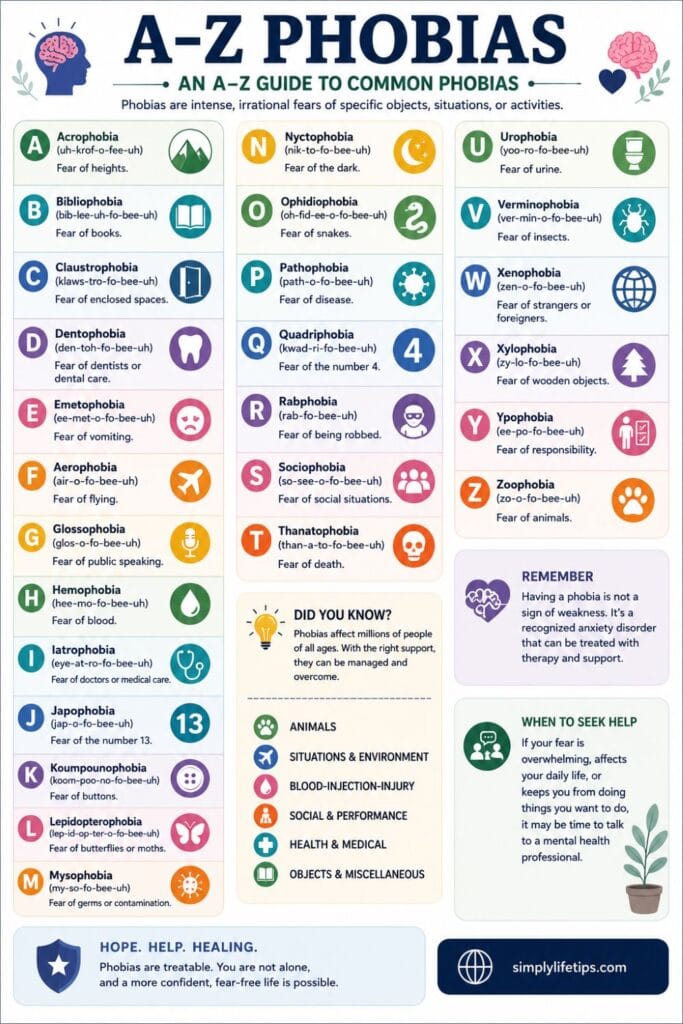
Editorial note
The infographic works well as a visual summary, but because it can only display a limited number of phobias, it should complement—not replace—your comprehensive A–Z section. A small note such as “Explore the complete A–Z list below” can help guide readers from the infographic to the full content and improve engagement.
Phobias Beginning with A
| Phobia | Fear of | Description |
|---|---|---|
| Ablutophobia | Bathing or washing | An uncommon fear of bathing, showering, or cleaning oneself that may interfere with personal hygiene. |
| Acrophobia | Heights | An intense fear of high places such as mountains, balconies, bridges, or tall buildings. |
| Aerophobia | Flying | A persistent fear of traveling by airplane, often accompanied by severe anxiety before or during flights. |
| Agoraphobia | Situations where escape may be difficult | Fear of open spaces, crowds, or places where help may not be be easily available during a panic attack. |
| Aichmophobia | Sharp objects | Fear of needles, knives, scissors, or other pointed objects that may cause injury. |
| Ailurophobia | Cats | An excessive fear of cats, whether encountered in person, in pictures, or even in conversation. |
| Algophobia | Pain | Persistent fear of experiencing physical pain, often leading to avoidance of medical or dental treatment. |
| Androphobia | Men | An intense fear of men that may develop after traumatic experiences or severe anxiety. |
| Anthropophobia | People | Fear of people or human interaction, often confused with social anxiety disorder. |
| Aquaphobia | Water | Fear of deep water, swimming pools, lakes, rivers, or even bathing in severe cases. |
| Arachnophobia | Spiders | One of the world’s most common phobias involving an intense fear of spiders and spider webs. |
| Astraphobia | Thunder and lightning | Fear of storms, thunder, or lightning that commonly affects both children and adults. |
| Atychiphobia | Failure | Fear of making mistakes or failing, which may discourage people from trying new opportunities. |
| Autophobia | Being alone | Fear of isolation or being left alone, often accompanied by anxiety about personal safety. |
Phobias Beginning with B
| Phobia | Fear of | Description |
| Bacteriophobia | Bacteria | Fear of germs and bacterial contamination that may encourage excessive cleaning behaviors. |
| Barophobia | Gravity | A rare fear involving gravity or the possibility of gravitational changes. |
| Bathmophobia | Stairs or steep slopes | Fear of climbing or descending stairs, hills, or steep pathways. |
| Belonephobia | Needles | Fear of pins, needles, or other sharp instruments, often associated with medical procedures. |
| Bibliophobia | Books | An unusual fear of books or reading materials, sometimes linked to negative past experiences. |
| Botanophobia | Plants | Fear of plants, trees, flowers, or vegetation despite their harmless nature. |
| Brontophobia | Thunder | Fear of thunder and loud storm sounds, closely related to astraphobia. |
Phobias Beginning with C
| Phobia | Fear of | Description |
| Cacophobia | Ugliness | Fear of ugly people, objects, or situations perceived as unattractive. |
| Carcinophobia | Cancer | Excessive fear of developing cancer despite little or no medical evidence of illness. |
| Catoptrophobia | Mirrors | Fear of mirrors or seeing one’s own reflection. |
| Chionophobia | Snow | Fear of snowfall, snow-covered environments, or winter weather. |
| Chrometophobia | Money | Fear of handling or spending money, sometimes associated with financial anxiety. |
| Chronophobia | Time | Persistent fear of time passing or the future, often reported among older adults or prisoners. |
| Claustrophobia | Enclosed spaces | One of the most common phobias involving elevators, tunnels, small rooms, or crowded places. |
| Climacophobia | Climbing | Fear of climbing stairs, ladders, or steep inclines because of falling or losing balance. |
| Coulrophobia | Clowns | Fear of clowns, often triggered by exaggerated facial makeup or unpredictable behavior. |
| Cynophobia | Dogs | An intense fear of dogs that may develop after a frightening encounter or bite. |
| Cypridophobia | Sexually transmitted infections | Fear of contracting sexually transmitted diseases, sometimes resulting in excessive worry. |
Phobias Beginning with D
| Phobia | Fear of | Description |
| Decidophobia | Making decisions | Fear of making choices due to concern about making the wrong decision. |
| Dendrophobia | Trees | Fear of trees or wooded areas, sometimes associated with fears of forests. |
| Dentophobia | Dentists | Fear of dental treatment, dental instruments, or dental clinics. |
| Dermatopathophobia | Skin diseases | Fear of developing skin disorders or infections. |
| Dikephobia | Justice or legal systems | Fear related to courts, legal proceedings, or punishment. |
| Dinophobia | Whirlpools or dizziness | Fear associated with spinning sensations, dizziness, or powerful water currents. |
| Domatophobia | Houses | Fear of entering or remaining inside houses or homes. |
| Dromophobia | Crossing streets | Fear of crossing roads, intersections, or busy traffic areas, often limiting independent travel. |
Phobias Beginning with E
| Phobia | Fear of | Description |
|---|---|---|
| Eisoptrophobia | Mirrors or reflections | Fear of mirrors or seeing one’s own reflection, sometimes linked to superstition or anxiety. |
| Electrophobia | Electricity | Fear of electrical appliances, power lines, or electric shocks. |
| Eleutherophobia | Freedom | A rare fear of freedom or personal independence, often associated with major life changes. |
| Emetophobia | Vomiting | An intense fear of vomiting or seeing others vomit, which may lead to avoiding certain foods or public places. |
| Enetophobia | Pins | Fear of pins or small sharp objects that may cause injury. |
| Entomophobia | Insects | Fear of insects such as ants, beetles, cockroaches, or grasshoppers. |
| Ephebiphobia | Teenagers | Persistent fear or strong anxiety around adolescents or teenagers. |
| Equinophobia | Horses | Fear of horses that may develop after a frightening experience or injury. |
| Ergophobia | Work or the workplace | Fear of working, finding employment, or performing job-related responsibilities. |
| Erythrophobia | Blushing | Fear of blushing in public, often associated with social anxiety. |
Phobias Beginning with F
| Phobia | Fear of | Description |
| Frigophobia | Cold or cold weather | Fear of low temperatures, cold air, or becoming too cold. |
Note: Clinically recognized phobias beginning with the letter F are relatively uncommon compared with other letters.
Phobias Beginning with G
| Phobia | Fear of | Description |
| Gamophobia | Marriage or commitment | Fear of marriage or long-term committed relationships. |
| Geliophobia | Laughter | Fear of laughter or being laughed at by others. |
| Geniophobia | Chins | An uncommon fear of chins or touching the chin area. |
| Genophobia | Sexual intimacy | Fear of sexual intercourse or intimate physical relationships. |
| Gerascophobia | Growing older | Fear of aging and the physical or emotional changes associated with getting older. |
| Germophobia (Mysophobia) | Germs | Intense fear of germs, bacteria, viruses, or contamination. |
| Gephyrophobia | Bridges | Fear of crossing bridges, particularly long or high bridges. |
| Glossophobia | Public speaking | One of the most common phobias involving fear of speaking in front of an audience. |
| Gynophobia | Women | Persistent fear or anxiety around women. |
| Gymnophobia | Nudity | Fear of being naked or seeing others without clothing. |
Phobias Beginning with H
| Phobia | Fear of | Description |
| Hadephobia | Hell | Fear of hell or eternal punishment, often associated with religious anxiety. |
| Haphephobia | Being touched | Fear of physical contact or being touched by other people. |
| Heliophobia | Sunlight | Fear of the sun or exposure to sunlight, sometimes leading to avoidance of outdoor activities. |
| Hemophobia | Blood | Fear of seeing blood, blood tests, or bleeding injuries. Some individuals may experience fainting. |
| Herpetophobia | Reptiles | Fear of reptiles, especially snakes and lizards. |
| Hippophobia | Horses | Another recognized term for fear of horses. |
| Hodophobia | Traveling | Fear of travel or long-distance journeys by any mode of transportation. |
| Homichlophobia | Fog | Fear of fog or poor visibility caused by mist or dense weather conditions. |
| Hydrophobia | Water (historical usage) | Historically associated with rabies, but sometimes used to describe an intense fear of water. Aquaphobia is the preferred term for fear of water. |
| Hypnophobia | Sleep | Fear of falling asleep, often related to nightmares or concerns about not waking up. |
Phobias Beginning with I
| Phobia | Fear of | Description |
|---|---|---|
| Iatrophobia | Doctors | Fear of visiting doctors or receiving medical care, which may delay important health checkups. |
| Ichthyophobia | Fish | Fear of fish, whether alive, dead, or seen in aquariums or open water. |
| Insectophobia | Insects | Another commonly used term for fear of insects, similar to entomophobia. |
| Isolophobia | Isolation | Fear of being isolated or separated from other people for extended periods. |
Phobias Beginning with J
| Phobia | Fear of | Description |
| Japanophobia | Japan or Japanese culture | An extremely rare fear associated with Japan or aspects of Japanese culture. |
| Judeophobia | Jewish people or Judaism | A historical term describing an irrational fear or prejudice; it is not used as a clinical diagnosis. |
Phobias Beginning with K
| Phobia | Fear of | Description |
| Kakorrhaphiophobia | Failure or defeat | Fear of failure, rejection, or performing poorly in important situations. |
| Katsaridaphobia | Cockroaches | Intense fear of cockroaches, often leading to avoidance of places where they may appear. |
| Kenophobia | Empty spaces | Fear of large empty rooms, open areas, or vacant spaces. |
| Keraunophobia | Thunder and lightning | Fear of thunderstorms, lightning, and severe weather, similar to astraphobia. |
| Koumpounophobia | Buttons | A rare fear of clothing buttons or touching them. |
Phobias Beginning with L
| Phobia | Fear of | Description |
| Lachanophobia | Vegetables | Fear of vegetables, sometimes beginning in childhood and continuing into adulthood. |
| Lepidopterophobia | Butterflies and moths | Fear of butterflies, moths, or similar winged insects. |
| Leucophobia | The color white | Fear or discomfort associated with the color white or white objects. |
| Ligyrophobia | Loud noises | Fear of loud or sudden sounds such as fireworks, alarms, or explosions. |
| Lilapsophobia | Tornadoes and hurricanes | Fear of destructive storms or extreme weather events. |
| Lockiophobia | Childbirth | Fear of pregnancy or giving birth, also known as tokophobia in many medical references. |
Phobias Beginning with M
| Phobia | Fear of | Description |
| Mageirocophobia | Cooking | Fear of cooking meals or making mistakes while preparing food. |
| Megalophobia | Large objects | Fear of very large buildings, statues, ships, or other oversized objects. |
| Melissophobia | Bees | Fear of bees and bee stings that may lead to avoiding parks or gardens. |
| Microphobia | Small things | Fear of tiny objects or microscopic organisms. |
| Mysophobia | Germs and contamination | Persistent fear of germs, dirt, or contamination that may lead to excessive cleaning or handwashing. |
| Myrmecophobia | Ants | Fear of ants or ant colonies, even when they pose little danger. |
Phobias Beginning with N
| Phobia | Fear of | Description |
| Necrophobia | Death or dead bodies | Fear of corpses, funerals, cemeteries, or anything associated with death. |
| Neophobia | New things | Fear of unfamiliar experiences, ideas, foods, or situations. |
| Nosocomephobia | Hospitals | Fear of hospitals or receiving hospital treatment. |
| Nyctophobia | Darkness | Fear of darkness or nighttime that may persist into adulthood. |
Phobias Beginning with O
| Phobia | Fear of | Description |
| Obesophobia | Gaining weight | Fear of becoming overweight, sometimes associated with eating disorders. |
| Ochlophobia | Crowds | Fear of crowded places where movement or escape may feel difficult. |
| Oikophobia | Household surroundings | Fear of home appliances or one’s home environment. |
| Ophidiophobia | Snakes | One of the most common animal phobias involving intense fear of snakes. |
| Ornithophobia | Birds | Fear of birds, feathers, or birds flying nearby. |
Phobias Beginning with P
| Phobia | Fear of | Description |
| Panphobia | Everything | A generalized fear without a single identifiable trigger, though not recognized as a formal clinical diagnosis. |
| Pathophobia | Disease | Fear of developing serious illnesses or medical conditions. |
| Pedophobia | Children | Fear of infants or young children. |
| Philophobia | Love or emotional attachment | Fear of falling in love or forming close emotional relationships. |
| Phonophobia | Loud sounds | Fear of loud or unexpected noises, often confused with ligyrophobia. |
| Pluviophobia | Rain | Fear of rain, storms, or getting caught in wet weather. |
| Pteromerhanophobia | Flying | Clinical term for fear of flying, often considered more specific than aerophobia. |
| Pyrophobia | Fire | Fear of fire, flames, or burns that may cause avoidance of fireplaces, candles, or campfires. |
Phobias Beginning with Q
| Phobia | Fear of | Description |
|---|---|---|
| Quadriphobia | The number four | Fear of the number four, most commonly influenced by cultural beliefs in some East Asian countries. |
Phobias Beginning with R
| Phobia | Fear of | Description |
| Radiophobia | Radiation | Fear of radiation, radioactive materials, or radiation exposure. |
| Ranidaphobia | Frogs | Fear of frogs or toads, often triggered by their appearance or movement. |
| Rhabdophobia | Magic or punishment | Fear of magic, supernatural punishment, or being severely disciplined. |
| Rupophobia | Dirt | Fear of dirt, filth, or contamination, closely related to mysophobia. |
Phobias Beginning with S
| Phobia | Fear of | Description |
| Scelerophobia | Criminals | Fear of burglars, criminals, or becoming the victim of crime. |
| Scopophobia | Being watched | Fear of being stared at or observed by others. |
| Selenophobia | The Moon | Fear of the moon or moonlight, particularly during a full moon. |
| Sociophobia | Social situations | An older term for fear of social interaction; Social Anxiety Disorder is the preferred clinical diagnosis. |
| Somniphobia | Sleep | Fear of falling asleep, often used interchangeably with hypnophobia. |
| Spermophobia | Germs | Fear of germs or contamination; another term related to mysophobia. |
Phobias Beginning with T
| Phobia | Fear of | Description |
| Tachophobia | Speed | Fear of traveling at high speeds in vehicles or amusement rides. |
| Technophobia | Technology | Fear of computers, smartphones, or modern technology. |
| Thanatophobia | Death | Fear of one’s own death or the process of dying. |
| Thalassophobia | Deep water | Fear of deep oceans, seas, or large bodies of water where the bottom cannot be seen. |
| Tokophobia | Pregnancy and childbirth | Intense fear of pregnancy or giving birth, affecting both first-time and experienced mothers. |
| Tomophobia | Surgery | Fear of surgical procedures or medical operations. |
| Traumatophobia | Injury | Fear of physical injury or accidents that could cause harm. |
| Trypanophobia | Needles | Fear of injections, blood tests, or vaccinations, sometimes leading to avoidance of medical care. |
Phobias Beginning with U
| Phobia | Fear of | Description |
| Uranophobia | Heaven | Fear of heaven or the afterlife, often associated with religious anxiety. |
| Urophobia | Urination | Fear of urinating or situations involving public restrooms. |
Phobias Beginning with V
| Phobia | Fear of | Description |
| Venustraphobia | Beautiful women | Fear or intense anxiety around attractive women. |
| Verminophobia | Germs | Fear of germs, bacteria, or infection, closely related to mysophobia. |
| Verbophobia | Words | Fear of words or language, particularly spoken communication. |
Phobias Beginning with W
Although there are very few widely recognized phobias beginning with the letter W, many people search for everyday fears such as fear of water, fear of work, and fear of wolves. These are generally classified under their established Greek-derived names:
- Aquaphobia – Fear of water.
- Ergophobia – Fear of work.
- Lupophobia – Fear of wolves.
Phobias Beginning with X
| Phobia | Fear of | Description |
| Xenophobia | Strangers or foreigners | Fear or distrust of strangers or people from other countries. In modern contexts, the term is more commonly used to describe prejudice or discrimination than a clinical phobia. |
Phobias Beginning with Y
There are no widely accepted clinical phobias beginning with the letter Y. Some unofficial names appear online, but they are not recognized in standard psychological references.
Phobias Beginning with Z
| Phobia | Fear of | Description |
| Zelophobia | Jealousy | Fear of jealousy or becoming the target of another person’s jealousy. |
| Zoophobia | Animals | General fear of animals rather than a specific species. |
Looking for more detailed information? Explore our in-depth guides on Glossophobia (Fear of Public Speaking) and Nomophobia (Fear of Being Without Your Phone) for symptoms, causes, and practical coping strategies.
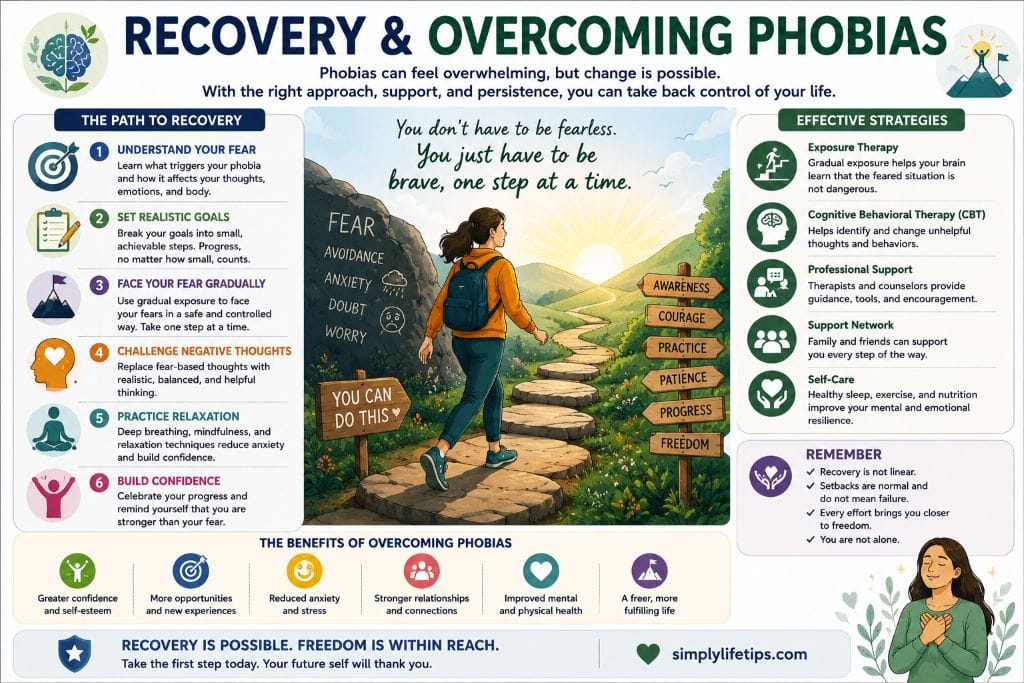
Editorial suggestions
This illustration is strong overall, but a few refinements would make it even better:
- Replace “Recovery is possible. Freedom is within reach.” with “Recovery is possible with the right treatment and support.” This is more consistent with evidence-based health communication.
- Add a small note near the therapy section: “Treatment plans should be personalized by a qualified mental health professional.”
- Keep the inspirational quote, but ensure it doesn’t imply that recovery depends only on willpower. The emphasis should remain on professional care, gradual progress, and evidence-based treatment.
Conclusion
Phobias are far more than ordinary fears. They are recognized anxiety disorders that can affect daily life, relationships, education, work, and overall well-being. While some people experience only mild discomfort, others may avoid everyday situations because of overwhelming fear.
Understanding the different types of phobias, their causes, symptoms, and treatment options is the first step toward managing them effectively. Modern treatments, particularly cognitive behavioral therapy (CBT) and exposure therapy, have helped countless individuals regain confidence and overcome fears that once seemed impossible to control.
If a phobia is preventing you or someone you know from living a full and active life, seeking help from a qualified mental health professional can make a significant difference. Early intervention often leads to better outcomes and improved quality of life.
Have you heard the term “Nomophobia”, an extreme fear of not having your phone or not being able to use it?
Frequently Asked Questions
1. What is the difference between fear and a phobia?
Fear is a normal response to real danger, while a phobia is an excessive and persistent fear that is disproportionate to the actual threat and may interfere with daily life.
2. What is the most common phobia?
Some of the most common phobias include arachnophobia (fear of spiders), acrophobia (fear of heights), claustrophobia (fear of enclosed spaces), and glossophobia (fear of public speaking).
3. Can phobias be cured?
Many people successfully overcome or manage their phobias through treatments such as cognitive behavioral therapy, exposure therapy, and professional counseling. The effectiveness of treatment varies from person to person.
4. Are phobias inherited?
Research suggests that genetics may increase a person’s susceptibility to anxiety disorders, but life experiences, learned behaviors, and environmental factors also play important roles in the development of phobias.
5. When should I seek professional help for a phobia?
You should consider seeking professional help if your fear causes significant distress, leads to persistent avoidance, interferes with work, education, relationships, or daily activities, or triggers frequent panic attacks.
Medical Disclaimer
This article is intended for educational purposes only and should not be considered medical advice, diagnosis, or treatment. If you experience persistent fear or anxiety that affects your daily life, consult a qualified healthcare professional or licensed mental health specialist for evaluation and appropriate care.
References
- 2021 Lancet review on anxiety disorders
- National Institute of Mental Health (NIMH). Specific Phobia.
- American Psychiatric Association (APA). Anxiety Disorders.
- Mayo Clinic. Specific Phobias.
- World Health Organization (WHO). Mental Health.

Mathukutty P V is a Blogger, YouTuber, and Content Writer and the founder of Simply Life Tips. After taking voluntary retirement in 2017, he embraced a free lifestyle focused on learning, personal growth, and sharing practical wisdom to help others live with more purpose and positivity.



