

How to feel better is a question many people ask when they experience stress, anxiety, emotional exhaustion, sadness, or a lack of motivation. Sometimes, everyday responsibilities become overwhelming, negative thoughts affect our confidence, and even simple activities feel difficult. During such moments, we may wish we could pause life and start again with a fresh mind.
However, improving how you feel does not always require a major lifestyle change. Small actions, such as taking a walk, spending time in nature, practising self-compassion, or reconnecting with your personal goals, can help support your mood and emotional well-being.
In an episode of The Mel Robbins Podcast, Mel Robbins explores five common emotional struggles and shares practical techniques discussed with four experts: neuroscientist Dr. Wendy Suzuki, researcher Dr. Adam Alter, comedian and author Chelsea Handler, and life coach Dr. Martha Beck.
Their conversations offer useful ideas for managing low energy, mental exhaustion, self-criticism, and feelings of being stuck.
Let’s explore these ideas along with ten additional everyday strategies that can help you feel better, develop healthier habits, and approach life’s challenges with a more positive mindset.
How to Feel Better Fast: 5 Things That Shift Your Mood Instantly
The following episode of The Mel Robbins Podcast discusses practical ways to improve your mood, manage mental exhaustion, and regain a sense of direction.
The discussion features insights from four experts and introduces five practical techniques that you can explore in your everyday life.
What Does It Mean to Feel Better?
Feeling better does not necessarily mean being happy all the time. Life naturally includes pleasant and unpleasant experiences. Everyone experiences disappointment, frustration, sadness, stress, and uncertainty.
According to the World Health Organization (WHO), mental health is an important part of overall well-being and influences how people cope with life’s stresses, use their abilities, and contribute to their communities.
Feeling better may involve:
- Having more physical energy.
- Experiencing less everyday stress.
- Developing a healthier relationship with yourself.
- Improving your concentration and motivation.
- Building meaningful relationships.
- Finding purpose and direction in life.
- Developing healthier ways to manage difficult emotions.
The goal is not to eliminate every negative feeling but to develop practical ways to support yourself through different experiences.
15 Simple Ways to Feel Better and Improve Your Mood
Here are 15 practical strategies you can incorporate into your everyday routine.
1. Take a 10-Minute Walk to Boost Your Energy
Physical activity is one of the simplest ways to support your physical and mental well-being.
In the podcast, neuroscientist Dr. Wendy Suzuki explains how movement influences brain activity. She discusses the role of neurotransmitters, including dopamine, serotonin, and noradrenaline, in mood, attention, and motivation.
She highlights that even a short walk can be a useful starting point when you feel tired or sluggish.
You do not need to run a marathon or spend hours at the gym to become more active.
Try these simple activities:
- Take a 10-minute walk around your neighbourhood.
- Walk in a nearby park or garden.
- Stretch your body between work sessions.
- Use the stairs instead of the lift when appropriate.
- Take short movement breaks during prolonged sitting.
Example: Imagine working at your computer for several hours. Your concentration decreases, your body feels tired, and you struggle to complete even simple tasks. Instead of forcing yourself to continue, take a short walk outside. Returning to your work after a break may help you feel refreshed.
The National Institute of Mental Health (NIMH) also recommends regular exercise as part of caring for your mental health.
Make walking a regular habit rather than waiting until you feel exhausted.
2. Try a Refreshing Shower
A refreshing shower can help you feel more awake and ready to begin your day.
In the podcast, Dr. Wendy Suzuki discusses ending a warm shower with a brief period of cooler water. She explains how cold exposure can trigger a physiological response involving adrenaline and increased alertness.
Mel Robbins also shares her experience of gradually turning the shower temperature down at the end of her usual shower.
However, cold showers are optional. You do not need extreme cold exposure to improve your daily well-being.
You can:
- Begin with a comfortable shower.
- Try slightly cooler water if it feels safe.
- Avoid forcing yourself to tolerate uncomfortable temperatures.
- Use a refreshing shower as part of your morning routine.
People with cardiovascular conditions or other health concerns should seek medical advice before experimenting with sudden cold exposure.
Remember that a cold shower is a refreshing habit, not a treatment for depression, anxiety, or burnout.
3. Spend Five Minutes in Nature
Modern life often involves continuous screen exposure, notifications, deadlines, and information overload. These demands can leave you mentally exhausted.
Spending time in nature offers an opportunity to step away from these distractions.
In the podcast, researcher Dr. Adam Alter discusses how natural environments can help restore attention. He explains that activities such as listening to running water, observing trees, and watching natural surroundings provide a different kind of stimulation from the constant demands of digital devices.
He recommends spending approximately five minutes simply taking in your natural surroundings.
Try these activities:
- Sit in your garden and listen to birds.
- Watch the trees moving in the breeze.
- Spend a few minutes near a river or pond.
- Observe the clouds and changing sky.
- Keep indoor plants near your workspace.
- Listen to the sound of rain or flowing water.
Example: If you spend most of your working day looking at a computer screen, take a five-minute break. Step outside, observe the trees, and listen to the sounds around you. Avoid checking your phone during this time.
These small moments of connection with nature can provide a welcome mental break.
If you frequently experience difficulty concentrating, forgetfulness, or mental exhaustion, read our article on 10 Mental Fatigue Symptoms: Warning Signs to Know.
4. Stop Being So Hard on Yourself
Do you frequently criticise yourself, even after accomplishing something important?
Perhaps you compare your achievements with others, focus on your mistakes, or feel that your efforts are never good enough.
Constant self-criticism can affect your confidence and emotional well-being.
In the podcast, comedian and author Chelsea Handler discusses becoming her own best friend, listener, and cheerleader. Her message is simple: learn to support yourself instead of waiting for other people to provide all the encouragement you need.
You can practise self-compassion by:
- Recognising your achievements, even small ones.
- Accepting that making mistakes is part of learning.
- Avoiding unnecessary comparisons.
- Speaking to yourself with kindness.
- Giving yourself permission to rest.
- Appreciating how far you have come.
Try a simple mirror exercise. Look at yourself and say:
- I am doing better than I think.
- I can handle challenges one step at a time.
- I do not need to be perfect.
- I deserve kindness and respect.
- I am proud of my progress.
It may feel uncomfortable initially, but practising supportive self-talk can help you develop a healthier relationship with yourself.
You can also read our detailed guide on Negative Self-Talk: Bad Effects and 7 Ways to Stop It to understand how unhelpful thinking patterns affect confidence and emotional well-being.
5. Visualise Your Ideal Day
Sometimes, we feel unhappy because we are uncertain about the direction of our lives.
We may continue following the same routine without knowing what we really want. We worry about the future but struggle to identify the first step towards change.
In the podcast, Dr. Martha Beck introduces an exercise called the Ideal Day.
The exercise encourages you to imagine an ordinary day in your ideal future. Instead of immediately worrying about how to achieve everything, use your imagination and senses to explore what a fulfilling life might look like.
Ask yourself:
- Where would you like to wake up?
- What would your surroundings look like?
- Who would you like to spend time with?
- What activities would make you happy?
- What would you hear and experience?
- How would you feel about your life?
Imagine a future that reflects your personal values rather than other people’s expectations.
Example: Suppose you feel trapped in a stressful work routine. When imagining your ideal day, you may picture having meaningful work, spending more time with family, enjoying nature, and maintaining a healthier lifestyle.
Once you identify what matters to you, choose one small action that moves you towards that future.
Visualization cannot guarantee success, but it can help clarify your priorities, strengthen motivation, and encourage purposeful action.
For more practical ideas, explore our guide to 7 Effective Goal Setting Strategies for Better Results.
6. Talk to Someone You Trust
You do not have to face every difficulty alone.
Sometimes, talking to a trusted friend, family member, or supportive person can help you understand your feelings and see a problem from another perspective.
When you keep worries to yourself, they may become increasingly difficult to manage.
Consider these simple steps:
- Call a friend when you feel lonely.
- Share your concerns with someone you trust.
- Spend quality time with family.
- Listen to others without constantly checking your phone.
- Ask for help when you need it.
Example: You may feel overwhelmed by work responsibilities and family commitments. Instead of silently struggling, discuss your concerns with someone who understands your situation. They may offer practical suggestions or simply listen.
Meaningful relationships provide emotional support and help create a sense of belonging.
The NHS guide to five steps for mental well-being highlights the importance of connecting with other people and maintaining supportive relationships.
7. Practise Gratitude Every Day
Gratitude means recognising and appreciating the positive aspects of your life.
It does not mean ignoring problems or pretending everything is perfect. Rather, it encourages you to notice the good things that may otherwise go unnoticed.
Start a simple gratitude journal.
Every evening, write down three things you appreciate.
For example:
- I enjoyed a peaceful morning.
- A friend called and checked on me.
- I completed an important task today.
You can also express gratitude directly by thanking people who support you.
Over time, this practice may help you develop a more balanced perspective on everyday experiences.
8. Challenge Negative Thoughts
Negative thoughts can influence how you feel, behave, and respond to challenges.
For example, after making a mistake, you might think, “I always fail. I am not good at anything.”
Such statements turn one disappointing experience into a negative judgement about your entire identity.
Instead of accepting every negative thought as fact, examine it.
Ask yourself:
- Is this thought completely true?
- Am I exaggerating the situation?
- What evidence supports or challenges this belief?
- How would I encourage a friend facing the same problem?
Replace extreme statements with balanced alternatives.
Instead of saying, “I cannot do anything correctly,” try, “I made a mistake, but I can learn from it.”
Changing negative thinking patterns takes practice. Be patient with yourself.
For additional guidance, see Healthdirect’s explanation of self-talk, which explains how to recognise and change unhelpful self-talk.
9. Take a Break from Social Media
Social media helps us stay connected, learn new things, and share experiences. However, excessive use can sometimes contribute to stress, distraction, and unhealthy comparisons.
You may see other people’s holidays, achievements, relationships, and lifestyles and begin to feel dissatisfied with your own life.
Remember that social media usually presents selected moments rather than someone’s complete reality.
To develop healthier digital habits:
- Limit unnecessary scrolling.
- Avoid checking your phone immediately after waking up.
- Turn off non-essential notifications.
- Unfollow accounts that make you feel inadequate.
- Keep your phone away during meals.
- Spend more time on meaningful offline activities.
A short digital break can help you redirect your attention towards your own priorities.
10. Listen to Music You Enjoy
Music can influence our emotions and create a sense of comfort, relaxation, or excitement.
A favourite song may remind you of happy memories, reduce feelings of loneliness, or provide motivation when you feel tired.
Choose music according to your needs.
For example:
- Relaxing instrumental music when you want to unwind.
- Cheerful songs when you need encouragement.
- Familiar favourites when you feel nostalgic.
- Gentle music before bedtime.
You can also combine music with other activities, such as walking, cooking, or exercising.
Music is not a substitute for professional mental health care, but it can be a pleasant part of your everyday self-care routine.
11. Do Something You Enjoy
Responsibilities can gradually take over our lives.
Work, family duties, financial concerns, and daily commitments may leave very little time for personal interests.
However, enjoyable activities are important for maintaining a balanced life.
Make time for hobbies that bring you satisfaction.
Some examples include:
- Reading a favourite book.
- Gardening.
- Cooking a new recipe.
- Painting or drawing.
- Playing a musical instrument.
- Watching a favourite film.
- Learning a new skill.
- Spending time with pets.
You do not have to be exceptionally good at an activity to enjoy it.
The purpose is to make room for experiences that bring pleasure and meaning to your everyday life.
12. Help Someone Else
When you feel unhappy, it is natural to become focused on your own problems.
However, shifting some attention towards other people can help you reconnect with the world around you.
The podcast highlights Chelsea Handler’s suggestion that helping someone else can interrupt the cycle of repeatedly focusing on your own bad mood.
You can practise kindness through simple actions:
- Help a neighbour with a small task.
- Offer encouragement to a friend.
- Listen to someone who needs support.
- Volunteer for a community activity.
- Help an elderly person with an everyday need.
- Smile and speak kindly to people you meet.
Example: You may be having a difficult day. Instead of spending the entire evening thinking about what went wrong, call someone who needs encouragement or help a family member with a task.
Small acts of kindness can create positive social connections and a sense of purpose.
However, remember that helping others should not come at the expense of your own needs and boundaries.
13. Practise Deep Breathing and Relaxation
Stress can affect your body and mind. When you feel overwhelmed, you may notice faster breathing, muscle tension, restlessness, or difficulty concentrating.
A simple breathing exercise can help you pause and focus on the present moment.
Try this gentle technique:
- Sit comfortably.
- Relax your shoulders.
- Breathe in slowly through your nose.
- Breathe out gently without forcing it.
- Repeat for a few minutes.
You can also explore meditation, gentle yoga, or progressive muscle relaxation.
If an exercise makes you dizzy or uncomfortable, stop and return to normal breathing.
Practising relaxation regularly may help you develop better ways to manage everyday stress.
The NHS guide to managing stress and improving happiness also discusses exercise, breathing techniques, enjoyable activities, and social connection.
14. Set Small and Achievable Goals
Feeling stuck often becomes worse when we look at everything we need to accomplish at once.
Large goals can seem intimidating, especially when we are already tired or overwhelmed.
Instead, break your goals into smaller steps.
For example, if you want to improve your health:
- Begin with a 10-minute walk.
- Prepare one nutritious meal.
- Establish a consistent bedtime.
- Gradually increase your physical activity.
If you want to improve your career, identify one skill to develop or one task to complete this week.
Celebrate small achievements instead of constantly moving the goalposts.
You can also explore our guide to effective goal-setting strategies for practical ways to plan and achieve personal goals.
15. Accept Your Feelings Instead of Fighting Them
One important step towards emotional well-being is accepting that difficult feelings are part of being human.
You may feel sad, angry, disappointed, anxious, or frustrated at different times.
Trying to suppress every unpleasant emotion may make it harder to understand what is happening.
Instead:
- Identify what you are feeling.
- Give yourself time to process the experience.
- Avoid judging yourself for having emotions.
- Consider what may have triggered the feeling.
- Choose a healthy way to respond.
Example: If you feel disappointed after failing an examination or missing an opportunity, allow yourself to acknowledge that disappointment. Then consider what you can learn from the experience and what you might do differently next time.
Accepting an emotion does not mean giving up or allowing it to control your decisions. It means recognising your experience and responding thoughtfully.
15 Simple Ways to Feel Better at a Glance
Improving your mood does not always require major lifestyle changes. Small, positive actions can make everyday life feel more manageable. The infographic below summarises 15 simple ways to feel better, improve your mood and support emotional well-being. Save it as a helpful reminder when you need a little encouragement.
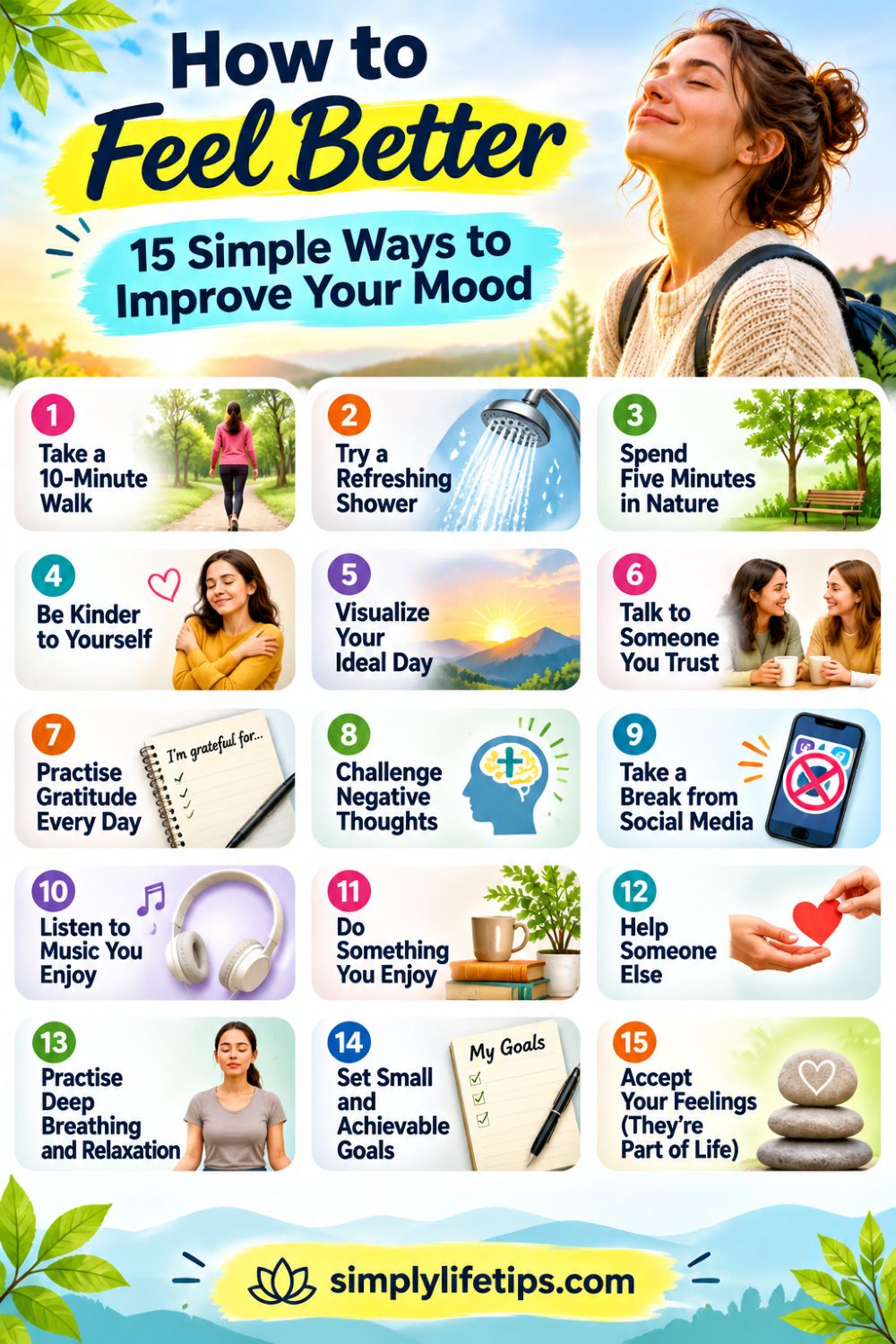
You do not need to try all 15 strategies at once. Choose one or two ideas that feel practical today and gradually build them into your routine. Consistency matters more than perfection. Even small positive steps can help you take better care of your emotional well-being.
Now, let’s look at how to feel better in specific situations, such as when you feel sad, anxious or emotionally overwhelmed.
How to Feel Better When You Are Sad, Anxious, or Depressed
Everyone experiences occasional sadness, worry, and emotional difficulty. However, persistent low mood or anxiety deserves attention.
If you are struggling emotionally, consider these supportive steps.
Maintain a Simple Daily Routine
Try to wake up, eat, exercise, and sleep at reasonably consistent times.
A manageable routine can provide structure when life feels uncertain.
Avoid Isolating Yourself
Stay connected with people you trust. You do not have to explain everything, but maintaining meaningful social contact can help reduce loneliness.
Focus on Basic Self-Care
Pay attention to sleep, nutrition, physical activity, and personal hygiene. Small steps matter, particularly when motivation is low.
Avoid Excessive Self-Criticism
Do not blame yourself for experiencing emotional difficulties. Treat yourself with the same understanding you would offer someone you care about.
Seek Professional Support When Necessary
If sadness, anxiety, or loss of interest persists, becomes overwhelming, or interferes with everyday activities, consult a qualified mental health professional.
The NIMH guide to caring for your mental health explains practical self-care approaches and when to seek professional help.
Depression and anxiety are genuine health conditions. They may require professional assessment and appropriate treatment. Walking, positive thinking, cold showers, or visualization should never be presented as replacements for medical care.
If you experience thoughts of harming yourself or suicide, seek immediate help from local emergency services or a qualified crisis support service.
How to Feel Better Quickly on a Difficult Day
Sometimes, you do not need a complete lifestyle plan. You simply need a few manageable actions to help you get through a difficult day.
Try this simple reset:
- Step away from your current activity for a few minutes.
- Drink a glass of water.
- Take a short walk or stretch gently.
- Listen to a favourite song.
- Take a few slow, comfortable breaths.
- Talk to someone you trust.
- Identify one small task you can complete.
- Give yourself permission to rest.
Do not expect every technique to work immediately or in the same way for everyone.
Choose what feels appropriate for your situation and give yourself time.
Why Small Daily Habits Matter
Improving emotional well-being is not usually about making one dramatic change.
It is often the result of small, consistent actions that support your physical health, relationships, confidence, and sense of purpose.
A 10-minute walk may seem insignificant, but it can become the beginning of a healthier routine. A few minutes in nature can provide a welcome break from screens. A kind word to yourself can challenge an unhelpful thinking pattern.
Similarly, setting a meaningful goal can help you move towards a future that reflects your values.
The most important thing is to identify what works for you and practise it consistently.
Conclusion
Learning how to feel better begins with understanding your needs and taking small, meaningful steps towards improving your well-being.
When you feel exhausted, try taking a short walk. When your mind feels overloaded, spend a few minutes in nature. When negative thoughts affect your confidence, practise self-compassion. When you feel lost, take time to imagine the kind of future you want to create.
The five techniques discussed in the Mel Robbins Podcast offer useful inspiration, while the additional strategies in this article provide more ways to support everyday emotional wellness.
Remember that you do not need to feel happy every moment or solve every problem immediately. Give yourself permission to rest, learn, grow, and seek support when necessary.
Sometimes, feeling a little better begins with one small action. What is one positive step you can take today to care for yourself?
Frequently Asked Questions About How to Feel Better
1. How can I feel better immediately when I am stressed?
Try stepping away from the stressful situation, taking a short walk, practising gentle breathing, listening to relaxing music, or talking to someone you trust. These actions may help you manage everyday stress, although their effects vary from person to person.
2. What is the fastest way to improve your mood?
There is no single method that works for everyone. Physical movement, spending time outdoors, listening to enjoyable music, and connecting with supportive people are practical options that may help improve your mood.
3. How can I feel better when I am sad for no reason?
Start by acknowledging your feelings rather than judging yourself. Maintain a simple routine, spend time with supportive people, get enough rest, and engage in activities you enjoy. If sadness persists or affects your daily life, consider speaking with a mental health professional.
4. Can walking help improve your mood?
Yes. Regular physical activity, including walking, can support mental and physical well-being. Even a short walk can provide movement, a change of environment, and a break from everyday responsibilities.
5. How can I stop negative thoughts and feel better about myself?
Start by recognising unhelpful thinking patterns. Challenge exaggerated or unfair self-judgements, appreciate your achievements, and practise speaking to yourself with kindness. If negative thoughts become persistent or overwhelming, professional support may help.
References and Further Reading
- National Institute of Mental Health (NIMH) – Caring for Your Mental Health
- NHS – How to Be Happier
- World Health Organization – Mental Health: Strengthening Our Response
- NHS – Five Steps to Mental Wellbeing
- The Mel Robbins Podcast – Five Simple Things That Shift Your Mood
Disclaimer: This article is intended for general educational and informational purposes. It is not a substitute for professional medical advice, diagnosis, or treatment. Consult a qualified healthcare professional if you have persistent emotional or mental health concerns.

Mathukutty P. V. is the founder of Simply Life Tips. He shares practical advice and useful insights on personal growth, health, well-being, technology, and everyday living. His goal is to help readers build positive habits and make informed decisions. He believes in continuous learning and sharing knowledge to help people live healthier, happier, and more meaningful lives.


