What makes a good life? Is it money, career success, good health, a loving family, close friendships, meaningful work, or simply having enough time to enjoy the years we have?
Most of us spend much of our lives trying to build a successful future. We study, work, earn money, pursue goals, buy homes, raise families, and seek greater security. Yet success and fulfillment are not necessarily the same thing.
Someone can have an impressive career and still feel lonely. Another person may have a modest income but experience deep satisfaction through family, friendship, meaningful work, community, and everyday experiences.
This difference between success and fulfillment makes the question of what makes a good life more complicated than it first appears.
Robert Waldinger, psychiatrist and director of the Harvard Study of Adult Development, explored this question in his widely viewed TED Talk, What Makes a Good Life? Lessons from the Longest Study on Happiness. The talk draws on decades of research into adult health, happiness, and relationships.
The research points strongly toward the importance of human connection. But a fulfilling life involves more than relationships. Health, purpose, meaningful activity, financial security, personal growth, contribution, and the way we use our limited time also matter.
A good life doesn’t have to look extraordinary from the outside.
It needs to feel meaningful from the inside.
What Makes a Good Life? Watch Robert Waldinger’s TED Talk
If you want to hear Waldinger explain the central findings himself, watch the original TED Talk below.
Robert Waldinger presented the talk at TEDxBeaconStreet in 2015. The official TED page provides the video and transcript and explains that Waldinger shares lessons from the long-running Harvard research into adult development and well-being.
The video provides the research context. The rest of this article takes those ideas further and considers how they can apply to everyday life.
What Makes a Good Life According to Research?
There is no scientific formula that can tell every person exactly how to live.
People have different personalities, circumstances, values, cultures, health conditions, responsibilities, and financial situations. A person who enjoys a quiet life may not want the same things as someone who thrives in a large community.
Research can, however, reveal patterns.
The Harvard Study of Adult Development began in 1938 and followed two original groups of men over many decades. The study examines factors associated with healthy aging, well-being, relationships, work, and other aspects of adult development. It is now also studying a second generation.
One of the most important lessons is that the quality of our relationships matters enormously.
But relationships are only one part of the larger picture.
Here are 15 foundations that can help us think more clearly about what makes a good life.
1. Build Meaningful Relationships
If you ask what makes a good life according to the Harvard research, relationships belong near the top of the list. The Harvard Study of Adult Development has found strong associations between satisfying relationships and long-term health and well-being. In a Harvard Gazette interview, Robert Waldinger explained that satisfaction in relationships during midlife was an important predictor of being happy and healthy later in life.
Think about what happens when life becomes difficult. You lose a job, become ill, experience financial trouble, go through a breakup, or lose someone close to you. A supportive person may not be able to remove the problem, but their presence can change how you experience it. They can listen without judgment, offer encouragement, help you see possibilities when you cannot see them yourself, or simply sit beside you when there is nothing useful to say.
That is why meaningful relationships are not an optional extra that we add to life after everything else is finished. They are part of the foundation. Having people we can trust and depend on gives us emotional support during difficult periods and allows us to share ordinary moments, achievements, worries, and experiences with people who genuinely care about us.
For practical ways to strengthen communication, trust, empathy, and connection, see our guide to Relationship Skills.
2. Value Quality Over Quantity
A large social circle does not automatically create a connected life. Someone may know hundreds of people yet have nobody they can call when something goes wrong, while another person may have only a few close friends and still feel deeply supported and understood.
What matters is not simply how many people you know, but the quality of the relationships you maintain. Strong relationships are built on trust, affection, mutual support, honesty, and emotional safety. They allow you to talk openly when you are struggling, disagree without destroying the relationship, celebrate each other’s successes, and depend on one another during difficult periods.
This is an important part of understanding what makes a good life. You don’t need to be popular or surrounded by people all the time. A few relationships in which you can be yourself, feel accepted, and know that someone genuinely cares about you may be far more valuable than a large network of casual contacts.
A good life does not require popularity. It requires meaningful connection.
3. Make Time for Family and Friends
Relationships need attention if they are going to remain strong. Important relationships can gradually weaken without anyone deliberately deciding to end them. Work becomes busy, children need attention, responsibilities accumulate, people move to different places, and years can pass before we realize that we have lost touch with someone who once mattered greatly to us.
Maintaining relationships doesn’t always require dramatic gestures or elaborate plans. A phone call, a shared meal, a short visit, or even a simple message asking, “How are you?” can remind someone that they matter. These small acts of attention can help keep relationships alive, especially when life becomes busy.
The Harvard Study of Adult Development emphasizes the importance of maintaining meaningful relationships throughout life rather than assuming they will take care of themselves. Making time for family and friends is therefore not something we should postpone until life becomes less demanding. If a relationship matters to us, giving it some attention today can be more valuable than promising to make time for it someday.
If family connection is especially important to you, you can also explore our practical guide to healthy parent-child relationships.
4. Understand the Difference Between Solitude and Loneliness
Being alone isn’t necessarily unhealthy. Some people genuinely enjoy solitude and may need quiet time to read, think, create, rest, or simply enjoy their own company. Spending time alone can be a healthy choice when it is something you want and find restorative.
Loneliness is different. It can occur when the level of connection we experience doesn’t match the connection we need. A person can be surrounded by people and still feel lonely, just as someone who spends considerable time alone can feel content and emotionally connected to others.
Robert Waldinger has discussed social isolation and loneliness as important concerns for health and well-being. The Harvard research does not suggest that everyone needs a particular number of friends or social relationships. Instead, the quality and dependability of our connections appear to matter greatly.
This is encouraging because you don’t need to become extremely social to build a fulfilling life. The right amount of connection depends on your personality, circumstances, and needs. For one person, it might mean a spouse and a few close friends. For another, it might include family, neighbors, colleagues, and participation in a community group.
The goal is not to eliminate solitude. It is to make sure that being alone is a choice you can enjoy rather than an unwanted form of isolation. Understanding this distinction is another useful way to think about what makes a good life.
5. Take Care of Your Physical Health
Relationships may be central to the Harvard research, but physical health remains an important part of a fulfilling life. Good health can make it easier to participate in the activities and relationships that give life meaning, while poor health can affect mobility, independence, work, travel, and many of the everyday experiences we enjoy.
Of course, health is never entirely under our control. People can become ill despite making healthy choices, aging is a natural part of life, accidents happen, and genetics can influence our health. For that reason, the goal should not be to achieve perfect health or to expect complete control over our bodies.
A more realistic goal is to take reasonable care of the health we have. Regular physical activity, adequate sleep, nutritious food, appropriate medical care, and avoiding harmful habits can all support better health and help us remain active and independent for longer.
The Harvard Study of Adult Development examines physical and psychological well-being across the lifespan, making it particularly valuable for understanding how different aspects of life interact as people grow older. Its long-term approach also reminds us that health and happiness are not separate parts of life; they influence our ability to maintain relationships, pursue meaningful activities, and remain engaged with the people and experiences that matter to us.
6. Protect Your Emotional Well-Being
A good life does not mean feeling happy every minute. Sadness, anger, disappointment, grief, fear, and frustration are normal parts of being human. If we expect life to feel pleasant all the time, difficult emotions can make us believe that something has gone terribly wrong.
Emotional well-being is not about eliminating uncomfortable feelings. It is about learning to experience difficult emotions without allowing them to define your entire life. Someone grieving the loss of a loved one may not feel happy, but that does not mean their life has lost its meaning. Similarly, someone facing a career setback may feel discouraged without having failed at life.
A difficult season is not necessarily a failed life. Every life contains uncertainty, loss, disappointment, and change alongside moments of happiness and achievement. Learning to accept this reality can help us develop a more balanced understanding of what makes a good life.
Rather than expecting constant happiness, we can aim for a life in which difficult emotions have a place without taking over everything else. Supportive relationships, meaningful activities, healthy routines, and a sense of purpose can help us navigate challenging periods while remaining connected to the things that matter.
7. Find Something That Gives You Purpose
A comfortable life is not automatically a meaningful life. People naturally want to feel that what they do matters and that their time, abilities, or experiences contribute to something beyond themselves. This sense of purpose can become an important part of a fulfilling life.
Purpose can come from many different sources. For one person, it may come from raising children or caring for family members. For another, it may come through teaching, creating, practicing a profession, building a business, volunteering, helping others, or contributing to a community. There is no single definition of purpose that applies to everyone.
Purpose also doesn’t have to involve changing the world. A parent helping a child develop confidence is doing meaningful work. A teacher encouraging a struggling student may have a lasting influence on that child’s future. Someone caring for an aging relative may never receive public recognition, yet their contribution can be deeply important.
This is why purpose should not be measured by fame, income, or public recognition. Some of the most meaningful things we do may be known only by the people whose lives we touch. A good life can be built around ordinary responsibilities and relationships when we recognize the value they bring to ourselves and others.
8. Find Meaning in Your Work
Work occupies a substantial part of adult life, so it naturally affects our overall well-being. Meaningful work does not necessarily mean having a dream job or pursuing a career that constantly excites you. For some people, work provides intellectual challenge and opportunities for creativity, while for others it offers a chance to serve others, maintain independence, achieve stability, or provide financial support for their families.
Waldinger’s work also challenges the assumption that professional success, wealth, or status automatically create a satisfying life. The Harvard Study of Adult Development points to a broader understanding of well-being, with the quality of relationships emerging as particularly important.
Instead of asking only, “Do I have the perfect career?” it can be more useful to ask, “Does the way I work support the kind of life I want?” A job may be valuable because it provides stability, allows you to help others, gives you opportunities to grow, or simply enables you to support the people you love.
Work can be an important part of a good life, but it does not have to become the whole of it. When career ambitions leave no time for relationships, health, rest, or the experiences that matter to you, it may be worth reconsidering what success really means.
9. Seek Financial Security, Not Endless Accumulation
Money matters because financial insecurity can make it difficult to focus on relationships, health, purpose, or personal growth. Housing, food, healthcare, education, transportation, and unexpected emergencies all require resources, so having enough money to meet basic needs and maintain reasonable financial security is an important part of a stable life.
At the same time, financial security and endless accumulation are not the same thing. Once essential needs are met and a reasonable level of security has been established, continually pursuing more money can involve trade-offs that deserve careful consideration. More income may be useful, but if earning it requires sacrificing relationships, health, rest, or every opportunity to enjoy life, the cost may be greater than it first appears.
This does not mean ambition is bad. Working toward financial goals can provide independence, reduce stress, and create opportunities for yourself and the people you care about. The more important question is whether the pursuit of greater wealth is supporting the life you want or gradually consuming the time and energy needed to enjoy it.
Money can provide comfort, freedom, and security, but it cannot automatically provide meaning. Understanding what makes a good life means recognizing the difference between having enough resources to live well and allowing the pursuit of more to become the purpose of life itself.
10. Spend Your Time on What Matters
Time may be the most limited resource we possess. You can earn more money, replace possessions, change careers, and recover from some mistakes, but you cannot recover yesterday. Once a day has passed, that time is gone. This makes the way we use our time central to the question of what makes a good life.
Your calendar can reveal your priorities more honestly than your intentions do. If you say that family is important but spend almost every waking hour working, there may be a gap between what you value and how you actually spend your time. If you care about your health but never have enough time for sleep, exercise, or proper meals, your schedule may be telling you that something needs to change.
This does not mean every minute needs to be optimized. A good life is not a productivity contest in which every hour must produce something measurable. Rest, conversation, hobbies, and unplanned moments have value too.
The goal is to make deliberate room for the people, relationships, activities, and experiences you don’t want to lose. When you understand that time is limited, it becomes easier to ask whether the way you spend today reflects the life you genuinely want to build.
Our article on how to lead a better life also explores intentional living, personal growth, resilience, and making time count.
11. Learn to Be Present
Modern technology makes distraction remarkably easy. You can sit beside your family while checking messages, have dinner with a friend while scrolling through social media, or spend time with a child while mentally preparing for tomorrow’s work. Being physically present is not always the same as being emotionally present.
Being present means giving genuine attention to what is happening now. During an important conversation, putting your phone aside can show the other person that they have your attention. Listening instead of simply waiting for your turn to speak can deepen a conversation, while noticing the people, surroundings, and experiences around you can help you appreciate moments that might otherwise pass unnoticed.
This doesn’t require rejecting technology or becoming completely disconnected from the digital world. It simply means deciding when your attention belongs somewhere else. Enjoy the meal you’re eating, pay attention during a walk, look up from the screen when someone is speaking to you, and give yourself opportunities to experience life without constant interruption.
These actions may seem small, but life is made from small moments. If we are always distracted while they are happening, we may miss much of what makes a good life meaningful.
Our article Enjoy Every Moment of Life explores practical ways to become more aware of everyday experiences and appreciate the present.
12. Keep Learning and Growing
A good life changes as you change. The things that mattered to you at 20 may not have the same importance at 40 or 60. Marriage, parenthood, career changes, retirement, illness, loss, new responsibilities, and other major experiences can all reshape your priorities and your understanding of what makes a good life.
Personal growth means remaining open to learning and adapting as life changes. You might learn a new skill, improve your communication, become more patient, develop healthier habits, understand your emotional patterns, become more confident, or simply become more comfortable with who you are. Growth does not always involve a dramatic transformation; sometimes it means making small changes that gradually improve the way you live and relate to others.
Growth also doesn’t mean constantly criticizing yourself or believing that your present self is inadequate. It means remaining curious about who you are, what you value, and what you can learn from your experiences. Every stage of life can teach you something if you remain willing to reflect and adapt.
A useful question at any age is: What can this period of my life teach me? The answer may reveal a new opportunity, a neglected priority, or simply a different way of looking at the life you already have.
13. Contribute to Other People’s Lives
A fulfilling life isn’t only about what we receive; contribution matters too. Helping another person can create a sense of meaning, strengthen relationships, and remind us that our actions can have an impact beyond ourselves. We don’t need wealth, fame, or influence to make a difference in someone’s life.
Contribution can take many ordinary forms. You can help a neighbor, teach someone a useful skill, listen when a friend is struggling, encourage a colleague, mentor a younger person, volunteer in your community, or share knowledge that may benefit someone else. These actions may take only a small amount of time, but they can have lasting value.
Sometimes a small act of kindness arrives at exactly the moment another person needs it. A few encouraging words can restore someone’s confidence, a helping hand can make a difficult day easier, and simply being available can remind someone that they are not alone.
The value of a contribution isn’t always measured by its size or by whether anyone notices it. It can be measured by its effect on another person’s life. When we use our time and abilities to help others, we add another important dimension to what makes a good life meaningful.
14. Appreciate Ordinary Moments
We often postpone happiness without realizing it. We tell ourselves, “I’ll enjoy life when I earn more,” “I’ll relax after this project,” or “I’ll spend more time with my family when work becomes less busy.” We may even imagine that life will finally slow down after retirement. But there is always another project, another bill, another responsibility, or another goal waiting for our attention.
That is why learning to appreciate ordinary experiences matters. A cup of tea in the morning, a conversation with a friend, a family meal, a walk after dinner, a favorite song, rain outside the window, a child’s laughter, or a quiet moment after a difficult day may seem insignificant when viewed individually. Yet these simple experiences are often the moments we remember and value.
We don’t have to wait for a major achievement, expensive vacation, or perfect circumstances before allowing ourselves to enjoy life. Happiness can exist alongside ordinary responsibilities when we learn to notice what is already good.
These everyday experiences may not seem important while they are happening, but they are the raw material from which a life is made. Understanding what makes a good life therefore means learning not only to plan for tomorrow but also to appreciate the life unfolding today.
Our Path to Happiness also explores gratitude, self-love, compassion, enjoyable activities, and meaningful connections as parts of everyday well-being.
15. Balance Achievement With What Matters
Ambition isn’t the enemy of a good life. Achievement can provide satisfaction, work can provide purpose, money can provide security, and learning can build confidence. Pursuing meaningful goals can give us direction and a sense of accomplishment.
The problem begins when achievement becomes the only measure of success. Imagine someone spending decades building an impressive career while continually postponing relationships, family time, hobbies, travel, rest, and personal interests. They may eventually achieve everything they wanted professionally, only to discover that some of the time and experiences they sacrificed cannot be recovered.
This is where the Harvard research becomes especially relevant. Robert Waldinger has repeatedly emphasized that strong relationships are central to health and well-being, challenging the assumption that wealth, fame, or professional achievement alone are enough to create a satisfying life.
The goal isn’t to abandon ambition or stop pursuing meaningful goals. It is to place ambition within a larger definition of a good life. Success becomes more valuable when it helps us build a life that includes the people we love, time to enjoy what we have achieved, opportunities to remain healthy and curious, and experiences that give our lives meaning.
What Makes a Good Life According to Robert Waldinger?
Robert Waldinger’s TED Talk challenges a common assumption about success: that fame, money, and professional achievement are the primary ingredients of happiness. Drawing on decades of findings from the Harvard Study of Adult Development, he presents a different perspective in which the quality of our relationships plays a central role in health and well-being.
The research suggests that people who are more socially connected to family, friends, and their community tend to experience better health and well-being than those who are less connected. Relationship quality matters too. Having people around us is not enough if those relationships leave us feeling unsupported, misunderstood, or alone. Robert Waldinger’s TED Talk and transcript
This doesn’t mean money is irrelevant or that career achievement has no value. Financial security can reduce stress, work can provide purpose, and achieving meaningful goals can bring satisfaction. Nor does it mean everyone needs the same number or type of relationships. Different people have different social needs and circumstances.
The broader lesson is that external success is not a complete definition of a successful life. A person can have an impressive résumé and still feel lonely, while someone with an ordinary career may experience deep satisfaction through family, friends, purpose, and community.
The research therefore encourages us to ask a different set of questions. Instead of asking only, “How successful am I?” we can also ask, “How connected am I, and am I investing enough time in the relationships that matter to me?”
That shift in perspective may be one of the most important lessons when considering what makes a good life.
What Makes a Good Life? Harvard Study of Adult Development
The Harvard Study of Adult Development began in 1938 and has followed participants across decades, collecting information about their physical and mental health, relationships, careers, marriage, retirement, and other aspects of adult life. Because researchers have been able to observe people over such a long period, the study offers a rare opportunity to examine how experiences earlier in life are associated with health and well-being later on. Official Harvard Study of Adult Development
One of the study’s greatest strengths is its long-term design. Rather than taking a snapshot of people’s lives at a single point in time, researchers have been able to follow changes and patterns across adulthood. The project has also expanded into a second-generation study involving the children of original participants, allowing researchers to investigate how experiences earlier in life may relate to health and development in the next generation. Harvard Study — Second Generation Study
One of the best-known findings concerns relationships. Harvard’s reporting on Robert Waldinger’s work describes satisfaction in relationships, particularly in midlife, as an important predictor of health and happiness later in life. The research does not suggest that strong relationships must be perfect or free from disagreements. Instead, it points to the importance of having people we can rely on and relationships that provide genuine support.
That distinction matters. Every close relationship has disagreements, misunderstandings, and difficult periods. What makes a relationship valuable is not the absence of conflict but the presence of trust, support, affection, and a sense that you are not facing life’s challenges entirely alone.
This is one of the clearest lessons from the research when considering what makes a good life: we don’t need perfect relationships, but we do need meaningful connections we can depend on.
The Three Big Lessons From the TED Talk
Robert Waldinger’s TED Talk presents three broad lessons from the Harvard Study of Adult Development, all pointing toward the importance of meaningful human connection. The findings don’t suggest that relationships are the only ingredient in a fulfilling life, but they do show why our social connections deserve more attention than we often give them.
Social Connections Matter
People who are more connected to family, friends, and their community tend to have better health and well-being than those who experience greater social isolation. Connection can provide emotional support, companionship, and a sense of belonging, particularly during challenging periods of life. Robert Waldinger’s TED Talk
Relationship Quality Matters
Simply having people around you isn’t enough. A large social network cannot replace relationships built on trust, affection, mutual support, and dependability. A smaller number of close relationships can be deeply valuable when they provide a sense of security and allow people to be themselves.
This is why the quality of our relationships deserves at least as much attention as the number of people we know. A relationship that looks ordinary from the outside may be one of the most important sources of strength in someone’s life.
Good Relationships Support Health
The research has also connected satisfying relationships with healthier aging and greater well-being. In his Harvard Gazette interview, Waldinger describes relationship satisfaction as an important predictor of health and happiness later in life.
These findings offer a practical lesson: relationships should not be treated as something we will make time for after everything else is finished. They are part of the life we are building now. Making time for the people who matter, maintaining meaningful connections, and paying attention to relationship quality can be valuable investments in both present well-being and the years ahead.

Can You Build a Good Life at Any Age?
Yes. One encouraging lesson from long-term research into adult development is that life is not permanently determined by what happened in the past. People change, circumstances change, and priorities change. Relationships can be strengthened, new connections can be developed, new interests can emerge, and new sources of purpose can be discovered at different stages of life.
The Harvard Study of Adult Development continues to examine development across generations, including a second-generation study involving the children of the original participants. This ongoing research reflects an important reality: adult development does not simply end after youth. Our health, relationships, priorities, and sense of purpose can continue to evolve throughout life. Harvard Study of Adult Development — Second Generation Study
You don’t need to have made every decision correctly, have perfect relationships, or have discovered your purpose at 20. You can begin where you are. You might call someone you have lost touch with, join a group, learn something new, repair a relationship when appropriate, set a healthy boundary, make more time for the people who matter, or start taking better care of your health.
None of these actions guarantees a perfect life, but small changes can influence the direction of your life over time. Building a good life is not a project that must be completed by a certain age. It is an ongoing process of learning, adjusting, connecting, and choosing what deserves your time and attention.
How to Build a Good Life in Everyday Life
Knowing what makes a good life is useful, but putting that knowledge into practice is more important. You don’t need a dramatic transformation or a complete change in your lifestyle. A fulfilling life is often built through small choices that are repeated consistently over time.
Start with the relationships that matter to you. Call someone you have been meaning to contact, invite a friend for tea, share a meal with your family, or make time for a conversation without allowing your phone to become a distraction. These simple actions can strengthen connections and help you remain present in the lives of people who matter.
Give attention to your own well-being as well. Protect your sleep, make time for regular physical activity, learn something new, and create space for activities that give you a sense of purpose or enjoyment. If work is taking over your life, consider whether clearer boundaries could give you more time for relationships, rest, and other priorities.
Look for opportunities to contribute to someone else’s life. Help a neighbor, encourage a colleague, teach someone a useful skill, or simply be available when a friend needs to talk. Meaning can often be found not only in what we accomplish for ourselves but also in what we do for others.
It can also help to step back occasionally and examine the direction of your life. Ask yourself: If I continued living this way for the next ten years, would I be happy with how I spent my time? The question may be uncomfortable, but it can reveal a gap between what you say matters to you and how you actually spend your days.
If the answer isn’t what you hoped, that doesn’t mean your life has failed. It may simply mean that something deserves more attention. A good life is built gradually, and even small changes can move you closer to the life you want.

A Simple Good-Life Check
Instead of asking whether your life is perfect, consider whether the important foundations of a fulfilling life are receiving enough attention. A few honest questions can help you notice areas that may have been neglected while you were busy dealing with everyday responsibilities.
Do you have people you can rely on when life becomes difficult? Are you investing enough time and attention in your relationships? Are you taking reasonable care of your physical and emotional health? Does your life give you a sense of purpose, and are you continuing to learn and grow? Do you have enough financial security to meet your needs without allowing the pursuit of money to consume your life?
It is also worth considering how you spend your time. Is work taking more of your life than you want it to? Do you make time for the people you love? Do you contribute something useful to other people’s lives? Can you appreciate ordinary experiences instead of constantly waiting for the next achievement or milestone? Most importantly, are your everyday choices consistent with the values you say are important to you?
You don’t need a perfect score, and these questions are not meant to turn life into another performance test. Their purpose is awareness. Once you recognize where your life needs more attention, you can begin making deliberate changes and gradually create greater balance, meaning, and connection.
A good life is not one in which every area is perfect. It is one in which the things that matter most are given the attention they deserve.
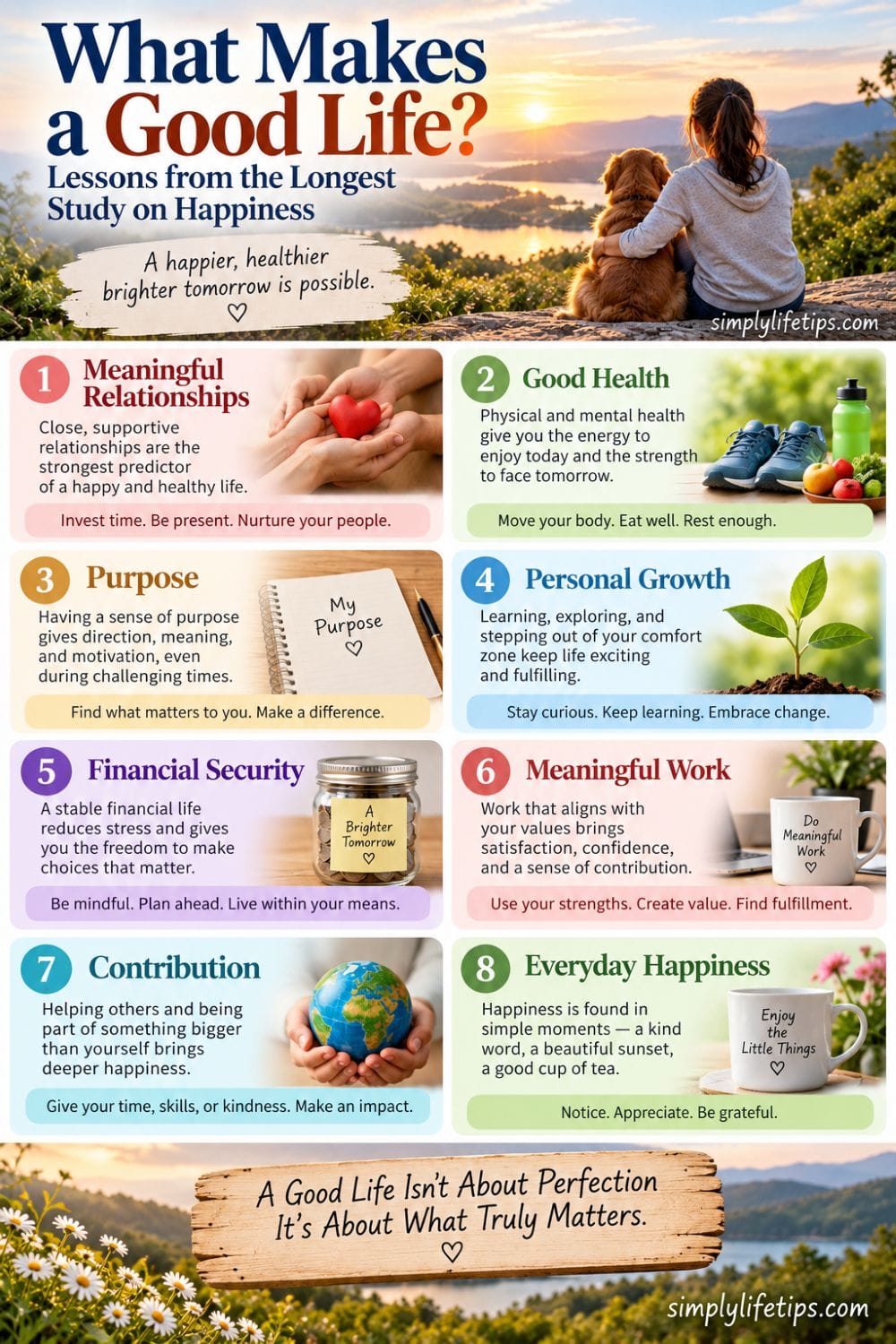
The following infographic brings these ideas together in a quick visual summary of what makes a good life.
Conclusion
What makes a good life is not one extraordinary achievement, but the way relationships, health, purpose, growth, contribution, and everyday experiences come together over time. Robert Waldinger’s work offers a powerful reminder that the things we chase most intensely are not always the things we value most when we look back.
Money can provide security, achievement can provide satisfaction, work can provide purpose, and good health can provide greater freedom. But meaningful relationships can give these parts of life a deeper sense of connection and belonging. The evidence from the Harvard Study of Adult Development suggests that how we relate to the people around us can have lasting importance for our well-being. Harvard Study of Adult Development
A good life doesn’t have to look extraordinary from the outside. It may be a relatively ordinary life filled with people you care about and who care about you, meaningful work, reasonable financial security, opportunities to learn and grow, and enough awareness to appreciate the experiences happening around you.
We don’t get unlimited time, which makes the way we spend it one of the most important choices we make. We can continue chasing the next achievement, or we can also make room for the relationships, experiences, and values that make those achievements worthwhile.
So perhaps the most useful question isn’t simply, “What makes a good life?” It is: “What am I doing today to build one?”
Frequently Asked Questions
What makes a good life?
A good life can include meaningful relationships, physical and emotional well-being, purpose, financial security, personal growth, contribution, and time spent on things that matter. Research from the Harvard Study of Adult Development places particular emphasis on the importance of satisfying relationships.
What does Robert Waldinger say makes a good life?
Robert Waldinger’s TED Talk emphasizes the importance of good relationships. Drawing on the Harvard Study of Adult Development, he explains how social connection and relationship quality are associated with health, happiness, and well-being.
Is money important for a good life?
Money matters because financial security helps people meet basic needs and deal with uncertainty. However, wealth and status alone do not provide a complete definition of a fulfilling life. Waldinger’s discussion of the Harvard research places particular emphasis on relationships and broader well-being.
Why are relationships important for a good life?
Relationships can provide companionship, emotional support, belonging, and help during difficult periods. The Harvard Study of Adult Development has identified relationship satisfaction as an important factor associated with healthy and happy aging.
Can you build a good life at any age?
Yes. A good life is an ongoing process rather than a deadline. People can strengthen relationships, develop new connections, improve their habits, discover new interests, and find new sources of meaning at many stages of life.
References
- Waldinger, Robert. “What Makes a Good Life? Lessons from the Longest Study on Happiness.” TEDxBeaconStreet, TED, 2015.
Official TED Talk and transcript - Harvard Study of Adult Development. Massachusetts General Hospital / Harvard Medical School.
Official Harvard Study of Adult Development - Mineo, Liz. “Work out daily? OK, but how socially fit are you?” Harvard Gazette, February 10, 2023.
Harvard Gazette interview with Robert Waldinger - Harvard Study of Adult Development. “Grant & Glueck Study.”
Study history and research overview - Harvard Study of Adult Development. “Second Generation Study.”
Second Generation Study

Mathukutty P V is a Blogger, YouTuber, and Content Writer and the founder of Simply Life Tips. After taking voluntary retirement in 2017, he embraced a free lifestyle focused on learning, personal growth, and sharing practical wisdom to help others live with more purpose and positivity.