
Relationships shape every stage of our lives, and relationship skills determine whether those connections become a source of happiness, support, and growth or stress, conflict, and disappointment. While schools teach academic subjects and workplaces focus on technical abilities, many people enter adulthood without learning the essential skills needed to build and maintain healthy relationships.
Strong relationship skills are not limited to romantic partnerships. They influence how we communicate with family members, interact with friends, collaborate with colleagues, and connect with our communities. These skills help us understand others, express ourselves respectfully, manage disagreements, and build trust over time.
Like any life skill, relationship skills can be developed through practice. Anyone willing to practice effective communication, empathy, emotional intelligence, and mutual respect can improve their relationships.
In this guide, you’ll learn what relationship skills are, why they matter, the essential skills everyone should develop, and practical ways to strengthen every important relationship in your life.
What Are Relationship Skills?
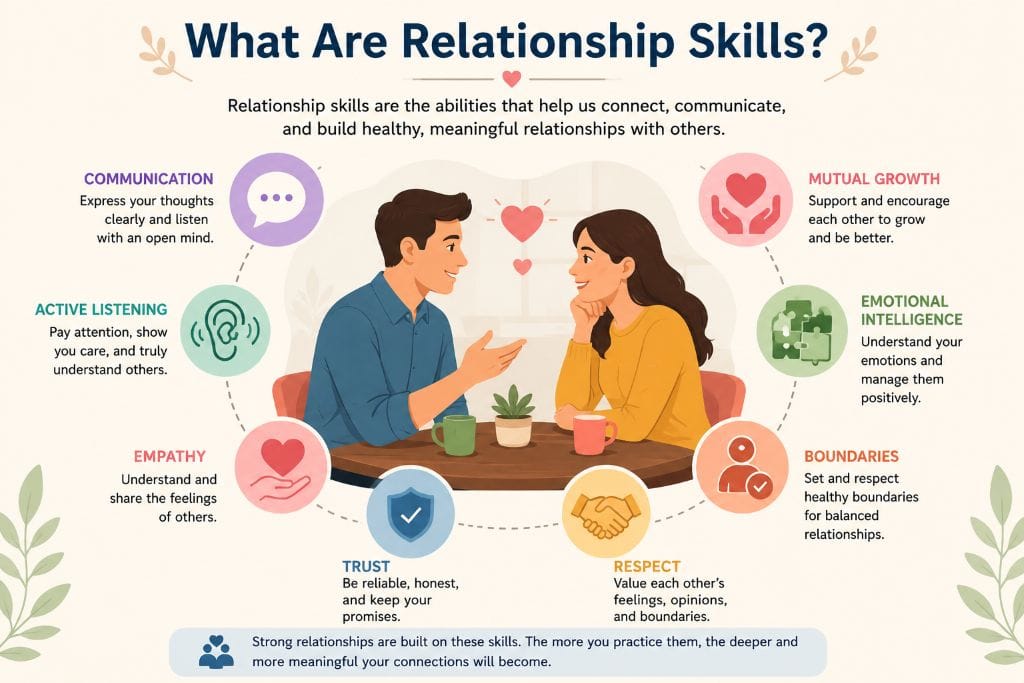
Relationship skills are the abilities that help people build, maintain, and improve healthy connections with others. They include communication, emotional awareness, listening, trust-building, conflict resolution, empathy, respect, and cooperation.
Rather than relying on luck or personality, successful relationships are built on behaviors that can be learned and practiced.
For example:
- A couple discussing financial decisions calmly instead of arguing.
- Friends resolving misunderstandings through honest conversations.
- Parents listening patiently to their children.
- Colleagues respecting different opinions during team discussions.
These everyday situations demonstrate that relationship skills affect nearly every interaction we have.
Relationship Skills Are Life Skills
Many people think relationship skills only matter in marriage or dating. In reality, they influence almost every part of life.
Healthy relationship skills help you:
- Build stronger family bonds.
- Develop lasting friendships.
- Become a better team member at work.
- Reduce unnecessary conflicts.
- Improve emotional well-being.
- Increase confidence in social situations.
Someone may be highly educated or professionally successful, but poor relationship skills can still create loneliness, workplace conflicts, and family problems.
Importance of Relationship Skills
Healthy relationships contribute significantly to emotional well-being, resilience, and overall life satisfaction. While career achievements and financial security are important, meaningful relationships often provide the support people rely on during both successes and difficult times.
Developing relationship skills offers many benefits.
Better Communication
Clear communication reduces misunderstandings before they become larger problems.
Instead of saying:
“You never listen to me.”
A healthier approach would be:
“I feel unheard when I’m interrupted. Can we talk without distractions?”
This small change encourages understanding instead of defensiveness.
Stronger Trust
Trust develops gradually through honesty, consistency, and keeping promises.
For example:
- Arriving on time.
- Following through on commitments.
- Being truthful, even during difficult conversations.
- Respecting privacy.
Trust isn’t built through grand gestures but through consistent everyday actions.
Improved Mental Well-Being
Supportive relationships can help reduce stress, encourage resilience, and provide emotional comfort during challenging times. Feeling understood and valued often contributes to greater emotional stability.
On the other hand, unhealthy relationships may increase stress and affect overall well-being, highlighting the importance of developing healthy relationship habits.
Greater Confidence
Positive relationships reinforce self-worth.
When people feel respected and accepted, they are often more willing to:
- Share ideas.
- Express emotions.
- Take healthy risks.
- Build new friendships.
- Face challenges confidently.
Better Conflict Management
Disagreements are a normal part of every relationship.
Relationship skills don’t eliminate conflict—they help people manage disagreements respectfully without damaging the relationship.
Healthy conflict often leads to stronger understanding rather than lasting resentment.
Essential Relationship Skills Everyone Should Develop
Strong relationships are built on a combination of skills that work together. Improving even one of these abilities can have a positive impact on your interactions with others.
Improving relationship skills doesn’t require dramatic changes. Small, consistent actions—such as listening attentively, communicating honestly, and respecting boundaries—can strengthen your relationships over time. The illustration below outlines seven practical steps you can start applying today.
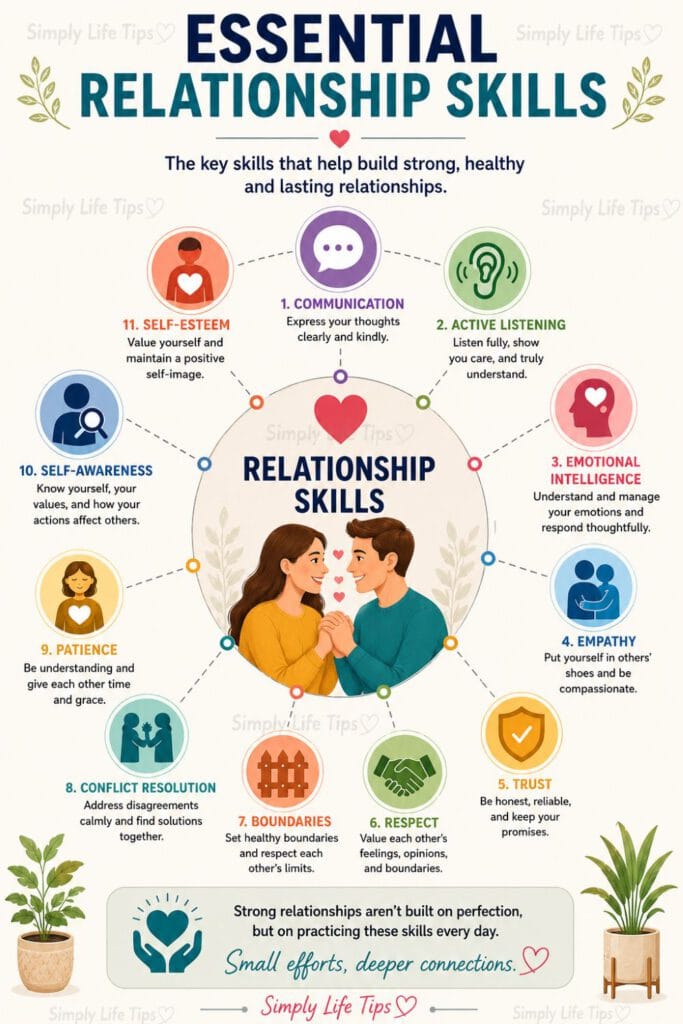
Each step builds on the previous one, helping you develop stronger communication, greater emotional awareness, and healthier interactions. The following sections explore these relationship skills in more detail and provide practical tips for putting them into practice.
Communication
Communication forms the foundation of every healthy relationship. It involves more than speaking—it includes expressing thoughts clearly, choosing appropriate words, understanding non-verbal signals, and ensuring the other person feels heard. Effective communication helps people express their thoughts, understand others, and resolve misunderstandings. To learn practical techniques, read our detailed guide on developing effective communication skills.
Good communicators:
- Speak honestly.
- Listen without interrupting.
- Ask thoughtful questions.
- Clarify misunderstandings.
- Avoid blaming language.
For example, instead of making assumptions, ask, “Can you help me understand what you meant?” This encourages open dialogue rather than defensiveness.
Active Listening
Active listening is more than simply hearing words. It means giving someone your full attention, understanding their message, and responding thoughtfully. Developing this skill helps reduce misunderstandings, strengthens trust, and improves every type of relationship. To learn practical techniques and phrases you can use every day, read our guide on Active Listening Phrases to Boost Your Communication Skills.
Someone practicing active listening will:
- Maintain eye contact.
- Avoid interrupting.
- Ask follow-up questions.
- Summarize what they heard.
- Show genuine interest.
Imagine a friend sharing a difficult experience. Instead of immediately offering advice, simply listening and acknowledging their feelings can be far more supportive.
Emotional Intelligence
Emotional intelligence is the ability to recognize, understand, and manage your own emotions while responding appropriately to the emotions of others. It plays an important role in building trust, resolving conflicts, communicating effectively, and developing healthier relationships. People with higher emotional intelligence are often better equipped to handle disagreements calmly and respond with empathy rather than reacting impulsively. If you’d like to strengthen this essential skill, read our guide on developing emotional intelligence.
It includes:
- Self-awareness.
- Emotional regulation.
- Empathy.
- Social awareness.
- Healthy decision-making.
For example, instead of reacting angrily during a disagreement, someone with strong emotional intelligence pauses, reflects, and responds calmly.
This ability often prevents minor disagreements from becoming major conflicts.
Empathy
Empathy is the ability to understand another person’s thoughts, feelings, and experiences. It helps people communicate with compassion, build trust, and respond thoughtfully during both everyday conversations and difficult situations. Empathy doesn’t require agreeing with someone—it requires making a genuine effort to understand their perspective. To learn practical ways to develop this essential skill, read our guide on empathy in the workplace. Although the article focuses on professional settings, the same principles can strengthen relationships with family, friends, and partners.
For example:
Instead of saying:
“You’re overreacting.”
A more empathetic response is:
“I can understand why that situation upset you.”
Simple moments of empathy often strengthen relationships more than elaborate solutions.
Trust
Trust is the foundation of every healthy relationship. It develops through honesty, reliability, consistency, and mutual respect. Trust isn’t built by grand gestures but by keeping promises, communicating openly, and being dependable over time. When trust is strong, people feel emotionally safe to share their thoughts, feelings, and concerns without fear of judgment. Once broken, trust often requires patience, accountability, and consistent actions to rebuild. To understand why trust matters and how to strengthen it, read our complete guide on the role of trust in building stronger relationships.
Trustworthy people:
- Keep confidential information private.
- Admit mistakes.
- Remain dependable.
- Tell the truth.
- Respect personal boundaries.
When trust is broken, rebuilding it usually requires patience, accountability, and consistent effort over time.
Respect
Respect is one of the most important relationship skills because it allows people to feel valued even when opinions differ.
Respect involves:
- Listening without ridicule.
- Accepting differences.
- Avoiding insults.
- Valuing personal choices.
- Speaking politely during disagreements.
Respect creates emotional safety, making honest conversations easier.
Healthy Boundaries
Healthy boundaries are the limits we set to protect our emotional, physical, and mental well-being while maintaining respectful relationships. They help people communicate their needs, protect their personal space, and create mutual understanding without controlling or distancing others.
Setting healthy boundaries may involve saying “no” when necessary, respecting personal time, maintaining privacy, and expressing expectations clearly. Contrary to popular belief, boundaries do not weaken relationships—they strengthen them by reducing resentment, preventing misunderstandings, and encouraging mutual respect.
Healthy boundaries also help individuals maintain their identity while building meaningful connections. They create a safe environment where both people feel respected, valued, and free to express themselves honestly.
Examples include:
- Respecting personal time.
- Saying no without guilt.
- Maintaining privacy.
- Avoiding controlling behavior.
- Communicating personal limits clearly.
To learn practical strategies for creating and maintaining healthy limits, read our detailed guide on setting healthy boundaries in relationships.
Self-Esteem
Healthy relationships begin with a healthy relationship with yourself. Self-esteem influences how you communicate, express your needs, set boundaries, and respond to challenges in your interactions with others. When you value yourself, you’re more likely to build relationships based on mutual respect rather than fear, insecurity, or the need for constant approval.
People with healthy self-esteem often:
- Communicate their thoughts with confidence.
- Respect their own needs as well as those of others.
- Set healthy boundaries without feeling guilty.
- Accept constructive feedback positively.
- Handle disagreements calmly instead of taking everything personally.
- Develop stronger and more balanced relationships.
On the other hand, low self-esteem can make it difficult to say “no,” express opinions honestly, or leave unhealthy relationships. It may also lead to excessive people-pleasing, fear of rejection, or seeking validation from others.
Building healthy self-esteem takes time, but even small improvements can positively influence every relationship in your life.
Learn practical ways to strengthen your confidence in our guide on increasing self-esteem and improving relationships.
Conflict Resolution
Conflict is a natural part of every healthy relationship because no two people think, feel, or communicate in the same way. Strong relationship skills don’t eliminate disagreements—they help you handle them with respect, empathy, and a focus on finding solutions. Learning to stay calm, listen actively, and understand different perspectives can turn conflicts into opportunities for growth rather than sources of resentment.
Healthy conflict resolution involves:
- Remaining calm.
- Focusing on the issue rather than personal attacks.
- Looking for solutions.
- Compromising when appropriate.
- Taking responsibility for mistakes.
For example, two siblings arguing over household responsibilities can work together to create a fair schedule rather than continue blaming each other.
For practical strategies, read our complete guide on how to handle conflict the right way.
Conflict handled respectfully often increases trust and understanding.
Self-Awareness
Self-awareness is the ability to recognize your thoughts, emotions, behaviors, strengths, and areas for improvement. It is one of the most important relationship skills because healthy relationships begin with understanding yourself before trying to understand others.
When you’re self-aware, you’re more likely to:
- Recognize your emotional triggers.
- Communicate your needs clearly.
- Accept responsibility for your actions.
- Respond thoughtfully instead of reacting impulsively.
- Understand how your behavior affects other people.
- Learn from mistakes and grow stronger through experience.
For example, if you notice that stress makes you impatient, self-awareness allows you to pause, manage your emotions, and communicate more calmly instead of saying something you’ll regret.
Developing self-awareness is an ongoing process of reflection, learning, and personal growth. As you understand yourself better, you naturally become a better listener, communicator, partner, friend, family member, and colleague.
Related reading: Cultivating Self-Awareness: The Path to Personal Growth
Patience
Strong relationships require patience because people grow, learn, and make mistakes.
Patience means:
- Allowing time for improvement.
- Avoiding impulsive reactions.
- Understanding that lasting trust develops gradually.
- Accepting that no relationship is perfect.
Patient individuals often create calmer, more supportive relationships where everyone feels safe to learn and grow.
How to Improve Relationship Skills?
Developing relationship skills doesn’t require dramatic changes overnight. Small, consistent improvements in how you communicate, listen, and respond to others can transform your relationships over time.
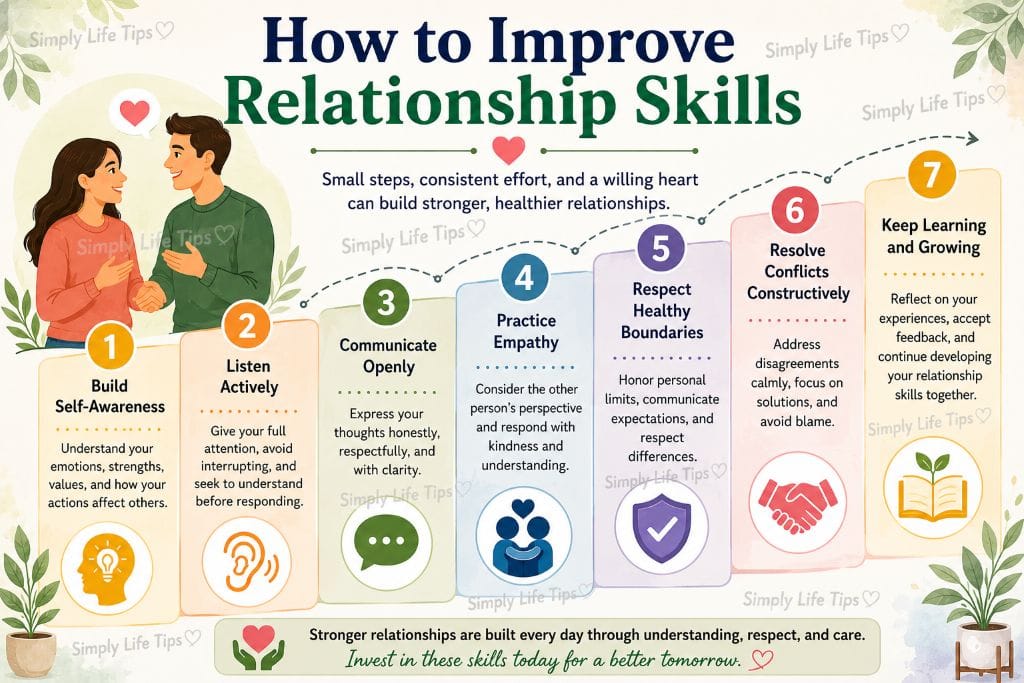
Think of relationship skills like learning to play a musical instrument. No one becomes an expert after one lesson, but regular practice leads to steady progress.
Become a Better Listener
One of the simplest ways to improve any relationship is to listen with the intention of understanding rather than responding.
Many conversations fail because people are already planning their reply while the other person is still speaking.
Practice these habits:
- Put away your phone during important conversations.
- Maintain appropriate eye contact.
- Let the other person finish speaking.
- Ask clarifying questions instead of making assumptions.
- Reflect what you heard to confirm your understanding.
Example:
Instead of interrupting with advice, say:
“If I understand correctly, you’re feeling overwhelmed because of work. Is that right?”
Feeling heard often matters more than hearing the “perfect” response.
Express Your Feelings Clearly
People cannot read your mind. Expecting others to know what you’re thinking often leads to disappointment.
Learn to express your feelings honestly without blaming others.
Instead of saying:
“You never care about me.”
Try:
“I felt disappointed when we couldn’t spend time together because I was looking forward to it.”
This approach focuses on your feelings rather than attacking the other person’s character.
Practice Empathy Every Day
Empathy grows through curiosity.
Before reacting, ask yourself:
- What might this person be experiencing?
- Could there be another explanation for their behavior?
- How would I feel in the same situation?
For example, a coworker who seems impatient may be dealing with family responsibilities or work-related stress rather than intentionally being rude.
Trying to understand before judging often prevents unnecessary conflict.
Learn to Manage Emotions
Strong emotions can cloud judgment and lead to words or actions we later regret.
When emotions become intense:
- Pause before responding.
- Take slow, deep breaths.
- Step away briefly if needed.
- Return to the conversation when calmer.
- Focus on solving the problem instead of winning the argument.
Responding thoughtfully is usually more effective than reacting impulsively.
Keep Your Promises
Trust is strengthened through consistency.
Simple actions make a significant difference:
- Arrive when you say you will.
- Complete commitments.
- Admit mistakes honestly.
- Follow through on responsibilities.
- Be dependable even in small matters.
Over time, these behaviors create lasting trust.
Accept Constructive Feedback
No one is perfect.
Healthy relationships require humility and a willingness to learn.
Instead of becoming defensive when receiving feedback:
- Listen completely.
- Ask questions if something isn’t clear.
- Thank the person for sharing their perspective.
- Reflect before responding.
Growth begins when we are open to seeing ourselves through another person’s eyes.
Respect Differences
People have different personalities, communication styles, beliefs, and life experiences.
Healthy relationships do not require complete agreement.
Respect means accepting differences without trying to control or change the other person.
For example, one partner may enjoy social gatherings while the other prefers quiet evenings at home. Instead of criticizing each other’s preferences, they can find a balance that respects both needs.
How to Improve Communication Skills in a Relationship?
Communication is often the first area people want to improve because it influences every other relationship skill.
Whether you’re talking with a spouse, parent, sibling, friend, or colleague, these habits can strengthen communication.
Speak Honestly but Kindly
Honesty should never become an excuse for being hurtful.
Choose words that communicate your thoughts without damaging the relationship.
Instead of:
“That’s a terrible idea.”
Try:
“I see it differently. Can I explain my perspective?”
Honesty combined with kindness encourages meaningful discussions.
Avoid Assumptions
Many misunderstandings begin with assumptions rather than facts.
Instead of assuming someone’s intentions, ask questions.
Examples:
- “Can you explain what you meant?”
- “Did I understand you correctly?”
- “Can we talk about what happened?”
Clarifying misunderstandings early prevents larger conflicts later.
Choose the Right Time
Difficult conversations rarely go well when someone is exhausted, distracted, or under significant stress.
Whenever possible:
- Discuss important issues privately.
- Avoid serious conversations during heated arguments.
- Give each other enough time to talk without interruptions.
Timing often influences the outcome as much as the conversation itself.
Focus on One Issue at a Time
Avoid bringing up every past disagreement during a current discussion.
Stay focused on the present issue.
This makes conversations more productive and reduces feelings of being overwhelmed.
Common Mistakes That Damage Relationships
Even people with good intentions sometimes develop habits that weaken relationships.
Recognizing these patterns is the first step toward changing them.
Poor Communication
Avoiding important conversations allows small problems to become larger ones.
Ignoring issues rarely makes them disappear.
Healthy relationships encourage honest, respectful discussions even when topics are uncomfortable.
Taking People for Granted
People naturally appreciate feeling valued.
Simple gestures such as expressing gratitude, saying “thank you,” or acknowledging someone’s effort help maintain strong relationships.
Never assume people already know they are appreciated.
Refusing to Apologize
Everyone makes mistakes.
A sincere apology demonstrates maturity and accountability.
A meaningful apology includes:
- Acknowledging the mistake.
- Expressing genuine regret.
- Taking responsibility.
- Committing to change.
Avoid apologies that shift blame, such as:
“I’m sorry you felt that way.”
Instead, say:
“I’m sorry for what I said. I understand it hurt you, and I’ll work on communicating more respectfully.”
Ignoring Boundaries
Healthy relationships require mutual respect.
Ignoring someone’s personal space, privacy, or emotional limits can gradually damage trust.
Respecting boundaries shows consideration rather than distance.
Trying to Win Every Argument
Relationships are partnerships, not competitions.
If one person always has to “win,” both people often lose emotionally.
Instead of asking:
“How can I prove I’m right?”
Ask:
“How can we solve this together?”
This shift in mindset encourages cooperation instead of conflict.
Benefits of Strong Relationship Skills
Developing relationship skills improves much more than personal relationships.
These skills positively influence emotional well-being, career success, and overall quality of life.
Stronger Family Relationships
Families communicate more openly when trust and respect become daily habits.
Children also learn healthy relationship behaviors by observing adults.
Healthier Friendships
Good friends support each other through life’s successes and challenges.
Relationship skills help friendships remain honest, respectful, and long-lasting.
Better Romantic Relationships
Healthy romantic relationships rely on communication, trust, respect, patience, and emotional support rather than unrealistic expectations.
When couples develop these skills together, they are often better equipped to navigate life’s challenges.
Greater Workplace Success
Relationship skills are equally valuable in professional settings.
Employees who communicate effectively, resolve conflicts respectfully, and collaborate well often contribute to stronger teams and more positive work environments.
Strong interpersonal skills can also support career growth by improving leadership, teamwork, and professional relationships.
Improved Emotional Well-Being
Supportive relationships can help reduce feelings of isolation and provide encouragement during difficult times.
Feeling connected to others often contributes to greater resilience and life satisfaction.
Increased Confidence
Healthy relationships reinforce self-worth by creating environments where people feel accepted, respected, and valued.
This confidence often extends into other areas of life, including education, work, and community involvement.
Understanding Attachment Styles
Relationship skills are influenced not only by what we learn but also by how we connect with others emotionally. Attachment styles describe patterns of thinking, feeling, and behaving in close relationships, often shaped by early life experiences.
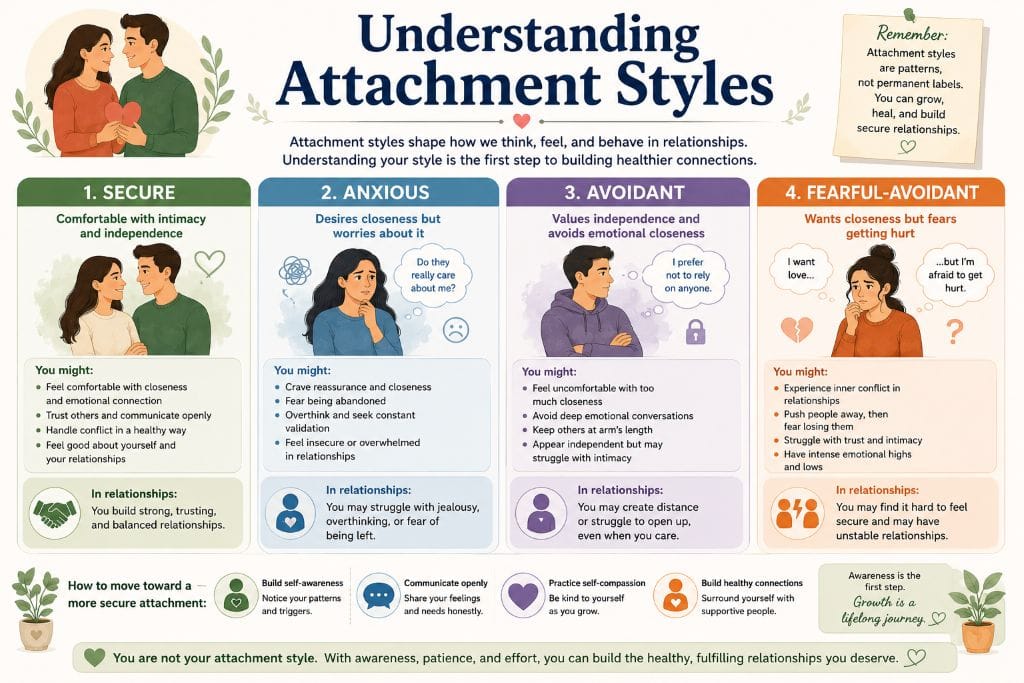
The four main attachment styles are:
- Secure attachment
- Anxious attachment
- Avoidant attachment
- Fearful-avoidant attachment
Understanding your attachment style can help you recognize recurring relationship patterns, improve communication, build trust, and respond more effectively during conflicts. While attachment styles may influence your behavior, they do not define your future. Developing healthy relationship skills can help you build stronger and more secure relationships over time.
Related reading: How Attachment Styles Affect Relationships
Understanding Love Languages
Every person has unique ways of expressing and receiving love. The concept of love languages suggests that understanding these preferences can strengthen emotional connections and reduce misunderstandings in relationships.
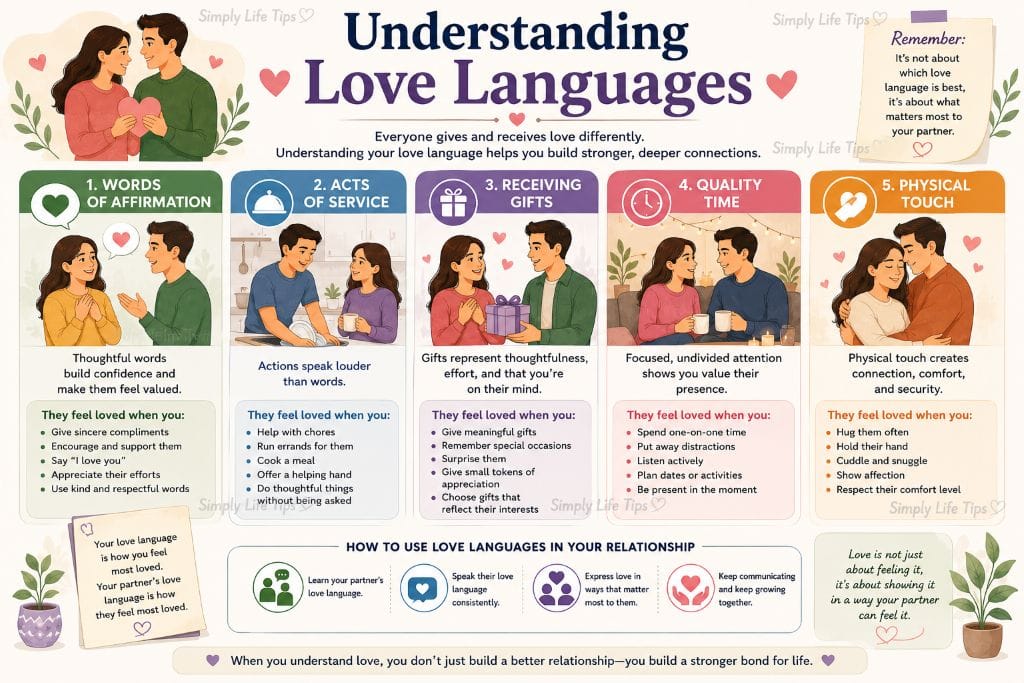
The five commonly recognized love languages are:
- Words of Affirmation
- Quality Time
- Acts of Service
- Receiving Gifts
- Physical Touch
For example, one person may feel most appreciated through encouraging words, while another values spending uninterrupted time together. Recognizing these differences helps couples, family members, and friends express care in ways that feel meaningful to one another.
However, love languages work best when combined with strong relationship skills such as communication, empathy, trust, respect, and active listening. Simply knowing someone’s preferred love language cannot replace honest conversations, healthy boundaries, or effective conflict resolution.
Related reading: Love Languages for Healthy Relationships
Relationship Skills Across Different Stages of Life
Relationship skills remain important throughout life, although the way we use them evolves.
Children
Children begin learning relationship skills by observing parents, teachers, and caregivers.
Important lessons include:
- Sharing
- Taking turns
- Saying sorry
- Showing kindness
- Respecting others
Adults play a vital role by modeling these behaviors consistently.
Teenagers and Young Adults
As young people gain independence, relationship skills help them:
- Build healthy friendships.
- Navigate romantic relationships.
- Handle peer pressure.
- Communicate respectfully.
- Manage rejection and disappointment.
- Resolve disagreements constructively.
These experiences can shape future relationships and emotional well-being.
Adults
Adults apply relationship skills in many areas of life, including:
- Marriage or long-term partnerships.
- Parenting.
- Friendships.
- Workplace collaboration.
- Community involvement.
Balancing these relationships requires ongoing communication, patience, and mutual respect.
Older Adults
In later life, relationship skills continue to foster meaningful connections with family, friends, neighbors, and caregivers.
Maintaining supportive relationships can help reduce loneliness and enhance overall quality of life.
Strong relationship skills remain valuable at every age because the need for connection never disappears.
Relationship Skills Can Be Learned at Any Age
One of the biggest misconceptions is that people are either “good with relationships” or they are not. In reality, relationship skills are learned through experience, self-awareness, and intentional practice.
Just as people improve their fitness through regular exercise, they can strengthen their relationships by developing healthy habits over time.
If you’ve experienced difficult relationships in the past, it doesn’t mean you’re destined to repeat the same patterns. Every conversation, disagreement, and shared experience offers an opportunity to learn and grow.
Remember that improvement doesn’t happen overnight. Focus on making small, meaningful changes consistently rather than trying to become perfect.
The Future of Relationship Education
Modern education prepares students for careers, but life requires much more than academic knowledge.
Imagine if schools and colleges taught practical life skills such as:
- Effective communication
- Active listening
- Emotional intelligence
- Conflict resolution
- Building trust
- Respecting boundaries
- Managing emotions
- Healthy relationships
- Teamwork
- Problem-solving
These skills would not only improve personal relationships but also help students become better leaders, employees, parents, and community members.
Many workplaces now recognize the importance of emotional intelligence and interpersonal skills because technical expertise alone is no longer enough. As society becomes more connected digitally, learning how to build meaningful human connections may be more important than ever.
Relationship education should not replace academic learning—it should complement it by preparing people for the realities of everyday life.
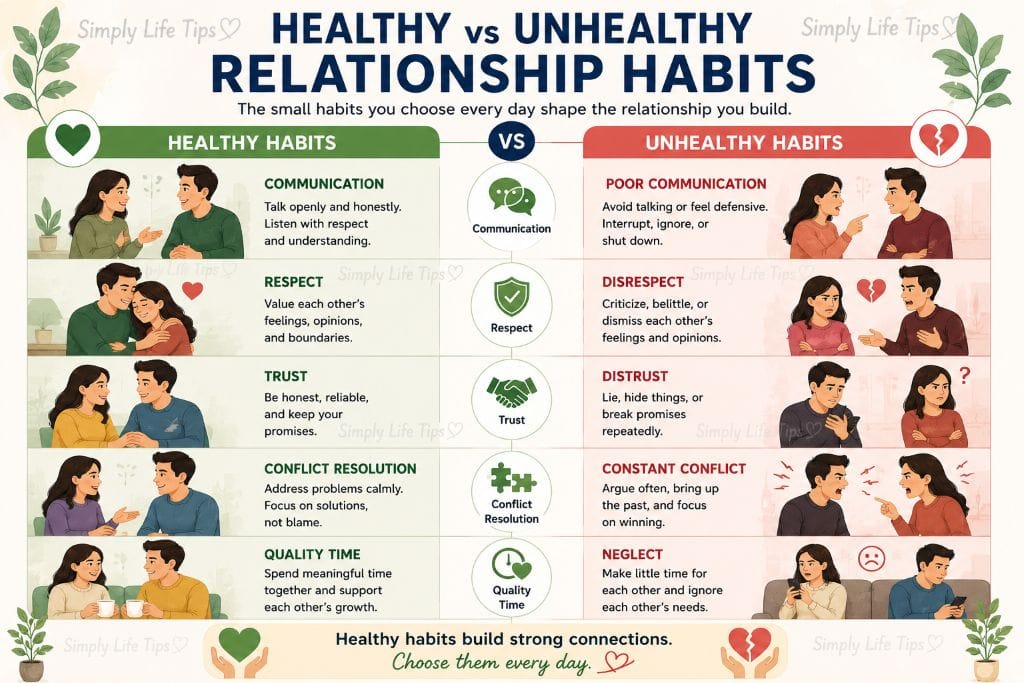
Healthy relationships are strengthened by the small choices we make every day. Simple habits such as listening carefully, expressing appreciation, communicating honestly, and showing respect can gradually build trust, deepen emotional connections, and improve overall relationship satisfaction. The infographic below highlights practical daily habits that anyone can incorporate into their relationships.
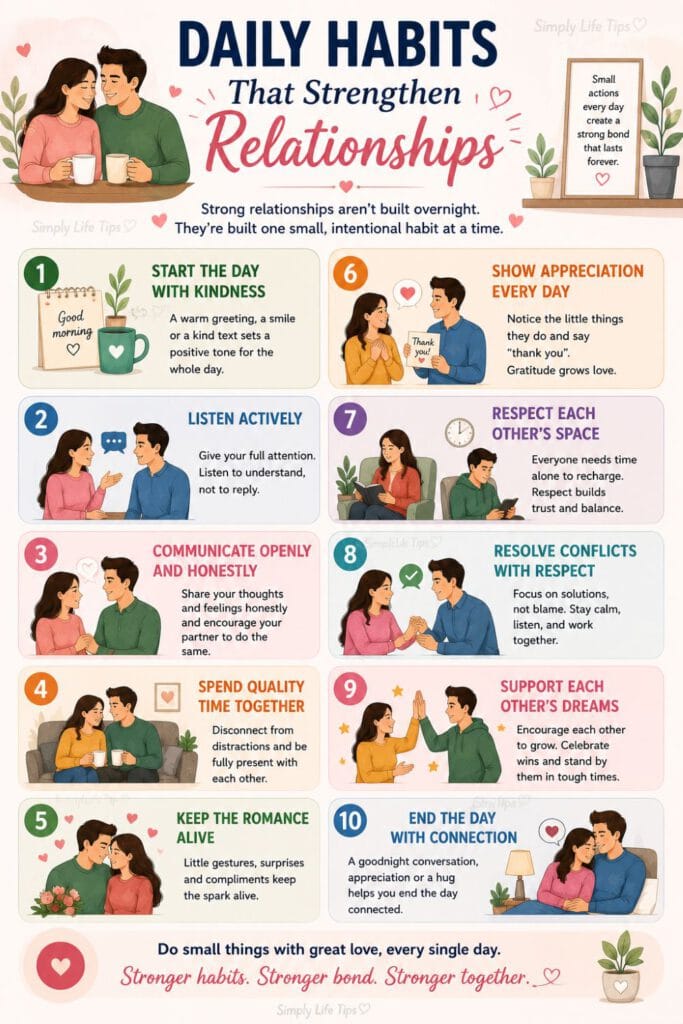
Developing healthy relationship habits is an ongoing process rather than a one-time achievement. By consistently practicing these simple actions, you can create stronger communication, greater trust, and deeper emotional bonds over time. Even small, positive changes made every day can have a lasting impact on the quality and strength of your relationships.
Conclusion
Relationship skills are among the most valuable life skills anyone can develop. They influence how we communicate, resolve conflicts, build trust, express empathy, and create meaningful connections with the people around us.
Healthy relationships rarely happen by chance. They are built through consistent effort, mutual respect, honest communication, and emotional maturity.
The good news is that relationship skills can be learned at any stage of life. Every positive conversation, every sincere apology, every act of kindness, and every moment of active listening strengthens the foundation of lasting relationships.
While success and financial security contribute to a comfortable life, meaningful relationships often provide the support, encouragement, and sense of belonging that make life truly fulfilling.
Start with one skill today. Listen more attentively. Communicate more openly. Show greater empathy. Respect healthy boundaries. Small improvements practiced consistently can lead to stronger relationships that enrich every area of your life.
Frequently Asked Questions
What are relationship skills?
Relationship skills are the abilities that help people build, maintain, and strengthen healthy relationships. They include communication, active listening, empathy, trust, emotional intelligence, conflict resolution, respect, and setting healthy boundaries.
Why are relationship skills important?
Relationship skills help improve communication, reduce misunderstandings, strengthen trust, resolve conflicts respectfully, and build healthier personal and professional relationships. They also contribute to emotional well-being and overall life satisfaction.
Can relationship skills be learned?
Yes. Relationship skills are not fixed personality traits. Anyone can improve them through self-awareness, practice, constructive feedback, and a willingness to learn from experiences.
How can I improve my communication skills in a relationship?
You can improve communication by listening actively, expressing your feelings respectfully, avoiding assumptions, choosing the right time for important conversations, and focusing on understanding rather than winning arguments.
What are the most important relationship skills?
Some of the most important relationship skills include effective communication, active listening, empathy, emotional intelligence, trust, respect, conflict resolution, patience, and maintaining healthy boundaries.
Disclaimer
This article is for educational and informational purposes only and should not be considered professional psychological, medical, or relationship counseling advice. If relationship difficulties are causing significant emotional distress, abuse, or safety concerns, consider seeking support from a qualified mental health professional or licensed relationship counselor.
References:
- Centers for Disease Control and Prevention (CDC) – How to Listen and Support Someone in Need (active listening and supportive communication)
- Centers for Disease Control and Prevention (CDC) – Conversation Tips for Connecting Conversations (active listening and communication)
- PubMed (Journal of Family Psychology) – The Power of Listening: Lending an Ear to the Partner During Dyadic Coping Conversations (research linking attentive listening with relationship satisfaction)
- The Gottman Institute – 5 Ways to Improve Communication in Relationships (evidence-informed communication strategies)
- The Gottman Institute – How to Improve Emotional Intelligence (emotional intelligence in relationships)

Mathukutty P V is a Blogger, YouTuber, and Content Writer and the founder of Simply Life Tips. After taking voluntary retirement in 2017, he embraced a free lifestyle focused on learning, personal growth, and sharing practical wisdom to help others live with more purpose and positivity.