

Sleep is essential for our physical health, mental well-being, memory, and daily energy. Yet many people still believe things about sleep that are not entirely true. From the idea that everyone needs exactly eight hours of sleep to the belief that we can easily make up for lost sleep on weekends, common sleep myths can influence our everyday habits.
But how much of what we hear about sleep is supported by science?
Understanding the difference between sleep myths and facts can help us make better decisions about our rest and daily routines. In this article, we will explore 10 common sleep myths, explain what scientific evidence tells us, and share practical tips for developing healthier sleep habits.
10 Common Sleep Myths and Facts Explained
Sleep Myth 1: Everyone Needs Exactly Eight Hours of Sleep
The myth: Every adult must sleep exactly eight hours each night to stay healthy.
The fact: Eight hours is a useful guideline, but it is not a fixed requirement for everyone. Most adults need at least seven hours of sleep per night, and many do best with around seven to nine hours. Sleep needs vary with age, health, lifestyle, and individual circumstances.
Children and teenagers generally need more sleep than adults because they are still growing and developing. Parents can learn more about sleep deprivation in children and discover practical ways to help children sleep.
The important thing is to get enough sleep regularly and feel reasonably rested during the day. Consistently sleeping too little may affect concentration, mood, memory, and overall well-being.
What you can do: Maintain a regular sleep schedule and pay attention to how you feel during the day. If you regularly feel exhausted despite getting enough sleep, consider speaking with a healthcare professional.
Sleep Myth 2: You Can Train Yourself to Need Less Sleep
The myth: If you regularly sleep for only four or five hours, your body will eventually adapt, allowing you to function normally with less rest.
The fact: People may become accustomed to a short sleep schedule, but that does not necessarily mean their bodies and brains have adapted successfully. Research suggests that ongoing sleep restriction can impair attention, thinking, and performance even when people do not fully recognize how affected they are.
Sleep plays an important role in memory, learning, emotional regulation, and physical recovery. Regularly sacrificing sleep to work longer or stay busy may eventually affect productivity rather than improve it.
Teenagers also need sufficient sleep for their development and daily functioning. If you are a parent, explore these strategies to help your teen get enough sleep.
What you can do: Prioritize sleep instead of trying to train yourself to function on too little. Build a routine that allows enough time for rest, and reduce habits that regularly delay bedtime.
Sleep Myth 3: Falling Asleep Anywhere Means You Sleep Well
The myth: People who can fall asleep quickly in a car, at a desk, or almost anywhere have a particularly healthy sleep system.
The fact: Falling asleep easily is not always a sign of good sleep. Excessive daytime sleepiness can indicate that someone is not getting enough sleep or is experiencing poor-quality sleep.
An expert-led study published in Sleep Health identified the belief that falling asleep anywhere is a sign of healthy sleep as a misconception. The researchers noted that this ability may instead reflect chronic sleep deprivation.
Of course, feeling sleepy occasionally after a late night is not automatically a sign of a sleep disorder. However, regularly struggling to stay awake during ordinary daytime activities deserves attention.
What you can do: Review your sleep schedule and whether you wake feeling refreshed. If you frequently experience excessive daytime sleepiness despite allowing enough time for sleep, consult a healthcare professional.
Sleep Myth 4: Your Brain Becomes Inactive During Sleep
The myth: When you fall asleep, your brain shuts down and stops working until morning.
The fact: Your brain remains active throughout sleep. It moves through different sleep stages, each associated with distinct patterns of brain activity and important physiological processes.
During sleep, the brain helps process information, consolidate memories, and support learning. Different sleep stages contribute to these functions in different ways. Sleep also supports emotional regulation and overall health.
This is one of the clearest misconceptions identified in the expert-led research on sleep myths. Sleep is not simply a period when the brain switches off; it is an active and complex biological process.
What you can do: Give yourself enough time for regular, uninterrupted sleep. A consistent bedtime and wake-up time can help support a healthier sleep routine.
Sleep Myth 5: You Can Bank Sleep Before a Busy Week
The myth: If you know you will be busy or sleep less later in the week, you can sleep extra beforehand and store that sleep for future use.
The fact: Getting sufficient sleep before a demanding period may help you start well-rested, but sleep cannot be banked like money in a savings account. Extra sleep beforehand does not guarantee that you will avoid the effects of inadequate sleep later.
Your body needs sleep regularly. Although additional rest may help in certain circumstances, it is not a substitute for consistently meeting your sleep needs.
This matters for students preparing for exams, professionals facing deadlines, and anyone who routinely sacrifices sleep to meet responsibilities.
What you can do: Plan your schedule to protect sleep as much as possible. Rather than relying on extra sleep before a busy day, aim for a routine throughout the week.
Sleep Myth 6: You Can Fully Catch Up on Lost Sleep During Weekends
The myth: Sleeping late on Saturday and Sunday completely reverses the effects of losing sleep during the week.
The fact: Sleeping longer after a period of insufficient sleep can help you recover some lost rest. However, it may take more than one long night to recover, and weekend sleep does not reliably erase all the effects of repeated sleep deprivation.
Large differences between weekday and weekend sleep schedules can also make it harder to maintain a consistent routine.
This does not mean you should avoid extra sleep when you need it. It means that regular, adequate sleep is a better long-term goal than repeatedly sleeping too little and trying to make up for it later.
What you can do: Try to keep your sleep and wake times reasonably consistent throughout the week. If you have accumulated sleep debt, allow yourself enough time to recover while working toward a sustainable routine.
Sleep Myth 7: Alcohol Helps You Sleep Better
The myth: A drink before bedtime helps you relax and guarantees a deeper, more refreshing night’s sleep.
The fact: Alcohol may make you feel sleepy initially, but it can disrupt normal sleep patterns and reduce sleep quality. It may lead to more frequent awakenings and interfere with restorative sleep later in the night.
Alcohol can also worsen snoring and sleep-related breathing problems in some people. Feeling drowsy after drinking is therefore not the same as getting healthy, restorative sleep.
If you are trying to improve your sleep, it is better to avoid relying on alcohol as a bedtime aid.
What you can do: Establish a calming evening routine that does not depend on alcohol. You can also explore these tips for good-quality sleep and a relaxed mind for practical ideas to support better rest.
Sleep Myth 8: Sleep Quantity Matters More Than Sleep Quality
The myth: If you spend enough hours in bed, your sleep must be healthy, regardless of how often you wake up or how rested you feel.
The fact: Sleep duration matters, but sleep quality matters too. Frequent awakenings, difficulty staying asleep, or sleep-related breathing problems can interfere with restorative rest even when you spend plenty of time in bed.
For example, someone may spend eight hours in bed but still wake feeling tired because their sleep was repeatedly interrupted. On the other hand, regularly getting too little sleep is also a problem, even if the sleep itself feels uninterrupted.
Good sleep involves both sufficient duration and sleep that leaves you able to function well during the day.
What you can do: Pay attention to both how long you sleep and how you feel when you wake up. Keep your bedroom comfortable, reduce distractions, and maintain a consistent schedule. If sleep problems persist, seek professional advice.
Sleep Myth 9: You Should Stay in Bed Until You Fall Asleep
The myth: If you cannot fall asleep, the best approach is to remain in bed and keep trying until sleep finally comes.
The fact: Lying awake for a long time can sometimes increase frustration and make it harder to relax. For people experiencing difficulty falling asleep, a technique used in insomnia treatment is to get out of bed when unable to sleep, do something quiet in dim light, and return when sleepy.
The aim is to strengthen the association between bed and sleep rather than prolonged wakefulness and frustration. This approach is part of stimulus control therapy, a component of evidence-based insomnia treatment.
It does not mean that everyone who takes a little time to fall asleep needs to get out of bed. The approach is particularly relevant when difficulty sleeping becomes a recurring problem.
What you can do: If you remain awake and frustrated, move to a quiet, dimly lit space and try a relaxing activity, such as reading a printed book. Avoid repeatedly checking the clock or scrolling through your phone. Return to bed when you feel sleepy.
If persistent insomnia is affecting your daily life, consider speaking with a healthcare professional.
Sleep Myth 10: It Doesn’t Matter What Time You Go to Sleep
The myth: As long as you get enough hours of sleep, your bedtime and wake-up time do not matter.
The fact: Sleep duration is important, but timing and consistency matter too. Your body has an internal timing system, known as the circadian rhythm, that helps regulate the sleep-wake cycle.
Light exposure, daily routines, and work schedules can influence this rhythm. Frequently changing your bedtime or working against your natural sleep-wake pattern may make it more difficult to sleep well or feel alert when needed.
People who work night shifts or have irregular schedules may face additional challenges. Their sleep needs remain important even when their sleep timing differs from a typical daytime schedule.
What you can do: Aim for a consistent sleep and wake time that fits your daily responsibilities. Get natural light during the day when possible, and create a relaxing environment before bedtime.
Now that we have explored these 10 common sleep myths, let’s review the key facts in one simple infographic. It highlights important points about sleep duration, sleep quality, sleep debt, and healthy sleep habits.
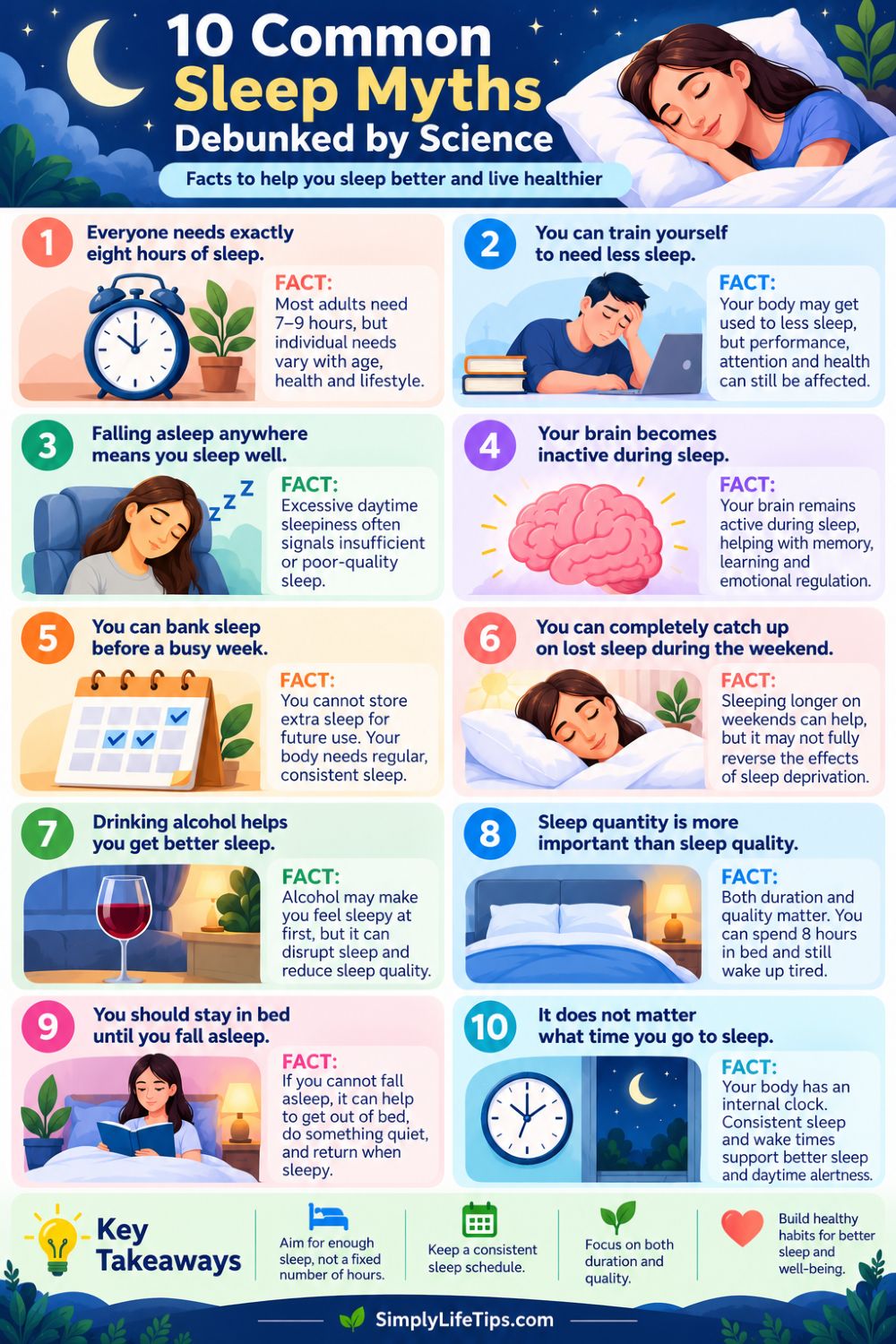
Understanding sleep myths is a useful first step toward better rest. Remember that healthy sleep involves getting enough hours, maintaining a consistent schedule, and paying attention to sleep quality. Small, sustainable changes to your daily routine can help support your overall well-being.
Sleep Myths: What Does Science Tell Us?
The science of sleep shows that healthy rest involves more than simply spending time in bed. Sleep duration, quality, timing, and regularity all contribute to how rested and alert we feel.
Research also shows why common sleep myths deserve attention. Believing that people can function normally on very little sleep, for example, may encourage habits that undermine concentration and performance.
If sleep difficulties are affecting your mood or daily life, you may also find it helpful to read about sleep disorders and their effects on mental health.
For more practical guidance, the Sleep Foundation’s guide to sleep myths and the CDC’s information about sleep explain common misconceptions and healthy sleep recommendations.
Conclusion
Sleep myths can influence the way we organize our days, manage our energy, and respond to tiredness. From believing that everyone needs exactly eight hours to assuming that weekend sleep can fix an entire week of sleep deprivation, these misconceptions can encourage habits that make healthy rest more difficult.
The good news is that improving your sleep does not have to be complicated. Start by allowing enough time for rest, maintaining a reasonably consistent schedule, creating a relaxing bedtime routine, and paying attention to how you feel during the day.
Most importantly, do not ignore persistent sleep difficulties or excessive daytime sleepiness. These symptoms can have several causes and may require professional evaluation.
Understanding the facts behind common sleep myths is a useful first step toward making better choices for your health, well-being, and daily life.
FAQs About Sleep Myths
Is the Eight-Hour Sleep Rule a Myth?
Not exactly. Eight hours is a useful target for many adults, but it is not a strict requirement for everyone. Most adults need at least seven hours of sleep, and individual needs vary. Children and teenagers generally require more sleep.
Can You Train Your Body to Need Less Sleep?
You may become accustomed to sleeping less, but that does not mean your body has adapted without consequences. Regular sleep restriction can affect attention, thinking, and performance, even if you do not always notice the changes.
Can You Make Up for Lost Sleep on Weekends?
Sleeping longer can help you recover some lost sleep, but it may not fully reverse the effects of repeated sleep deprivation. Consistently getting enough sleep is a better long-term approach.
Does It Matter What Time You Sleep if You Get Eight Hours?
Yes, sleep timing can matter. Your circadian rhythm helps regulate when you feel sleepy and alert. A reasonably consistent schedule can support better sleep, although the best timing depends partly on your work, responsibilities, and individual circumstances.
References
- Sleep Foundation: Debunking Sleep Myths With Facts About Sleep
- Robbins et al. (2019), Sleep Health: Sleep myths: An expert-led study to identify false beliefs about sleep that impinge upon population sleep health practices
- Centers for Disease Control and Prevention (CDC): About Sleep
- National Heart, Lung, and Blood Institute (NHLBI): Insomnia Treatment
- Sleep Foundation: Alcohol and Sleep
Disclaimer: This article is for general educational purposes only and is not a substitute for professional medical advice, diagnosis, or treatment. Consult a qualified healthcare professional about persistent sleep problems or concerns about your health.

Mathukutty P. V. is the founder of Simply Life Tips. He shares practical advice and useful insights on personal growth, health, well-being, technology, and everyday living. His goal is to help readers build positive habits and make informed decisions. He believes in continuous learning and sharing knowledge to help people live healthier, happier, and more meaningful lives.