
Brain myths can influence how we think, learn, make decisions, and understand our own brains. From the popular belief that humans use only 10% of their brains to misconceptions about memory and intelligence, many common brain myths contradict scientific evidence.
The human brain is an extraordinarily complex organ. It coordinates movement, processes information, regulates emotions, stores and retrieves memories, and helps us adapt to new experiences. Yet, despite decades of scientific research, misconceptions about how the brain works continue to circulate.
Some of these myths sound convincing because they contain a small element of truth. Others survive through movies, social media, advertisements, and oversimplified explanations of neuroscience.
In this article, inspired by the educational discussion shared by Dr Arun Oommen, a neurosurgeon, we examine 12 common brain myths and explain what science actually tells us. The goal is not simply to replace one belief with another, but to understand the evidence more clearly.
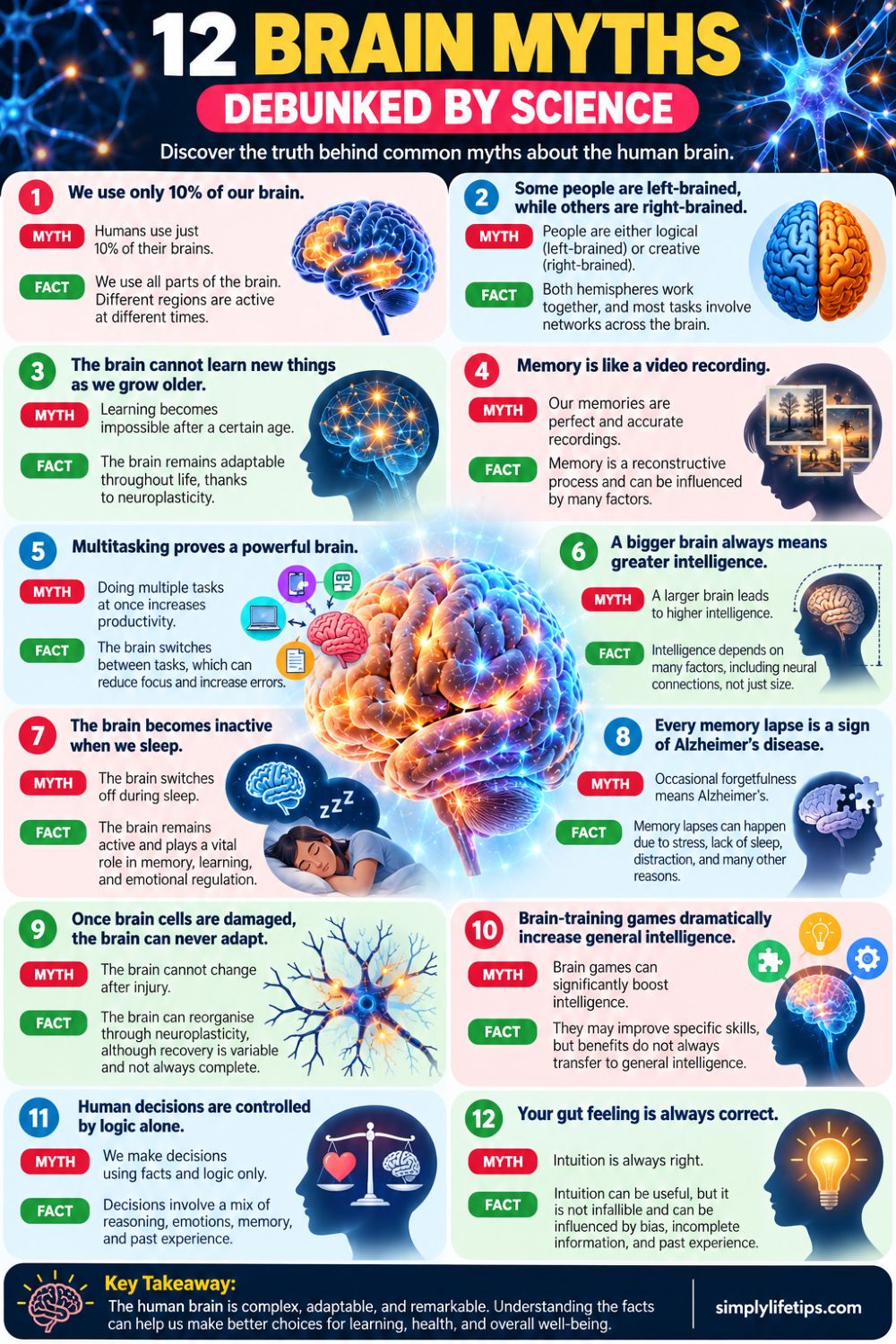
12 Common Brain Myths and Facts Explained by Science
1. Myth: We use only 10% of our brain
The scientific truth
The claim that humans use only 10% of their brains is one of the most persistent brain myths. It suggests that 90% of our brain remains unused and that unlocking this hidden capacity could produce extraordinary intelligence or abilities.
Scientific evidence does not support this claim.
Different brain regions contribute to different functions, including movement, sensation, language, attention, memory, and emotion. Not every region is equally active at every moment, but brain imaging and neurological research show that many interconnected areas participate in our daily activities.
Even when we sleep, the brain continues to regulate essential bodily functions and participate in processes associated with learning and memory.
For example, when you read a book, your brain processes visual information, recognises words, retrieves meanings, and connects new information with existing knowledge. These activities involve multiple neural networks rather than a single isolated region.
The brain also requires substantial energy to function. It is not an organ with 90% of its capacity waiting to be switched on.
What you should remember: Improving your mental performance is not about awakening an unused 90% of your brain. It is about supporting the brain through learning, adequate sleep, physical activity, and healthy daily habits.
For a scientific explanation, read the MIT McGovern Institute’s article on the 10% brain myth.
2. Myth: Some people are left-brained, while others are right-brained
The scientific truth
You may have heard that left-brained people are logical and analytical, while right-brained people are creative, artistic, and emotional.
This popular classification oversimplifies how the human brain works.
The brain has two hemispheres, and some functions show a degree of lateralisation. For example, language processing is predominantly associated with the left hemisphere in many people. Other functions involve different patterns of specialisation across the hemispheres.
However, the two sides communicate continuously through neural connections and work together during many complex activities.
Consider a musician composing a song. The task may involve sound perception, emotional responses, memory, motor coordination, pattern recognition, and planning. These activities rely on distributed brain networks rather than one hemisphere working independently.
Similarly, solving a mathematical problem may require logical reasoning, visualisation, working memory, and language processing.
A person’s creativity or analytical ability cannot be reliably explained by labelling them a left-brain or right-brain personality type.
What you should remember: Both hemispheres contribute to complex thinking. Your personality and abilities are shaped by many interacting factors, not simply by one side of your brain.
3. Myth: The brain cannot learn new things as we grow older
The scientific truth
Many people assume that learning becomes impossible after a certain age. This belief can discourage adults from learning a new language, practising a musical instrument, developing a skill, or returning to education.
Neuroscience tells a different story.
The brain has a capacity called neuroplasticity, which allows neural connections and networks to change in response to learning, experience, practice, and some forms of rehabilitation.
When you repeatedly practise a new skill, the brain can adapt the connections involved in that activity. Learning to play the keyboard, for example, involves coordination between sensory processing, movement, attention, and memory.
Age can influence learning speed, processing speed, and some forms of memory. Adults may need more practice or different learning strategies than children for certain tasks. Nevertheless, learning does not simply stop when adulthood begins.
Regular practice, meaningful challenges, feedback, and sufficient rest can all support learning.
Explore our guide to neuroplasticity and the brain’s ability to adapt to understand this process in greater detail.
What you should remember: Age may change how we learn, but it does not automatically eliminate the ability to acquire new knowledge and skills.
4. Myth: Memory is like a video recording
The scientific truth
When we remember an important event, we may feel that we are replaying an accurate recording of what happened.
Human memory does not work like a video camera.
Memory involves several processes, including encoding information, storing it, and retrieving it later. Attention, emotions, expectations, previous experiences, and information encountered afterward can influence what we remember.
Imagine two people witnessing the same argument. One may focus on the words spoken, while the other notices facial expressions and body language. When they discuss the incident later, their accounts may differ even though both sincerely believe their memories are accurate.
Memory can also change as we reconstruct an experience during recall. This does not mean every memory is false. Many memories preserve important and accurate information, but confidence alone cannot guarantee that every detail is correct.
This is one reason eyewitness testimony can sometimes be mistaken.
Sleep and learning also influence how memories are maintained. Research supported by the National Institutes of Health continues to investigate how brain activity during sleep contributes to memory processing.
What you should remember: A vivid memory is not necessarily a perfectly accurate one. When an important decision depends on remembering an event, consider supporting evidence rather than relying only on confidence.
5. Myth: Multitasking proves that you have a powerful brain
The scientific truth
Answering messages while attending a meeting, watching a video, and completing a report may create the impression that you are accomplishing more.
However, many attention-demanding activities compete for limited cognitive resources.
When you switch between tasks, your brain must redirect attention, retrieve relevant information, and adjust to a different set of demands. This process can increase errors, interrupt concentration, and make complicated work take longer.
For example, a person preparing an important financial report while repeatedly checking phone notifications may lose track of figures or overlook an error. The interruptions can also make it harder to remember what they were doing before switching tasks.
Some activities can be combined effectively, particularly when one is relatively automatic. Walking along a familiar path while listening to uncomplicated audio may be manageable for many people. But combining two tasks that both require concentrated attention is much more demanding.
What you should remember: Being busy with several tasks is not the same as being productive. For important work, try focusing on one demanding task at a time and checking messages during planned breaks.
6. Myth: A bigger brain always means greater intelligence
The scientific truth
It may seem reasonable to assume that a larger brain must produce greater intelligence. However, brain size alone cannot explain a person’s cognitive abilities.
Intelligence is influenced by multiple factors, including the organisation of neural networks, communication between brain regions, development, genetics, education, experience, and environmental conditions.
The number of connections between neurons, the efficiency of neural processing, and the way different brain systems coordinate all contribute to brain function.
Brain size also varies naturally between individuals and is influenced by factors such as body size and biological development. A larger brain does not automatically mean better reasoning, stronger memory, or greater creativity.
For example, two people may have different brain volumes but perform similarly on particular cognitive tasks. Conversely, people with similar brain volumes can have different strengths and abilities.
Intelligence itself is multidimensional and cannot be reduced to a single measurement of brain anatomy.
What you should remember: Brain size is only one aspect of a complex biological system. It is not a simple measure of an individual’s intelligence or potential.
7. Myth: The brain becomes inactive when we sleep
The scientific truth
Sleep may look like a period when the body and brain switch off. In reality, the sleeping brain remains active and moves through several distinct stages.
During sleep, the brain regulates essential bodily processes and participates in functions associated with memory, learning, and emotional regulation.
Research indicates that different stages of sleep contribute to different aspects of memory processing. Sleep is also important for attention, learning, reaction time, and everyday performance.
Consider a student who studies late into the night before an examination. The student may gain additional study time but struggle to concentrate and retrieve information the next day if sleep is insufficient.
Similarly, repeated sleep deprivation can interfere with mood, judgement, and the ability to perform demanding tasks safely.
Sleep needs vary with age and individual circumstances. The important point is that adequate, regular sleep is a fundamental part of maintaining health and cognitive performance.
Learn more about habits that can damage brain health and why everyday routines matter.
What you should remember: Sleep is not wasted time. It is an essential biological process that supports the brain and the rest of the body.
8. Myth: Every memory lapse is a sign of Alzheimer’s disease
The scientific truth
Forgetting a name, misplacing keys, or struggling to recall a word occasionally does not automatically mean that someone has Alzheimer’s disease.
Memory can be affected by many factors, including insufficient sleep, stress, distraction, certain medications, mood disorders, and some medical conditions. The significance of a memory problem depends on its pattern, severity, progression, and effect on daily life.
For example, forgetting where you left your glasses and finding them a few minutes later is different from repeatedly forgetting recent conversations or becoming lost on a familiar route.
Warning signs deserve attention when memory or thinking problems progressively worsen, interfere with everyday activities, or occur alongside noticeable changes in judgement, language, behaviour, or orientation.
Alzheimer’s disease is one possible cause of cognitive decline, but it is not the only one. Some causes of memory difficulties can be treated or managed, which is why proper assessment matters.
If you or someone close to you experiences persistent or worsening memory problems, consult a qualified healthcare professional rather than attempting to diagnose the condition independently.
What you should remember: Occasional forgetfulness is not enough to diagnose Alzheimer’s disease. Persistent, progressive, or functionally disruptive changes should be medically evaluated.
9. Myth: Once brain cells are damaged, the brain can never adapt
The scientific truth
The idea that the brain cannot change after damage is an oversimplification. However, the opposite claim—that the brain can always repair every injury—is also incorrect.
Neuroplasticity allows the brain to reorganise certain neural connections and networks. After a stroke or other neurological injuries, rehabilitation may help surviving networks support functions that have been impaired.
For example, a person recovering from a stroke may work with physiotherapists, occupational therapists, or speech and language therapists to practise movements, communication, and everyday activities.
Improvement depends on many factors, including the type and severity of injury, the affected brain regions, the person’s overall health, and access to appropriate rehabilitation.
It is important to distinguish between functional recovery and the replacement of lost cells. The extent to which new neurons are generated in different regions of the adult human brain remains an active area of scientific investigation. Neuroplasticity does not mean that every damaged neuron can be replaced or that every lost function will return.
What you should remember: The brain has meaningful adaptive capacities, but recovery is variable. Early medical care and an appropriate rehabilitation plan can be important after neurological injury.
10. Myth: Brain-training games dramatically increase general intelligence
The scientific truth
Brain-training applications often promise sharper memory, greater intelligence, and improved concentration. Some exercises can help people become better at the specific tasks they practise, but improvements on a particular game do not necessarily translate into broad improvements in everyday cognitive abilities.
For example, someone who repeatedly practises a memory game may become more skilled at remembering the kinds of patterns used in that game. That result alone does not establish that the person will perform better in every aspect of learning, decision-making, or problem-solving.
The effects of brain-training programmes vary depending on the activity, the population studied, and the outcomes measured. Strong claims about dramatic or universal improvements should therefore be treated cautiously.
A broader approach to brain health includes regular physical activity, adequate sleep, learning meaningful new skills, maintaining social connections, and managing relevant health risks.
You can explore our article on exercise and brain health for practical ways to make physical activity part of a healthy routine.
What you should remember: Enjoy brain games if you find them useful, but do not rely on one app or puzzle as a guaranteed way to increase general intelligence.
11. Myth: Human decisions are controlled by logic alone
The scientific truth
We often like to believe that our decisions are based entirely on facts and logical reasoning. In reality, decision-making involves interactions between reasoning, emotions, memory, expectations, and experience.
Emotions are not necessarily the enemy of rational thought. They can help us recognise danger, identify what matters, and evaluate possible outcomes. However, intense emotions, stress, and cognitive biases can sometimes lead us to make poor decisions.
Imagine someone deciding whether to accept a new job. Salary, responsibilities, and career opportunities matter, but so do personal values, confidence, family circumstances, and fear of change.
A good decision requires more than suppressing emotions. It involves recognising emotional influences, considering evidence, examining alternatives, and allowing time for reflection when possible.
Understanding the brain’s role in emotional responses can also help us recognise patterns in our behaviour. Our guide to brain chemistry and the dose of happiness explores related aspects of brain function and emotional experience.
What you should remember: Better decisions come from combining evidence-based reasoning with an awareness of emotional influences, rather than pretending emotions do not exist.
12. Myth: Your gut feeling is always correct
The scientific truth
Intuition can sometimes be useful. Experienced people may recognise familiar patterns quickly without consciously analysing every detail.
For example, an experienced doctor may notice subtle changes in a patient’s appearance or behaviour that prompt further examination. Years of training and experience can help the brain recognise patterns rapidly.
However, intuition is not infallible. Fear, stress, prejudice, incomplete information, and previous mistakes can also influence what feels right.
One important cognitive bias is confirmation bias: the tendency to favour information that supports an existing belief while overlooking evidence that challenges it.
Suppose someone believes a particular food is harmful. They may remember stories that support their belief while ignoring stronger scientific evidence pointing in another direction.
The feeling of certainty can seem convincing even when the supporting evidence is weak.
Intuition is often more useful when a person has relevant experience and receives reliable feedback. In unfamiliar situations or high-stakes decisions, checking evidence and considering alternative explanations is particularly important.
What you should remember: Treat intuition as a possible starting point, not as proof. When the consequences matter, test your assumptions against reliable information.
Conclusion
Brain myths can sound convincing because they simplify a complicated subject into an easy explanation. Yet the human brain rarely works according to the neat rules presented in popular sayings, advertisements, or entertainment.
We do not use only 10% of our brains. Logical and creative thinking cannot be divided into two personality types based on brain hemispheres. Memory is not a perfect recording, and learning does not automatically stop in adulthood.
At the same time, scientific accuracy means recognising limitations. Neuroplasticity does not guarantee complete recovery from injury, brain games do not promise extraordinary intelligence, and every memory lapse should not be treated as a disease.
Understanding these distinctions can help us make more informed choices about learning, sleep, physical activity, emotional wellbeing, and brain health.
The most valuable lesson is simple: curiosity should lead us to investigate claims, examine evidence, and remain willing to change our minds when better information becomes available.
The more accurately we understand the brain, the better equipped we are to care for it throughout life.
Understanding these common brain myths helps us distinguish scientific evidence from popular misconceptions and make informed decisions about learning, memory, and brain health.
Which of these 12 brain myths surprised you the most, and was there one you believed before learning the scientific explanation?
FAQs About Brain Myths
1. What are the most common brain myths?
Common brain myths include the claims that humans use only 10% of their brains, that people are exclusively left-brained or right-brained, that adults cannot learn new skills, and that memory works like a video recording. Scientific research shows that these beliefs oversimplify how the brain functions.
2. Is the 10% brain myth true?
No. The claim that humans use only 10% of their brains is not supported by scientific evidence. Different brain regions contribute to different functions, and brain activity changes according to the task, the person’s state, and other circumstances.
3. Can the brain learn new things at any age?
Yes. The brain retains the capacity to adapt through neuroplasticity throughout adulthood. Learning speed and some cognitive abilities can change with age, but adults can continue to develop knowledge and skills through practice, experience, and appropriate learning strategies.
4. Does forgetfulness always indicate Alzheimer’s disease?
No. Occasional forgetfulness can occur for many reasons, including distraction, stress, and inadequate sleep. Persistent or worsening memory problems that interfere with everyday activities should be assessed by a qualified healthcare professional.
5. How can I maintain a healthy brain?
Regular physical activity, sufficient sleep, continued learning, social engagement, a balanced diet, and appropriate management of health conditions can support overall brain health. No single activity guarantees protection against neurological disease, so a consistent and balanced approach is more useful than relying on a supposed brain-boosting shortcut.
References and Further Reading
- Northwestern Medicine: 10 Surprising Facts About Your Brain
- MIT McGovern Institute: Do We Only Use 10 Percent of Our Brain?
- NIH / NCBI Bookshelf: Information About the Brain
Editorial note: This article is original educational content inspired by the subject matter discussed by Dr Arun Oommen, neurosurgeon. It is not presented as a verbatim reproduction or as a medically reviewed article. It is for general information and does not replace professional medical advice.

Mathukutty P. V. is the founder of Simply Life Tips. He shares practical advice and useful insights on personal growth, health, well-being, technology, and everyday living. His goal is to help readers build positive habits and make informed decisions. He believes in continuous learning and sharing knowledge to help people live healthier, happier, and more meaningful lives.