Entitled kids may expect to get what they want, become frustrated when they hear “no,” or struggle to appreciate what others do for them. But entitlement is not a permanent personality trait. Entitled kids are still learning patience, responsibility, empathy, self-control, and gratitude, and parents can help them develop these skills through everyday experiences.
Every parent wants to make their child happy. We naturally want to protect them from disappointment, give them opportunities, and provide things we may not have had ourselves.
But there is an important difference between providing for a child and giving them everything they demand.
When children regularly receive whatever they want, are rescued from every difficulty, or avoid responsibilities, they may gradually develop expectations that everything should come easily.
The good news is that parents can encourage a different path.
Children can learn that some things must be earned, some things require patience, challenges can be overcome, and kindness should be appreciated.
Before exploring each strategy in detail, this quick infographic highlights the key differences between entitled and grateful behavior and 15 practical ways to raise grateful children.
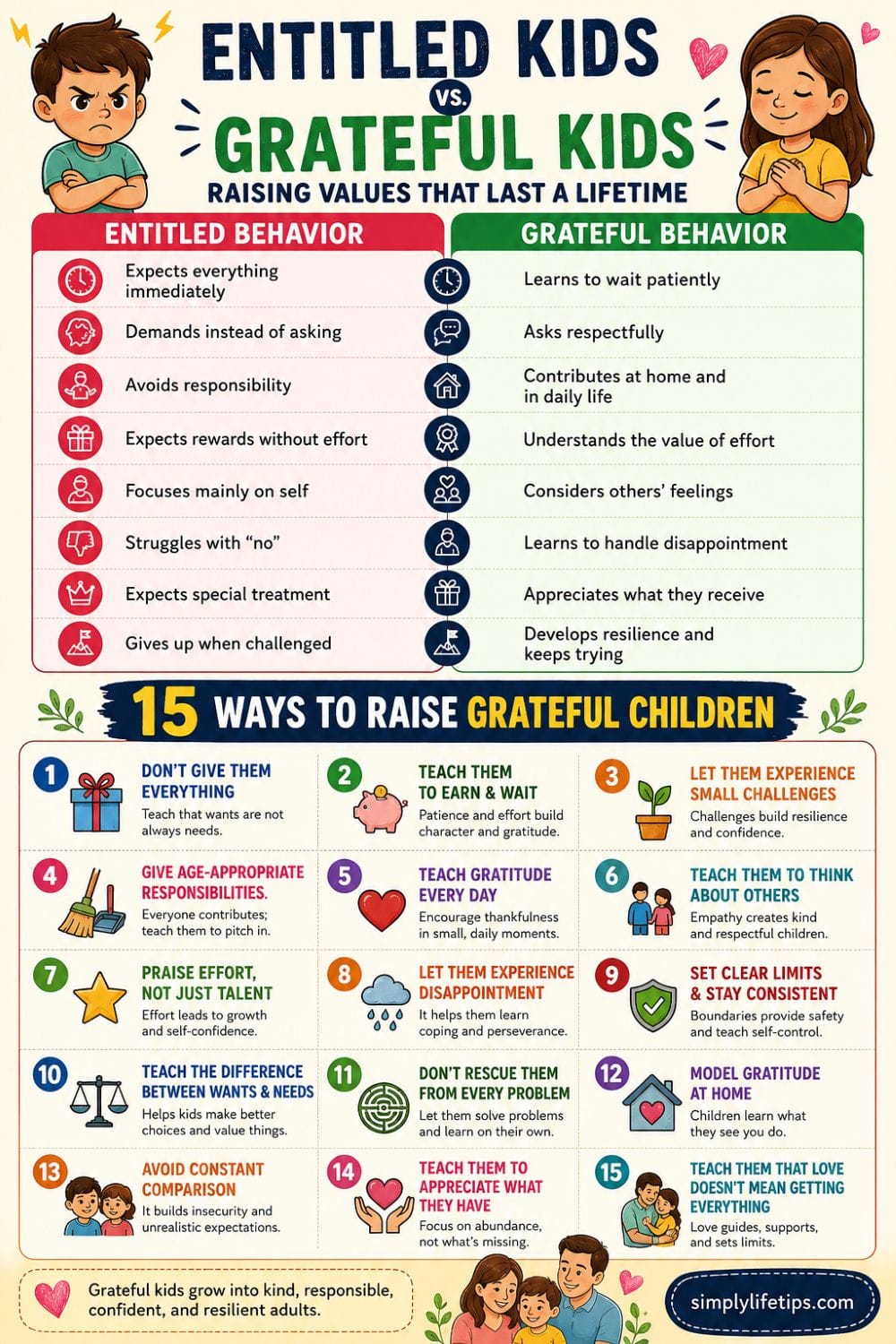
These simple ideas are easier to put into practice when they become part of everyday family life, so let’s look at each one in more detail.
What Are the Signs of Entitled Kids?
One difficult day does not mean a child is entitled. However, when entitled kids repeatedly expect special treatment or immediate gratification, parents may need to look at the patterns behind that behavior.
The concern is a repeated pattern.
Some common signs include:
- Expecting everything immediately
- Becoming extremely upset when told “no”
- Demanding special treatment
- Complaining despite having plenty
- Expecting rewards without effort
- Refusing age-appropriate responsibilities
- Struggling to say thank you
- Blaming others when things go wrong
- Having difficulty sharing
- Giving up when something becomes difficult
- Believing they deserve more than others
- Becoming overly focused on possessions
Parents should look at the overall pattern rather than labeling a child because of occasional difficult behavior.
The better question is:
“What can I teach my child through this behavior?”
Why Do Children Become Entitled?
There isn’t one simple reason why a child may develop entitled behavior.
Family habits, inconsistent boundaries, excessive rewards, social influences, temperament, and developmental stage can all play a role.
Sometimes parents unintentionally reinforce demanding behavior.
Understanding why entitled kids develop these expectations can help parents respond to the behavior without simply labeling the child.
For example, imagine a child demands a toy in a store. The parent initially says no. The child starts crying and shouting. To avoid embarrassment, the parent buys the toy.
The child may learn:
“If I keep demanding, I eventually get what I want.”
The parent may not have intended to teach this lesson, but the pattern can become reinforced.
The solution isn’t to become harsh or emotionally distant.
It is to become loving, consistent, and intentional.
Some everyday parenting patterns can unintentionally reinforce demanding behavior, so it is worth understanding parenting styles that can encourage entitlement and learning how to replace them with healthier approaches.
How to Stop Raising Entitled Kids
1. Don’t Give Them Everything They Want
One of the simplest ways to prevent entitlement is to stop treating every want as a need.
Children can want the latest toy, game, phone, shoes, or gadget without actually needing it.
Instead of automatically saying yes, teach them that some things require waiting, saving, or making choices.
For example:
“I know you really want that toy. We’re not buying it today. You can save toward it if you still want it later.”
This doesn’t mean depriving children.
This approach helps entitled kids understand that wanting something and needing something are two different things.
2. Teach Children to Earn and Wait
Patience is an important life skill. For entitled kids, learning to wait for something they want can be an important lesson in patience and self-control.
Children who are accustomed to immediate gratification may struggle when something takes time. Giving them opportunities to wait and work toward goals can help build patience.
For example, a child who wants a special bicycle might contribute some of their allowance toward it.
An older child might save for a game or gadget.
The lesson isn’t simply about money.
It is about understanding:
Effort + patience + responsibility can lead to a reward.
3. Let Them Experience Small Challenges
Parents naturally want to rescue their children when they struggle.
But children need opportunities to discover that they can handle difficulties.
If your child can’t complete a puzzle, tie their shoelaces, organize something, or solve a minor problem, don’t immediately take over.
Instead, offer encouragement:
“It’s difficult, but try another way. I’m here if you need help.”
Small challenges can help children develop:
- Resilience
- Problem-solving skills
- Patience
- Independence
- Confidence
The goal isn’t to make children struggle unnecessarily.
It’s to avoid removing every reasonable obstacle.
Allowing children to experience manageable challenges is also an important part of building emotional resilience in children, because they learn that difficult emotions and setbacks can be handled rather than avoided.
4. Give Children Age-Appropriate Responsibilities
Children should understand that being part of a family means contributing.
Even young children can have simple responsibilities.
They might:
- Put toys away
- Carry their plate to the kitchen
- Put clothes in the laundry basket
- Help tidy their room
- Feed a pet with supervision
Older children can help with:
- Folding laundry
- Washing dishes
- Organizing their room
- Preparing simple meals
- Helping with household tasks
Chores aren’t simply about getting work done.
They teach children:
“Everyone contributes. I’m not entitled to have other people do everything for me.”
Regular responsibilities can help entitled kids understand that everyone in a family has a role to play.
5. Teach Gratitude Every Day
Gratitude shouldn’t be limited to birthdays or holidays.
Make it part of everyday family life.
At dinner, ask:
“What is one thing you’re grateful for today?”
The answer can be simple.
A child might appreciate a friend, a teacher, a favorite meal, a family activity, or simply having fun outside.
You can also encourage children to notice the effort behind what they receive.
Instead of simply saying:
“Say thank you.”
Explain:
“Grandma spent time choosing that gift for you. How do you think you could show her that you appreciate it?”
This helps gratitude become more meaningful.
If you want to make gratitude a regular part of family life, these practical ideas for teaching children appreciation can help turn thankfulness into a daily habit.
Research highlighted by the American Psychological Association suggests that parents can help children develop gratitude by helping them recognize kindness and by modelling gratitude themselves.
6. Teach Them to Think About Others
Entitlement often involves focusing heavily on “me.”
Parents can encourage children to think about how their behavior affects other people.
Ask questions such as:
- “How do you think your sister felt?”
- “What could you do to help?”
- “Would you want someone to treat you that way?”
- “How could we make this fair?”
- “What can we do for someone who needs help?”
These conversations gradually build empathy.
Even better, give children opportunities to practice kindness.
Encourage them to help a sibling, assist a grandparent, share with a friend, or donate things they no longer use.
7. Praise Effort, Not Just Talent
Children benefit from hearing that their effort matters.
Instead of constantly saying:
“You’re so talented!”
Try:
“You worked really hard on that.”
Or:
“You didn’t give up when it became difficult.”
Praising effort can help children understand that improvement often comes from practice and persistence.
This is particularly important when children face failure.
If they believe they must always be naturally “the best,” they may avoid difficult tasks because struggling feels like failure.
Recognizing effort encourages them to keep learning.
Helping children understand other people’s feelings is an important part of teaching emotional intelligence to children, especially when they are learning empathy, self-control, and respectful communication.
8. Let Children Experience Disappointment
Disappointment is part of life.
Children won’t always win.
They won’t always receive the gift they want.
They won’t always get the role in a school performance or the position they hoped for on a team.
Parents cannot—and shouldn’t—remove every disappointment.
Instead, help children learn how to handle it.
You might say:
“I know you’re disappointed. It’s okay to feel upset. Let’s talk about what happened.”
This validates the emotion without changing the decision simply to make the disappointment disappear.
Over time, children learn an important lesson:
Disappointment feels bad, but I can handle it.
Learning to handle disappointment is particularly important for entitled kids, because they may be accustomed to having their preferences immediately accommodated.
9. Set Clear Limits and Stay Consistent
Children need boundaries.
Rules might involve:
- Bedtime
- Screen time
- Homework
- Respectful communication
- Household responsibilities
- Appropriate behavior in public
- Sharing
- Safety
The most effective boundaries don’t need to be harsh.
A parent can calmly say:
“Screen time is finished for today. You can use it again tomorrow.”
If the child complains, the parent can acknowledge the feeling without changing the boundary:
“I know you’re disappointed. The answer is still no.”
Consistency matters because constantly changing rules teaches children that enough arguing may eventually change the outcome.
Setting boundaries doesn’t mean becoming harsh; wise parenting balances kindness with firmness while helping children develop responsibility, emotional intelligence, and respect.
10. Teach the Difference Between Wants and Needs
A child saying “I need a new phone” provides an excellent teaching opportunity.
Explain the difference between a genuine need and a personal want.
Children need things such as:
- Food
- Water
- Shelter
- Safety
- Education
- Clothing
- Healthcare
- Love and support
They may want:
- A new video game
- Expensive shoes
- The latest smartphone
- More toys
- Designer clothing
- A new gadget
Wants aren’t bad.
The lesson is that not every want needs to be fulfilled immediately.
This distinction can also help children develop healthier financial habits as they grow.
11. Don’t Rescue Them From Every Discomfort
Protecting children is part of parenting.
But protecting them from every uncomfortable experience can prevent them from developing independence.
If a child forgets something at home, let them experience the natural consequence when it is safe and reasonable.
If they make a mistake on a project, encourage them to correct it.
If they have a minor disagreement with a friend, help them think through possible solutions rather than immediately intervening.
Ask:
“What do you think you could do?”
This turns problems into opportunities to learn.
12. Model Gratitude Yourself
Children listen to parents, but they also watch them.
If adults constantly complain about what they don’t have, compare themselves with neighbors, or become unhappy because someone has something newer, children notice.
If parents regularly express appreciation, children notice that too.
Say things like:
“I’m really grateful we could spend time together today.”
“That was kind of your brother to help.”
“We already have something that works, so we don’t need to replace it just because there’s a newer version.”
Children learn gratitude partly by seeing it practiced.
13. Don’t Reward Every Good Behavior With Stuff
Rewards can be useful in certain situations, but children don’t need a material prize every time they behave well.
If every accomplishment results in a toy, treat, or purchase, children may begin to associate good behavior primarily with getting something.
Instead, recognize the behavior itself.
Say:
“You kept practicing even when it was hard.”
“I noticed that you helped your sister without being asked.”
“You handled that disappointment really well.”
Children need to learn that kindness, responsibility, and effort have value beyond receiving a material reward.
14. Teach Children to Appreciate What They Have
A child surrounded by possessions can still feel that they don’t have enough.
Occasionally encourage children to look at what they already own.
You might organize toys together and ask:
“Which ones do you still play with?”
Unused items can be donated to other children.
This creates an opportunity to teach:
- Appreciation
- Generosity
- Organization
- Sharing
- Responsible consumption
A child doesn’t need to have very little to learn gratitude.
They need opportunities to recognize the value of what they already have.
15. Remember That Love Doesn’t Mean Saying Yes
Perhaps the most important lesson for parents is this:
You can love your child deeply and still say no.
A child can feel loved while having limits.
A child can feel supported while being expected to help.
A child can feel secure while experiencing disappointment.
A child can receive plenty while still learning gratitude.
Love is not measured by how many demands parents satisfy.
Sometimes love looks like encouragement.
Sometimes it looks like patience.
Sometimes it looks like listening.
And sometimes, it looks like calmly saying:
“No, you can’t have that.”
Setting boundaries does not reduce the love a child receives; in fact, unconditional love means valuing your child while still guiding them toward responsible and respectful behavior.
Entitled Kids vs. Grateful Kids
The difference isn’t that grateful children never want anything.
They do.
The difference is how they respond to what they have and what they don’t have.
| Entitled Behavior | Grateful Behavior |
|---|---|
| Expects everything immediately | Learns to wait |
| Demands instead of asking | Asks respectfully |
| Avoids responsibility | Contributes at home |
| Expects rewards | Understands effort |
| Focuses mainly on self | Considers others |
| Struggles with “no” | Learns to handle disappointment |
| Expects special treatment | Appreciates kindness |
| Gives up when challenged | Develops resilience |
| Constantly compares | Appreciates what they have |
| Expects others to help | Learns to help others |
This doesn’t mean children will always behave perfectly.
Gratitude is a skill that develops over time.
Raising Grateful Kids in an Entitled World
Children are surrounded by messages telling them that they need the newest product, latest device, trendiest clothes, or most exciting experience.
Social media and advertising can make comparison especially powerful.
Your child may see what another child has and immediately ask:
“Why don’t I have that?”
You don’t need to criticize the other family.
Instead, teach your child that every family makes different choices.
You can say:
“It’s okay to like what they have. We don’t need to own everything other people own.”
This teaches children that comparison doesn’t have to determine their happiness.
A Simple Daily Routine for Raising Grateful Children
You don’t need a complicated parenting system.
Try incorporating five small habits into everyday life.
Ask one gratitude question
“What are you thankful for today?”
Give one responsibility
Choose a task appropriate for your child’s age.
Allow one small challenge
Give them a chance to solve a problem before stepping in.
Notice one positive behavior
Praise effort, kindness, patience, or responsibility.
Maintain one healthy boundary
If you’ve made a reasonable decision, don’t automatically reverse it because your child complains.
Small actions repeated consistently can have a greater impact than occasional big parenting lessons.
What Parents Should Avoid
If you’re concerned about entitled behavior, look at your own patterns without blaming yourself.
Ask whether you frequently:
- Give in to stop tantrums
- Buy things to compensate for lack of time
- Rescue your child from every problem
- Do tasks your child could reasonably do
- Ignore disrespect to avoid conflict
- Change rules frequently
- Compare your child with others
- Use possessions as the main expression of love
- Protect your child from every disappointment
- Expect gratitude without modeling it
Recognizing a pattern isn’t a reason for guilt.
It is an opportunity to change it.
The Goal Isn’t to Raise a Perfect Child
The goal isn’t to raise a child who never complains, never gets angry, and always says thank you.
That’s unrealistic.
Children are still learning.
They will sometimes be selfish.
They will test boundaries.
They will demand things.
They will become frustrated when they hear “no.”
What matters is how parents respond and what children learn from those experiences.
A child can be disappointed and still learn patience.
A child can make a mistake and learn responsibility.
A child can want something and learn to wait.
A child can receive a gift and learn appreciation.
A child can face a challenge and discover resilience.
That’s the foundation of raising grateful children.
Conclusion
Raising entitled kids isn’t about giving children too much love. It is about helping them understand that love, support, and material possessions are not the same thing as getting everything they want.
The goal isn’t to shame entitled kids, but to help them develop the gratitude, patience, empathy, and responsibility they need as they grow.
Teach children to wait, earn, contribute, appreciate, share, persevere, and consider others.
Let them experience small challenges. Give them age-appropriate responsibilities. Praise effort rather than simply talent. Set clear boundaries and maintain them with warmth and consistency. Most importantly, model the gratitude you want your children to develop.
You don’t have to be a perfect parent.
You simply need to keep giving your children opportunities to practice the values that will serve them throughout life.
What is one small change you can make today to help your child become more grateful, responsible, and resilient?
FAQs About Entitled Kids
What are the signs of entitled kids?
Common signs include expecting immediate gratification, struggling to accept “no,” demanding special treatment, avoiding responsibilities, complaining despite having plenty, and showing little appreciation for other people’s efforts.
How do you deal with entitled kids?
Set clear boundaries, remain consistent, avoid rewarding demanding behavior, assign age-appropriate responsibilities, teach gratitude, and allow children to experience reasonable disappointment and challenges.
How do I stop raising an entitled child?
Start by examining patterns at home. Avoid giving in simply to stop complaints, teach children to wait and earn privileges, encourage responsibility, model gratitude, and maintain reasonable boundaries.
How can I raise grateful kids?
Model gratitude, regularly discuss what your family appreciates, encourage children to help others, teach them to recognize effort and kindness, and avoid treating every want as a need.
Does giving children everything make them entitled?
Giving children material things does not automatically make them entitled. The greater concern is a consistent pattern in which children expect every want to be fulfilled, avoid responsibility, and rarely experience limits, patience, or consequences.
References
- American Psychological Association. Stop telling your kids to be grateful. Show them how instead. APA article
- Center on the Developing Child at Harvard University. Resilience: A skill your child really needs to learn. Harvard Center on the Developing Child

Mathukutty P. V. is the founder of Simply Life Tips. He shares practical advice and useful insights on personal growth, health, well-being, technology, and everyday living. His goal is to help readers build positive habits and make informed decisions. He believes in continuous learning and sharing knowledge to help people live healthier, happier, and more meaningful lives.