
Stress management is one of the most important skills we can learn for a healthier, more balanced, and successful life. But does stress always weaken us, or can learning to manage it make us stronger?
Stress is a normal human response to challenging situations. A certain amount of stress can increase alertness, motivation, and readiness to act. But when stress becomes intense, persistent, or difficult to control, it can affect both mental and physical well-being. The World Health Organization explains that some stress can help us respond to challenges, while excessive stress can contribute to physical and mental health problems.
The goal, therefore, is not to eliminate every stressful experience.
The goal is to learn how to respond to stress more effectively.
A little pressure before an examination may encourage better preparation. A deadline may help us focus. A dangerous situation can trigger the body’s rapid stress response and prepare us to act.
But when the internal alarm keeps ringing even when there is no immediate danger, the body and mind need recovery.
That is where effective stress management becomes important.
Stress is a natural response to challenging situations, but learning healthy ways to cope with stress can help protect our mental and physical well-being, according to the World Health Organization
These 10 stress management techniques can help you handle everyday pressure, calm your mind, and build greater resilience over time.
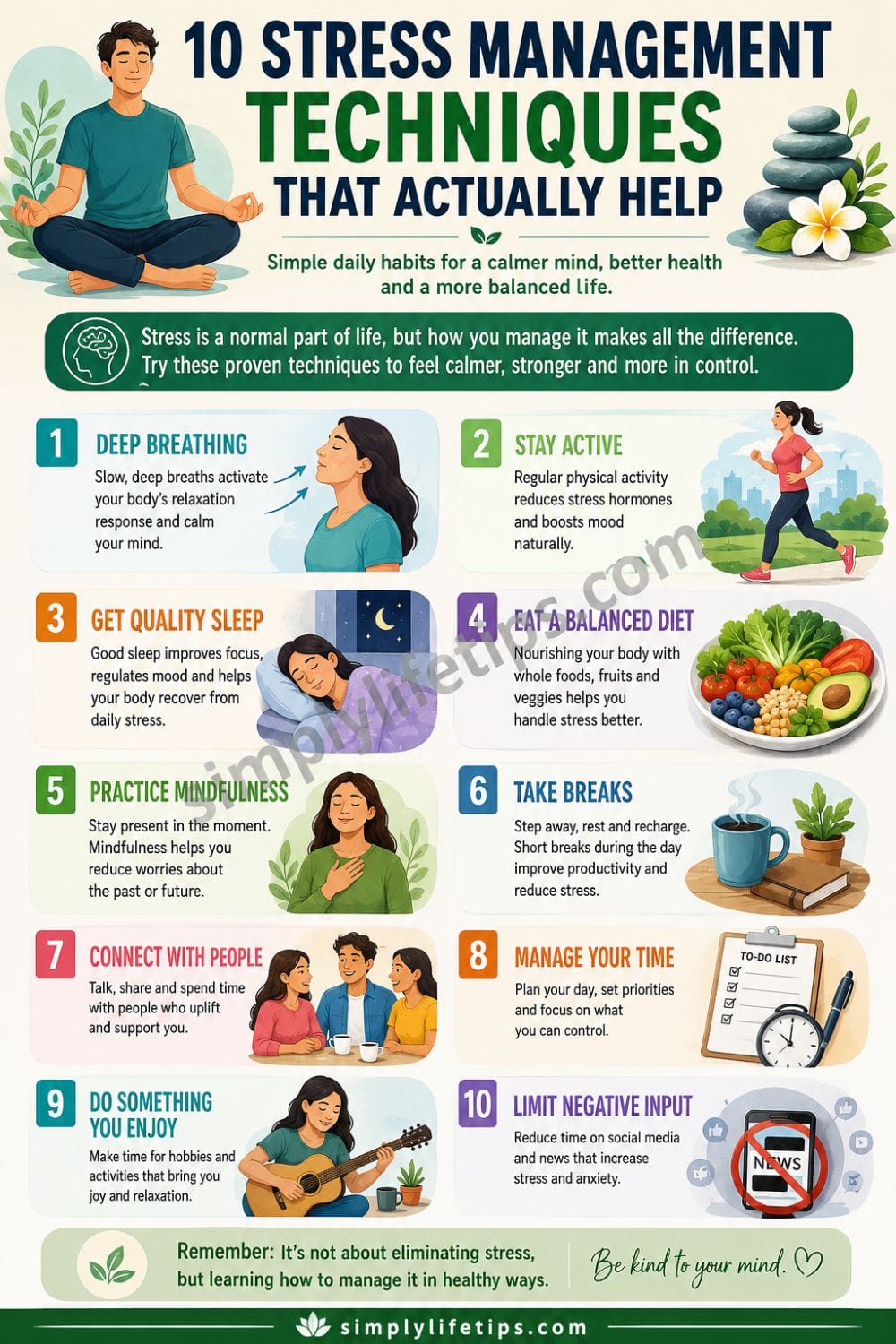
From breathing and exercise to better sleep, meaningful breaks, and social connection, these simple habits can become powerful tools for managing stress.
What Is Stress Management?
Stress management involves using practical strategies to recognize stress, cope with stressful situations, and regulate the body’s response to pressure.
These may include relaxation techniques, breathing exercises, physical activity, healthy sleep habits, cognitive strategies, social support, and problem-solving. The American Psychological Association defines stress management in terms of techniques and strategies used to deal with stress-inducing situations and the state of being stressed.
In simple terms:
Stress management means learning to manage your response instead of allowing stress to manage you.
It does not mean pretending that problems do not exist.
It means identifying what you can change, accepting what you cannot change, and developing healthier ways to deal with pressure.
Is Stress Always Harmful?
No.
Stress is not automatically the enemy.
The body’s stress response is a survival mechanism that prepares us to respond to threats and challenges. Some stressful experiences can even feel motivating when they are manageable and followed by recovery.
Consider an important presentation.
A little nervousness may make you rehearse more carefully.
Now imagine being so overwhelmed by stress that you cannot sleep, concentrate or remember what you prepared.
The problem is no longer simply the presence of stress.
It is the intensity and persistence of the response.
Short-term stress can help us respond.
Chronic, unmanaged stress can wear us down.
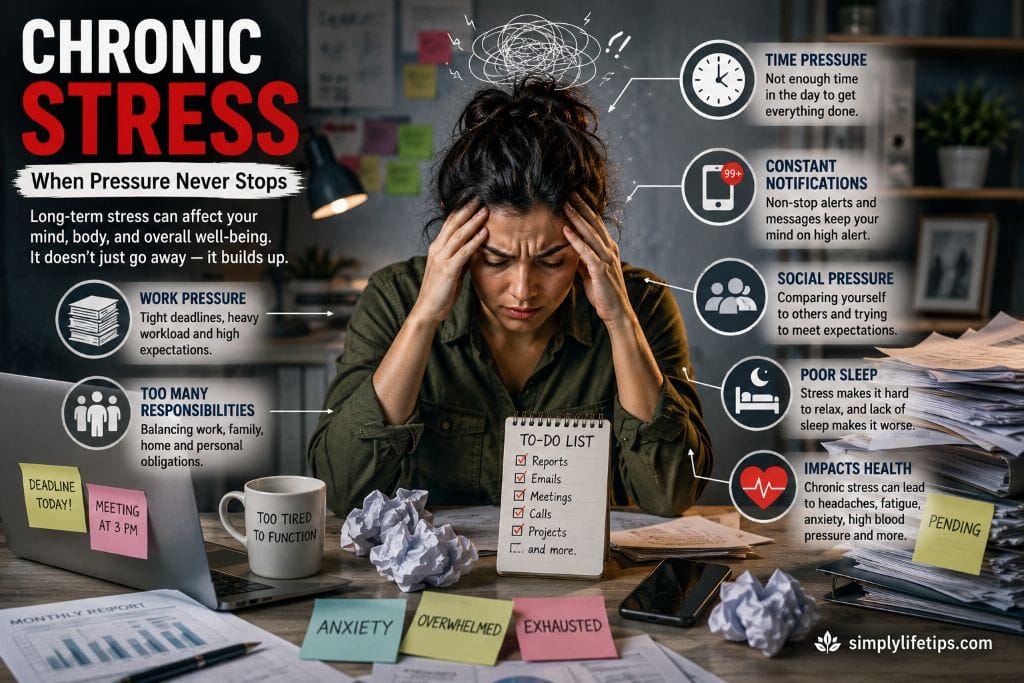
What Happens When Stress Becomes Chronic?
When stress continues for a long time, it can affect several systems in the body, including sleep, mood, and concentration, as explained by the American Psychological Association
When the brain perceives a challenge or threat, the body activates systems that help us respond. Stress hormones such as cortisol, adrenaline, and noradrenaline play important roles in this response.
This is useful when immediate action is required.
But persistent stress can affect sleep, concentration, mood and physical well-being. The WHO lists difficulty relaxing, irritability, concentration problems, headaches, body pains, digestive problems, and sleep difficulties among possible signs associated with stress.
Persistent stress can leave you feeling mentally drained and unable to concentrate, which can gradually contribute to mental exhaustion
Chronic stress can also contribute to unhealthy patterns.
For example, a person under prolonged pressure may:
- Sleep too little
- Depend excessively on caffeine
- Stop exercising
- Eat irregularly
- Spend excessive time online
- Withdraw from friends and family
- Become increasingly negative
- Find ordinary problems overwhelming
This can create a cycle:
Stress → poor recovery → exhaustion → reduced coping ability → more stress
Breaking that cycle is one of the central goals of stress management.
10 Stress Management Techniques That Actually Help
There is no single technique that works for everyone, but regular physical activity, adequate sleep, relaxation, social connection, and focusing on manageable actions are among the practical approaches recommended by the American Psychological Association for managing stress.
The good news is that stress management does not always require dramatic lifestyle changes.
Small, consistent practices can help you respond to pressure more effectively.
Here are 10 practical stress management techniques you can begin using in everyday life.
1. Don’t Become a Prisoner of Your Thoughts
Not every thought is a fact.
Not every fear is a prediction.
When stress rises, the mind can quickly move into worst-case scenarios.
“What if everything goes wrong?”
“What if I cannot handle this?”
“What will happen tomorrow?”
Instead of repeatedly asking what might happen, ask:
“What can I do right now?”
This shifts your attention from imagined outcomes to practical action.
For example, if you are worried about an examination, repeatedly imagining failure will not improve your preparation.
Studying one chapter will.
Solving ten questions will.
Preparing a realistic schedule will.
You cannot control every possible outcome.
But you can control your next useful action.
The APA recommends reframing unhelpful thinking, setting realistic expectations, and accepting situations outside your control as part of healthy stress management.
When stress makes your thoughts race toward worst-case scenarios, try to shift your attention toward what you can actually control.
When your mind is constantly making decisions under pressure, the mental load can become exhausting and contribute to decision fatigue
2. When Your Mind Races, Slow Your Breathing
Stress can change breathing, heart rate, and muscle tension.
When you feel overwhelmed, deliberately slowing your breathing can create a brief pause and help reduce physiological arousal. The APA recommends slow breathing as one practical tool for managing acute stress.
Try this simple approach:
- Sit comfortably.
- Relax your shoulders.
- Breathe in slowly.
- Pause briefly.
- Breathe out more slowly.
- Repeat several times.
The purpose is not to force every stressful thought away.
It is to give your body a chance to settle.
When the body begins to calm, the mind often gets a little more room to think clearly.
3. Move Your Body and Wake Up Your Mind
Physical activity is one of the simplest stress management techniques.
You do not need an expensive gym membership or an extreme workout.
Walking, cycling, stretching, yoga, swimming, dancing, or another activity you enjoy can be useful.
The APA recommends regular physical activity as one evidence-based approach to managing stress, noting that even activities such as a brisk walk can help.
Imagine finishing a difficult day at work.
Instead of immediately sitting down with your phone for several hours, take a 20- or 30-minute walk.
You may return physically tired—but mentally lighter.
Move the body. Give the mind a chance to reset.
4. Protect Your Sleep
Sleep is not wasted time.
It is part of recovery.
Stress can interfere with sleep, while insufficient sleep can affect mood, concentration and the ability to cope with challenges.
The WHO recommends consistent sleep habits, limiting electronic-device use before bedtime, avoiding excessive caffeine close to bedtime, and maintaining regular physical activity.
Try to:
- Maintain a reasonably consistent sleep schedule.
- Create a relaxing wind-down period.
- Reduce stimulating screen use before bed.
- Avoid excessive caffeine late in the day.
- Keep your sleeping environment comfortable.
- Give yourself enough time to sleep.
A tired brain can make ordinary problems appear much bigger.
Building healthy habits into a consistent daily routine can make it easier to protect sleep, exercise and regular recovery time.
Better recovery gives you a better chance of responding the next day calmly.
5. Give Your Brain Good Fuel
The food we eat supports the body—and the brain.
A balanced diet containing a variety of nutrient-rich foods can support overall physical and mental well-being.
Consider including:
- Vegetables
- Fruits
- Whole grains
- Beans and other legumes
- Nuts and seeds
- Fish and other nutritious protein sources
Try to limit excessive amounts of highly processed foods and added sugars. Excessive caffeine can also make some people feel more restless or interfere with sleep.
The APA recommends nutritious food as part of healthy stress management and notes that chronic stress can influence appetite and food cravings.
Think of nutrition as part of your stress-management foundation.
Healthy body → better recovery → greater capacity to cope.
6. Take a Digital Break
When was the last time your mind experienced genuine silence?
Smartphones, social media, messages, videos, and continuous news updates can keep our attention engaged throughout the day.
A brain that is constantly receiving new information rarely gets a meaningful pause.
Try creating small digital breaks:
- Eat one meal without your phone.
- Turn off unnecessary notifications.
- Take a walk without checking social media.
- Keep your phone away during your bedtime routine.
- Set specific times for checking news.
- Take short periods away from screens.
The WHO specifically recommends limiting news consumption if following news increases your stress.
Your phone may help you stay connected.
But your attention also needs protection.
A digital break can become a mental break.
7. Break Big Problems Into Smaller Steps
One of the fastest ways to become overwhelmed is to look at an entire problem at once.
Instead of asking:
“How will I solve all of this?”
Ask:
“What is the next thing I need to do?”
Suppose you have ten unfinished tasks.
You do not need to solve all ten simultaneously.
Choose the most important one.
Break it into smaller actions.
Complete the first action.
Then move forward.
For example:
Large problem: Prepare for an important examination.
Smaller actions:
- List the subjects.
- Identify weak areas.
- Choose today’s topic.
- Study for 30–45 minutes.
- Take a short break.
- Test yourself.
The mountain becomes smaller when you stop staring at the summit and start taking steps.
One useful action is better than an hour of anxious thinking.
8. Don’t Carry Emotional Weight Alone
Sometimes stress becomes heavier because we keep everything inside.
Talking to someone you trust does not necessarily solve the problem immediately.
But it can make the burden easier to carry.
Talk to:
- A trusted family member
- A close friend
- A mentor
- A colleague
- A healthcare professional
- A qualified mental health professional when appropriate
The WHO recommends maintaining connections with family and friends and sharing concerns and feelings with trusted people.
Sometimes what a person needs first is not advice.
It is simply someone willing to listen.
“I am listening.”
Those words can matter.
9. Give Your Life a Break
When life becomes busy, leisure is often the first thing people sacrifice.
That can be a mistake.
Make room for activities that genuinely restore you.
Travel when possible.
Spend time in nature.
Read a book.
Listen to music.
Enjoy a hobby.
Watch something entertaining.
Spend time with people you care about.
Laugh.
Rest.
The APA recommends maintaining pleasurable activities even during stressful periods and notes that nature, hobbies, and enjoyable activities can support well-being.
A break is not necessarily wasted time.
Recovery is part of sustainable performance.
You do not have to keep running until you collapse before you are allowed to rest.
10. Stop Trying to Control Everything
This may be one of the most powerful stress management skills.
Some things are within your control.
Some are partly within your control.
Some are completely outside your control.
Trying to control everything creates unnecessary pressure.
Instead, ask:
“What can I influence?”
and
“What must I accept?”
If you can change something, act.
If you cannot change it, learn to stop spending all your energy fighting it.
Acceptance does not mean giving up.
It means recognizing reality and directing your effort toward what you can actually influence.
The APA specifically recommends accepting situations outside your control and focusing attention on manageable responses.
You cannot control the whole world.
You can work on controlling your response to it.
Can Stress Make Us Stronger?
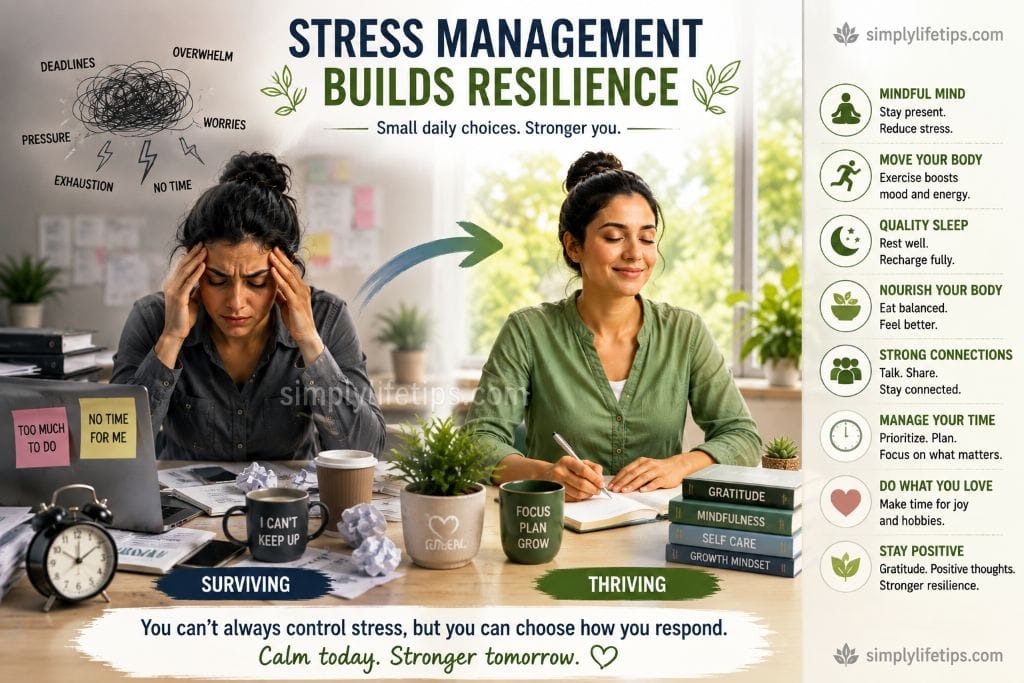
Yes—but not simply because stress exists.
A manageable challenge can motivate us to prepare, focus, and act. But chronic stress without sufficient recovery can negatively affect physical and mental well-being.
Think about exercise.
A reasonable physical challenge can stimulate adaptation.
But excessive training without recovery can leave the body exhausted.
Stress can be considered similarly.
Challenge + recovery + adaptation can build resilience.
Persistent overload + inadequate recovery can cause harm.
That distinction is important.
The objective of stress management is therefore not to make life completely free of pressure.
It is to develop the capacity to face challenges while maintaining recovery, perspective and healthy coping strategies.
What Is the Importance of Stress Management?
Effective stress management can help us function more effectively when life becomes demanding.
It can help us:
- Respond rather than react impulsively.
- Protect sleep and recovery.
- Maintain concentration.
- Support healthy routines.
- Stay connected with others.
- Recognize when we are becoming overwhelmed.
- Focus on practical solutions.
- Build resilience over time.
The WHO emphasizes that learning to cope with stress can help people feel less overwhelmed and support mental and physical well-being.
Stress management is therefore not merely a relaxation technique.
It is a life skill.
Stress Management Is Not About Eliminating Stress
A completely stress-free life is unrealistic.
Examinations will come.
Deadlines will come.
Unexpected expenses will come.
Relationships will sometimes become difficult.
Plans will sometimes fail.
Life will continue to present challenges.
We cannot eliminate all of them.
But we can improve the way we respond.
Stress management means learning to:
- Recognize stress early.
- Slow down before reacting.
- Regulate breathing and physical tension.
- Challenge unhelpful thoughts.
- Exercise regularly.
- Protect sleep.
- Eat well.
- Maintain social connections.
- Take meaningful breaks.
- Focus on what we can control.
- Ask for help when self-help is not enough.
When prolonged pressure is combined with inadequate recovery, it can contribute to exhaustion and eventually increase the risk of burnout
When Should You Seek Professional Help?
Not every stressful period requires professional treatment.
But persistent or overwhelming stress should not simply be ignored.
Consider talking with a qualified healthcare or mental health professional if stress is significantly affecting your:
- Sleep
- Work
- Studies
- Relationships
- Concentration
- Daily functioning
- Ability to cope
The World Health Organization advises people who are struggling to cope with stress to seek help from a trusted healthcare provider or another trusted person. The APA likewise recommends professional support when self-help strategies are not enough.
Seeking help is not weakness.
Recognizing when you need support is a form of strength.
The Real Lesson About Stress Management
Stress-free living is not the definition of a successful life.
Life will always bring pressure.
The important question is:
How well can we respond when pressure arrives?
A manageable challenge can encourage preparation, focus and action.
But when stress becomes chronic and recovery disappears, the same stress response that helps us deal with immediate challenges can become part of a larger problem.
We cannot stop every wave.
But we can learn how to swim.
Life will create stress.
It may sometimes test our patience, confidence, and strength.
But stress does not have to control the direction of our lives.
Learn to manage your thoughts.
Slow your breathing.
Move your body.
Protect your sleep.
Eat well.
Take digital breaks.
Break big problems into small steps.
Talk to people you trust.
Make time for recovery.
Focus on what you can control.
The goal is not a life without stress.
The goal is a life in which stress does not control you.
You cannot always stop the waves, but you can learn to swim.
Based on the stress-management insights shared by Dr. Arun Oommen, Neurosurgeon, and supplemented with evidence-based guidance from the World Health Organization and the American Psychological Association.
FAQs About Stress Management
What is stress management?
Stress management is the use of practical strategies and skills to cope with stressful situations and regulate the effects of stress. Examples include breathing exercises, physical activity, relaxation, healthy sleep, problem-solving, social support, and changing unhelpful thought patterns.
What are the best stress management techniques?
Useful techniques include slow breathing, regular exercise, adequate sleep, healthy nutrition, mindfulness or relaxation, social connection, taking breaks, breaking problems into smaller tasks, and focusing on things within your control. Different strategies work differently for different people.
Why is stress management important?
Stress management is important because persistent or excessive stress can affect both mental and physical well-being. Learning healthy coping strategies can help reduce feelings of being overwhelmed and support everyday functioning.
Can yoga help with stress management?
Yoga can be one useful form of physical activity and relaxation for some people. It combines movement, breathing, and attention, making it a practical option for people who enjoy it. It should be viewed as one tool within a broader stress-management approach rather than a universal solution.
When should I seek help for stress?
If stress becomes persistent or overwhelming, or begins significantly affecting sleep, work, studies, relationships, or everyday functioning, consider speaking with a qualified healthcare or mental health professional.

Mathukutty P V is a Blogger, YouTuber, and Content Writer and the founder of Simply Life Tips. After taking voluntary retirement in 2017, he embraced a free lifestyle focused on learning, personal growth, and sharing practical wisdom to help others live with more purpose and positivity.



