

Negative thought patterns can quietly shape the way you see yourself, other people, and everyday situations. A single disappointing experience can sometimes turn into a familiar way of thinking: “I always get things wrong,” “Nobody understands me,” or “Something bad is going to happen.” When these thoughts are repeated, they can begin to feel like facts rather than interpretations. Learning to recognize negative thought patterns can help you step back, examine what you are thinking, and develop more balanced ways of responding.
Having a negative thought from time to time is a normal part of being human. The problem is not the occasional unpleasant thought. The bigger issue is becoming stuck in a recurring pattern that affects your emotions, decisions, relationships, confidence, or willingness to try new things. Thought, feeling, and behavior can influence one another, creating cycles that become increasingly familiar.
The good news is that recognizing a pattern creates an opportunity to examine it. You do not have to believe every thought that appears in your mind, and you do not need to force yourself to think positively all the time. A more practical goal is to become aware of unhelpful thinking, examine the evidence, consider alternative explanations, and choose a response that is more realistic and useful.
Understanding negative thought patterns is the first step toward changing the automatic reactions that keep them going.
What Are Negative Thought Patterns?
Negative thought patterns are recurring ways of interpreting yourself, other people, or situations in a consistently pessimistic, critical, fearful, or unhelpful way. They can include expecting the worst, assuming that other people think badly of you, focusing heavily on mistakes, or treating one disappointing experience as proof that everything will go wrong.
For example, imagine that you send an important message to a friend and do not receive a reply for several hours. One interpretation might be, “They must be angry with me.” Another might be, “They are probably busy and will respond when they have time.” The first interpretation may trigger anxiety, while the second leaves room for other possibilities.
The event itself has not changed. The interpretation has.
Negative thought patterns can also influence behavior. If you repeatedly think that you are going to fail, you may stop trying. If you believe that nobody likes you, you may withdraw from social situations. If you assume that a new opportunity will end badly, you may never give yourself the chance to discover what could happen. The resulting behavior can then reinforce the original thought. This relationship between thoughts, feelings, and behaviors is an important part of cognitive behavioral approaches.
Why Do Negative Thought Patterns Develop?
Negative thinking does not usually appear out of nowhere. Your experiences, learning history, environment, relationships, stress levels, and repeated interpretations of events can all influence the way you respond to situations.
Some thought patterns begin as attempts to protect yourself. If you have experienced repeated criticism, for example, you may become especially alert to signs that you have made a mistake. If you have experienced rejection, you may become quick to interpret ambiguous situations as evidence that someone does not like you.
Over time, a response that once helped you cope can become a familiar habit of thinking. The Mental Health Foundation notes that automatic thought and behavior patterns can become familiar because they once served protective or coping functions, even when they are no longer helpful.
This does not mean that your past determines your future. It means that understanding where a pattern comes from can help you approach it with curiosity rather than self-blame.
The good news is that negative thought patterns are not necessarily permanent; becoming aware of them can give you an opportunity to practice different ways of responding.
How Negative Thought Patterns Affect Everyday Life
Negative thought patterns can affect much more than your mood. They can influence the decisions you make, the risks you take, the way you communicate, and the opportunities you pursue.
Consider someone who receives constructive feedback at work. A balanced interpretation might be, “There are some things I can improve.” A negative pattern might turn the same feedback into, “My manager thinks I am incompetent.”
The first interpretation leaves room for learning. The second can create shame or anxiety and may cause the person to avoid future opportunities.
The same thing can happen in relationships. Someone who expects rejection may interpret a delayed reply as evidence that a friend is losing interest. They may then withdraw or become defensive. The other person notices the change and becomes less communicative, which can appear to confirm the original fear.
This is why changing negative thought patterns is not simply about “thinking happy thoughts.” It is about learning to recognize the connection between interpretation, emotion, and behavior.
Common Negative Thought Patterns
All-or-Nothing Thinking
All-or-nothing thinking turns situations into extremes. Something is either a complete success or a complete failure. There is little room for partial progress, mistakes, learning, or ordinary imperfection.
For example, you might exercise four days in a week but focus entirely on the one day you missed. Instead of thinking, “I exercised consistently this week,” you think, “I failed because I didn’t stick to my plan.”
Another example is writing. You may produce several good paragraphs but notice one weak section and conclude that the entire article is terrible.
A more balanced perspective recognizes that performance exists on a spectrum. A mistake does not automatically cancel everything that went well.
Overgeneralization
Overgeneralization happens when one event is treated as evidence of a much larger and permanent pattern.
You make a mistake during a presentation and think, “I always embarrass myself.”
One relationship ends badly and you conclude, “Relationships never work for me.”
You miss one deadline and decide, “I’m always disorganized.”
The words “always,” “never,” and “every time” can sometimes be clues that you are turning a specific experience into a broad conclusion. Harvard’s Stress & Development Lab identifies overgeneralization as a common negative automatic thinking pattern.
Instead, ask whether the evidence really supports the larger conclusion.
Mental Filtering
Mental filtering occurs when you focus heavily on one negative detail while overlooking other relevant information.
Imagine receiving ten comments about a piece of work. Nine people say it is useful, but one person points out a problem. You spend the entire evening thinking about the criticism and barely remember the positive feedback.
The criticism may be worth considering. But allowing one negative detail to represent the entire experience can create a distorted picture.
A useful question is: “What information am I leaving out?”
Discounting the Positive
Sometimes people acknowledge positive experiences but immediately explain them away.
“You did well because the task was easy.”
“They complimented me because they were being polite.”
“I only succeeded because I got lucky.”
This pattern can make positive evidence almost impossible to accept. If every success is dismissed while every mistake is treated as meaningful, your mind receives a consistently negative picture.
Try allowing positive information to count. You do not have to exaggerate it. Simply acknowledge it.
Jumping to Conclusions
Jumping to conclusions means reaching a negative interpretation without having enough evidence to support it.
There are two common forms: assuming you know what someone else is thinking and predicting that you know how the future will unfold.
For example:
“She didn’t smile when I arrived, so she must be upset with me.”
Or:
“The interview probably went badly, so I definitely won’t get the job.”
The problem is not that these outcomes are impossible. They are possible. The problem is treating them as established facts before you have enough evidence.
Harvard’s Stress & Development Lab includes mind reading and fortune telling among common negative automatic thought patterns.
Catastrophizing
Catastrophizing involves treating a feared outcome as far more disastrous or certain than the available evidence suggests.
You make a small mistake and immediately imagine losing your job.
You experience a minor disagreement and assume the relationship is going to end.
You feel nervous before an event and conclude that you will completely fail.
Catastrophizing can make the future feel more certain and threatening than it actually is.
Try asking: “What is the most likely outcome, rather than the worst outcome I can imagine?”
Emotional Reasoning
Emotional reasoning occurs when you treat a feeling as proof of a fact.
“I feel like I’m going to fail, so I must be incapable.”
“I feel unwanted, so nobody cares about me.”
“I feel guilty, therefore I must have done something wrong.”
Feelings are real experiences, but they are not always accurate measurements of external reality. A person can feel inadequate while still performing competently. Someone can feel rejected even when the other person is simply busy.
The goal is not to ignore your emotions. Instead, recognize them while also examining the evidence.
Should Statements
“Should,” “must,” and “ought to” can become sources of unnecessary pressure when they create rigid expectations.
“I should never make mistakes.”
“I should always be productive.”
“I must make everyone happy.”
“I should have figured this out already.”
These expectations can turn ordinary human limitations into evidence of personal failure.
A more flexible alternative might be:
“I would like to improve at this.”
“I want to become more consistent.”
“I can learn from this mistake.”
The change may seem small, but flexible language creates more room for realistic action.
Personalization
Personalization involves assuming excessive responsibility for events that are not entirely within your control.
Suppose someone seems unusually quiet during a conversation. You immediately think, “I must have done something wrong.”
There could be many explanations. They might be tired, distracted, worried about something else, or dealing with a completely unrelated problem.
Taking responsibility for your own actions is healthy. Assuming responsibility for everything around you is different.
How to Recognize Negative Thought Patterns
The first step in changing negative thought patterns is noticing them.
This sounds simple, but automatic thoughts can happen so quickly that you may experience the emotional reaction before you consciously recognize the thought that triggered it.
Imagine receiving an unexpected email from your manager. Your stomach tightens and you immediately feel anxious. Before you even open the message, your mind may have already produced a prediction: “I’ve done something wrong.”
Instead of immediately accepting that interpretation, pause.
Ask yourself:
“What exactly am I thinking?”
“What happened before this thought?”
“What evidence supports it?”
“What evidence does not support it?”
“Am I assuming something I don’t actually know?”
“Is there another reasonable explanation?”
Harvard’s Stress & Development Lab recommends identifying recurring negative automatic thought patterns and examining the evidence behind the interpretation.
This process becomes easier with practice.
Negative Thoughts Are Not the Same as Facts
One of the most important distinctions you can learn is the difference between having a thought and knowing something to be true.
Your mind might say:
“Nobody likes me.”
That is a thought, not a measurement.
It may feel convincing, especially if you are lonely or upset, but the statement is extremely broad. What evidence would actually prove that nobody likes you?
Perhaps a friend recently called you. Someone at work thanked you. A family member asked how you were doing. These pieces of evidence may not immediately remove the uncomfortable feeling, but they show why the original thought should not automatically be treated as a fact.
Learning to say “I’m having the thought that nobody likes me” can create a little distance between you and the thought.
That distance can make examination easier.
How to Break Negative Thought Patterns
Breaking negative thought patterns does not mean forcing yourself to think positively every minute of the day. In many situations, trying to replace every negative thought with an extremely positive statement can feel unrealistic.
Breaking negative thought patterns requires more than recognizing that a thought is unhelpful; it also involves learning how to respond differently when the pattern appears.
A more sustainable approach is to develop balanced thinking.
If your mind says, “I’m going to fail,” you do not necessarily need to replace it with, “I’m definitely going to succeed.”
You might instead say:
“I don’t know how this will turn out, but I can prepare and give myself the best chance.”
That statement is realistic. It acknowledges uncertainty while returning your attention to something you can influence.
Use the Catch, Check, Change Approach
A practical way to work with an unhelpful thought is to catch it, check it, and change it.
The NHS Every Mind Matters program uses this type of process to help people identify, examine, and reframe unhelpful thoughts.
Catch the thought
Notice what your mind is saying.
For example:
“My presentation is going to be a disaster.”
Don’t immediately argue with the thought. First recognize it.
Check the evidence
Ask what supports the thought and what contradicts it.
Have you prepared?
Have you successfully presented before?
Is there actual evidence that the presentation will be a disaster?
Are you predicting the future?
Could nervousness simply mean that the presentation matters to you?
Change the interpretation
Now create a more balanced thought.
“I’m nervous because the presentation matters, but I’ve prepared and I can handle it one step at a time.”
This is not pretending that everything will be perfect. It is replacing an extreme prediction with a more realistic interpretation.
Try a Thought Record
A thought record can be particularly useful when a negative thought keeps returning.
The NHS describes a thought record as a CBT exercise that helps you examine a situation, your feelings, the unhelpful thought, evidence supporting it, evidence against it, and a more realistic alternative thought.
You can create a simple version in a notebook.
Start with the situation.
Then write down how you felt.
Next, write the automatic thought exactly as it appeared in your mind.
After that, list evidence that supports the thought and evidence that challenges it.
Finally, write a more balanced interpretation.
For example:
Situation: My article received critical feedback.
Feeling: Disappointed and embarrassed.
Automatic thought: “I’m a terrible writer.”
Evidence supporting the thought: Some parts need improvement.
Evidence against the thought: I have written useful articles before and the feedback identifies specific areas I can improve.
Balanced thought: “The article has weaknesses, but that does not define my ability as a writer. I can use the feedback to improve the next version.”
The objective is not to prove that the positive interpretation is true. It is to develop a more complete view of the situation.
Ask Better Questions
Questions can interrupt automatic thinking because they force you to examine an assumption.
When you notice a negative thought, try asking:
“What evidence do I actually have?”
“Am I treating an assumption as a fact?”
“Am I predicting the future?”
“Am I using words such as always or never?”
“What would I say to a friend in this situation?”
“Is there another explanation?”
“What part of this situation is actually within my control?”
“What is one useful action I can take now?”
These questions shift your attention from automatic judgment toward investigation.
Curiosity is particularly useful because it changes the attitude you bring to your own thoughts. Instead of saying, “Why am I always like this?” you can ask, “Why did this thought appear, and what might have triggered it?”
The Mental Health Foundation recommends curiosity and open-mindedness as part of working with unhealthy thought patterns.
Practice Mindfulness
Mindfulness can help you notice thoughts without immediately reacting to them.
Suppose you are worried about an upcoming conversation. Your mind starts generating predictions about everything that could go wrong. Rather than following every prediction, you can notice:
“I am having anxious thoughts about the conversation.”
You can then bring your attention back to the present moment and decide what, if anything, needs to be done.
Mindfulness does not require you to eliminate thoughts. It can instead help you become more aware of them and create space before reacting.
For a simple practice, sit quietly for a few minutes and notice your breathing. When thoughts appear, acknowledge them and gently return your attention to your breath. The goal is not to produce a completely empty mind.
Stop Fighting Every Negative Thought
An important mistake is assuming that every negative thought needs to be defeated.
Sometimes the harder you try not to think about something, the more attention you give it. Instead of declaring, “I must stop thinking about this,” acknowledge the thought and decide what deserves your attention.
For example:
“I’m worried about tomorrow’s meeting.”
You can acknowledge that worry without spending the next hour constructing dozens of possible scenarios.
If there is something useful you can do, take that action.
If there is nothing you can do at the moment, return your attention to the present task.
This is different from suppressing the thought. You are recognizing it without allowing it to control your entire attention.
Replace the Pattern With a Useful Response
Changing a negative thought becomes easier when you have something practical to do instead.
Suppose your automatic pattern is:
Mistake → self-criticism → avoidance
You could practice:
Mistake → pause → identify the lesson → make one correction → continue
Suppose your pattern is:
Unanswered message → assume rejection → withdraw
You could practice:
Unanswered message → notice the assumption → consider alternatives → continue with your day
Or:
Difficult task → “I can’t do this” → procrastinate
Could become:
Difficult task → “This feels difficult” → break it into one small step → begin
The replacement does not need to be dramatic. A small change in the sequence can create a different outcome.
Change Your Environment When Necessary
Not every negative thought pattern can be solved through thinking alone. Sometimes your environment repeatedly reinforces the same behavior.
If you spend hours consuming content that makes you anxious or angry, changing what you regularly expose yourself to may be useful.
If you repeatedly isolate yourself when feeling low, creating a simple routine for contacting someone you trust may interrupt that pattern.
If your work environment constantly encourages distraction, reducing notifications and creating a more focused workspace may help.
Your surroundings can provide cues that influence behavior. Changing those cues can make it easier to practice a different response.
Practice Self-Compassion
Self-criticism can become part of the negative cycle.
You notice an unwanted thought.
You criticize yourself for having it.
You feel worse.
The emotional discomfort creates more negative thinking.
The cycle continues.
A kinder approach is not the same as excusing every mistake. It means responding to yourself in a way that supports learning rather than adding another layer of punishment.
Instead of:
“What’s wrong with me?”
Try:
“I’m having a difficult moment. What would help me respond better?”
The Mental Health Foundation similarly recommends treating yourself more like a supportive coach than a harsh critic when working with unhealthy thought patterns.
Build a Daily Practice
Changing negative thought patterns usually requires more than reading one article and trying a technique once. Practice matters.
Regularly observing negative thought patterns can help you recognize common triggers and notice which situations repeatedly lead to the same automatic response.
You might spend five minutes each evening reviewing one difficult thought from the day.
What happened?
What did you immediately think?
What emotion followed?
What did you do?
Was your interpretation supported by evidence?
What could you try next time?
Over time, this creates a record of recurring patterns. You may discover that certain situations repeatedly trigger the same type of thinking.
For example, perhaps you become highly self-critical after receiving feedback. Once you recognize that pattern, you can prepare a response before the next feedback session.
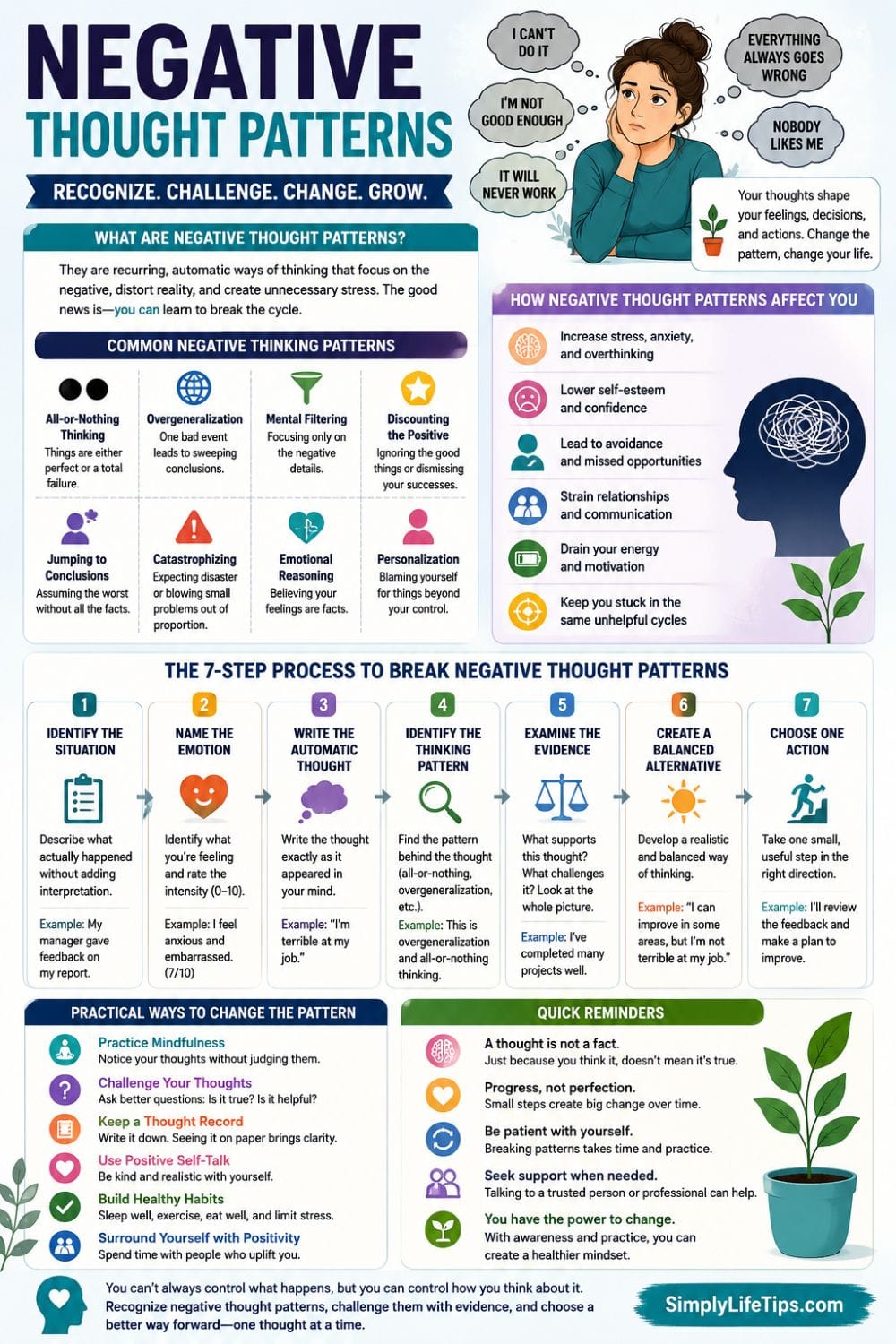
A Simple 7-Step Method
When you notice a recurring negative thought, do not try to force it away immediately. Instead, slow the process down and examine what is happening between the situation, your interpretation, your emotional response, and what you do next. A simple seven-step process can help you turn an automatic reaction into a deliberate response.
Step 1: Identify the situation
Start with what actually happened. Describe the situation as objectively as possible, without adding assumptions about what it means.
For example, instead of writing, “My manager thinks I’m useless,” describe the event more precisely: “My manager reviewed my work and pointed out three areas that need improvement.”
This distinction matters because the first statement includes an interpretation, while the second describes an observable event. Keeping the situation separate from your interpretation makes it easier to examine the thought that follows.
You can ask yourself, “What happened that I can describe as a fact?” Try to avoid words such as always, never, everyone, or nobody at this stage.
Step 2: Name the emotion
Once you have identified the situation, notice what you are feeling. You might experience anxiety, anger, sadness, embarrassment, disappointment, frustration, guilt, or fear. Sometimes several emotions appear at the same time.
Try to be specific rather than simply writing, “I feel bad.”
For example, you might write, “I feel embarrassed and worried,” or “I feel disappointed and frustrated.”
You can also rate the intensity of the emotion from 0 to 10. This gives you a simple way to observe whether the intensity changes after you examine the thought.
For example, if you feel anxious at an 8 out of 10 after receiving an unexpected message, identifying and examining the thought behind that anxiety may help you understand why the reaction became so strong.
Step 3: Write the automatic thought
Now capture the thought that appeared in your mind. Write it as honestly as possible rather than trying to make it sound reasonable.
For example:
“I’m going to fail.”
“They must be angry with me.”
“I’m not good enough.”
“Nothing ever works out for me.”
“Everyone else is better than me.”
These are automatic thoughts because they can appear quickly, sometimes before you have consciously examined them.
Don’t censor the thought because it sounds unreasonable. The purpose of this exercise is not to judge yourself. It is to understand the interpretation your mind produced in that moment.
A useful question is: “What did I immediately tell myself this situation meant?”
Step 4: Identify the thinking pattern
Once you have written the automatic thought, examine how you are thinking about the situation.
Does the thought contain all-or-nothing thinking? Are you assuming that one mistake means you always fail? Are you predicting the future? Are you assuming that you know what another person is thinking? Are you focusing exclusively on negative information while ignoring positive evidence?
For example, consider the thought:
“I made one mistake in my presentation, so I’m terrible at public speaking.”
This could involve overgeneralization, because one experience is being used to reach a much broader conclusion.
Another example is:
“My friend hasn’t replied, so she must be angry with me.”
That may involve mind reading, because you are assuming you know what another person is thinking without enough evidence.
Or consider:
“If this interview doesn’t go well, my career is finished.”
That could involve catastrophizing, because one uncertain event is being interpreted as a disastrous outcome.
Identifying the pattern gives you something specific to examine rather than simply telling yourself to “stop thinking negatively.”
Step 5: Examine the evidence
Now challenge the thought by looking at the evidence on both sides.
Ask:
What evidence supports this thought?
What evidence challenges it?
Am I assuming something I don’t actually know?
Is there another explanation?
Would I reach the same conclusion if I looked at the situation from a distance?
Suppose your automatic thought is:
“My article isn’t good enough because one reader criticized it.”
Evidence supporting the thought might be that the reader identified genuine weaknesses.
But evidence against the extreme conclusion might include positive feedback from other readers, previous successful articles, useful information contained in the piece, or the fact that criticism of one article does not establish that you are incapable of writing.
The objective is not to collect evidence only for a positive conclusion. It is to consider the whole picture.
This is one reason cognitive approaches focus on examining automatic thoughts rather than simply replacing every negative thought with a positive one.
Step 6: Create a balanced alternative
After examining the evidence, create a more balanced interpretation.
Importantly, balanced does not mean artificially positive.
If your thought is:
“I’m definitely going to fail.”
You do not have to replace it with:
“I’m definitely going to succeed.”
A more realistic alternative might be:
“I don’t know exactly how this will turn out, but I can prepare and give myself the best chance.”
Similarly:
Automatic thought: “I always make mistakes.”
Balanced alternative: “I made a mistake in this situation, but that doesn’t mean I always make mistakes.”
Automatic thought: “Nobody likes me.”
Balanced alternative: “I feel lonely right now, but I don’t have evidence that nobody likes me.”
Automatic thought: “My career is finished if this interview goes badly.”
Balanced alternative: “This interview matters to me, but one interview will not determine my entire career.”
The alternative thought should be credible enough that you can actually believe it. If it feels obviously false, your mind may simply reject it.
Step 7: Choose one action
Finally, ask what you can actually do.
This step is important because changing thought patterns is not only an intellectual exercise. Your response and behavior can also reinforce a new pattern.
If you made a mistake, correct it if possible.
If you are worried about an upcoming presentation, prepare.
If you have been avoiding a difficult task, work on it for ten minutes.
If you misunderstood someone’s message, ask rather than assuming.
If you are comparing yourself with other people, return your attention to your own next step.
The action does not need to solve the entire problem. It only needs to move you in a useful direction.
For example, the complete process might look like this:
Situation: My manager gave me critical feedback.
Emotion: Embarrassment — 7/10.
Automatic thought: “I’m terrible at my job.”
Thinking pattern: Overgeneralization and all-or-nothing thinking.
Evidence: Some parts of my work need improvement.
Evidence against: I have completed other projects successfully, and the feedback was about specific areas rather than my entire ability.
Balanced thought: “There are things I need to improve, but this feedback doesn’t define my overall ability.”
Action: Review the feedback and improve the specific areas identified.
This method turns an abstract idea into something you can actually practice. With repetition, you may become quicker at noticing the moment when a situation turns into an automatic negative interpretation.
The goal is not to become someone who never has negative thoughts. The goal is to become better at recognizing negative thought patterns before they automatically determine what you feel and do.
Real-Life Examples of Changing Negative Thought Patterns
At work
Automatic thought: “My manager corrected my work because I’m not good enough.”
More balanced response: “My manager identified something I can improve. Feedback does not automatically mean I’m incompetent.”
The useful action is to understand the feedback and apply it.
In relationships
Automatic thought: “My friend hasn’t replied because they are angry with me.”
More balanced response: “I don’t know why they haven’t replied. They may be busy or dealing with something else.”
The useful action may simply be to continue your day rather than repeatedly checking your phone.
With personal goals
Automatic thought: “I missed my routine today, so I’ve ruined everything.”
More balanced response: “I missed one day. I can return to the routine tomorrow.”
The useful action is to resume rather than abandon the goal.
After making a mistake
Automatic thought: “I always mess things up.”
More balanced response: “I made a mistake in this situation. What can I learn from it?”
The useful action is to correct the mistake where possible.
What Not to Do
Don’t demand constant positivity
You are not required to feel positive all the time. Difficult emotions and unpleasant thoughts are normal. The goal is not to replace every negative thought with an unrealistic positive statement.
Don’t treat every thought as meaningful
A thought can appear without being accurate, useful, or important. Learning to observe thoughts rather than automatically obeying them is an important skill.
Don’t criticize yourself for negative thoughts
Having an unwanted thought does not make you a bad person. Judging yourself for having the thought can strengthen the emotional cycle.
Don’t expect instant change
A pattern that has been repeated for years may not disappear after one exercise. Practice and patience are more realistic expectations.
Don’t ignore genuine problems
Not every negative thought is distorted. Sometimes a situation really does need attention. If there is a real problem, changing your interpretation should not become an excuse to avoid solving it.
The aim is balanced thinking, not blind optimism.
Negative Thought Patterns and the Subconscious Mind
Negative thought patterns connect naturally with the subject of the subconscious mind because repeated thoughts and behaviors can become familiar and automatic. However, it is important not to treat the subconscious mind as a magical system that creates every event in your life.
If you have been working on reprogramming your subconscious mind, recognizing recurring negative thought patterns is a useful next step. Instead of trying to force your mind to become positive, focus on identifying the patterns you repeatedly reinforce and practicing healthier alternatives.
Your previous experiences may influence your automatic reactions, but they do not mean that every future situation has to produce the same response.
Negative Thought Patterns and Habits
Thought patterns can also become connected with everyday habits.
You might feel stressed, think negatively, and then automatically reach for your phone.
You might feel uncertain, think that you will fail, and then procrastinate.
You might feel lonely, assume nobody cares, and then isolate yourself.
Changing the thought is only part of the process. You can also change what happens next.
If you want to explore this relationship further, our article on the power of your subconscious mind explains how repeated patterns, habits, beliefs, and behavior can interact.
The goal is not to control every thought. It is to become more aware of the patterns that repeatedly influence your actions.
When Negative Thinking Needs More Support
Everyone experiences negative thoughts. However, persistent negative thinking can sometimes occur alongside anxiety, depression, trauma, or other mental-health difficulties.
If negative thoughts are persistent, overwhelming, interfering with everyday life, affecting your relationships, or making it difficult to function, consider talking with a qualified mental-health professional.
Self-help techniques can be useful, but they are not a replacement for professional assessment or treatment when significant difficulties are present. The NHS notes that CBT can help people recognize and respond to unhelpful thoughts and behaviors and provides self-help techniques based on CBT principles.
Seeking help is not a failure. Sometimes having professional guidance makes it easier to understand patterns that are difficult to change alone.
The more consistently you recognize negative thought patterns and question their assumptions, the easier it can become to pause before automatically reacting.
Conclusion
Negative thought patterns can become powerful because repetition makes familiar ways of interpreting life feel natural, even when those interpretations are incomplete or unhelpful. A disappointing experience can become “I always fail,” a delayed message can become “Nobody cares about me,” and one mistake can become “I’m not good enough.” When these interpretations repeatedly influence your emotions and behavior, they can create cycles that are difficult to recognize from the inside.
The goal is not to eliminate every negative thought or force yourself to be positive all the time. A healthier approach is to notice the thought, separate it from the facts, examine the evidence, consider another explanation, and choose a response that is more balanced and useful. Techniques such as thought records, mindfulness, cognitive reframing, self-compassion, and small behavioral changes can help you practice this process.
You may not be able to control which thoughts appear in your mind, but you can become more deliberate about how you respond to them. Instead of asking, “How do I stop every negative thought?” a more useful question is, “What can I learn from this thought, and what would be a healthier response?” With patience and repeated practice, that shift can help you develop a more flexible relationship with your thoughts and make it easier to respond to everyday challenges without automatically falling into the same old patterns.
Frequently Asked Questions
What are negative thought patterns?
Negative thought patterns are recurring ways of interpreting yourself, other people, or situations in a pessimistic, critical, fearful, or otherwise unhelpful way. Common examples include all-or-nothing thinking, overgeneralization, catastrophizing, mind reading, and focusing only on negative information.
How can I break negative thought patterns?
Start by recognizing the recurring thought, identifying the situation that triggered it, examining the evidence, considering alternative explanations, and choosing a more balanced response. A CBT-style thought record can help you work through this process.
How do I stop negative thoughts from controlling me?
You do not necessarily need to stop every negative thought. Instead, practice noticing thoughts without automatically accepting them as facts. Mindfulness, cognitive reframing, and focusing on a useful action can help create distance between a thought and your response.
Can negative thought patterns be changed?
Yes, thought patterns can be worked on through awareness and repeated practice. Change is usually gradual rather than instant. Recognizing cognitive distortions and learning to examine thoughts more flexibly are practical approaches.
When should I seek professional help for negative thoughts?
Consider professional support if negative thoughts are persistent, overwhelming, interfere with everyday functioning, or occur alongside significant anxiety, depression, trauma-related symptoms, or other mental-health concerns. A qualified professional can help determine what type of support may be appropriate.
References
- Harvard Stress & Development Lab — Identifying Negative Automatic Thought Patterns
- NHS Every Mind Matters — Thought Record
- NHS Every Mind Matters — Self-help CBT Techniques
- Mental Health Foundation — How to Replace Negative Thought Patterns
- Child Mind Institute — How to Change Negative Thinking Patterns

Mathukutty P. V. is the founder of Simply Life Tips. He shares practical advice and useful insights on personal growth, health, well-being, technology, and everyday living. His goal is to help readers build positive habits and make informed decisions. He believes in continuous learning and sharing knowledge to help people live healthier, happier, and more meaningful lives.