
What is enlightenment? For some people, enlightenment means a profound spiritual awakening; for others, it brings to mind meditation, Buddha, philosophy, or the search for a deeper meaning in life. Although the word can have different meanings, spiritual enlightenment is often associated with greater awareness, deeper self-understanding, and a different way of relating to our thoughts, emotions, desires, and everyday experiences.
Enlightenment is not necessarily about becoming perfect, escaping ordinary life, or never experiencing difficult emotions again. Instead, it can be understood as a journey toward seeing ourselves and life with greater clarity. As we become more aware of what happens inside us, we may begin to recognize that although we cannot always control what happens around us, we can become more conscious of how we respond.
What Is Enlightenment?
Enlightenment is a concept that has been understood in different ways across spiritual, philosophical, and religious traditions. In a broad spiritual sense, it refers to a profound awakening or realization. It is often associated with seeing reality more clearly, understanding the nature of the self, and becoming less controlled by ignorance, attachment, fear, or habitual reactions.
There is no single definition of enlightenment that applies equally to every tradition. In Buddhism, for example, enlightenment is closely associated with awakening and liberation from ignorance and suffering. Other spiritual traditions use different concepts and language to describe profound inner realization.
For everyday personal growth, we can approach the idea more simply. Enlightenment can be viewed as a deeper form of awareness in which we begin to understand our thoughts, emotions, motivations, fears, attachments, and reactions rather than automatically being controlled by them. It is not about knowing everything. It is about becoming more aware of what we do not understand and remaining willing to learn.
Enlightenment Has More Than One Meaning
The word “enlightenment” can be confusing because it is used in different contexts. In European intellectual history, the Enlightenment refers to a major period of philosophical and intellectual development associated with reason, science, individual liberty, and new approaches to society and government.
Immanuel Kant also famously explored the question “What Is Enlightenment?” in his eighteenth-century essay, published in 1784. Kant’s philosophical discussion of enlightenment is different from the spiritual meaning explored in this article. Stanford Encyclopedia of Philosophy – Immanuel Kant
Here, the focus is on spiritual enlightenment, inner awakening, self-awareness, and conscious living. Understanding this distinction is important because the word “enlightenment” does not always refer to the same concept.
What Does Enlightenment Mean in Spirituality?
Understanding what enlightenment means in a spiritual context requires recognizing that different traditions describe awakening and realization in different ways. In spirituality, enlightenment is often associated with awakening to a deeper understanding of oneself and reality. Different traditions explain this in different ways. Some emphasize liberation from ignorance, while others focus on awareness, compassion, detachment, or realizing that our ordinary assumptions about ourselves and the world may not tell the whole story.
A person interested in spiritual enlightenment may begin asking questions such as:
- Who am I beyond my roles and labels?
- Why do certain situations trigger such strong emotions in me?
- Why do I constantly seek approval from others?
- What am I attached to?
- Which fears influence my decisions?
- How much of my behavior is automatic?
- Can I observe my thoughts without immediately believing every thought?
These questions do not provide instant answers. Instead, they can begin a process of looking inward and becoming more honest about how we think, feel, and behave.
In Buddhism, enlightenment is traditionally associated with awakening and freedom from ignorance and suffering. APA Dictionary of Psychology – Buddhism
Is Enlightenment the Same as Spiritual Awakening?
The terms enlightenment and spiritual awakening are sometimes used interchangeably, but they do not necessarily mean the same thing. A spiritual awakening can describe a period when someone begins questioning long-held beliefs, searching for deeper meaning, or becoming more aware of their inner life.
Enlightenment is generally used for a more profound realization, particularly within spiritual and philosophical traditions. In everyday conversation, however, there is considerable overlap between the two terms. The important point is not to become trapped by terminology but to understand the broader idea of becoming more conscious, reflective, and aware.
Asking what enlightenment is can therefore lead to a broader exploration of spiritual awakening, self-awareness, and personal transformation.
Does Enlightenment Mean You Never Feel Angry?
No. This is one of the common misconceptions about enlightenment. Greater awareness does not necessarily mean that a person will never experience anger, fear, sadness, jealousy, disappointment, or frustration. Human emotions are part of ordinary life.
The difference may be in what happens after an emotion appears. Imagine someone criticizes you in front of other people. An automatic reaction might be criticism, followed by anger, hurt, an immediate response, and perhaps an argument. Greater awareness may create another possibility: you notice the anger, pause, understand what you are feeling, and then choose how to respond.
The anger has not necessarily disappeared. However, there is now a moment of awareness between the experience and the reaction. That moment can change what happens next.
Why Self-Awareness Matters on the Journey Within
Self-awareness means becoming more conscious of your thoughts, emotions, behavior, strengths, weaknesses, motivations, and patterns. Without self-awareness, we may repeatedly react in the same way without understanding why.
For example, suppose someone becomes extremely upset whenever another person disagrees with them. They may think, “People are disrespecting me.” But deeper reflection might reveal, “I feel threatened when people challenge my opinions because I have connected being right with my sense of worth.”
That realization does not solve everything immediately. However, it creates an opportunity for change. Instead of simply blaming other people, the person can begin examining what is happening inside. This is why self-awareness can be an important part of an inner journey.
Self-awareness is an important part of this inner journey. You can learn more about practical ways to develop it in our guide to cultivating self-awareness.
7 Practices That Can Help Develop Greater Inner Awareness
There is no guaranteed formula for enlightenment. No particular book, meditation technique, or daily routine can promise that a person will become enlightened. However, several practices can encourage reflection and greater self-awareness.
1. Spend Some Time in Silence
Modern life is filled with noise. Phones, notifications, social media, television, conversations, work, and constant information can leave very little room for quiet reflection. Spending a few minutes without digital distractions can help you notice what is happening inside your mind.
At first, silence may feel uncomfortable. That discomfort itself can be useful because you may discover how often you reach for your phone or another distraction simply to avoid being alone with your thoughts. Start small by sitting quietly for five or ten minutes and noticing your breathing, thoughts, emotions, and surroundings without trying to force anything.
2. Practice Mindfulness
Mindfulness involves paying attention to the present moment rather than becoming completely absorbed in thoughts about the past or future. For example, while drinking tea, instead of automatically scrolling through your phone, notice the warmth of the cup, the taste, the smell, and the experience itself.
Mindfulness can also be applied to emotions. Instead of immediately thinking, “I am angry,” you might pause and recognize, “Anger is present right now.” This small change in perspective can encourage observation rather than immediate reaction.
Mindfulness can also be applied to everyday activities and emotional experiences. Learn more about the practice and its potential benefits in our guide to mindfulness.
3. Examine Your Reactions
Our strongest reactions can sometimes teach us something about ourselves. When something upsets you, ask yourself why it affected you so strongly. Perhaps criticism reminds you of an old insecurity, being ignored makes you fear rejection, someone else’s success triggers comparison, or losing control makes you anxious.
The goal is not to blame yourself for having emotions. The goal is to understand yourself better. When you understand the patterns behind your reactions, you have a greater opportunity to respond differently.
4. Question Your Assumptions
We all carry assumptions about ourselves and other people. We may believe that we know what someone else is thinking, that everyone must respect us, that failure makes us a failure, or that people who disagree with us are against us.
But assumptions are not always facts. Learning to question them can create greater mental flexibility. Sometimes wisdom begins with being able to say, “Maybe I could be wrong.”
5. Examine the Need to Always Be Right
The desire to be right can become a powerful source of conflict. Consider an argument with someone close to you. You may eventually realize that proving your point is less important than understanding the other person.
This does not mean accepting false information or abandoning your principles. It means recognizing that being right is not always the same as being wise. A willingness to listen, reconsider, and admit mistakes can be an important part of personal growth.
6. Develop Compassion
Self-awareness without compassion can become harsh self-criticism. As you learn to understand your own fears and weaknesses, try to extend the same understanding to other people.
Someone who behaves badly may still be struggling with pain, fear, insecurity, or circumstances you know nothing about. Compassion does not mean approving harmful behavior. It means trying to understand another person without immediately reducing them to their worst moment.
7. Keep Learning
One of the biggest obstacles to growth is believing that we already know enough. The more we learn, the more we may recognize how much remains unknown. A person who continues learning can remain curious, humble, and open to changing their perspective.
Sometimes inner growth begins with three simple words: “I don’t know.” Being comfortable with not having every answer can create room for curiosity and deeper understanding.
What Changes When You Become More Self-Aware?
Inner growth does not necessarily make life easier. Problems will still happen. People may still disappoint you. Plans may still fail. You may still experience grief, fear, anger, and uncertainty.
What can change is your relationship with those experiences. Anger may become something you observe rather than something that immediately controls your behavior. Fear may become something you understand rather than something that automatically makes every decision for you. Criticism may become an opportunity to reflect, even when the criticism itself is unfair.
Failure can also be viewed differently. Instead of seeing one unsuccessful attempt as proof that you are a failure, you may begin asking what the experience can teach you. Similarly, difficult experiences do not automatically make someone wiser, but honest reflection on them can sometimes lead to deeper understanding.
Life experiences can also become opportunities for reflection and growth. Our article on learning from life experiences explores how everyday experiences can contribute to self-awareness and emotional growth.
Possible Benefits of Greater Inner Awareness
When people ask what enlightenment is, they may also wonder whether the idea has any practical relevance to everyday life. Although enlightenment is a spiritual and philosophical concept with different meanings across traditions, developing greater inner awareness can have practical value in everyday life. Becoming more aware of our thoughts, emotions, reactions, and patterns may change the way we relate to ourselves and the people around us.
Greater Emotional Awareness
Greater inner awareness can help you recognize what you are feeling instead of reacting automatically. When anger, fear, jealousy, disappointment, or frustration appears, you may become better at noticing the emotion and understanding what triggered it. This awareness can give you more choice in how you respond.
Better Self-Understanding
Looking inward can help you recognize patterns that may otherwise remain unnoticed. You may begin to understand why certain situations make you anxious, why criticism affects you strongly, or why you repeatedly seek approval from others. Understanding these patterns does not change them overnight, but it creates an opportunity to work with them more consciously.
More Thoughtful Responses
One of the practical benefits of greater awareness is the ability to create a small pause between an experience and your response. Someone may criticize you, frustrate you, or say something hurtful, but instead of immediately reacting, you can take a moment to consider what you are feeling and what response is appropriate. That pause can sometimes prevent unnecessary conflict.
Greater Acceptance
Inner awareness can also encourage acceptance of things we cannot control. Life will include uncertainty, disappointment, change, loss, and situations that do not go according to plan. Acceptance does not mean giving up or approving everything that happens. It means recognizing reality clearly enough to decide where your energy can be used constructively.
Healthier Relationships
Understanding your own emotions can influence the way you relate to other people. When you become more aware of your assumptions and reactions, you may listen more carefully, communicate more thoughtfully, and become less defensive during disagreements. Greater self-awareness can also make it easier to recognize when you need to apologize, set a boundary, or give someone space.
Less Attachment to Being Right
A growing awareness of yourself can make it easier to question your own assumptions. Instead of treating every disagreement as a battle that must be won, you may become more willing to listen and consider another perspective. You can still hold strong principles while accepting that you may not always have the complete picture.
Greater Compassion
As you become more familiar with your own fears, weaknesses, mistakes, and struggles, you may find it easier to understand that other people are also dealing with challenges that are not always visible. Compassion does not mean ignoring harmful behavior or removing healthy boundaries. It means responding with understanding rather than immediately judging someone by a single action.
A Deeper Sense of Meaning
Greater inner awareness can encourage you to examine what genuinely matters to you. Instead of measuring your life only through money, status, possessions, or external approval, you may begin asking whether your choices reflect your values and priorities. This kind of reflection can help you develop a more personal understanding of what gives your life meaning.
These possible benefits should not be understood as guaranteed results of enlightenment. Different spiritual traditions define enlightenment in different ways, and scientific research into related practices such as mindfulness should not be presented as proof of spiritual enlightenment itself. The practical value lies in the ongoing process of becoming more aware, reflective, compassionate, and intentional in the way we live.
Scientific research has examined practices such as mindfulness and meditation and their possible effects on areas including emotional regulation and psychological well-being. Research on mindfulness and emotion regulation. These findings should not be interpreted as scientific proof of spiritual enlightenment itself. Research into mindfulness and related practices can help us understand some aspects of attention, emotional responses, and self-awareness, but spiritual enlightenment remains a broader spiritual and philosophical concept.
The journey toward greater inner awareness can influence how we understand ourselves, respond to emotions, relate to others, and find meaning in everyday life. The infographic below brings these ideas together, from the meaning of enlightenment to practices that can support greater awareness and conscious living.
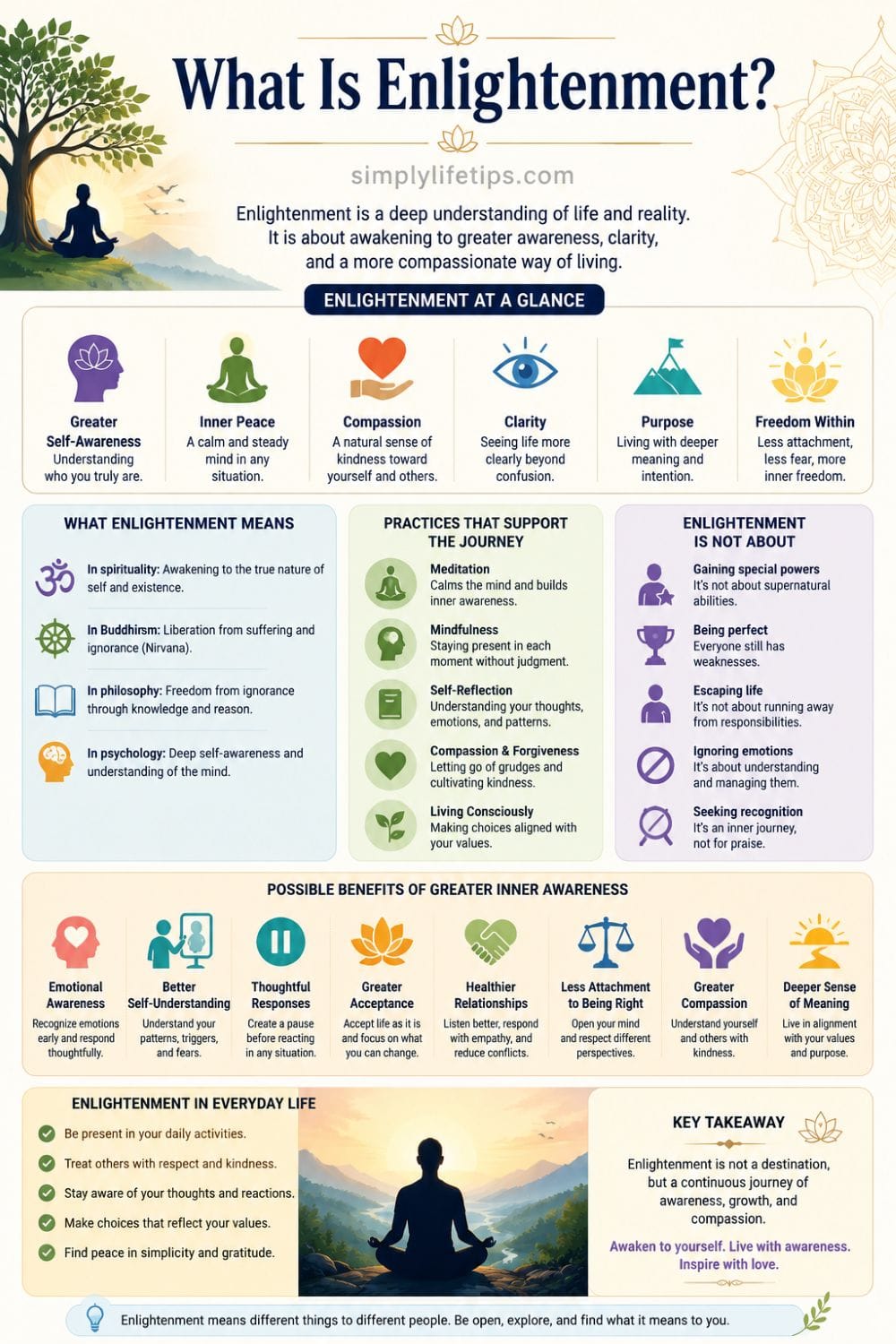
Enlightenment is not about becoming a perfect person or escaping everyday life. It can be understood as an ongoing journey of awareness, reflection, compassion, and personal growth. Small moments of conscious choice can gradually change the way we experience ourselves and the world around us.
Enlightenment Does Not Mean Becoming Perfect
The idea of enlightenment can sometimes create an unrealistic image of a person who is permanently peaceful, endlessly compassionate, and completely free from negative emotions. Real life is more complicated.
A person can become more self-aware and still make mistakes. They can understand anger and still occasionally lose their temper. They can practice compassion and still become frustrated. They can meditate and still have difficult days.
Growth does not require perfection. In fact, expecting yourself to become perfect can become another form of pressure. The goal is not to become a flawless human being. It is to become more aware of who you are and how you live.
Can Meditation Lead to Enlightenment?
Meditation has an important place in several spiritual traditions, and research has also examined mindfulness and meditation in relation to attention, emotional regulation, stress, and psychological well-being. However, these findings do not establish that meditation automatically produces spiritual enlightenment.
Meditation is a practice. Enlightenment, when understood as a profound spiritual realization, is a much broader concept. Someone can meditate regularly and still behave without awareness in everyday life.
Inner growth involves more than sitting quietly for a few minutes each day. How we speak, how we treat people, how we handle criticism, how we respond to failure, and how honestly we examine ourselves are also part of the journey.
PubMed – Mindfulness-Based Interventions and Emotion Regulation.
Enlightenment in Everyday Life
You do not need to leave ordinary life behind to explore greater awareness. The journey can happen during ordinary moments.
Someone criticizes your work. Instead of immediately becoming defensive, you pause and consider whether there is something useful in what was said. Someone disagrees with your opinion. Instead of assuming they are against you, you listen and try to understand their perspective.
You make a mistake. Instead of calling yourself a failure, you ask what you can learn. Someone succeeds where you wanted to succeed. Instead of allowing jealousy to consume you, you notice the feeling and examine where it comes from.
Someone hurts you. Instead of pretending nothing happened, you acknowledge the pain while deciding how you want to respond. These moments may appear small, but repeated moments of awareness can gradually influence how we live.
Greater self-awareness can also help us make choices that are more consistent with our values and identity. Our guide to authentic living explores this idea in greater detail.
The Space Between an Experience and a Reaction
One of the most practical ways to understand inner awareness is to consider the space between what happens and what we do next.
A person says something hurtful, and the first emotional reaction may be immediate. But there can be a brief pause. In that pause, you can ask yourself: What am I feeling? Why am I reacting this way? Do I need to respond immediately? What response will I respect tomorrow?
That pause does not guarantee a perfect decision. However, it gives you a choice. Instead of being completely driven by the first reaction, you become more aware of your own experience.
This does not mean suppressing emotions. It means noticing them before deciding what to do with them.
Learning to pause before reacting can also improve everyday communication. Our guide on thinking before you speak explores practical ways to respond more thoughtfully.
Is Enlightenment a Spiritual or Psychological Concept?
Enlightenment is primarily a spiritual and philosophical concept, and different traditions give it different meanings. Psychology, meanwhile, studies related areas such as self-awareness, attention, emotional regulation, mindfulness, and human behavior.
These subjects can overlap, but they should not be treated as identical. Scientific research has examined practices such as mindfulness and meditation and their possible effects on areas including emotional regulation and psychological well-being. However, this research should not be interpreted as scientific proof of spiritual enlightenment itself.
It is therefore useful to distinguish between spiritual enlightenment, psychological self-awareness, and mindfulness. Spiritual enlightenment generally refers to a profound idea of awakening or realization found in various traditions. Psychological self-awareness involves understanding our thoughts, emotions, motivations, and behavior. Mindfulness involves deliberately paying attention to present-moment experience with greater awareness.
These concepts can complement one another, but they describe different things.
Research on mindfulness and emotion regulation
Can Ordinary People Experience Enlightenment?
Spiritual traditions differ considerably in how they answer this question. Some describe enlightenment as a profound transformation that requires deep spiritual practice. Others describe awakening in ways that may include moments of insight, realization, or freedom from habitual patterns.
For everyday readers, it may be more useful not to become obsessed with whether they have “achieved enlightenment.” Instead, ask whether you are becoming more aware of your thoughts, understanding your emotional reactions better, becoming less controlled by fear, admitting when you are wrong, listening without immediately becoming defensive, and developing greater compassion.
These questions focus on growth rather than a label.
Enlightenment Is a Journey, Not a Competition
There is a danger in turning enlightenment into another achievement. People can become competitive even about spirituality. One person may think, “I meditate more than you,” while another may believe, “I am more spiritually aware than other people.”
But if the search for enlightenment strengthens arrogance, judgment, or a sense of superiority, it is worth asking whether the search itself has become another form of ego.
Inner growth is not a competition. You do not need to prove your progress to anyone. The journey is personal, and what matters is the honesty with which you examine yourself and live your life.
Conclusion
What is enlightenment? At its deepest spiritual level, the answer depends on the tradition through which it is understood. From a practical perspective, however, the idea can invite us to look more honestly at our inner world and become more aware of how our thoughts, emotions, fears, and habits influence the way we live.
Enlightenment does not have to mean escaping life. It can be explored through becoming more aware of life. You may still experience anger, but you can learn to notice it before acting. You may still experience fear, but you can understand it instead of allowing it to control every decision. You may still experience pain, but you can learn from it without allowing it to define your entire life.
The world around you may not change immediately, but your way of seeing it can change. Perhaps the journey begins with something very simple: pause, notice, question, understand, and choose.
Enlightenment, in this sense, is not about becoming someone completely different. It is about becoming more conscious of who you are and having the courage to keep growing.
FAQs about What Is Enlightenment
What is enlightenment in simple words?
Enlightenment can be described simply as a profound awakening or deeper understanding. In spiritual traditions, it may refer to liberation from ignorance and a transformed understanding of reality. In everyday personal growth, it can be explored through greater self-awareness and conscious living.
What are some signs of enlightenment?
There is no universally accepted checklist of enlightenment, and different spiritual traditions describe it in different ways. Some traditions and personal-development approaches associate deeper inner awareness with qualities such as greater self-understanding, compassion, humility, acceptance, and less automatic reactivity. These qualities should not be treated as a scientific test or proof of enlightenment.
Is enlightenment the same as spiritual awakening?
The terms overlap, but they are not necessarily identical. Spiritual awakening can describe a period of increased awareness or questioning, while enlightenment often refers to a more profound realization. Their meanings vary between traditions.
Can meditation help with enlightenment?
Meditation is an important practice in several spiritual traditions and can help people develop attention, mindfulness, and self-awareness. However, meditation should not be presented as a guaranteed path to enlightenment, which has different meanings across traditions.
Does enlightenment mean you never feel negative emotions?
No. Enlightenment should not automatically be understood as never experiencing anger, fear, sadness, or frustration. A more practical understanding of inner awareness focuses on recognizing emotions and becoming less controlled by automatic reactions.

Mathukutty P V is a Blogger, YouTuber, and Content Writer and the founder of Simply Life Tips. After taking voluntary retirement in 2017, he embraced a free lifestyle focused on learning, personal growth, and sharing practical wisdom to help others live with more purpose and positivity.