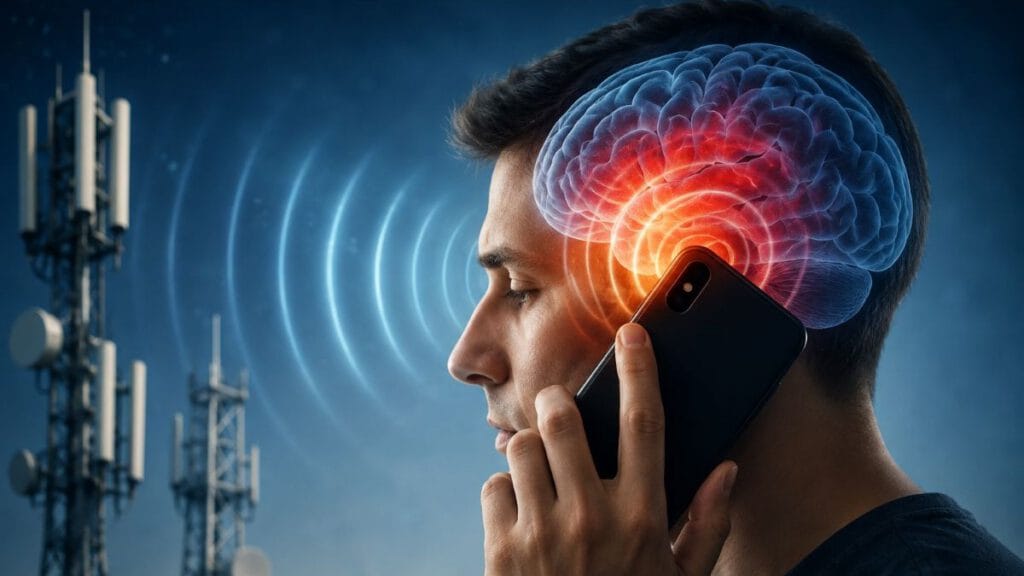
Mobile phone radiation has worried people for years, particularly because we often hold smartphones close to our heads for long periods. But can that exposure actually cause a brain tumor?
It is a reasonable question.
Millions of people use mobile phones every day. Some spend several hours talking, browsing, watching videos, messaging, or scrolling. Because mobile phones communicate using radiofrequency (RF) electromagnetic energy, concerns about possible effects on the brain have continued for decades.
The reassuring part is that current human evidence does not establish that mobile-phone use causes brain tumors. The National Cancer Institute says the evidence to date suggests that cell-phone use does not cause brain or other cancers in humans. A large prospective study involving more than 250,000 mobile-phone users also found that people with the highest lifetime number of mobile-phone call hours did not have a higher risk of brain tumors than lighter users.
But that is not the end of the story.
Mobile-phone radiation and excessive smartphone use are two related but different subjects. While researchers continue to study RF exposure, there is also substantial research into how our patterns of smartphone use may affect sleep, attention, and emotional well-being.
Understanding that difference can help us separate genuine scientific concerns from unnecessary fear.
What Is Mobile Phone Radiation?
Mobile phones emit radiofrequency electromagnetic radiation, commonly called RF radiation.
This is a form of non-ionizing radiation.
The word “radiation” can sound alarming because X-rays and gamma rays are also radiation. However, radiation is a broad term, and different types have very different properties.
X-rays and gamma rays are forms of ionizing radiation. They have enough energy to damage DNA and can increase cancer risk.
Mobile-phone RF radiation is non-ionizing and has much lower energy. According to the National Cancer Institute, the energy of radiofrequency radiation from mobile phones is too low to damage DNA directly.
That does not mean researchers have stopped studying it.
Because mobile phones are used extremely close to the body, scientists have continued investigating whether long-term exposure could have health effects.
Can Mobile Phone Radiation Cause Brain Tumors?
Based on current evidence, mobile-phone use has not been established as a cause of brain tumors.
This is one of the most important conclusions to understand.
The 2024 COSMOS prospective cohort study conducted by researchers including the International Agency for Research on Cancer (IARC) followed more than 250,000 mobile-phone users. Many participants had already used mobile phones regularly for 15 years or more.
Researchers compared people with the highest total number of mobile-phone call hours with lighter users.
They found no higher risk of developing brain tumors among the heaviest users. The study examined tumors including glioma, meningioma, and acoustic neuroma.
The National Cancer Institute similarly reports that the major epidemiological studies conducted so far, including Interphone, the Danish study, the Million Women Study, and COSMOS, do not show an overall association between cell-phone use and cancer.
That is reassuring.
However, scientific language matters.
It is better to say:
Current evidence has not established that mobile-phone use causes brain tumors.
rather than:
Mobile phones can never cause brain tumors.
The first statement accurately reflects the evidence without claiming that science can predict every possible future finding.
Why Is There Still Concern About Mobile Phone Radiation?
Part of the confusion comes from an IARC classification made in 2011.
IARC classified radiofrequency electromagnetic fields as “possibly carcinogenic to humans” (Group 2B).
This classification is sometimes misunderstood.
“Possibly carcinogenic” does not mean “proven to cause cancer.”
It means that the available evidence at the time was limited or uncertain enough that a possible association could not be ruled out with sufficient confidence.
The classification was based on the scientific evidence available at that time, and research has continued since then.
The newer COSMOS findings provide additional reassuring evidence regarding brain-tumor risk from mobile-phone use.
So the scientific picture is more nuanced than either extreme:
“Mobile phones definitely cause cancer” is not supported by current evidence.
But neither should we claim that science has answered every possible question about every form of long-term RF exposure.
Related Video: Dr. Arun Oommen on Excessive Cellphone Use
Neurosurgeon Dr. Arun Oommen discussed mobile-phone use and radiation in a video published in 2017.
His recommendations included using an earpiece, avoiding continuous calls for 15–20 minutes, using texting when practical, avoiding mobile-phone use in moving vehicles, using landlines when possible, and checking the phone’s SAR value.
These recommendations should be understood as precautionary advice from a medical professional, rather than as proof that mobile-phone radiation causes brain cancer.
Dr. Arun Oommen’s 2017 video provides an expert perspective from that time. The scientific evidence discussed in this article has also been updated using more recent research.
For a current assessment, it is more appropriate to consider newer research alongside authoritative sources such as the National Cancer Institute, WHO, IARC, and Indian telecommunications authorities.
What Does Current Science Say About Mobile Phone Radiation Effects?
The question of mobile phone radiation effects is broader than cancer.
Researchers have investigated possible effects involving cognition, sleep, headaches, and other symptoms.
Here again, the distinction between RF exposure and smartphone behaviour is important.
A 2024 systematic review and meta-analysis of human observational studies examining RF exposure and cognition found little to no association with several measures of learning, memory, executive function, and complex attention, although the certainty of evidence was generally low or very low and more research was recommended.
That does not support the claim that mobile-phone RF radiation causes memory loss.
At the same time, smartphones can influence attention through a completely different mechanism: distraction.
Does Smartphone Use Affect Memory and Attention?
It would be misleading to say that smartphones simply “damage memory.”
Our phones can actually help us remember things. We use calendars, reminders, notes, navigation, photographs, contact lists, and other tools to support everyday memory.
The concern is more about constant distraction and dependence on digital devices.
A 2023 meta-analysis examined 22 studies involving 43 relevant effects related to memory, attention, and general cognitive performance. It found an overall negative effect associated with smartphone use or smartphone presence, although the effects varied across cognitive domains, and the researchers emphasized the need for further research.
This suggests that having a smartphone constantly competing for attention may make concentration more difficult in some circumstances.
That is very different from saying that RF radiation is damaging the brain.
Can Excessive Smartphone Use Affect Sleep?
Sleep is one area where the evidence is more concerning.
A 2024 systematic review and meta-analysis examined 55 studies involving more than 41,000 participants from more than 20 countries. Overall electronic-media use was associated with poorer sleep quality and more sleep problems, while problematic use showed an even stronger association. Smartphone use was also associated with sleep problems in the analysis.
Think about what happens at bedtime.
You intend to check one message.
Then you watch a short video.
Another appears.
You check social media.
You read a news story.
You answer a message.
Suddenly, half an hour has disappeared.
The resulting problem may not be radiation at all.
The phone simply kept you awake.
That is why protecting sleep is one of the most practical reasons to create boundaries around smartphone use.
What About Anxiety and Depression?
Problematic smartphone use has also been associated with symptoms of anxiety and depression.
Excessive smartphone use can also affect everyday life, including relationships, concentration, and productivity. Read more about the negative impact of mobile phone addiction
A meta-analysis of 27 studies involving 120,895 participants found a moderate association between problematic smartphone use and both anxiety and depression symptoms.
But an association does not automatically mean that smartphone use causes anxiety or depression.
The relationship may operate in both directions.
Someone experiencing anxiety or low mood may use a smartphone excessively as a distraction or coping mechanism. At the same time, excessive use may contribute to poor sleep, reduced physical activity, social comparison, or withdrawal from other activities.
Therefore, it is more accurate to describe this as an association with problematic smartphone use, rather than claiming that mobile-phone radiation causes anxiety or depression.
Can Mobile Phone Use Cause Headaches or Neck Pain?
Long periods of smartphone use can contribute to physical discomfort.
Looking down at a phone for extended periods may place strain on the neck and shoulders. Prolonged close-up screen viewing may also contribute to eye discomfort and headaches.
These problems are primarily related to posture, screen viewing, repetitive use, and insufficient breaks.
They should not automatically be attributed to mobile-phone radiation.
If headaches are persistent, severe, unusual, or accompanied by other concerning symptoms, medical evaluation is appropriate rather than assuming that the phone is responsible.
The Biggest Immediate Danger May Be Distraction
There is one risk associated with mobile-phone use that does not depend on the radiation debate.
Distraction.
Using a phone while driving can take attention away from the road.
Looking at a screen while crossing a busy road can reduce awareness of vehicles and other hazards.
No SAR value can make distracted driving safe.
The simple rule is:
Never use your phone while driving or while crossing a road.
Put it away until you are safely stopped.
What Is SAR?
SAR stands for Specific Absorption Rate.
It is a measurement of the rate at which the body absorbs radiofrequency energy from a device under specified testing conditions. SAR is expressed in watts per kilogram (W/kg).
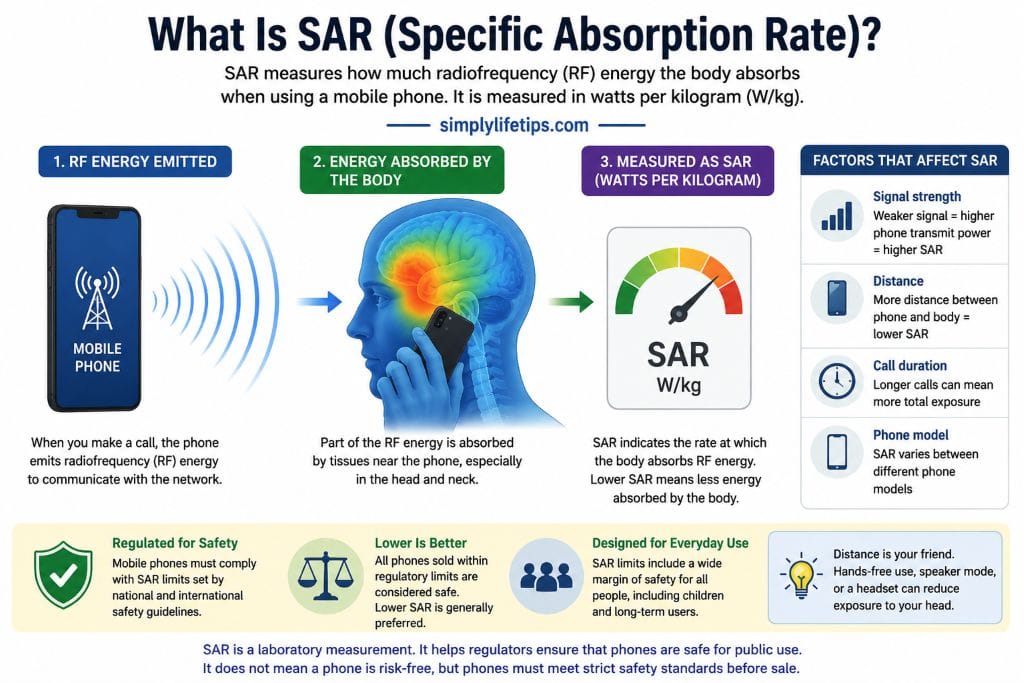
India has adopted a SAR limit of 1.6 W/kg averaged over 1 gram of human tissue for mobile handsets. The Department of Telecommunications states that mobile handsets manufactured or imported for the Indian domestic market have been required to comply with this revised limit since September 2013.
You may find your phone’s SAR information in the manufacturer’s specifications, documentation, or regulatory information.
But SAR should not be interpreted as a simple overall “health score.”
It is a standardized measurement obtained under defined testing conditions. Actual exposure can vary depending on factors such as how the phone is used, the distance between the phone and the body, and network conditions.
How Can You Reduce Mobile Phone Radiation Exposure?
If you remain concerned about mobile phone radiation, you do not have to stop using your smartphone. There are simple ways to reduce your exposure to radiofrequency (RF) energy, particularly during long calls.
The most straightforward principle is distance.
The closer a transmitting phone is to your body, especially your head during a voice call, the greater the RF exposure. As the distance between the phone and your body increases, the absorbed RF energy decreases rapidly. The National Cancer Institute specifically notes that SAR decreases very quickly as the distance from the exposure source increases.
These measures are precautionary. They are not based on evidence that ordinary mobile-phone use has been proven to cause brain tumors.
Keep the phone away from your head during long calls
If you are going to have a long conversation, consider using speaker mode, headphones, or earbuds instead of holding the phone directly against your ear.
The reason is simple: increasing the distance between the phone and your head reduces RF exposure to the head. NCI notes that wired or wireless headsets reduce exposure because the phone is no longer positioned directly against the head.
You do not need to hold the phone several feet away. Even moving it away from direct contact with your head can substantially reduce exposure.
For example, instead of holding the phone against your ear for a 30-minute conversation, you could place it on a table and use speaker mode.
Reduce unnecessary long calls
Another simple approach is to reduce the amount of time spent on mobile-phone calls when practical.
If a conversation can be completed quickly, there is no reason to prolong it simply because the phone makes communication convenient.
For longer conversations, consider alternatives such as:
- Speaker mode
- Headphones or earbuds
- Video or internet-based communication when appropriate
- Text messaging when a conversation does not require a call
- A landline when one is conveniently available
NCI lists reducing the amount of time spent using a mobile phone as one way concerned users can reduce RF exposure.
This does not mean that every long phone call is dangerous. It is simply a practical way to reduce exposure if you prefer a precautionary approach.
Avoid calls when the signal is very weak
This is an important point that many people overlook.
A mobile phone communicates with a nearby cellular network by transmitting RF signals. When the connection is poor, the phone may increase its transmitting power to maintain communication.
The National Cancer Institute specifically advises concerned users to avoid making calls when the signal is weak because the phone can increase its RF transmission power under those conditions.
You may notice this in places such as:
- Underground parking areas
- Elevators
- Remote rural locations
- Buildings with poor reception
- Areas where the phone shows only one or two bars
You do not need to panic when the signal is weak. If you are concerned about RF exposure, however, postponing a long call until you have a stronger connection is a simple precaution.
Use speaker mode or a headset for longer conversations
A headset can be useful because it allows you to keep the phone away from your head while talking.
Both wired and wireless headsets can provide this separation. NCI notes that wireless Bluetooth devices such as headphones and earbuds generally transmit at much lower power than mobile phones themselves.
The important point is not that a headset makes the phone “radiation-free.”
It does not.
The benefit is that the main transmitting device—the phone—is farther away from your head.
Keep the phone away from your body when you are not using it
If you are not actively using the phone, there is little reason to keep it pressed against your body continuously.
For example, instead of keeping it against your head or tucked tightly against your body during a long period of inactivity, you can place it on a desk, table, or other nearby surface.
Again, this is a precaution based on the effect of distance. RF exposure decreases as the distance from the transmitting device increases.
There is no need to become obsessive about this. The purpose is simply to avoid unnecessary close contact when the phone is not being used.
Use texting when it makes sense—but never while driving
If you need to communicate something brief, a text message can sometimes eliminate the need for a voice call.
However, never text while driving.
The potential danger from distracted driving is much more immediate and established than the debated long-term health effects of mobile-phone RF exposure.
If you need to make or answer a call, send a message, or check something on your phone while travelling, wait until you have safely stopped.
Consider using a landline for long conversations
If you have convenient access to a landline, it can be another option for lengthy conversations.
A landline does not require you to hold a mobile phone against your head during the call. For someone who wants to minimize mobile-phone RF exposure as a precaution, this is a simple alternative.
You do not need to abandon your smartphone. A landline can simply be another communication option when it is available.
Do not confuse distance with fear
The purpose of these precautions is not to suggest that every mobile-phone call is harmful.
Current evidence has not established ordinary mobile-phone use as a cause of brain tumors, and major research continues to examine long-term exposure. The National Cancer Institute states that the evidence to date suggests that cell-phone use does not cause brain or other cancers in humans.
So why take precautions?
Because reducing exposure is easy.
Moving a phone away from your head, using speaker mode, shortening unnecessary calls, and avoiding calls in very weak-signal conditions require little effort. Someone who prefers a precautionary approach can adopt these habits without giving up the benefits of mobile technology.
Remember that smartphone habits involve more than radiation
There is another important reason to reduce unnecessary phone use: your overall wellbeing.
Putting the phone down can also mean:
- More time for sleep
- Fewer interruptions
- Better concentration
- More physical activity
- More face-to-face conversation
- Less unconscious scrolling
- More time away from screens
These benefits are separate from the question of RF radiation.
In other words, you do not need to believe that mobile-phone radiation causes brain tumors to have a good reason to create healthier boundaries around smartphone use.
A practical approach
You can keep your approach simple:
During a short call: Use your phone normally if you wish.
During a long call: Consider speaker mode or a headset.
When reception is very poor: Consider waiting until you have a stronger signal before making a long call.
When you are not using the phone: Avoid unnecessary prolonged close contact with your body.
While driving: Keep the phone out of your hands and your attention on the road.
Before sleep: Put the phone aside and protect your sleep.
These are reasonable precautionary and healthy-use habits—not evidence that ordinary mobile-phone use has been shown to cause brain tumors.
The goal is not to fear your smartphone.
The goal is to use it wisely, keep unnecessary exposure and distraction under control, and remain in charge of the technology you use every day.
How Can You Make Smartphone Use Healthier?
Reducing smartphone exposure to radiofrequency (RF) energy is only one part of the picture. Your daily smartphone habits can also influence sleep, attention, physical activity, and how much time you spend interacting with the world around you.
These recommendations are not based on the idea that smartphones have been proven to damage the brain. Instead, they focus on using technology to support a healthier daily routine.
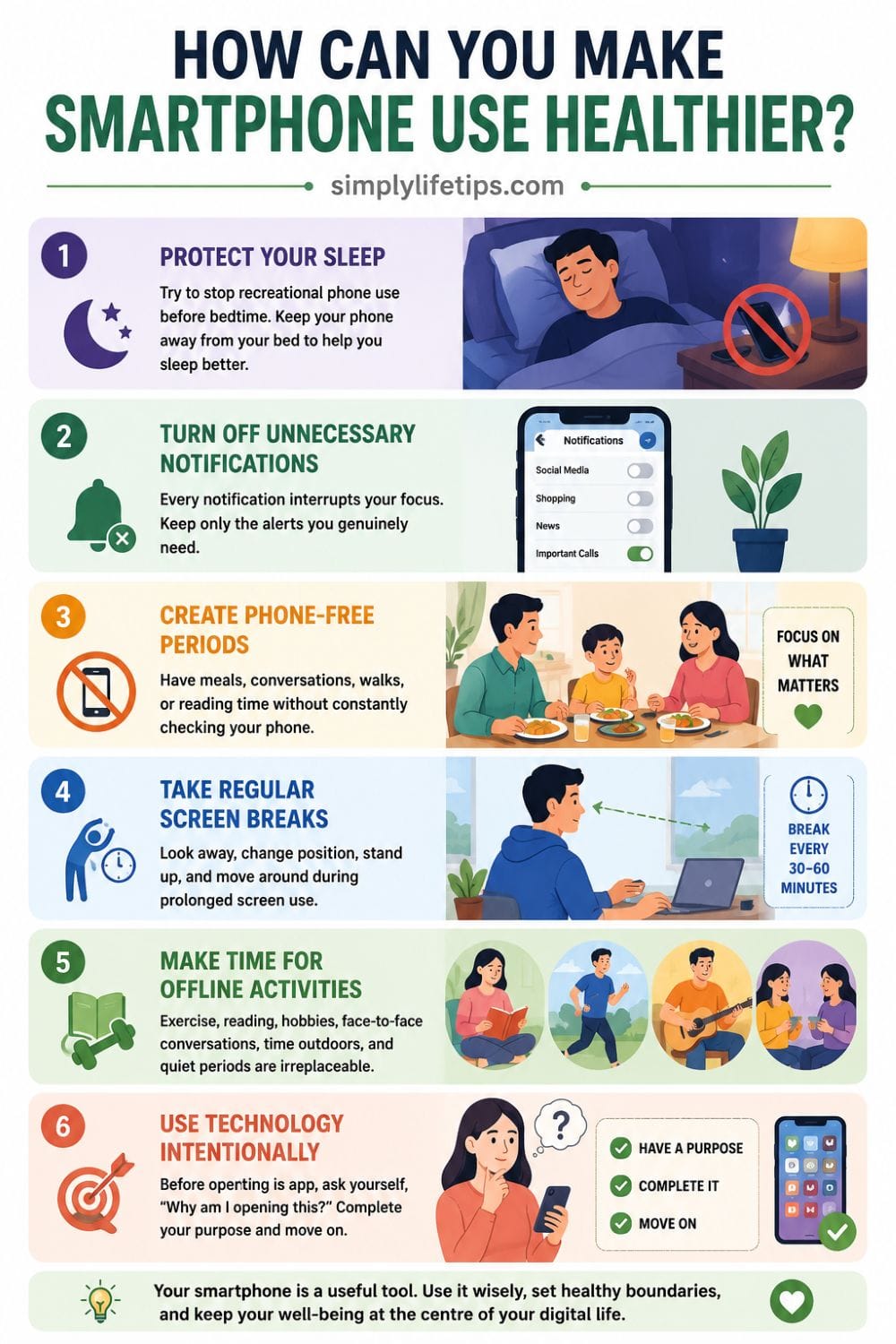
Protect Your Sleep
Try to stop recreational smartphone use before bedtime, particularly if you notice that scrolling, messaging, or watching videos keeps you awake.
Using a phone in bed can also make it tempting to check notifications repeatedly. Keeping the device away from your bed—or even outside the bedroom—can make it easier to establish a consistent bedtime routine.
If you need your phone as an alarm, consider placing it across the room rather than beside your pillow.
Good sleep is important for concentration, memory, mood, and overall health, so protecting your sleep may be one of the most useful changes you can make to your smartphone routine.
Turn Off Unnecessary Notifications
Every notification creates another opportunity for interruption.
A message, social-media alert, shopping notification, news update, or app reminder can pull your attention away from whatever you are doing.
You do not need to allow every app to interrupt you.
Review your notification settings and keep alerts only for things that genuinely require your attention. You can also use Do Not Disturb or similar features during work, study, meals, reading, or sleep.
Fewer unnecessary interruptions can make it easier to concentrate on one task at a time.
Create Phone-Free Periods
You do not need to be connected every minute of the day.
Try creating specific periods when your phone stays away from you.
For example:
- Keep phones away during family meals.
- Put your phone aside during face-to-face conversations.
- Take a walk without constantly checking the screen.
- Read a book without keeping the phone beside you.
- Create a phone-free period before bedtime.
- Spend some time outdoors without using the phone as entertainment.
These small periods can help restore a healthier balance between online and offline life.
Take Regular Screen Breaks
If you spend several hours looking at a screen, take regular breaks.
Look away from the screen, change your posture, stand up, stretch, or walk around for a few minutes.
You can also use the break to look at something farther away rather than immediately switching from your phone to another screen.
Regular movement and changes in posture are particularly useful if your work or daily routine requires prolonged screen use.
The goal is not to follow a complicated formula. The important thing is to avoid remaining in the same position and staring continuously at a screen for long periods.
Make Time for Offline Activities
A smartphone can provide information, entertainment, communication, and countless other services.
But it cannot replace every experience that supports a balanced life.
Make time for activities such as:
- Exercise and physical activity
- Reading
- Hobbies
- Face-to-face conversations
- Time with family and friends
- Spending time outdoors
- Creative activities
- Quiet periods without digital stimulation
These activities give your attention a chance to move away from the constant stream of notifications, messages, and new content.
The goal is not to reject technology. It is to make sure that technology does not crowd out everything else.
Use Technology Intentionally
One of the simplest ways to reduce unnecessary smartphone use is to pause before opening an app.
Ask yourself:
“Why am I opening this?”
If you have a specific purpose, complete it and move on.
For example, if you pick up your phone to check the weather, check the weather and put the phone down. If you open it to reply to a message, reply and return to what you were doing.
Without this small pause, it is easy to move from one app to another and eventually spend 20 or 30 minutes scrolling without intending to.
Intentional use turns the smartphone back into what it should be:
a tool that serves you, rather than a source of constant interruption.
Set Boundaries for Social Media and Short Videos
Endless scrolling is designed to keep your attention moving from one piece of content to another.
If you find yourself repeatedly opening social media apps without a clear reason, consider setting daily limits or removing unnecessary apps from your home screen.
You can also log out of apps that you tend to check automatically.
The aim is not to eliminate social media. It is to make your use more deliberate.
Keep Your Phone Away During Important Tasks
When you need deep concentration, put the phone out of immediate reach.
Simply placing it face down beside you may not be enough if you are tempted to check it repeatedly.
During work, studying, writing, reading, or other tasks that require sustained attention, consider placing the phone in another room or switching on Do Not Disturb.
This creates a physical boundary that makes distraction less automatic.
Don’t Let the Phone Replace Human Connection
A smartphone can help people stay connected, but digital communication should not completely replace meaningful face-to-face interaction.
When you are talking with someone, try putting the phone away and giving them your full attention.
A conversation without constant glances at a screen can be more meaningful for both people.
A Simple Rule to Remember
You do not have to follow a complicated smartphone-detox programme.
Start with a few simple boundaries:
Protect your sleep.
Silence unnecessary notifications.
Take regular breaks.
Create phone-free periods.
Make time for offline activities.
Use your phone with a clear purpose.
These habits are not about fearing mobile-phone radiation. They are about maintaining a healthy relationship with a technology that has become part of everyday life.
A smartphone can make life easier, more connected, and more productive.
The goal is to make sure it remains a tool in your life—not the centre of it.
If you want more practical guidance for developing safer smartphone habits, see Essential Habits for Smartphone Use: Stay Safe and Healthy.
Should You Be Worried About Mobile Phone Radiation?
For most people, there is no reason to panic about ordinary mobile-phone use because of fear of brain tumors.
Current evidence has not established that mobile-phone use causes brain tumors. The large COSMOS study found no increased brain-tumor risk among people with the highest lifetime number of mobile-phone call hours.
At the same time, it is reasonable to use technology thoughtfully.
If you want to reduce RF exposure, increasing the distance between the phone and your body during long calls is a simple precaution.
And if you want to improve your overall well-being, limiting unnecessary smartphone use can help protect something that is unquestionably valuable:
your time and attention.
Mobile Phone Radiation vs Excessive Smartphone Use
These two issues should not be confused.
Mobile phone radiation refers to the radiofrequency electromagnetic energy emitted by the device.
Excessive smartphone use refers to how frequently and compulsively we use the device and how that behaviour affects our daily life.
Current research does not establish that mobile-phone RF radiation causes brain tumors.
Meanwhile, research has found associations between electronic-media or problematic smartphone use and poorer sleep, while problematic smartphone use has also been associated with anxiety and depression symptoms.
That distinction is important.
We do not need to frighten people about radiation to make a strong case for healthier smartphone habits.
If checking your phone has become difficult to control or is interfering with sleep, work, relationships, or everyday activities, you may want to explore the signs and practical approaches discussed in Smartphone Addiction: Problems and Solutions.
Conclusion
Mobile phone radiation has been the subject of intense scientific research and public concern for decades. Based on the evidence available today, mobile-phone use has not been established as a cause of brain tumors, and a large prospective study found no increased brain-tumor risk among the heaviest mobile-phone callers.
That is reassuring.
But it does not mean we should ignore how smartphones affect our everyday lives.
The more immediate concerns may be familiar ones: staying awake too late, constantly checking notifications, losing concentration, spending less time being physically active, or reaching for the phone during moments that deserve our full attention.
The answer is not necessarily to fear your smartphone.
It is to use it intentionally.
Protect your sleep. Protect your attention. Take breaks. Put the phone away while driving. Make time for people, exercise, reading, nature, and quiet.
A smartphone is a powerful tool.
Keep it in your hands—but don’t let it take control of your life.
Medical Disclaimer
This article is for general informational and educational purposes only. It is not a substitute for professional medical advice, diagnosis, or treatment. If you have a health concern or persistent symptoms, consult a qualified healthcare professional.
Sources and Further Reading
- National Cancer Institute — Cell Phones and Cancer Risk: National Cancer Institute
- International Agency for Research on Cancer — COSMOS prospective cohort study: IARC / WHO
- World Health Organization — Electromagnetic fields and mobile technology: WHO
- Government of India — Department of Telecommunications, EMF and SAR information: Department of Telecommunications
- PubMed — Electronic Media Use and Sleep Quality: Updated Systematic Review and Meta-Analysis: PubMed
- PubMed — Problematic Smartphone Use, Anxiety and Depression Meta-analysis: PubMed
- Dr. Arun Oommen — 2017 video/article on excessive cellphone use: Dr. Arun Oommen
FAQs – Mobile Phone Radiation
Can mobile phone radiation cause brain tumors?
Current evidence has not established that mobile-phone use causes brain tumors. The large COSMOS prospective study found no increased risk of brain tumors among people with the highest lifetime number of mobile phone call hours.
Is mobile phone radiation the same as X-ray radiation?
No. Mobile phones emit non-ionizing radiofrequency radiation, while X-rays are ionizing radiation. X-rays have enough energy to damage DNA directly; mobile-phone RF radiation does not have that level of energy.
What is the SAR limit for mobile phones in India?
India has adopted a SAR limit of 1.6 W/kg averaged over 1 gram of tissue for mobile handsets.
Can excessive smartphone use affect sleep?
Research has found an association between electronic-media use, including smartphone use, and poorer sleep outcomes. Problematic use shows a stronger association with sleep problems.
Should I stop using my mobile phone because of radiation?
Current evidence does not provide a reason for most people to panic about ordinary mobile-phone use because of brain-tumor concerns. If you nevertheless want to reduce RF exposure, using speaker mode or a headset during longer calls and increasing the distance between the phone and your body are simple precautionary measures.

Mathukutty P V is a Blogger, YouTuber, and Content Writer and the founder of Simply Life Tips. After taking voluntary retirement in 2017, he embraced a free lifestyle focused on learning, personal growth, and sharing practical wisdom to help others live with more purpose and positivity.