
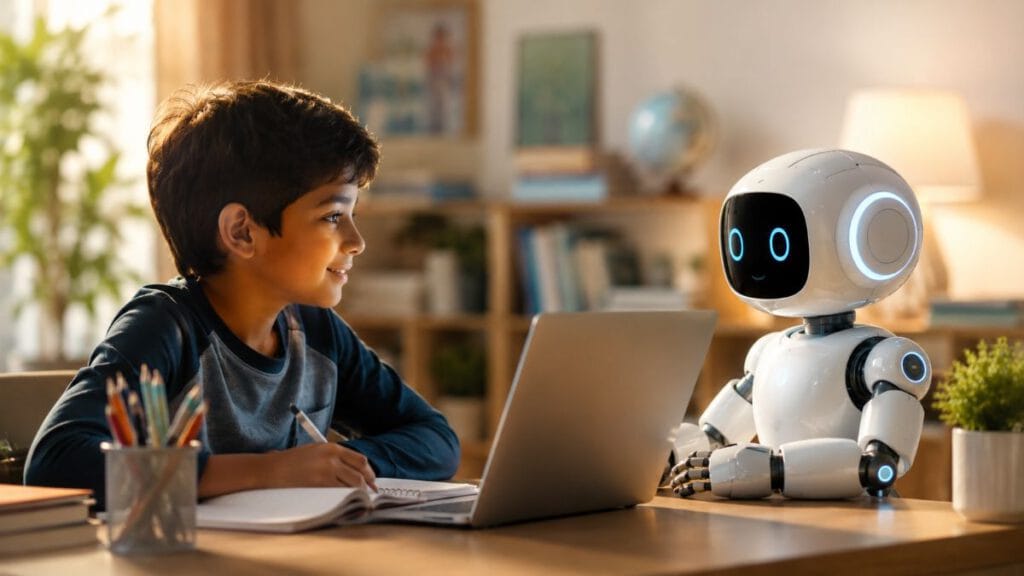
Emotional Intelligence for Kids may become one of the most important skills children need in a world increasingly shaped by artificial intelligence. AI is changing how children learn, find information, and think about their future. As technology becomes more powerful, parents need to ask an important question: Will intelligence and good marks alone prepare our children for tomorrow?
This article was inspired by a thought-provoking Facebook post by neurosurgeon Dr Arun Oommen, VPS Lakeshore Hospital, Ernakulam, about the skills children may need to succeed in a future shaped by artificial intelligence. The article develops that idea further from a parenting perspective.
What Is Emotional Intelligence for Kids?
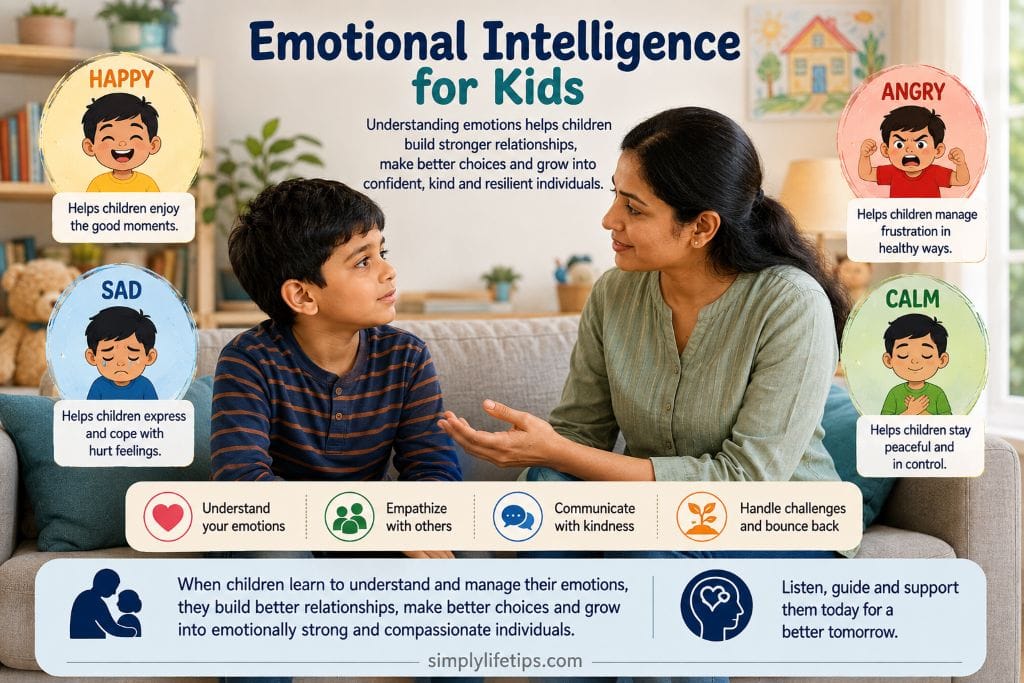
Emotional Intelligence, often called EI or EQ, is the ability to recognize and understand our own emotions, manage them appropriately, and understand the emotions of other people.
For children, it can begin with something very simple. A child loses a game and becomes angry. Instead of shouting or blaming others, the child gradually learns to recognize the feeling and say, “I am angry because I wanted to win.”
The goal is not to stop the child from feeling angry. Anger is a normal human emotion. The goal is to help the child understand the feeling and choose a better response.
Another child may notice that a friend is unusually quiet. Instead of ignoring the change, the child asks, “Are you okay?” That simple question can be an expression of empathy.
These may look like small moments, but they can become important life skills.
Is Your Child Really Ready for the Future?
Ask a child today, “What do you want to become when you grow up?” The answer may be an engineer, scientist, doctor, IAS officer, entrepreneur, teacher, or something completely different. Children dream about their future, and parents naturally want to give them the best education possible.
But there is another question we often forget to ask:
What skills will help our children succeed when they grow up in a world where machines can think, learn, and work faster than ever before?
That question is becoming more important as artificial intelligence enters education, work, and everyday life. The future our children will experience may look very different from the world their parents grew up in.
Will Intelligence and Good Marks Be Enough?
For many years, academic success has been one of the main measures of a child’s future. Parents encourage children to study hard, get good marks, and build a successful career. Knowledge, education, and intelligence will always matter, and there is no reason to stop encouraging children to learn.
But the nature of learning is changing.
Artificial Intelligence can already create images, generate music, summarize information, assist with computer programming, prepare documents, and help people solve many problems. Children can ask AI to explain a difficult subject, provide examples, or help them explore an unfamiliar topic within seconds.
As AI becomes more capable, simply knowing information may not be enough.
A child may know the answer to a question. But can that child decide whether the answer is correct? Can the child explain it clearly? Can the child work with someone who has a different opinion? Can the child handle failure and try again?
These abilities may become increasingly important.
What Will Make Our Children Different?
Imagine two children with similar academic ability. One becomes extremely upset whenever something goes wrong. Criticism feels like a personal attack, losing a competition becomes unbearable, and working with others is difficult.
The other child also wants to succeed but can listen to criticism, understand different opinions, remain calm during difficult situations, and try again after making a mistake.
Both children may be intelligent. Both may get good marks. But they have developed different emotional skills.
As children grow into adults, these skills can influence friendships, relationships, education, teamwork, leadership, and work. This is where Emotional Intelligence becomes important.
Emotional Intelligence for Kids in the AI Age
Artificial Intelligence is becoming increasingly good at processing information. It can answer questions, summarize large amounts of material, generate images, and assist with many different tasks.
UNICEF is also examining the skills children will need to thrive in a world where AI plays an increasing role. Its recent work highlights digital skills alongside critical thinking, creative and relational thinking, evaluating information, and learning how to learn. UNICEF: Skills for an AI World
Children growing up today will probably use AI in ways that are difficult for us to predict.
This does not mean knowledge will become unimportant. It means children may need to learn how to use knowledge rather than simply collect it.
A child may ask AI for an answer, but the child still needs to decide whether that answer makes sense. A child may use AI to generate an idea, but still needs judgment to decide whether the idea is useful. And when children work with other people, they still need to listen, communicate, cooperate, and understand different points of view.
The more powerful technology becomes, the more important strong human skills may become.
Can a Machine Understand What a Person Is Feeling?
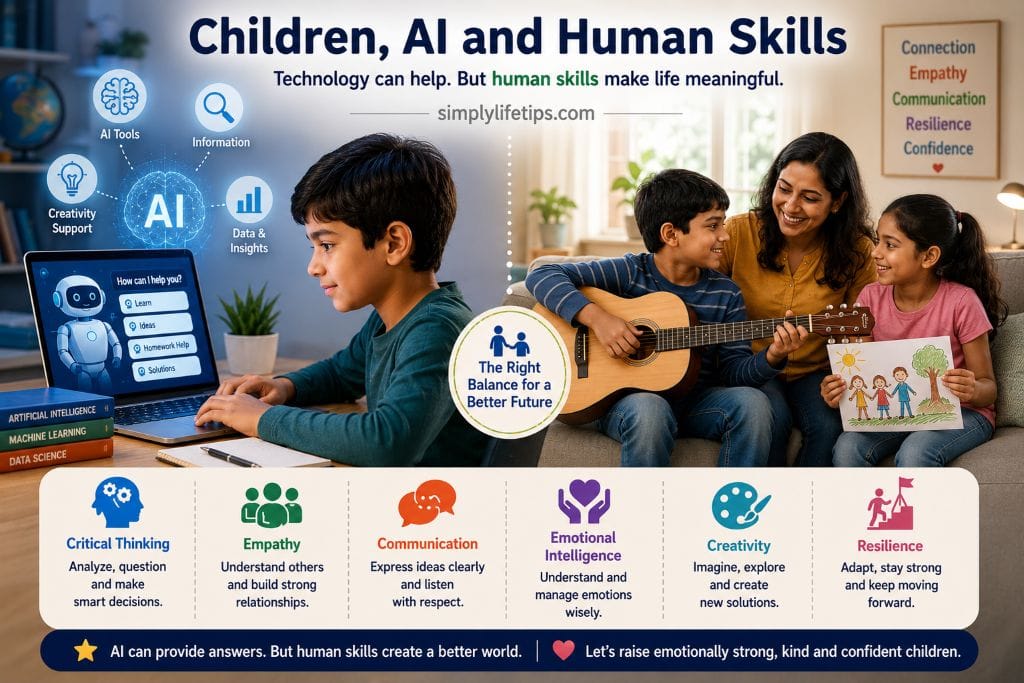
As AI becomes more capable, children will still need human skills such as empathy, emotional awareness, communication, and judgment to navigate relationships and real-life situations.
AI can recognize patterns in language, images, and other forms of information. It can also produce responses that sound caring or understanding.
But human emotional experiences are connected to real relationships, memories, and life experiences.
Think about a mother’s worry about her child. Think about a friend’s silent pain. Think about a child’s fear before an important examination. Think about a patient’s hope while waiting for treatment.
Children need to learn how to recognize these emotions in themselves and others.
That is one reason Emotional Intelligence matters. It helps children understand feelings, manage their own reactions, and respond to other people with empathy and care.
Emotional Intelligence for Kids Matters for Future Success
It may be tempting to say that EQ will replace IQ in the future. But that would be too simple.
Children need both.
IQ and academic knowledge can help children learn, reason, and solve problems. Emotional Intelligence can help them manage pressure, respond to criticism, communicate with others, build relationships, and recover from setbacks.
A child may be very intelligent but become overwhelmed whenever something does not go according to plan. Another child with similar academic ability may be able to accept feedback, learn from mistakes, and continue working after failure.
Academic intelligence matters to both children. But emotional skills can make a major difference in how they handle real-life situations.
The future is unlikely to belong only to the most intelligent or only to the most emotionally intelligent. Children will need a combination of knowledge, technology skills, and human abilities.
What Emotional Skills Do Children Need?
Empathy
Empathy means trying to understand what another person may be feeling.
Imagine a child seeing a classmate sitting alone during lunch. The child could simply walk away. But the child may also wonder, “Why is my friend alone today?”
Perhaps the friend is worried about something. Perhaps there was an argument at home. Perhaps the child is simply having a difficult day.
When children learn to notice these situations and respond with kindness, they begin to understand that everyone has feelings and struggles that may not always be visible.
Empathy can help children become better friends, classmates, teammates and, later, better adults.
Handling Failure and Building Resilience
Every child will experience failure. A child may receive a poor mark, lose a competition, make a mistake, fail to get selected for a team, or experience rejection.
Parents naturally want to protect children from disappointment. But children also need opportunities to learn how to recover.
When a child receives a poor result, the conversation does not always have to end with, “You should have studied harder.”
A better question may be, “What happened, and what can we learn from it?”
This helps children understand that failure is not a permanent label. It can become part of learning.
A child who learns to say, “I did not succeed this time, but I can try again,” is developing resilience.
Listening and Communication
We often encourage children to speak confidently. That is important, but listening is equally valuable.
A child who listens can understand another person’s point of view. A child who listens can learn from teachers and classmates. A child who listens can handle disagreements more calmly.
Parents can encourage this through everyday conversations. When a child disagrees, instead of immediately saying, “You are wrong,” parents can ask, “Why do you think that?”
The child learns to explain the thinking behind an opinion while also learning that another person may see the same situation differently.
Good communication is not only about speaking. It is also about listening.
Self-Awareness and Emotional Control
Children need to learn to recognize what they are feeling.
A child who can say, “I am frustrated because I cannot solve this problem,” is already developing greater self-awareness than a child who can only say, “I hate this.”
Parents can help by giving children simple words for their emotions and allowing them to talk about difficult feelings without immediately judging them.
Emotional control does not mean hiding emotions. It means learning how to respond to them without allowing strong feelings to control every action.
Emotional Intelligence is not just one skill. It includes several abilities that children can develop through everyday experiences, guidance, and practice. These skills can help children understand themselves, connect with others, and handle challenges more confidently.
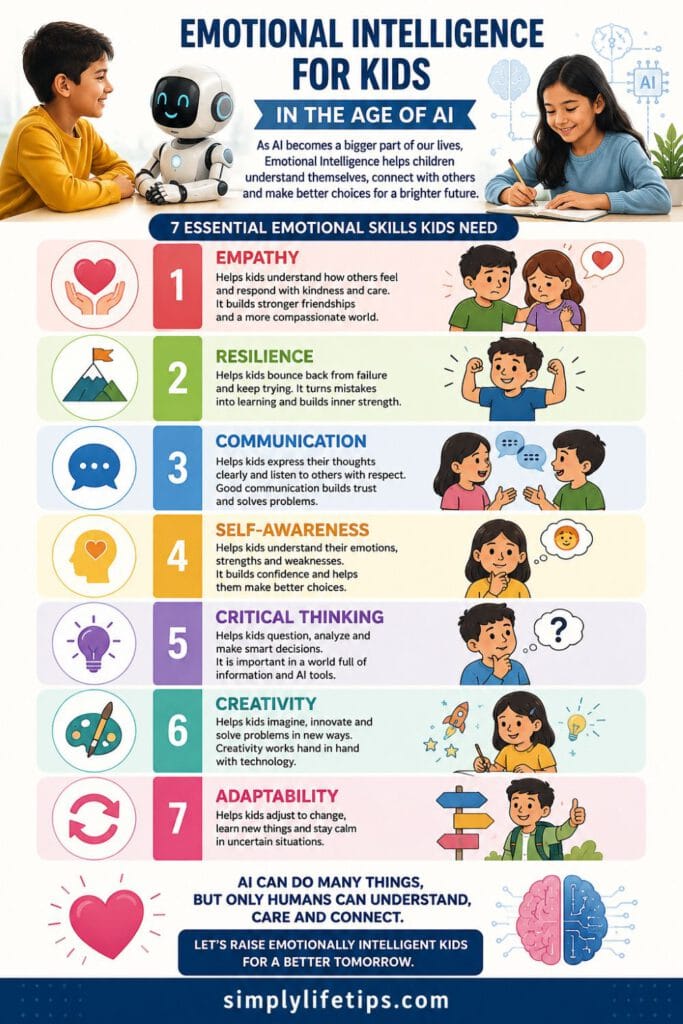
These skills become even more important as children grow up alongside increasingly powerful technology. AI can provide information and help with many tasks, but children still need empathy, resilience, communication, and good judgment to navigate real-life relationships and challenges.
What Other Skills Will Children Need in the AI Age?
Emotional Intelligence is important, but it is not the only skill children will need.
The future will require a combination of human and technological abilities.
Critical Thinking
AI can provide answers quickly, but children should not learn to accept every answer without thinking.
AI systems can make mistakes. Information can be incomplete, outdated, or incorrect.
UNICEF’s recent research also emphasizes the importance of children being able to evaluate information and verify AI-generated responses rather than simply trusting them. UNICEF: Skills for an AI World — What Children Say About the Future
Children therefore need to learn how to ask questions, check information and think independently.
If a child uses AI to understand a science lesson, that can be useful. But the child should understand the lesson rather than simply copy the AI-generated answer.
Technology should support learning, not replace learning.
Creativity
AI can generate stories, pictures, music and ideas. But children still need opportunities to imagine, experiment and create things themselves.
Drawing a picture, writing a story, building something, inventing a game or finding a new solution to a problem can all develop creativity.
Creativity is not only useful for artists. It helps people see possibilities and find new ways to solve problems.
Adaptability
We cannot predict exactly what the world will look like when today’s children become adults.
Some jobs may change. New careers may appear. Technologies that seem unusual today may become ordinary tomorrow.
Children therefore need to become comfortable with learning and adapting.
Instead of teaching children to fear change, parents can help them approach change with curiosity.
The message can be simple: “You may not know what the future will look like, but you can learn how to face it.”
AI Literacy
Children will need to understand how to use AI responsibly.
They should learn that AI is a tool, not an authority that is always correct. They should know how to check information, protect personal information, and use AI without allowing it to do all their thinking for them.
Learning how to work with AI may become as important as learning how to use other digital tools.
UNICEF’s digital education work also identifies critical thinking, AI literacy, collaboration, and socioemotional skills as important areas for children’s development. UNICEF: Competencies and Skills Development
How Can Parents Develop Emotional Intelligence for Kids?
Emotional Intelligence for Kids is not about preventing children from experiencing difficult emotions. It is about helping them understand those emotions and respond to them in healthier ways.
Children should certainly be encouraged to study and develop their academic abilities. But education should not stop with marks.
Parents can create everyday opportunities for children to talk about feelings, solve small problems, make decisions, and learn from mistakes.
When siblings argue, parents do not always have to decide who is right. Sometimes they can ask what happened, how each person feels, and how the disagreement could be resolved.
When a child makes a mistake, parents can focus not only on what went wrong but also on what the child can learn from it.
When a child succeeds, parents can celebrate the achievement while also encouraging humility and gratitude.
These ordinary moments can teach lessons that no textbook can fully provide.
For practical ways to develop emotional intelligence, parents can also read our guide on Teaching Emotional Intelligence to Children.
What Should Schools Teach?
Schools have an important role too.
Children need academic knowledge, but they also need opportunities to communicate, cooperate, solve problems, and work with people who think differently.
Group projects, classroom discussions, sports, creative activities, and real-world experiences can help children develop these abilities.
Education should prepare children not only to answer examination questions but also to face real-life situations.
A child may eventually forget some facts learned at school. But learning how to communicate, cooperate, handle disappointment, and solve problems can remain useful throughout life.
Should We Be Afraid of AI?
AI is not something children simply need to fear.
In India, UNICEF has also highlighted the need for a safe, inclusive, and empowering approach to AI as children become increasingly exposed to AI-driven platforms. UNICEF India: AI and Children
It is a powerful technology that will probably become part of everyday life.
The better goal is to teach children how to use it wisely.
UNICEF’s guidance on AI and children emphasizes the need for AI systems and their use to protect children’s safety, rights, and privacy. UNICEF: Guidance on AI and Children
Children can learn to use AI as a tool for learning, exploring ideas, and improving their understanding. At the same time, they should learn to check information, think independently, and understand its limitations.
Parents should also make sure technology does not replace real human experiences.
Children need face-to-face conversations, friendships, play, family time, and opportunities to solve problems without a machine doing everything for them.
Technology should support childhood, not take its place.
Neuroplasticity Gives Parents Hope
There is an encouraging idea from neuroscience: the brain can change and adapt through learning and experience. This ability is called neuroplasticity.
In simple terms, children can develop new ways of thinking and responding through practice.
A child who struggles with anger can learn healthier ways to respond. A child who finds it difficult to listen can improve with practice. A child who is afraid of failure can gradually become more comfortable with making mistakes and trying again.
A child who does not naturally notice other people’s feelings can learn empathy through conversations and real-life experiences.
Everyday experiences can become growth opportunities.
A good conversation can teach emotional awareness. Helping someone can develop empathy. Facing a difficult challenge can build resilience. Learning from a mistake can strengthen problem-solving.
This is encouraging for parents because Emotional Intelligence for Kids is not a fixed ability. Children can develop these skills through experience, practice, and supportive relationships.
It can grow.
What Kind of Children Are We Preparing?
This may be one of the most important questions parents can ask.
Are we preparing children only to score high marks, or are we preparing them for life?
Are we teaching them only how to find answers, or are we teaching them how to ask good questions?
Are we teaching them only how to compete, or are we teaching them how to cooperate?
Are we teaching them only how to succeed, or are we also teaching them how to recover when they fail?
The future may demand much more than academic knowledge.
Our children will need to think, adapt, communicate, create, solve problems, and understand other people.
Emotional Intelligence can help bring many of these abilities together.
The Future Needs Intelligent Humans, Not Just Intelligent Machines
Our children will probably grow up with technologies that seem extraordinary to us today. They may use AI at school, at work, and in everyday life. They may have instant access to information that previous generations had to spend hours finding.
But knowing more is not the same as living wisely.
A child may know the answer but still need to understand how that answer affects another person.
A child may have access to powerful technology but still need judgment to decide how to use it.
A child may be academically brilliant but still need resilience when life does not go according to plan.
That is why Emotional Intelligence deserves a place alongside academic learning and digital skills.
Conclusion
The future of our children will be very different from the world we grew up in. Artificial Intelligence will continue to change education, work, and everyday life, and we cannot predict exactly what that future will look like. What we can do is prepare our children with skills that will remain valuable even as technology changes.
Children will need to think critically, communicate clearly, adapt to change, learn from failure, and understand the people around them. Along with academic knowledge and digital skills, Emotional Intelligence for Kids can help them develop the confidence and emotional strength they need to face an uncertain future.
High IQ can help a child understand a difficult problem, and knowledge can help find an answer. AI can provide information in seconds. But Emotional Intelligence can help a child understand people, manage emotions, build trust, handle setbacks, and make thoughtful choices.
Perhaps the most important question is not whether our children will become smarter than machines. It is whether they will grow into better thinkers, better communicators, and better human beings. AI may change the future, but the human qualities we help develop in our children will help them live in that future with confidence, empathy, and wisdom.
FAQs – Emotional Intelligence for kids
What is Emotional Intelligence for kids?
Emotional Intelligence for kids is the ability to understand their own emotions, manage them appropriately, and recognize the feelings of other people. It includes self-awareness, empathy, communication, emotional control, and relationship skills.
Why is Emotional Intelligence for kids important in the age of AI?
AI is becoming increasingly capable of providing information and helping with many tasks. Children will therefore need more than knowledge alone. Emotional Intelligence can help them communicate, manage challenges, understand others, and build healthy relationships.
Is Emotional Intelligence for kids more important than IQ?
IQ and Emotional Intelligence should not be treated as competing abilities. Children need both. Academic intelligence can help them learn and solve problems, while Emotional Intelligence can help them manage emotions, communicate, cooperate, and handle difficult situations.
How can parents develop Emotional Intelligence in children?
Parents can talk openly about emotions, listen to children, encourage empathy, allow them to solve age-appropriate problems, and help them learn from mistakes. Everyday family experiences can provide many opportunities to develop emotional skills.
Should children use AI for learning?
AI can be a useful learning tool when used responsibly. Children should learn to use AI to explore and understand subjects while also checking information, thinking independently, and avoiding dependence on AI for every answer.
Disclaimer: This article is for general informational and educational purposes only. It is not a substitute for professional medical, psychological, or educational advice. Every child is different, and parents should seek appropriate professional guidance when they have concerns about a child’s emotional, behavioural, or developmental needs.
References
- UNICEF: Skills for an AI World — Where We Stand Today
- UNICEF: Skills for an AI World — Where We May Be Tomorrow
- UNICEF: Competencies and Skills Development
- UNICEF: Guidance on AI and Children
- UNICEF India: Need for Safe, Inclusive and Empowering AI Framework for Children

Mathukutty P V is a Blogger, YouTuber, and Content Writer and the founder of Simply Life Tips. After taking voluntary retirement in 2017, he embraced a free lifestyle focused on learning, personal growth, and sharing practical wisdom to help others live with more purpose and positivity.



