

A daily routine for students can make studying more manageable, improve focus, and create a healthier balance between school, study, rest, and personal time. Instead of trying to follow an extreme schedule, a practical routine helps you decide what needs to be done and when.
Have you ever promised yourself, “Tomorrow, I’ll finally fix my routine,” only to wake up late, check your phone, postpone your work, and suddenly realise the day is almost over? It happens to many students.
The solution is not to fill every minute with studying. A good student routine should include focused study sessions, regular breaks, physical activity, healthy meals, hobbies, and enough sleep. It should also be flexible enough to fit your school or college schedule and your personal responsibilities.
In this guide, you’ll learn how to build a realistic daily routine for students, including a practical morning, afternoon, evening, and night routine. You’ll also find strategies for creating an effective study routine, avoiding distractions, staying consistent, and making time for rest and activities you enjoy.
Sample Daily Routine Timetable for Students
A daily routine timetable for students does not have to be rigid. The best schedule is one that fits your school or college hours, whether you are a school student or a college student. Use the following timetable as a starting point and adjust the times to suit your life.
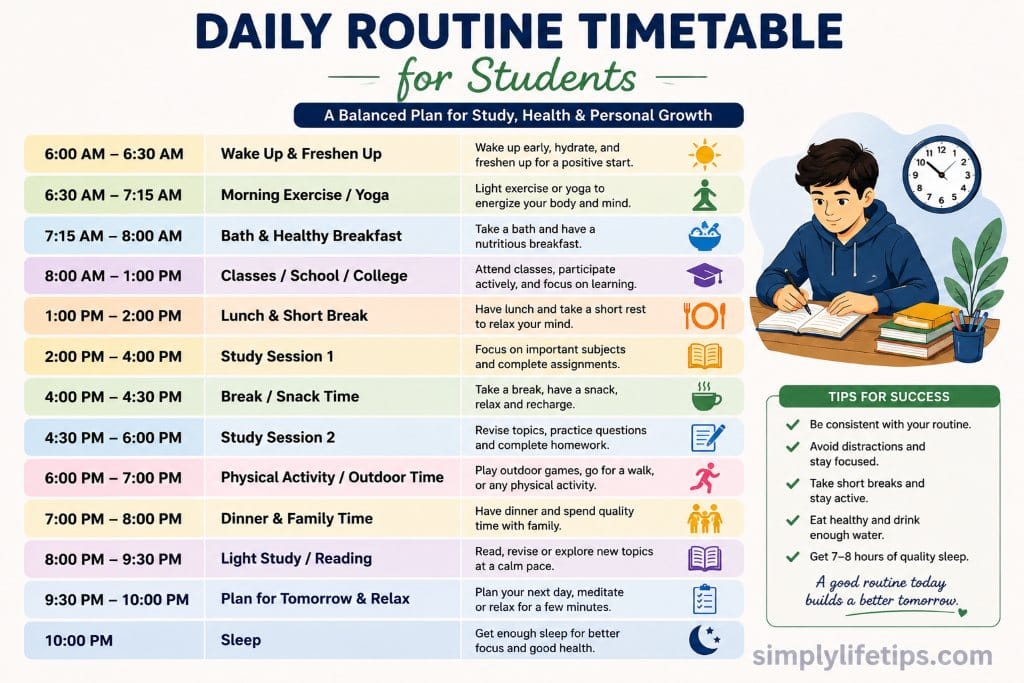
| Time | Activity |
|---|---|
| 6:00 AM | Wake up, drink water, and get ready |
| 6:15 AM | Stretching, walking, or light exercise |
| 6:30 AM | Breakfast and preparation for the day |
| 7:00 AM | Focused study or revision |
| 8:00 AM | School, college, or daily classes |
| 1:00 PM | Lunch and a short break |
| 2:00 PM | Classes, assignments, or practical study |
| 4:00 PM | Short break, snack, or outdoor walk |
| 5:00 PM | Revision, practice questions, or homework |
| 6:30 PM | Exercise, sports, or a hobby |
| 7:30 PM | Dinner and relaxation |
| 8:00 PM | Light study and review |
| 9:00 PM | Prepare for the next day |
| 9:30 PM | Reading, journaling, or quiet time |
| 10:00 PM | Sleep |
You do not need to follow these exact times every day. For example, a college student with evening classes may need a completely different schedule. What matters most is maintaining a consistent pattern that gives enough time for focused study, movement, meals, relaxation, and sleep.
If you have a particularly busy day, prioritise your most important academic tasks rather than trying to complete everything. A realistic routine that you can follow consistently is more useful than a perfect timetable that becomes difficult to maintain.
Why a Daily Routine for Students Is Important
A daily routine gives students a simple structure for managing study, classes, meals, exercise, relaxation, and sleep. Without some structure, it can be easy to postpone important tasks, spend too much time on distractions, or leave assignments and revision until the last minute.
A consistent routine can also reduce the mental effort involved in deciding what to do next. When certain activities become part of your regular schedule, you spend less time planning and more time getting started.
A good routine is not about studying all day. Students need time for movement, hobbies, friends, family, meals, and rest as well. Balancing these activities can make a routine easier to maintain and help prevent study from becoming overwhelming.
Most importantly, a routine should be realistic. A schedule that looks impressive on paper but is difficult to follow will not help much. It is better to create a manageable daily routine and follow it consistently, while allowing enough flexibility for busy school days, exams, unexpected tasks, and personal commitments.
Motivation can change from day to day, but a simple routine can provide a useful structure when motivation is low. The goal is not perfection—it is to build steady habits that support learning and everyday life.
Daily Routine for Students
Morning Routine: Wake Up, Movement, Breakfast, Study
Wake Up
Start your day at a consistent time that gives you enough sleep and fits your school or college schedule. You do not need to wake up extremely early to have a productive day.
After waking up, avoid immediately checking social media or getting caught up in notifications. Drink some water, open the curtains or window for natural light, freshen up, and take a few calm breaths. Starting the morning without unnecessary digital distractions can make it easier to focus on the tasks ahead.
Movement
A few minutes of movement can help you feel more awake and ready for the day. Try gentle stretching, yoga, walking, or simple exercises such as squats or push-ups.
You do not need a long workout in the morning. Even a short period of movement can be a practical way to get your body moving before classes or study.
Breakfast and Hydration
Give your body enough fuel for the day. A simple breakfast can include foods such as oats, eggs, whole-grain toast, fruit, or bananas. Choose foods that fit your preferences and daily needs.
Remember to drink enough water throughout the day. If you feel tired or unfocused, check whether you have had enough fluids before assuming that you simply lack motivation.
Morning Study Session
Use this time for focused study when you feel fresh and have fewer distractions. Start with a subject or task that requires more concentration, whether it involves solving math problems, learning historical facts, understanding a difficult concept, or practising coding.
Avoid distractions such as social media and unrelated videos while studying. You can use the Pomodoro technique—50 minutes of focused study followed by a 10-minute break—if this study pattern works well for you.
During breaks, give your mind a genuine rest. Stretch, walk around, drink some water, or look outside instead of immediately checking your phone. Short breaks away from digital distractions can help you return to your studies with better focus.
For more practical strategies, see How To Tune Out Distractions And Focus On Your Studies.

Afternoon Routine: Classes, Lunch, Midday Study
Classes and Active Learning
Afternoons can be a challenging time for students, especially when energy levels begin to drop. Instead of passively copying notes or losing focus, actively engage with the material. Take notes in your own words, ask questions, and summarise what you have learned. Spending a few minutes after class reviewing the main points can strengthen your understanding and make later revision easier.
Lunch and Power Break
Choose a balanced lunch that gives you steady energy without leaving you feeling too heavy. Foods such as eggs, lentils, chicken, vegetables, and fruit can be part of a nutritious meal. Drink enough water and avoid relying heavily on sugary or fried foods when you need to study afterwards.
After lunch, take a short break. A 15–20 minute nap or a brief walk can help you feel refreshed before returning to your studies.
Midday Study Session
Afternoon energy can be lower than in the morning, so use this time for practical and active study. Solve math problems, work through past papers, practise questions, or review with flashcards. These activities help reinforce what you have already learned without requiring the same level of concentration as learning a completely new and difficult topic.
The goal is to make the most of your available energy rather than forcing yourself to study in the same way throughout the day.
Evening Routine: Exercise, Creativity, Study
Movement and Physical Activity
After several hours of studying, physical activity can help you refresh both your body and mind. Aim for around 20–30 minutes of movement that you enjoy, such as playing a sport, going for a walk or run, or dancing to music. Regular physical activity can support your mood, memory, and sleep. You can also try these best ways to exercise at home when you cannot go outside.
Creative Time
Studying continuously can become tiring, so make some time for activities you enjoy. Drawing, writing, playing an instrument, cooking, or another hobby can give your mind a break from academic tasks. Creative activities can also help you relax and maintain motivation.
Evening Study Session
After exercise and some relaxation, use the evening for lighter academic work. Review your notes, practise easier questions, organise your study materials, or prepare for the next day. Avoid leaving difficult new topics for late at night if you are already tired.
A short, focused evening study session can help you stay consistent without making the night feel like another long period of intensive study.
Night Routine: Plan, Digital Sunset, Sleep
Planning for Tomorrow
Before going to bed, write down 3–5 specific tasks for the next day. Instead of writing a vague goal such as “study,” choose a clear task such as “complete Chapter 4 of physics” or “solve 20 math problems.” A specific plan makes it easier to know where to start the next day.
Digital Sunset
Try to reduce screen use before bedtime. Instead of spending the last part of the evening on your phone or laptop, choose calming activities such as reading, listening to music, or journaling.
Sleep and Its Importance
Do not sacrifice sleep for last-minute studying. Adequate sleep is an important part of a healthy study routine and gives your body and mind time to rest and recover. Set a consistent bedtime whenever possible and make sleep a regular part of your daily routine.
For more information, see Good Sleep For Good Health: Achieving Optimal Well-Being.
The Mindset Behind Routines
A routine works best when you focus on consistency rather than perfection. Avoid comparing your study hours with students who claim to study for long periods. Spending a reasonable amount of time studying consistently is often more sustainable than occasional, exhausting study sessions.
For example, studying for a few focused hours regularly can be more manageable than trying to study for 10 or 12 hours only when an exam is approaching. Give yourself realistic goals and adjust your routine when your workload changes.
You may also have days when your routine does not go as planned. That is normal. If you miss a study session or fall behind, avoid giving up on the entire routine. Identify what went wrong, make a small adjustment, and start again the next day.
The goal is not to follow your timetable perfectly every day. It is to develop habits that help you study, rest, and take care of yourself consistently.
Conclusion
A good daily routine for students should balance focused study with movement, meals, hobbies, relaxation, and enough sleep. Mornings can be used for focused learning, afternoons for classes and practical study, evenings for exercise and creative activities, and nights for planning and rest.
You do not need to follow a perfect timetable every day. Adjust your routine around your school or college schedule, responsibilities, energy levels, and personal needs. What matters most is creating a realistic routine that you can follow consistently.
When a day does not go as planned, simply make the necessary adjustment and begin again. Small, consistent habits can make studying more organised and help you maintain a healthier balance between academic work and everyday life.
FAQs About Daily Routine for Students
What is a good daily routine for students?
A good daily routine includes focused study, classes or schoolwork, regular breaks, physical activity, healthy meals, hobbies or personal time, and enough sleep. The routine should be realistic and flexible enough to fit the student’s schedule.
How long should a student study each day?
There is no single number of study hours that works for every student. Focus on the quality and consistency of study rather than simply counting hours. Use focused study sessions with short breaks and adjust the amount of study according to your classes, assignments, exams, and personal needs.
Is exercise important in a student’s daily routine?
Yes. Regular physical activity can help students stay active and support their mood, memory, and sleep. It does not have to be intense; walking, stretching, playing a sport, or another enjoyable activity can be part of a balanced routine.
How can students avoid distractions while studying?
Keep your phone on silent or away from your study area during focused study sessions. Turn off unnecessary notifications and avoid social media or unrelated videos until your planned break. Having a specific study goal can also make it easier to stay focused.
What should I do if I miss a day of my routine?
Do not give up because of one missed day. Look at what disrupted your routine, make any necessary adjustments, and start the next day again. A consistent routine does not require perfection every day.

Mathukutty P V is a Blogger, YouTuber, and Content Writer and the founder of Simply Life Tips. After taking voluntary retirement in 2017, he embraced a free lifestyle focused on learning, personal growth, and sharing practical wisdom to help others live with more purpose and positivity.



