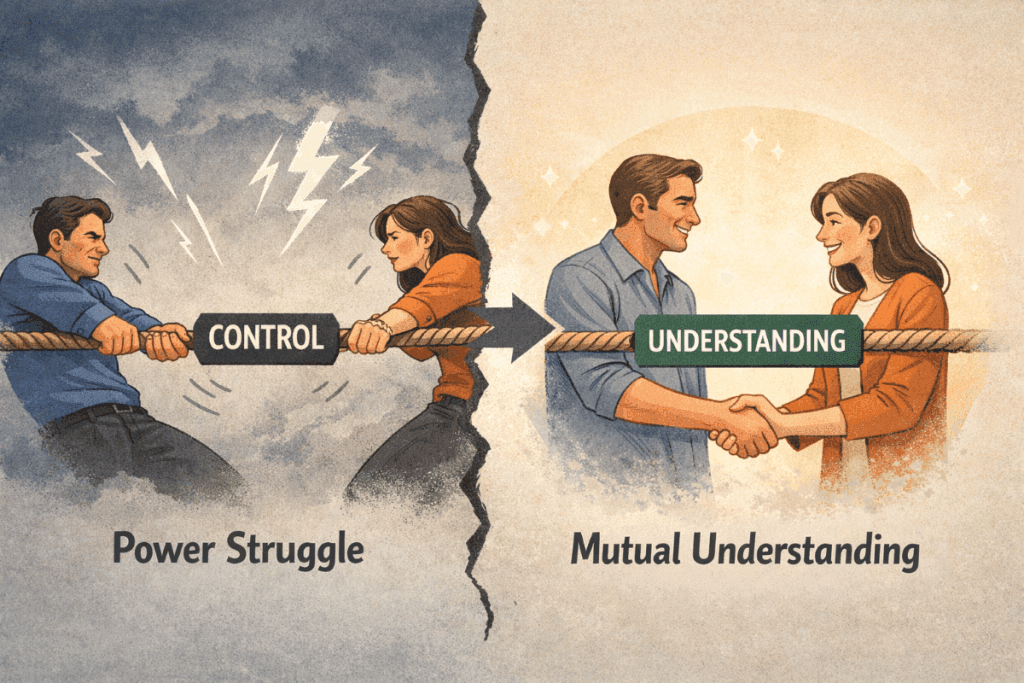
A power struggle begins when an interaction becomes a fight for control rather than a search for understanding. It can happen in relationships, parenting, workplaces, and everyday interactions when one person tries to control a situation and the other resists to protect their independence. What looks like a disagreement about money, rules, decisions, or behaviour may actually be a deeper struggle involving control, ego, fear, insecurity, or the need to feel respected. Understanding the meaning and causes of power struggles can help you recognise the pattern early and respond with cooperation instead of confrontation.
What Is a Power Struggle? Meaning Explained
Power struggle meaning describes a situation where two or more people compete for control, influence, or authority instead of working toward cooperation. It usually begins when one person feels their authority, influence, or autonomy is threatened, leading them to assert control, while the other person resists to protect their independence, creating a cycle of control and resistance.
For example, in a workplace, a supervisor may reject a useful suggestion simply to maintain authority, while an employee may resist instructions because they feel controlled. In a relationship, a simple disagreement about plans can escalate into emotional conflict when both partners try to “win” rather than understand each other. These examples show that a power struggle is often less about the issue itself and more about control. When interaction shifts from dominance to collaboration, the cycle weakens and constructive communication can begin.
Power Struggle in Relationships
A power struggle in relationships happens when partners compete for control over decisions, emotions, or outcomes instead of working together. One partner may try to dominate, while the other resists openly or silently.
For example, a couple may argue about money when one partner tries to control spending, and the other responds by hiding purchases. The real conflict is then about control, not finances. Emotional control can create a similar pattern: one partner demands understanding while the other withdraws. Over time, repeated power struggles can damage trust, communication, and emotional connection. Healthy relationships replace control with cooperation through calm communication, shared decision-making, empathy, and emotional validation. When both partners feel heard and respected, the struggle for control begins to weaken, and connection can grow.
Healthy relationships also depend on healthy communication, including listening to a partner’s perspective and handling disagreements constructively.
If you want to explore this topic specifically in romantic relationships, read our guide on power struggles in relationships and learn how to recognise and handle them more constructively.
Power Struggle With Children
A power struggle with children often appears during discipline, routines, and everyday expectations. It happens when parental authority meets a child’s growing need for independence, turning guidance into confrontation. Too much force can increase resistance and defiance. For example, when a parent repeatedly orders a child to do homework, the child may delay, argue, or refuse. Offering a limited choice, such as “Homework before or after snack?” can encourage cooperation while keeping the expectation clear.
Giving children structured choices can be useful when they resist tasks because it can encourage cooperation and reduce power struggles between parents and children.
Another example is forcing a child to apologise. A forced apology may create more resistance, while a calm conversation can help the child understand responsibility and repair the situation. Effective parenting combines calm authority with clear, consistent boundaries rather than turning disagreements into ego battles. Children also learn self-control by observing how adults manage conflict, not simply through force or commands.
For more practical guidance, read our article on power struggles with children to learn how parents can encourage cooperation while maintaining clear boundaries.
Psychological Causes Behind Power Struggles
Most power struggles are driven by underlying emotional and psychological needs rather than the visible issue itself. Common causes include fear of losing control, insecurity, the need for validation, a strong need for independence, and unresolved emotional experiences. These factors can operate beneath the surface and influence how people respond to disagreement or perceived threats to their authority.
For example, a leader who fears losing respect may reject ideas too quickly, while a partner who has previously felt ignored may try to control conversations. A child who strongly needs independence may resist parental authority. These reactions may look like stubbornness or defiance, but they can reflect deeper emotional needs. Understanding the underlying cause can reduce conflict and make it easier to respond with empathy, clear boundaries, and cooperation.
Signs You Are in a Power Struggle
Recognising the signs of a power struggle early can prevent repeated conflict and long-term damage to relationships. Common signs include arguing repeatedly over small issues, feeling a strong need to win, refusing to compromise, becoming emotionally reactive, and using silent resistance. Conversations may turn into debates where each person tries to prove they are right rather than understand the other person’s perspective.
For example, couples may repeat the same argument without resolving the underlying issue, while parents and children may argue repeatedly over homework, bedtime, or other routines. In workplaces, discussions can shift from finding solutions to defending authority or challenging control. These patterns show that interaction has moved from cooperation to competition. Recognising them early makes it easier to pause, understand the underlying issue, and break the cycle before trust and communication suffer.
How to Put an End to Power Struggles?
Ending a power struggle requires a calm strategy rather than more force. First, pause before reacting because emotional reactions can intensify the conflict. Second, identify the real need behind the disagreement, such as respect, independence, security, or clarity. Third, shift from control to collaboration by using language such as, “Let’s solve this together.” Fourth, set calm and firm boundaries without turning them into threats or arguments.
For example, a parent can calmly say, “Screen time ends at 8 PM,” rather than repeatedly arguing about it. Fifth, choose your battles wisely because not every disagreement requires a response. When people stop feeding the cycle of control and resistance, the power struggle gradually loses its intensity.
Using Curiosity as a Way to Defuse Power Struggles
Curiosity can help defuse power struggles because it focuses on understanding rather than dominance. Asking questions with genuine interest can lower emotional defensiveness and create space for cooperation.
For example, asking a partner, “What is bothering you?” can reduce resistance and open a more constructive conversation. Asking a child, “What made you upset?” encourages them to express their feelings instead of responding with defiance. In the workplace, asking, “What would improve this situation?” invites collaboration rather than confrontation. Curiosity turns a struggle for control into an opportunity for dialogue and can strengthen psychological safety. People often resist feeling controlled but respond more positively when they feel understood.
Healthy Alternatives to Power Struggle
Healthy alternatives to power struggles focus on cooperation rather than control. Use empathy, emotional intelligence, assertive communication, clear boundaries, and shared decision-making to create more respectful interactions.
For example, couples can schedule calm conversations to discuss recurring disagreements instead of reacting during an argument. Parents can use structure and consistent boundaries to guide children without relying on force. Leaders can influence through trust, listening, and collaboration rather than relying solely on authority. These approaches reduce resistance while strengthening respect and communication. Long-term respect grows from calm, consistent behaviour rather than control.
Building Stronger Relationships: The Power Of Ten Minutes
Long-Term Impact of Unresolved Power Struggles
Unresolved power struggles can lead to emotional exhaustion, resentment, and communication breakdown. In relationships, they can create emotional distance and repeated conflict. In parenting, ongoing control battles may increase resistance and defiance. In workplaces, persistent power struggles can reduce morale, cooperation, and productivity.
For example, constant attempts to control employees may cause them to disengage, while excessive force in parenting can make children resist or withdraw. Over time, repeated conflicts can weaken emotional safety and trust. When power struggles become a recurring pattern, they can pose a long-term risk to healthy relationships and effective communication.
Practical Daily Strategies to Prevent Power Struggles
Preventing power struggles is not about avoiding disagreement or giving up control. It is about creating consistent patterns of calm communication, emotional awareness, and respectful boundaries. Daily behaviour shapes long-term interactions, and small, intentional changes can prevent disagreements from turning into battles for control.
1. Set Clear Expectations Early
Clarity prevents confusion, and unclear expectations can create resistance. When people know what is expected in advance, they are more likely to feel secure and less defensive.
For example, a parent who explains, “Homework happens at 6 PM every day,” can reduce daily arguments. Similarly, a manager who clearly defines roles and responsibilities can prevent misunderstandings that develop into conflicts over authority.
2. Use a Calm and Neutral Tone
Your tone can influence how the other person responds, sometimes more than the words themselves. A calm, neutral tone reduces the sense of threat and makes cooperation easier, while a harsh or confrontational tone can increase defensiveness and resistance.
For example, saying, “Let’s talk about this,” in a calm voice invites discussion, while a sharp command may make the other person defensive and prolong the conflict. Staying calm does not mean being passive; it means communicating firmly without adding unnecessary emotional pressure.
3. Listen Fully Before Responding
Active listening can reduce power struggles because people are less likely to resist when they feel heard and understood. Give the other person time to explain their concerns without interrupting or immediately preparing a counterargument.
For example, when a partner expresses frustration, listening patiently before responding can prevent the conversation from escalating into another argument. With a child, asking questions and listening to their explanation can reveal the reason behind resistance instead of turning the situation into a confrontation. Listening does not mean agreeing with everything; it creates space for understanding while allowing you to maintain appropriate boundaries.
4. Offer Limited Choices Instead of Commands
Offering limited choices can give people a sense of autonomy while keeping expectations and boundaries clear. This can reduce resistance that often develops when someone feels controlled.
For example, instead of telling a child, “Do your homework now,” a parent could ask, “Would you like to do your homework before or after your snack?” Both choices meet the expectation, but the child has some control over how to approach the task. This approach works best when the choices are realistic, limited, and appropriate to the situation.
5. Acknowledge Feelings Without Losing Boundaries
Acknowledging someone’s feelings can reduce emotional defensiveness without requiring you to change a reasonable rule or boundary. Validation means recognising what the person is experiencing rather than automatically agreeing with their behaviour or demands.
For example, a parent might say, “I understand that you are upset, but the rule still applies.” This communicates empathy while maintaining structure. Similarly, in a relationship, saying, “I understand why that hurt you; let’s talk about what happened,” can open a conversation without turning the disagreement into a battle for control. Balancing empathy with clear boundaries helps prevent power struggles while preserving mutual respect.
6. Avoid Reacting Immediately
Pausing before responding can prevent emotions from turning a disagreement into a power struggle. Taking a moment to regulate your own emotions can make it easier to respond calmly rather than react defensively. When emotions are high, an immediate reaction can intensify tension and lead to words or actions that make the situation harder to resolve. A short pause gives you time to understand what is happening and choose a more constructive response. For example, a leader who pauses before responding to criticism is more likely to address the issue thoughtfully rather than react defensively. In a relationship, taking a few moments to calm down before continuing a heated conversation can also prevent unnecessary escalation.
For example, a leader who pauses before responding to criticism is more likely to address the issue thoughtfully rather than react defensively. In a relationship, taking a few moments to calm down before continuing a heated conversation can also prevent unnecessary escalation.
7. Focus on Solutions, Not Winning
Power struggles become stronger when the goal is to prove who is right or gain control. They begin to weaken when both people focus on resolving the underlying problem. Instead of asking, “Who is right?” try asking, “How can we solve this?”
For example, when a couple disagrees about household responsibilities, discussing how to divide the tasks fairly is more productive than arguing about who does more. In the workplace, focusing on what will improve a situation rather than who made the mistake can turn a confrontation into a problem-solving conversation. Shifting the goal from winning to finding a workable solution encourages cooperation and protects the relationship.
8. Stay Consistent With Boundaries
Consistent boundaries create clarity, predictability, and trust. When rules or expectations change frequently, people may become confused about what is acceptable and may test the limits more often.
For example, if a child’s bedtime changes every night, discussions and resistance may increase. A consistent bedtime routine makes the expectation predictable and reduces repeated negotiation. The same principle applies in relationships and workplaces: boundaries are more effective when they are communicated clearly and applied consistently. Consistency does not mean being rigid; it means following through calmly while remaining open to reasonable circumstances.
9. Model Calm Behaviour
People often learn how to handle conflict by observing how others respond to difficult situations. Staying calm during disagreement can demonstrate emotional regulation and show that problems can be addressed without aggression or intimidation.
For example, a parent who remains calm when a child becomes frustrated can model how to manage strong emotions. Similarly, a manager who responds respectfully to criticism can encourage a calmer and more constructive workplace culture. Modelling calm behaviour does not mean ignoring problems; it means addressing them firmly without allowing emotional intensity to take control.
10. Choose Battles Wisely
Not every disagreement needs to become a confrontation. Choosing your battles wisely means deciding which issues genuinely matter and which minor differences can be overlooked. Engaging in every disagreement can create unnecessary tension and increase the chance of a power struggle.
For example, if a child makes a harmless choice about clothing, correcting it may not be worth an argument. In a relationship, allowing a minor difference in preferences to pass without criticism can preserve emotional energy for more important concerns. Choosing your battles does not mean ignoring serious problems; it means responding intentionally rather than reacting to every disagreement.
Conclusion
A power struggle is not a battle to win but a pattern to understand and change. Behind the struggle for control there may be fear, insecurity, unmet emotional needs, or a desire to feel respected. When people focus on winning, communication suffers and relationships can become increasingly tense. When they shift toward curiosity, empathy, clear boundaries, and cooperation, the cycle can begin to break. The goal is not to avoid every disagreement but to handle differences without turning them into battles for control. Small changes in how we listen, respond, and communicate can create greater trust, respect, and cooperation over time.
What small shift from control to curiosity could end a hidden power struggle in your life today?
FAQs – Power Struggle
What is a power struggle in simple terms?
A power struggle is a conflict in which two or more people compete for control instead of cooperating to solve a problem. One person may try to assert authority while the other resists to protect their independence. The disagreement may appear to be about something small, but the deeper issue is often control, autonomy, respect, or emotional needs. Shifting the focus from winning to understanding can help break the cycle.
Why do power struggles happen?
Power struggles happen when people feel that their control, authority, independence, or sense of respect is being threatened. Common underlying factors include fear, insecurity, unmet emotional needs, the need for validation, and past experiences. Poor communication can make these reactions stronger, turning a disagreement into a struggle for control. Understanding what is driving the reaction can make it easier to respond with empathy, clear boundaries, and cooperation.
Are power struggles common in relationships?
Yes, power struggles are common in relationships, especially when partners have different needs, expectations, priorities, or communication styles. They can develop when one partner tries to control decisions, emotions, or outcomes while the other resists to protect their independence. Small disagreements can become recurring conflicts when the focus shifts from understanding to winning. Calm communication, empathy, shared decision-making, and respectful boundaries can help partners break the cycle and strengthen their emotional connection.
How can parents avoid power struggles with children?
Parents can reduce power struggles with children by staying calm, setting clear and consistent boundaries, and focusing on guidance rather than control. Offering limited choices, listening to a child’s feelings, and explaining expectations in advance can reduce resistance and encourage cooperation. For example, instead of demanding immediate compliance, a parent can offer two acceptable choices while keeping the expectation clear. Calm authority combined with empathy and consistent structure helps children develop cooperation, responsibility, and self-regulation.
What is the fastest way to stop a power struggle?
The fastest way to stop a power struggle is to pause and regulate your emotions before reacting. Instead of trying to regain control, shift toward curiosity by asking a calm question to understand the other person’s concern or need. Focus on finding a solution rather than proving who is right, and maintain clear, respectful boundaries without escalating the conflict. When one person stops feeding the cycle of control and resistance, the power struggle can quickly lose its intensity.
Have you experienced a power struggle in a relationship, at home, or at work? What helped you move from control and resistance toward cooperation? Share your thoughts in the comments below.

Mathukutty P V is a Blogger, YouTuber, and Content Writer and the founder of Simply Life Tips. After taking voluntary retirement in 2017, he embraced a free lifestyle focused on learning, personal growth, and sharing practical wisdom to help others live with more purpose and positivity.