

Power struggle in relationships happens when partners begin competing for control, influence, or emotional validation instead of working together. It may appear as repeated arguments, silent treatment, resistance, or disagreements over decisions, money, responsibilities, or personal space. Often, the visible disagreement is not the real issue; deeper concerns about respect, independence, security, or feeling unheard may be involved. Understanding these patterns can help couples move away from winning and losing and toward healthier communication, cooperation, and mutual respect.
Understanding power struggle in relationships can help couples recognise unhealthy patterns before they become deeply established.
Understanding Power Struggle in Relationships
A power struggle in relationships happens when partners compete for control, influence, or emotional validation instead of cooperating as a team. It is not always obvious or openly hostile; it can appear through silence, emotional withdrawal, stubbornness, resistance, or repeated disagreements. Often, the deeper issue is not the immediate topic but a feeling of being unheard, unimportant, controlled, or unable to maintain personal independence.
For example, one partner may insist on making financial or lifestyle decisions to feel secure, while the other resists because they feel controlled. When this pattern continues, frustration and resentment can replace cooperation and emotional closeness. Healthy relationships allow both partners to influence important decisions, express their needs, and maintain their individuality while working toward shared solutions.
Power struggles can also occur in other situations, including parenting and everyday family interactions. For a broader explanation of the concept, see our guide to Power Struggle Explained: Meaning, Causes, & How to Stop
Common Signs of Power Struggle in Relationships
Frequent arguments over small matters can be an early sign of a power struggle. When minor disagreements repeatedly become major conflicts, the visible issue may not be the real problem. The deeper concern may involve feeling unheard, disrespected, unappreciated, or controlled.
Another sign is a strong need to be right or to have the final word. When winning an argument becomes more important than understanding each other, conversations can turn into battles rather than opportunities to solve problems. Emotional withdrawal can also become part of the pattern. Ignoring messages, avoiding conversations, or using silence to punish a partner can create distance and make communication more difficult.
An imbalance in decision-making is another warning sign. If one partner regularly controls choices about money, social activities, family matters, or other important issues, the other may feel powerless or resentful. Keeping score—such as repeatedly comparing who sacrifices more or who does more—can also turn the relationship into a competition.
Recognising these patterns early can make it easier for both partners to pause and address the underlying issue before the disagreement becomes another battle for control. Active listening and genuine curiosity can help shift the conversation toward understanding.
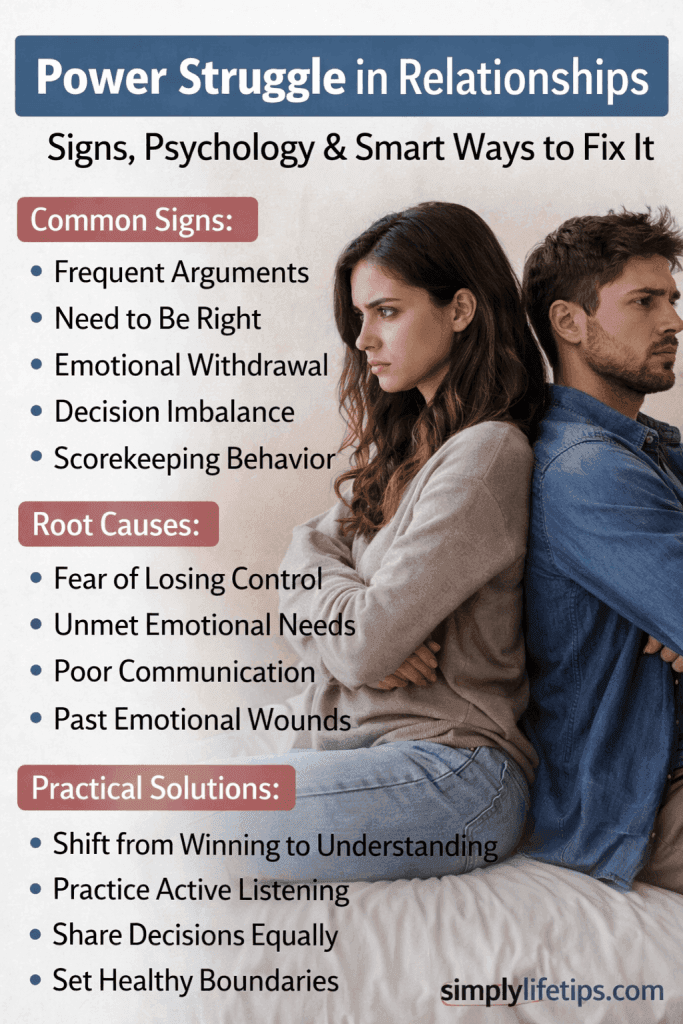
Power Struggle in Relationships in Psychology
In psychology, a power struggle in relationships describes a recurring pattern in which partners compete for control, influence, emotional validation, or decision-making authority rather than cooperating as equals. The pattern can develop when one or both partners feel that their autonomy, security, identity, or emotional needs are being threatened.
Psychological Meaning
A power struggle is not always about wanting to dominate a partner. It can also arise when someone feels unheard, insecure, or emotionally threatened. A person may try to control a conversation, decision, or outcome to regain a sense of security, while the other partner resists to protect their independence. This creates a cycle of control and resistance.
Why Do Power Struggles Occur?
Power struggles can become more noticeable as partners move beyond the early stage of a relationship and begin dealing with differences in personality, expectations, habits, and boundaries. When needs such as respect, validation, security, or independence are not communicated effectively, disagreements can become contests over control.
Core Psychological Drivers
Several underlying needs can contribute to power struggles, including autonomy, emotional security, identity, validation, and control. When these needs feel threatened, a person may respond through dominance, resistance, withdrawal, or defensiveness.
Psychological Impact on Relationships
Repeated power struggles can contribute to emotional exhaustion, communication difficulties, reduced intimacy, resentment, and loss of trust. When partners become more focused on protecting their position than understanding each other, vulnerability and emotional connection can gradually decline.
Moving From Competition to Cooperation
Understanding the psychological pattern can help partners respond differently. Emotional awareness, empathy, respectful communication, and balanced decision-making can reduce the need for control and create more space for cooperation.
Psychological Causes of Power Struggle in Relationships
Power struggles can develop when important emotional needs or personal boundaries feel threatened. A disagreement about money, responsibilities, decisions, or personal space may become more intense when one or both partners feel controlled, ignored, insecure, or unable to express their needs.
Fear of Losing Control
Some people may respond to uncertainty by trying to control decisions, conversations, or outcomes. The other partner may then resist because they feel their independence is being limited, creating a cycle of control and resistance.
Need for Autonomy
A strong need for independence can also contribute to power struggles. When one partner feels that their choices or personal space are being restricted, resistance may become a way of protecting their sense of autonomy.
Unmet Emotional Needs
Feeling unappreciated, unheard, or disrespected can turn an ordinary disagreement into a larger conflict. When these concerns are not communicated clearly, frustration may appear as criticism, withdrawal, stubbornness, or attempts to control the situation.
Insecurity and Past Experiences
Previous relationship experiences or other personal experiences may influence how someone responds to conflict, but they do not automatically determine behaviour. In some cases, insecurity or fear of rejection can make a person more sensitive to situations that feel threatening or controlling.
Communication Gaps
Poor communication can allow misunderstandings and resentment to build. When partners do not clearly express what they need or listen to each other’s perspective, small disagreements can become recurring conflicts.
Understanding these possible influences does not mean excusing controlling or disrespectful behaviour. It simply helps couples look beyond the immediate argument and identify what may be contributing to the pattern.
Stages of Power Struggle in Relationships
Power struggles can develop gradually as partners become more aware of their differences, needs, expectations, and boundaries. Not every relationship follows the same pattern or passes through every stage, but recognising how conflict can escalate may help couples address problems earlier.
1. Early Harmony
At the beginning of a relationship, partners may naturally accommodate each other’s preferences and focus strongly on shared interests. Differences may not yet be fully visible.
2. Emerging Differences
As the relationship develops, partners become more aware of differences in personality, habits, expectations, priorities, and communication styles. Disagreements may become more frequent.
3. Control and Resistance
If disagreements become focused on who should have the final say, one partner may try to assert control while the other resists. This can create a recurring cycle of control and resistance.
4. Emotional Distance
When the pattern continues without resolution, partners may become defensive, withdraw from conversations, or build resentment. Communication and emotional closeness can suffer.
5. Resolution or Continued Conflict
At this point, couples may recognise the pattern and work toward healthier communication, shared decision-making, and mutual respect. If the underlying issues remain unresolved, however, the same conflicts may continue or intensify.
Recognising these patterns early can help partners pause, understand what is happening, and address disagreements before they become deeply established.
How Power Struggles Damage Relationships
Repeated power struggles can gradually affect the quality of a relationship. When disagreements repeatedly become contests for control, partners may spend more energy defending their positions than understanding each other.
One consequence is emotional exhaustion. Frequent conflict can make everyday interactions feel stressful and leave both partners feeling frustrated or drained. Over time, repeated unresolved disagreements may also contribute to resentment.
Power struggles can also weaken trust and emotional intimacy. When a partner feels controlled, ignored, or unable to express their views safely, they may become less willing to communicate openly or show vulnerability.
Another consequence is communication breakdown. Partners may begin avoiding difficult conversations, responding defensively, or keeping score instead of addressing the underlying problem. This can create emotional distance and allow the same conflicts to return repeatedly.
The longer this pattern continues, the more important it becomes to recognise the cycle and change how disagreements are handled. Shifting from control and competition toward listening, cooperation, and respectful boundaries can help protect the relationship.
Ways to Resolve Power Struggles in Relationships
Resolving a power struggle does not mean deciding who is right or giving one partner control. The goal is to understand the underlying issue, communicate needs clearly, and find solutions that respect both people’s boundaries and perspectives.
Learning how to handle power struggle in relationships starts with recognising when disagreement has shifted into a battle for control.
Shift from Winning to Understanding
A power struggle becomes harder to resolve when both partners focus on proving who is right. Instead, try shifting the goal from winning an argument to understanding the problem.
For example, instead of arguing about who forgot a responsibility, ask what happened and how the responsibility can be handled differently next time. This changes the conversation from blame to problem-solving.
Practice Active Listening
Active listening means paying attention to what your partner is saying and trying to understand their perspective before responding. Avoid interrupting or immediately preparing a counterargument.
For example, if your partner says they feel ignored, you might respond, “I understand that you felt unheard. Tell me more about what happened.” Listening does not require agreeing with everything; it creates space for a more constructive conversation.
You can learn more about this communication skill in our guide to Benefits of Active Listening.
Share Decision-Making
An ongoing imbalance in important decisions can create resentment and feelings of being controlled. Whenever practical, discuss major decisions together and give both partners a meaningful opportunity to express their preferences.
This can include decisions about finances, family responsibilities, social activities, living arrangements, or other areas that affect both people. Shared decision-making helps reinforce the idea that partners are working as a team rather than competing for authority.
Express Needs Calmly and Clearly
Unspoken needs can turn into frustration, criticism, or withdrawal. Try to explain what you feel and need without attacking your partner.
For example, instead of saying, “You never appreciate me,” you could say, “I feel unappreciated when my efforts go unnoticed.” Clearer language can make it easier for both partners to understand the real concern.
Let Go of Ego Battles
Not every disagreement needs to produce a winner. Trying to prove that you are right can sometimes keep a conflict going long after the original issue has become unimportant.
Letting go of an ego battle does not mean ignoring serious problems or surrendering your boundaries. It means deciding whether proving a point is actually more important than finding a constructive solution.
Set Healthy Emotional Boundaries
Healthy boundaries allow partners to maintain individuality while staying connected. They can include personal time, privacy, acceptable ways of communicating, and limits around disrespectful behaviour.
For example, you might say, “I want to discuss this, but I don’t want us to continue while we are shouting. Let’s take some time and come back to it calmly.”
Boundaries work best when they are communicated clearly and followed consistently.
Address Root Emotional Causes
Sometimes the argument is only the surface issue. Underneath it may be a need for respect, reassurance, independence, security, or recognition.
Instead of repeatedly arguing about the same subject, ask what the disagreement represents for each person. Understanding the underlying concern can make it easier to find a solution that addresses more than the immediate argument.
Use Communication Techniques That Reduce Power Struggles
Small changes in communication can prevent disagreements from becoming battles for control. Use “we” language when appropriate, avoid absolute words such as “always” and “never,” and pause when emotions become overwhelming.
For example, instead of saying, “You always ignore me,” try, “I feel ignored when this happens, and I’d like us to find a better way to handle it.”
Taking a short pause can also help prevent an emotionally charged conversation from escalating. The goal is not to avoid difficult conversations but to return to them when both partners can communicate more constructively.
Healthy communication is central to breaking repeated patterns of conflict. For more ideas, read our guide to The Power of Communication in Relationships: A Lesson from Silence
Role of Emotional Intelligence in Ending Power Struggles
Emotional intelligence can help partners recognise their own emotional reactions and respond to conflict more thoughtfully. Self-awareness can help a person notice when insecurity, anger, frustration, or defensiveness is influencing their behaviour. Empathy can make it easier to understand a partner’s feelings and perspective, even when there is disagreement.
Emotional regulation is also important. Taking a pause before responding can prevent a difficult conversation from becoming another battle for control. Instead of reacting immediately, partners can acknowledge their emotions, listen to each other, and return to the issue when they are better able to communicate calmly.
For example, a partner who notices, “I am becoming defensive because I feel criticised,” may be able to pause and respond to the actual concern rather than trying to regain control of the conversation. Developing these skills can support more respectful communication and reduce the tendency to respond to disagreement through dominance, withdrawal, or resistance.
Emotional intelligence can also strengthen trust and communication within a relationship. Learn more in our guide to Building Trust With Emotional Intelligence
When to Seek Professional Help?
Some power struggles can improve when partners learn to communicate more clearly, listen to each other, and establish healthy boundaries. However, professional help may be useful when the same conflicts continue despite repeated efforts to resolve them.
Consider seeking help from a qualified mental health or relationship professional when:
- arguments are frequent and difficult to resolve
- communication repeatedly breaks down
- resentment or emotional distance continues to grow
- one or both partners feel unable to express themselves openly
- recurring conflicts are affecting trust, intimacy, parenting, or everyday life
- attempts to resolve the same problems have not produced lasting improvement
A trained professional can help couples identify recurring patterns, understand the emotions beneath their conflicts, and develop healthier ways to communicate and resolve disagreements.
However, controlling behaviour, threats, intimidation, physical violence, sexual violence, or other forms of abuse should not be treated simply as a normal power struggle. In such situations, safety and appropriate professional or specialist support should come first. Couples counselling may not be appropriate in situations involving abuse or violence.
Seeking professional help is not a sign that a relationship has failed. Sometimes outside guidance can help partners recognise patterns that are difficult to change on their own.
Healthy Relationship Mindset
A healthy relationship is built on respect, equality, emotional safety, and mutual growth, rather than control or dominance. Partners can have different opinions, needs, and preferences without turning every disagreement into a competition.
Seeing each other as teammates rather than competitors can make it easier to listen, compromise, maintain healthy boundaries, and work toward shared solutions. Both partners should be able to express their needs and maintain their individuality while also considering the needs of the relationship.
A healthy relationship does not require one person to always lead or the other to always agree. It allows both people to have a voice, handle differences respectfully, and make room for cooperation.
Conclusion
Power struggles can develop when disagreements become battles for control rather than opportunities for understanding. Recognising the pattern early can help partners step back from the need to win and focus on communication, mutual respect, healthy boundaries, and cooperation.
A strong relationship does not mean avoiding every disagreement. It means being able to handle differences without allowing them to become recurring battles over control. With greater self-awareness, active listening, and a willingness to understand each other’s needs, partners can create a relationship built on trust, respect, and emotional safety.
What small change could you make today to replace control with cooperation in your relationship?
FAQs About Power Struggle in Relationships
Is a power struggle normal in relationships?
Some disagreement and differences in preferences are normal in relationships. A power struggle becomes a concern when disagreements repeatedly turn into battles for control, dominance, or winning. Recognising the pattern early can help partners address the underlying issue more constructively.
How can I stop constant arguments with my partner?
Start by identifying what is happening beneath the repeated arguments. Practice active listening, express your needs calmly, avoid trying to win every disagreement, and take a pause when emotions become too intense. If the same conflicts continue despite your efforts, professional relationship support may be helpful.
What causes control issues in relationships?
Control issues can be associated with insecurity, fear, unmet emotional needs, a strong need for autonomy, or difficulties communicating. Personal experiences may also influence how someone responds to conflict, but the cause can vary from one person to another.
Can power struggles lead to a breakup?
Repeated unresolved power struggles can damage communication, trust, emotional closeness, and relationship satisfaction. If the pattern continues without meaningful change, it can contribute to serious relationship difficulties, including separation.
Can a relationship improve after power struggles?
Yes. Partners can work toward healthier patterns by improving communication, listening to each other, sharing decision-making, maintaining appropriate boundaries, and addressing recurring sources of conflict. Professional support may also help when couples struggle to make lasting changes on their own.
References:
- Gottman Institute – Conflict and Relationship Stability
- Daniel Goleman – Emotional Intelligence Studies
- The Power Struggle of Relationships

Mathukutty P V is a Blogger, YouTuber, and Content Writer and the founder of Simply Life Tips. After taking voluntary retirement in 2017, he embraced a free lifestyle focused on learning, personal growth, and sharing practical wisdom to help others live with more purpose and positivity.