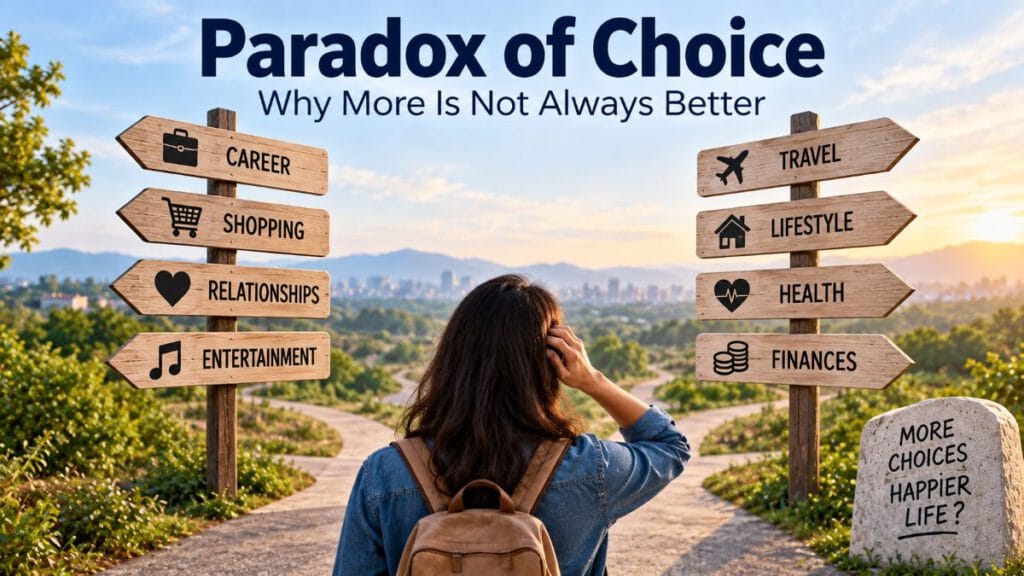
Paradox of Choice explains why having more options does not always make our decisions easier or make us happier with what we choose. Modern life gives us an extraordinary number of alternatives, from smartphones and restaurants to careers, entertainment, shopping, and even the way we spend our free time.
Having choices is valuable because it gives us freedom. But when the number of alternatives becomes difficult to compare, choice can become a burden rather than a benefit. We may spend more time deciding, worry about making the wrong choice, postpone the decision, or continue wondering whether another option would have been better.
This is the central idea behind the Paradox of Choice.
What Is the Paradox of Choice?
The Paradox of Choice is the idea that having too many options can sometimes make decision-making more difficult and reduce satisfaction with the decision we eventually make. The concept became widely known through psychologist Barry Schwartz and his book The Paradox of Choice: Why More Is Less.
The idea sounds contradictory at first. If having two options is useful, shouldn’t having twenty options be even better?
Not necessarily.
When alternatives are meaningfully different and easy to evaluate, additional choices can be helpful. But when options become numerous, complicated, or difficult to distinguish, the mental effort required to evaluate them can increase.
For example, imagine entering a shop looking for a simple black shirt. If the store has five suitable choices, you can probably compare them quickly. If the store has 500 black shirts that differ in fabric, fit, brand, price, collar, stitching, buttons, and dozens of other features, the decision can become surprisingly difficult.
The problem is not simply the number 500. It is the amount of comparison that those 500 alternatives create.
Why More Choices Can Become Difficult
More choices can create several psychological challenges. The experience varies from person to person and from one decision to another, but certain patterns can make excessive choice particularly difficult.
Comparing Too Many Options
The first problem is comparison. Once you know that several alternatives are available, you may feel that you should examine them before making a decision.
Suppose you want to purchase a new smartphone. You begin by comparing three models. Then you discover several other models that appear to offer better cameras, faster processors, larger batteries, or lower prices.
Soon, the original question—“Which phone meets my needs?”—becomes “Which phone is the absolute best?”
That is a much harder question to answer.
Every additional option creates another possibility to investigate. Reviews lead to comparisons, comparisons lead to specifications, and specifications lead to more research. A decision that should have taken a few minutes can consume hours.
Fear of Making the Wrong Choice
More alternatives can also increase uncertainty.
If you choose between two options, there is only one obvious alternative you did not select. If you choose between twenty options, there are nineteen alternatives you could potentially think about afterward.
That can create a nagging question: “Did I choose the right one?”
This is especially likely when the alternatives are similar in quality. When one option is obviously superior for your needs, the decision is relatively easy. When several options appear equally attractive, the decision becomes more complicated.
Regret and Missed Alternatives
The possibility of regret can make a decision harder.
Imagine buying a laptop after spending several hours comparing different models. A week later, you discover another laptop that has a slightly better display.
Even if your laptop performs perfectly well, you may begin wondering whether you made a mistake.
The alternative may not actually be better for you. Nevertheless, knowing that it existed can create dissatisfaction with the choice you already made.
This is one reason a decision can continue occupying your mind long after the purchasing process has ended.
Unrealistic Expectations
Having a large number of alternatives can also create the impression that the perfect choice must be available somewhere.
If a small shop offers four jackets, you may accept that none will be perfect. If an online marketplace offers thousands of jackets, you may believe that the ideal jacket must be somewhere among them.
You then continue searching.
The goal quietly changes from finding a suitable option to finding the perfect option.
That shift can make ordinary decisions unnecessarily exhausting.
What Research Says About Choice Overload
The scientific evidence surrounding choice overload is more nuanced than the popular statement that “more choices are always bad.”
A 2010 meta-analysis by Benjamin Scheibehenne, Rainer Greifeneder, and Peter M. Todd examined 63 conditions from 50 experiments involving 5,036 participants. The researchers found an average effect close to zero, although there was considerable variation between studies. This means that simply increasing the number of options does not automatically produce choice overload.
A later meta-analysis by Alexander Chernev, Ulf Böckenholt, and Joseph Goodman provided additional nuance. Their analysis identified factors including the complexity of the choice set, difficulty of the decision, uncertainty about personal preferences, and the person’s decision goal as important moderators of choice overload.
This distinction is important.
The Paradox of Choice should not be interpreted as “fewer choices are always better.” A more accurate conclusion is that more choices can become problematic when the decision itself is complex, preferences are uncertain, or the alternatives require substantial effort to evaluate.
The Evidence Is More Nuanced Than “Less Is Always Better”
Imagine two different situations.
You are choosing an ice-cream flavor and already know that you enjoy chocolate. Having ten chocolate-based options may give you useful variety.
Now imagine choosing a health insurance plan with dozens of differences in premiums, coverage, exclusions, deductibles, and conditions. The additional complexity can make the decision much harder.
The number of alternatives matters, but so do the differences between them and the difficulty of determining which alternative best serves your needs.
This is why research on choice overload should be understood in context rather than reduced to a simple rule.
The Jam Study
One of the most famous examples associated with choice overload is the jam study conducted by Sheena Iyengar and Mark Lepper. Shoppers encountered either a larger assortment or a smaller assortment of jams.
The study became widely discussed because the larger selection attracted more interest, while the smaller selection produced a higher proportion of purchases among those who stopped at the display.
The experiment became an influential illustration of how an attractive range of options can sometimes make action more difficult.
However, it should not be treated as proof that large selections always reduce purchases. Subsequent research has shown that the relationship between assortment size and choice overload is more complicated. The broader research literature indicates that the circumstances surrounding a decision matter considerably.
Paradox of Choice in Everyday Life
The Paradox of Choice is not limited to shopping experiments. We encounter situations involving large numbers of alternatives throughout everyday life.
Choosing What to Watch
You sit down intending to watch one program.
You open a streaming service and see hundreds or thousands of possibilities. You read descriptions, check ratings, watch trailers, scroll through categories, and look at recommendations.
Twenty minutes later, you are still searching.
The problem is not a lack of entertainment. It is the difficulty of deciding which entertainment deserves your limited time.
Buying a Smartphone
Buying a smartphone can become an excellent example of modern choice overload.
You may initially care about only three things: price, camera quality, and battery life. But online shopping exposes you to dozens of additional specifications.
You begin comparing processors, display refresh rates, storage, charging speeds, operating systems, camera sensors, warranties, reviews, and accessories.
Some of that information is useful. Beyond a certain point, however, additional information can make the decision harder rather than easier.
Choosing a Restaurant
Restaurant apps make it possible to compare hundreds of places before dinner.
You might start with a simple question: “What would I like to eat?”
Soon you are comparing ratings, prices, menus, distance, ambience, reviews, delivery times, offers, and photographs.
The abundance of information can turn a simple decision into an extended search.
Career Decisions
Career decisions can involve an even greater number of possibilities.
A student may consider medicine, engineering, teaching, business, design, technology, research, writing, entrepreneurship, government service, freelancing, and many specialized professions.
Having these possibilities is valuable.
But if every alternative is treated as something that must be investigated before choosing a direction, the person may become stuck in endless exploration.
A career decision rarely requires proving that every other career would have been worse.
Online Shopping
Online shopping has dramatically expanded the number of alternatives available to consumers.
You can compare brands, sellers, prices, specifications, reviews, ratings, delivery options, colors, sizes, and countless similar products.
This information can help you make better decisions.
But there is a point at which additional comparison stops being useful. If five products meet your requirements, examining another hundred may add very little value while consuming considerable time.
Maximizers and Satisficers
Barry Schwartz also popularized the distinction between maximizers and satisficers.
A maximizer tends to seek the best possible option. A satisficer looks for an option that meets the important requirements and is good enough to choose.
Consider someone buying a pair of walking shoes.
A maximizer might compare dozens of models, read extensive reviews, watch comparison videos, monitor prices, and continue searching in case a better model exists.
A satisficer might establish a few requirements—comfortable, durable, suitable for walking, and within budget—and choose the first product that satisfies them.
Neither approach is automatically right or wrong.
For a major decision, careful comparison can be valuable. For a minor and easily reversible decision, spending hours searching for perfection may not be worthwhile.
The important skill is knowing when additional comparison is producing useful information and when it is simply delaying the decision.
Paradox of Choice and Decision Fatigue
The Paradox of Choice is closely related to decision fatigue, although the two concepts are not identical.
Choice overload concerns difficulties that can arise from having numerous alternatives. Decision fatigue refers more broadly to the effects of repeated decision-making demands.
The two can overlap.
Think about a typical day. You may decide what to wear, what to eat, which messages to answer, which work task to complete first, what to buy, what to watch, when to exercise, and how to spend your evening.
Most individual decisions are small.
But when many decisions accumulate, the day can feel mentally crowded.
This is one reason routines can be useful. A routine removes certain decisions from your daily mental workload.
How to Overcome the Paradox of Choice
The solution is not to eliminate all choices from your life. Instead, the goal is to make important choices manageable and avoid wasting attention on alternatives that do not matter.
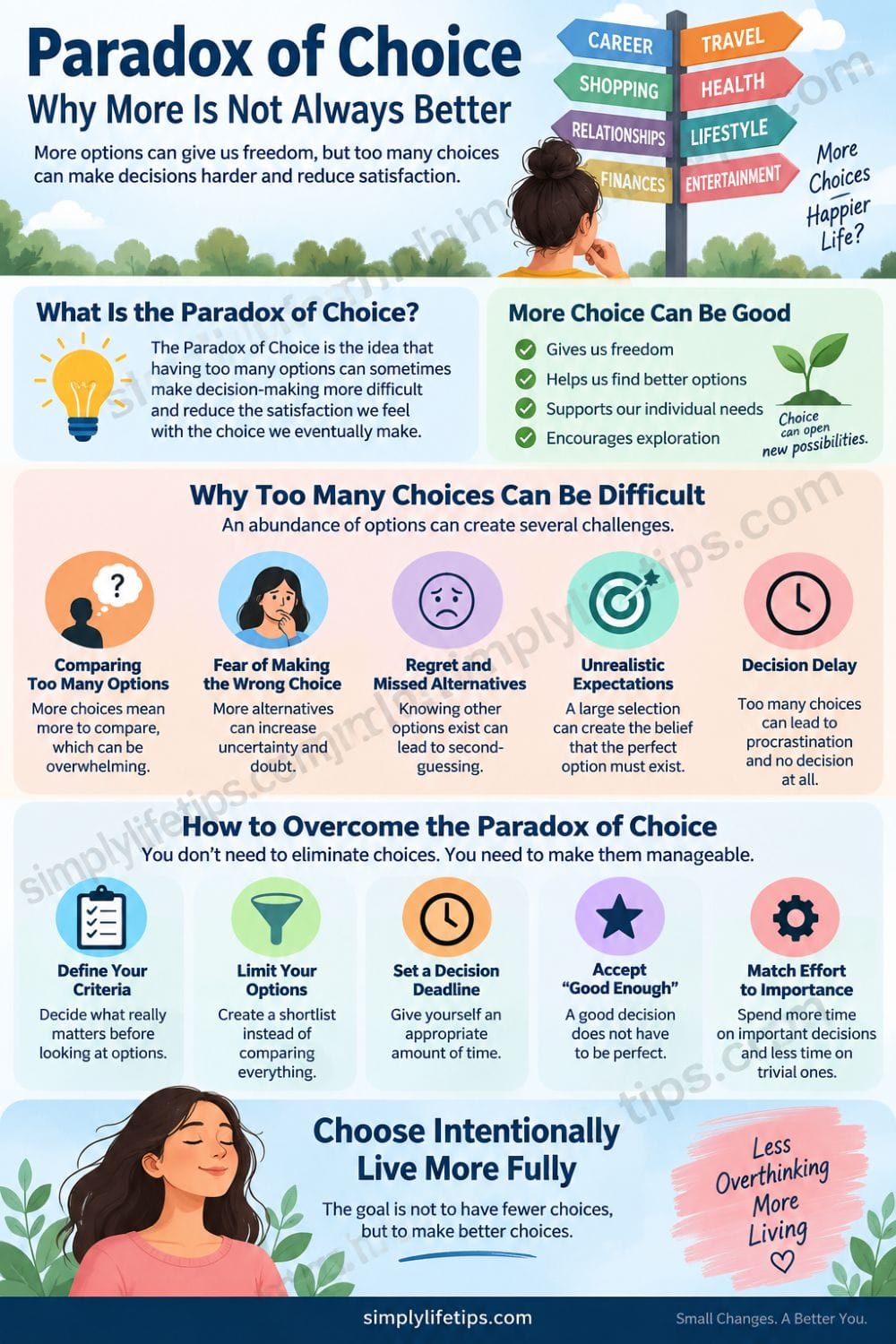
Define Your Criteria
Before looking at alternatives, decide what matters.
Suppose you are buying a laptop. Your essential requirements might be reliable performance, sufficient storage, a comfortable keyboard, and a specific budget.
Once you establish those criteria, many products can immediately be removed from consideration.
Without clear criteria, every new product can appear worth investigating.
Limit Your Options
Create a shortlist instead of comparing everything available.
If 30 products meet your requirements, choose five or six that appear particularly suitable and compare those.
You do not need to prove that you examined every possible alternative.
You need to identify an option that satisfies your important needs.
Separate Must-Haves From Nice-to-Haves
Not every feature deserves equal weight.
For a smartphone, a reliable battery may be a must-have. A particular shade of the phone may simply be a nice-to-have.
For a car, safety and reliability may be essential, while a particular interior feature may be optional.
Separating these categories prevents minor preferences from making every decision unnecessarily complicated.
Set a Decision Deadline
Give yourself an appropriate amount of time.
A simple purchase might deserve 15 or 30 minutes of research. A major financial, educational, or career decision may require considerably more time.
The point is not to rush.
The point is to prevent research from continuing indefinitely after you already have enough information to make a reasonable decision.
Accept “Good Enough”
A good decision does not have to be perfect.
If an option meets your important requirements and fits your circumstances, it may already be sufficient.
You do not need the world’s best notebook to take notes.
You do not need the perfect restaurant for an ordinary dinner.
You do not need the absolute best phone on the market if another phone already meets your needs.
“Good enough” is not necessarily careless. Sometimes it is an efficient way to protect your time and attention.
Match Effort to Importance
Not every decision deserves the same amount of analysis.
A decision that could affect your finances for years deserves more attention than a decision about what snack to buy.
A career choice deserves more thought than choosing a shirt.
A house purchase deserves more research than choosing a restaurant.
Matching the amount of effort to the importance of the decision helps prevent trivial choices from consuming disproportionate amounts of mental energy.
Stop Comparing After You Decide
One of the most useful habits is learning when to stop.
If you have made a reasonable decision based on your criteria, continuing to compare alternatives may simply reopen uncertainty.
For example, after buying a phone, you do not necessarily need to watch another 20 comparison videos.
After choosing a restaurant, you do not need to spend the evening checking whether another restaurant might have been slightly better.
Once a decision is good enough, allow yourself to use the result.
When More Choice Is Actually Better
The Paradox of Choice should not become an argument against variety.
More choice can be extremely useful when people have different needs and preferences.
Imagine a person with a specific dietary requirement. A larger selection of suitable foods can provide greater freedom and convenience.
Consider someone buying specialized professional equipment. Having more alternatives may make it possible to find a tool that fits their exact requirements.
Think about choosing a career. Exposure to different fields can help someone discover interests they did not previously know existed.
Choice is valuable when alternatives provide meaningful differences.
The problem is not simply having many options.
The problem occurs when the alternatives are difficult to evaluate, the decision is complicated, preferences are unclear, or additional choices create more comparison than useful information.
Paradox of Choice in the Digital Age
The digital age has dramatically increased the number of alternatives visible to us.
Entertainment is a clear example. In the past, people might have had only a handful of television channels or a limited collection of films and books. Today, enormous libraries of content are available almost instantly.
Shopping has undergone a similar transformation.
Instead of choosing from the products available in a nearby store, you can compare products from sellers across the country or around the world.
This expansion creates enormous benefits.
But it also changes the question we ask.
Instead of asking, “What is available?” we may begin asking, “What is the best option available anywhere?”
That second question is much harder to answer.
Social Media and Endless Alternatives
Social media can intensify the feeling of choice because it constantly exposes us to other people’s decisions.
Someone else’s career can become an alternative career.
Someone else’s holiday can become an alternative holiday.
Someone else’s home can become an alternative lifestyle.
Someone else’s purchase can become an alternative purchase.
The result is that we may compare our lives with an enormous number of alternatives that we would never have encountered otherwise.
Not every visible alternative deserves our attention.
How to Make Better Decisions With Fewer Choices
A simple decision-making framework can reduce unnecessary choice overload.
First, define the decision. Be clear about what you are actually trying to choose.
Second, identify your essential criteria. Determine what the chosen option must accomplish.
Third, filter the alternatives. Remove options that clearly fail to meet your requirements.
Fourth, create a shortlist. Compare a manageable number of strong candidates instead of every available possibility.
Fifth, make the decision. Once an option satisfies your important criteria, ask whether further research is genuinely likely to change the outcome.
Finally, move forward.
That last step matters.
A decision is useful when it allows you to act. Endless comparison can become another form of procrastination.
Paradox of Choice vs. Freedom of Choice
It may seem strange that more freedom can sometimes make decisions harder.
But freedom and unlimited choice are not the same thing.
Freedom means having meaningful control over your life. Unlimited choice means having an enormous number of alternatives.
The two can exist together, but they do not have to.
Useful constraints can actually make decision-making easier.
For example, if you decide that you will only consider homes within a certain budget and within a reasonable distance from work, you have eliminated thousands of possibilities.
You have not necessarily reduced your freedom in a harmful way.
You have created boundaries that make your freedom easier to use.
The same principle can apply to shopping, careers, entertainment, and everyday routines.
The Real Lesson of the Paradox of Choice
The most useful lesson is not that we should always choose less.
It is that we should choose intentionally.
More alternatives can be valuable when they provide meaningful differences and help us satisfy genuine needs. More alternatives can become burdensome when they produce endless comparison without adding meaningful value.
A practical approach is to identify what matters, eliminate irrelevant alternatives, compare a manageable shortlist, and recognize when you have enough information to decide.
You do not need to find the perfect option in every situation.
Sometimes the better decision is simply the one that meets your needs and allows you to move forward.
For a broader approach to making thoughtful decisions, see our guide on effective decision making. You can also explore different styles of thinking to understand how thinking patterns can influence the way people approach decisions.
If you are interested in how automatic mental patterns can influence everyday behavior, our article on The Power of Your Subconscious Mind provides another useful perspective.
Conclusion
The Paradox of Choice challenges the simple assumption that more options always produce better decisions. Choice gives us freedom and allows us to find alternatives that suit our individual needs, but excessive or complicated choice can sometimes make decision-making more difficult.
Research provides an important qualification. Choice overload does not occur simply because the number of alternatives increases. Studies have found mixed results, while later research has identified factors such as decision difficulty, choice complexity, uncertainty about preferences, and decision goals that can influence whether a large assortment becomes problematic.
The practical lesson is therefore not to fear choices.
Instead, learn to manage them.
Define what matters. Set useful criteria. Limit unnecessary alternatives. Create a shortlist. Give yourself an appropriate amount of time. Accept a good option when it meets your important requirements. And once you have made a sound decision, permit yourself to move forward.
In a world where almost everything can be compared with almost everything else, knowing when to stop comparing may be one of the most valuable decision-making skills you can develop.
Frequently Asked Questions
What is the Paradox of Choice?
The Paradox of Choice is the idea that having too many options can sometimes make decision-making more difficult and reduce satisfaction with the choice eventually made. The concept is strongly associated with psychologist Barry Schwartz and his book The Paradox of Choice: Why More Is Less.
Who developed the idea of the Paradox of Choice?
Psychologist Barry Schwartz popularized the concept through his 2004 book The Paradox of Choice: Why More Is Less. The broader scientific literature on choice overload includes research from many psychologists, economists, and consumer-behavior researchers.
Is the Paradox of Choice scientifically proven?
The evidence is more nuanced than saying that too many choices always cause problems. A 2010 meta-analysis found an average effect close to zero across the studies it examined, while later research identified several factors that can influence when choice overload occurs.
How does choice overload affect decision-making?
Choice overload can sometimes lead to greater difficulty comparing alternatives, postponing a decision, lower confidence, regret, or dissatisfaction. These effects are more likely in certain situations, particularly when the decision is complex or people are uncertain about their preferences.
How can I overcome the Paradox of Choice?
You can reduce choice overload by defining your priorities, limiting the number of alternatives, separating essential requirements from optional features, setting a decision deadline, accepting a good-enough option, and stopping further comparison once you have enough information to make a reasonable decision.
References
- Scheibehenne, B., Greifeneder, R., & Todd, P. M. (2010). Can There Ever Be Too Many Options? A Meta-Analytic Review of Choice Overload. Journal of Consumer Research, 37(3), 409–425. Oxford Academic – Journal of Consumer Research
- Chernev, A., Böckenholt, U., & Goodman, J. (2015). Choice Overload: A Conceptual Review and Meta-Analysis. Journal of Consumer Psychology, 25(2), 333–358. Wiley – Journal of Consumer Psychology
- Iyengar, S. S., & Lepper, M. R. (2000). When Choice Is Demotivating: Can One Desire Too Much of a Good Thing? Journal of Personality and Social Psychology, 79(6), 995–1006. APA PsycNet – Research Record

Mathukutty P V is a Blogger, YouTuber, and Content Writer and the founder of Simply Life Tips. After taking voluntary retirement in 2017, he embraced a free lifestyle focused on learning, personal growth, and sharing practical wisdom to help others live with more purpose and positivity.