How to Learn Anything becomes much easier when you stop thinking of learning as a talent and start treating it as a process. You do not need an exceptional memory or natural ability to learn a new subject or skill. Whether you want to learn a language, prepare for an exam, develop a professional skill, play an instrument, improve your writing, or start a new hobby, the way you approach learning can make a significant difference.
Think about something you have already learned. Perhaps you learned to ride a bicycle, cook a dish, drive a car, use a computer, or operate a smartphone. You probably did not master it simply by reading instructions. You learned the basics, tried it yourself, made mistakes, corrected them, and tried again.
That is the heart of effective learning.
The problem is that we often approach new subjects differently. We collect books, save videos, read articles, highlight pages, and take notes for hours. We feel productive, but when someone asks us to explain what we learned without looking at our notes, we may discover that surprisingly little has stayed with us.
Learning is not simply putting information into your head. It is developing the ability to understand, remember, retrieve, connect, and use information.
The good news is that learning itself is a skill. Once you understand how to learn effectively, you can apply the same principles to almost anything.
What Does It Really Mean to Learn Anything?
Knowing something and being able to use it are not always the same thing.
You may know grammar rules but struggle to hold a conversation in another language. You may watch dozens of cooking videos but still feel uncomfortable preparing a meal without a recipe. You may understand photography theory but struggle to take a well-composed photograph.
This happens because learning develops in stages.
At first, you become familiar with new information. Then you begin to understand it. With practice, you become able to recall it without assistance. Eventually, you can apply the knowledge in real situations.
That leads to a simple question:
Can I do something with what I have learned?
If the answer is yes, you are moving beyond passive exposure toward meaningful learning.
How Does the Brain Learn?
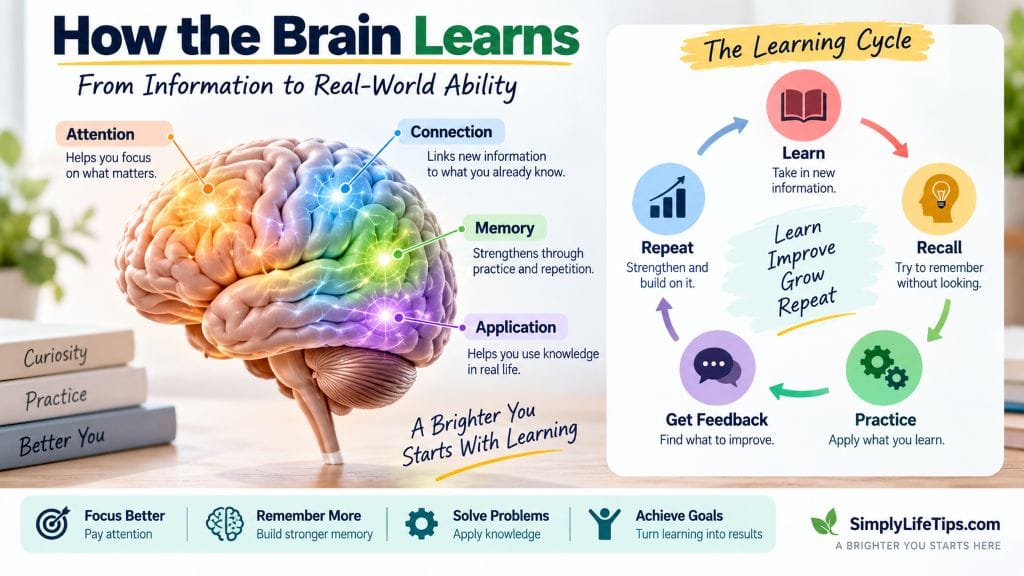
Understanding how to learn anything starts with understanding how attention, memory, and practice work together.
Attention is an important starting point. If you are distracted while learning, much of the information may never receive enough attention to be processed effectively.
New information also becomes easier to understand when you can connect it with something you already know. Existing knowledge provides a framework into which new ideas can fit.
Retrieval and practice matter as well. Reading the same page several times can make the material feel familiar, but familiarity can be misleading.
Close the book and try to explain the main idea from memory.
If you struggle, you have discovered the difference between recognizing information and actually retrieving it.
Effective learning therefore creates opportunities to recall, explain, solve, practice, and apply what you are learning.
How to Learn Anything: 15 Proven Ways
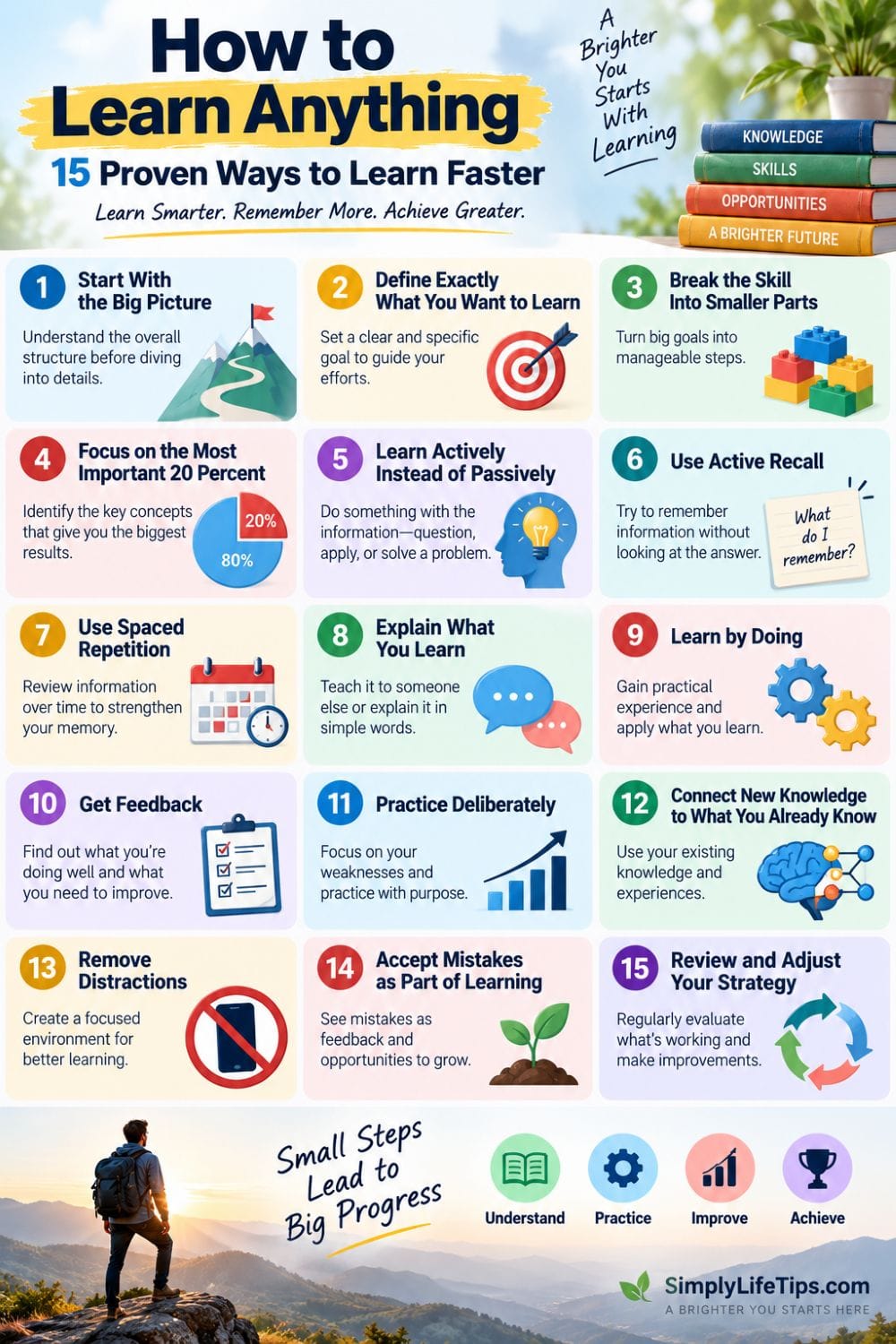
There is no magic technique that allows everyone to master a complex subject overnight. However, several reliable principles can make learning more efficient, improve retention, and help you make meaningful progress. The following strategies show you how to learn anything more efficiently.
1. Start With the Big Picture
One of the easiest mistakes when learning something new is jumping straight into the details.
Imagine opening an economics book and immediately trying to memorize dozens of definitions. Without understanding what economics is trying to explain, those definitions may feel disconnected.
Instead, begin by asking:
What is this subject really about?
If you are learning photography, first understand the major ideas: exposure, light, composition, focus, lenses, and camera controls. You do not need to master every detail immediately. You simply need to understand how the main pieces fit together.
Once you have a mental map, individual concepts have somewhere to go.
The same approach works for almost anything. Before worrying about every detail, understand the structure of the subject, identify its major concepts, and consider how they relate to one another.
Starting with the big picture gives your learning direction.
2. Define Exactly What You Want to Learn
“Learn Spanish” sounds like a goal, but it is too broad to guide your daily actions.
What does learning Spanish actually mean for you?
Perhaps you want to introduce yourself, order food, ask for directions, understand simple conversations, and communicate comfortably while travelling. That is a much clearer objective.
The same applies to other skills.
“Learn photography” is vague. “Learn to take properly exposed photographs using manual camera settings” gives you something concrete to practice.
“Learn writing” is broad. “Learn to write engaging 1,000-word blog posts” gives you a practical target.
A clear goal changes what you study and what you ignore.
Before beginning, ask:
What do I want to be able to do after learning this?
That question can prevent you from wasting time on information that does not contribute directly to your goal.
3. Break the Skill Into Smaller Parts
A difficult skill can look overwhelming when you view it as one giant task.
Suppose you want to learn public speaking. You are actually developing several abilities: organizing ideas, structuring a presentation, speaking clearly, controlling your voice, using body language, maintaining eye contact, managing nervousness, and responding to an audience.
Trying to improve everything simultaneously can be frustrating.
Instead, work on one component at a time.
You might begin with presentation structure. Then work on speaking clearly. Later, focus on delivery, body language, and audience engagement.
This also gives you a better sense of progress. Rather than thinking, “I am terrible at public speaking,” you can recognize that your presentation structure is improving while your delivery still needs work.
A difficult skill becomes more manageable when you turn one large challenge into several smaller learning problems.
4. Focus on the Most Important 20 Percent
You do not need to know everything about a subject before you can begin using it.
Trying to absorb every available piece of information can make learning slower because you may spend so much time exploring the subject that you lose sight of your original goal.
Some concepts are more important than others, especially at the beginning.
Think about learning a language. Instead of spending months studying obscure vocabulary, you could first learn common words, everyday expressions, basic sentence structures, and phrases you are likely to use.
This is where the idea behind the Pareto principle, or 80/20 rule, can be useful. It does not mean exactly 20 percent of your learning will always produce exactly 80 percent of your results. Rather, it encourages you to identify the relatively small number of concepts or actions that can make a disproportionately large difference.
Ask yourself:
Which concepts will help me make the biggest progress right now?
Focus on those first. Once you have a useful foundation, explore more advanced material.
5. Learn Actively Instead of Passively
Passive learning is comfortable.
You read an article, watch a video, listen to a lecture, or highlight sentences. You may feel productive because you are spending time with the subject, but simply receiving information does not guarantee that you can remember or use it later.
Active learning requires you to do something with the information.
You recall it, explain it, question it, apply it, or use it to solve a problem.
Suppose you have just learned about a scientific concept. Instead of immediately moving to another article, close the page and explain the concept in your own words.
You may discover that you understood less than you thought.
That realization is useful because it shows you exactly where you need to improve.
The same principle works with mathematics. Do not simply read through a worked example. Cover the solution and attempt a similar problem yourself.
If you are learning a language, form your own sentences instead of simply reading vocabulary lists.
If you are learning a practical skill, move from information to action as soon as you reasonably can.
Learning should not always feel easy. Sometimes the mental effort involved in recalling and applying information is exactly what makes the session valuable.
6. Use Active Recall
Active recall is the practice of trying to remember information without looking at the answer.
Imagine that you have just studied the human heart. Instead of rereading the section immediately, close the book and ask yourself:
What are the four chambers?
What does each chamber do?
How does blood move through the heart?
If you can answer, you have successfully retrieved the information.
If you cannot answer some questions, that is useful too. You now know what requires more attention.
You can use active recall almost anywhere. After reading an article, summarize it from memory. After watching a lesson, write down the main ideas without replaying the video. After studying a formula, reconstruct it and explain what each part means.
The important principle is:
Retrieve before reviewing.
Give your memory an opportunity to produce the answer before looking back at the material.
Research published in Science found that repeated testing produced a substantial benefit for delayed recall, supporting the value of retrieval practice.
7. Use Spaced Repetition
Have you ever studied something intensely for an exam, remembered it for a few days, and then forgotten much of it?
Instead of putting all your effort into one long session, spread your reviews over time.
This approach is known as spaced repetition or distributed practice.
For example, if you learn ten new vocabulary words today, review them tomorrow, again several days later, and then once more the following week.
The exact schedule does not have to be perfect. The important idea is to return to information periodically rather than relying on one massive study session.
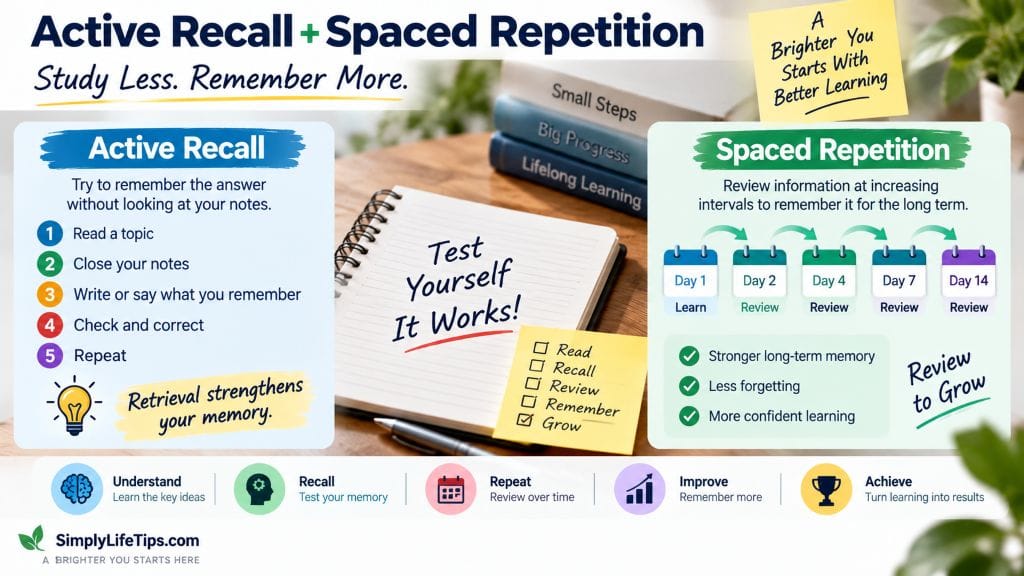
A large quantitative review of distributed practice found that spacing learning episodes over time can influence later retention, providing strong support for spreading learning and review across multiple sessions.
Spaced repetition is especially useful for vocabulary, terminology, formulas, definitions, facts, and other information that you need to remember over a long period.
It works particularly well when combined with active recall.
Instead of rereading your notes every few days, test yourself.
Try to remember the word, explain the concept, reconstruct the formula, or answer a question before checking the answer.
8. Explain What You Learn
Want to find out whether you really understand something?
Try explaining it to someone who knows nothing about the subject.
Suppose you have learned how compound interest works. You might understand the formula when you see it on a page, but can you explain the idea using simple language and a practical example?
If you can, you probably understand it reasonably well.
If your explanation becomes complicated or depends heavily on technical terminology, you may need to revisit the concept.
You do not even need another person. Explain the idea aloud to yourself as though you were teaching a curious beginner.
Ask:
If I had to explain this without technical language, what would I say?
Teaching forces you to organize your knowledge, identify important ideas, connect concepts, and recognize gaps in your understanding.
If you cannot explain an idea simply, it may be worth asking whether you understand it as well as you think you do.
9. Learn by Doing
If the thing you want to learn involves a practical skill, you need practical experience.
You cannot become a better photographer by only reading about cameras. You cannot become a better writer by only reading writing advice. You cannot learn to cook by watching cooking videos forever.
At some point, you have to do the thing.
This does not mean abandoning theory. Theory provides direction and can help you avoid unnecessary mistakes. But theory becomes much more meaningful when you connect it with practice.
Suppose you are learning photography. You may understand aperture, shutter speed, and ISO from reading. But once you start taking photographs, you discover how those settings affect real images.
A photograph may be too dark. Movement may cause blur. Changing the aperture may affect depth of field.
Suddenly, the theory has a practical context.
The same thing happens with writing. You can study headlines, introductions, storytelling, and editing, but your understanding changes when you actually write.
Some of the most valuable lessons also come from experiences rather than formal study. Every attempt, mistake, success, and unexpected result can teach you something when you take time to reflect on it. Learning From Life Experiences is another reminder that learning does not stop when a lesson, book, or course ends.
Practice reveals what you really need to learn.
You learn something, try it, observe the result, identify what went wrong, learn what you need, and try again.
That cycle can be much more productive than endlessly consuming information.
10. Get Feedback
Practice is important, but practice alone does not guarantee improvement.
If you repeatedly make the same mistake without realizing it, you may simply become better at making that mistake.
Feedback helps identify the gap between what you are doing and what you should be doing.
A teacher can correct pronunciation. A coach can correct technique. An editor can identify weaknesses in your writing. A practice test can reveal subjects you have not understood well enough.
You can also create your own feedback mechanisms.
Record yourself speaking and listen to the recording. Compare your photographs with strong examples. Test your knowledge with questions. Review your writing after leaving it for a day.
The key is to make mistakes visible.
A mistake you can identify becomes an opportunity to improve. A mistake you never notice is more likely to become a habit.
Once you know what needs improvement, your practice becomes more focused.
11. Practice Deliberately
There is a difference between practicing and deliberate practice.
Suppose you play the same guitar songs every evening. You may become more comfortable with those songs, but that does not necessarily mean your overall guitar ability is improving quickly.
Now imagine identifying the chord transitions that cause problems and spending fifteen minutes practicing only those transitions.
You slow down, concentrate on the difficult changes, notice where your fingers hesitate, and repeat the movement carefully.
That is more targeted practice.
Deliberate practice focuses on areas where your current ability falls short. You choose something difficult but achievable, practice with concentration, examine the result, and adjust based on what you discover.
This principle applies to almost any skill.
A student struggling with fractions can practice specific types of problems. A writer struggling with introductions can write several different openings. A language learner can isolate difficult pronunciation sounds instead of simply studying more vocabulary.
The goal is not simply to practice for more hours.
The goal is to make your practice purposeful.
The influential framework developed by K. Anders Ericsson and colleagues describes deliberate practice as effortful practice designed to improve performance. The idea is not simply to practice for more hours, but to practice with a clear purpose and continually work toward better performance.
12. Connect New Knowledge to What You Already Know
New information rarely exists in isolation.
You already have knowledge, experiences, memories, and mental models. Connecting new information to those existing structures can make learning more meaningful.
Suppose you understand one programming language and begin learning another. Your previous experience gives you concepts and patterns that can help you understand the new language.
Similarly, when studying history, connecting events through causes and consequences can be more meaningful than memorizing isolated dates.
When learning science, think about where you have encountered something similar in everyday life.
Ask yourself:
What does this remind me of?
How is this connected to something I already know?
How is it different?
These questions help turn isolated facts into connected knowledge.
13. Remove Distractions
Sometimes the reason you cannot learn efficiently has less to do with the subject and more to do with your environment.
Imagine trying to study while your phone is constantly buzzing, browser tabs are open, messages are arriving, and you are switching between several tasks.
You may spend an hour at your desk, but that does not necessarily mean you spent an hour learning.
Try simplifying your environment.
Put your phone away or silence unnecessary notifications. Close irrelevant browser tabs. Keep only the materials you need in front of you.
You do not necessarily need to study for several hours.
A focused 30-minute session can be valuable when you actually concentrate for those 30 minutes. Several hours of fragmented attention may leave you exhausted without producing comparable progress.
Learning faster is not always about consuming more information.
Sometimes it is about removing the things that steal your attention.
14. Accept Mistakes as Part of Learning
When people begin learning something difficult, they often interpret mistakes as evidence that they are not capable of learning.
But mistakes are unavoidable when developing a new skill.
A child learning to ride a bicycle falls. A language learner makes grammatical errors. A beginning musician plays wrong notes. A student gets mathematics problems wrong. A new writer produces awkward sentences.
These experiences do not necessarily mean learning has failed.
They mean the person is still learning.
The important question is what you do after making a mistake.
Instead of asking:
Why am I so bad at this?
Ask:
What is this mistake showing me?
A mistake can reveal a gap in knowledge, a misunderstanding, a weak technique, or an area that needs more practice.
Once you understand what went wrong, you have useful information.
When you treat mistakes as feedback rather than failure, they become part of the learning process.
You do not need to get everything right on the first attempt. You need to notice what is not working, make adjustments, and try again.
15. Review and Adjust Your Learning Strategy
Your first learning strategy does not have to be your permanent strategy.
If something is not working, change it.
Suppose you have watched language-learning videos for several weeks but still cannot hold a simple conversation. You might conclude that you are bad at languages.
But perhaps the problem is your method.
You may be spending too much time watching and not enough time speaking. The videos may provide useful knowledge, but you are not getting enough opportunities to retrieve words, construct sentences, listen actively, and communicate.
Changing the balance between consuming information and using the language may produce better results.
Likewise, if you repeatedly reread a textbook but cannot answer practice questions, you may need more active recall.
If you understand a concept but cannot apply it, you may need more practical work.
If you keep making the same mistake, you may need better feedback.
Every week, take a few minutes to evaluate your progress.
Ask:
What do I understand?
What can I remember?
Where am I struggling?
Which activities are actually helping?
What should I change?
Effective learners do not simply practice. They observe their learning and adjust it.
How to Learn Anything Faster
If your goal is to learn anything faster, do not confuse speed with consuming information quickly.
Watching more videos, reading more books, or collecting more resources can make you feel busy without improving what you remember or what you can actually do.
Real learning speed comes from using your time well.
Start by deciding exactly what you want to be able to do. Identify the essential knowledge and skills required to reach that goal. Learn enough of the fundamentals to begin practicing, then move into active practice.
For example, imagine that you want to learn basic photography.
You could spend ten hours watching tutorials about cameras, lenses, exposure, composition, and editing. You may know much more about photography afterward, but you could still struggle to take photographs you like.
A different approach would be to learn the fundamentals of exposure and composition and then start taking photographs.
Your photographs will reveal problems.
Perhaps they are too dark. Perhaps your subjects are out of focus. Perhaps your compositions feel unbalanced.
Those problems tell you what to learn next.
Instead of watching another general tutorial, focus on the specific weakness you have discovered. Learn how to address it, apply the new knowledge, and examine the result.
A useful learning cycle is:
Learn → Recall → Practice → Evaluate → Correct → Repeat
This cycle does not eliminate the time and effort required to learn. It reduces wasted effort.
Learning faster means reducing unnecessary consumption, focusing on what matters, practicing actively, and correcting mistakes quickly.
The First 20 Hours: A Practical Approach
The idea of using the first 20 hours to learn a new skill became widely known through Josh Kaufman’s work on rapid skill acquisition and his popular TEDx talk.
The important point is that 20 hours does not mean you can become an expert at anything in 20 hours.
Complex skills can require hundreds or thousands of hours to develop at an advanced level.
The more useful lesson is that you can make the beginning of a learning journey more efficient by concentrating on the essentials and practicing with purpose.
If you want to understand Kaufman’s approach directly, the following TEDx talk provides a useful introduction about how to learn anything.
Deconstruct the Skill
Start by asking what the skill is actually made of.
If you want to learn digital photography, identify the basic components: exposure, focus, composition, light, and camera controls.
You do not need to understand every advanced feature before taking your first photograph.
Start with the elements that will have the greatest effect on your results.
Learn Enough to Practice
Do not turn preparation into procrastination.
It is tempting to keep watching tutorials and collecting resources because preparation feels productive and safe.
But once you understand the fundamentals, additional information has diminishing value if you are not using it.
Learn enough to recognize mistakes and make sensible decisions.
Then practice.
Remove Barriers to Practice
Make it easy to begin.
If your equipment is packed away, your study materials are scattered, or you have not decided when to practice, beginning becomes harder.
Keep what you need available.
Prepare your materials.
Decide when you will practice.
Reduce unnecessary friction.
Practice the Most Important Parts
Do not divide your time equally across everything.
Some parts of a skill have a much greater effect on early results.
Identify those elements and give them priority.
As your ability improves, your priorities can change.
Build Consistency
Twenty hours of focused practice does not need to happen in one huge block.
You might practice for an hour each day or divide the time into shorter sessions.
Consistency keeps the skill active and gives you repeated opportunities to notice mistakes, receive feedback, make corrections, and improve.
The first 20 hours are about building basic competence and momentum, not achieving mastery.
How to Learn Anything in 48 Hours?
The phrase “how to learn anything in 48 hours” sounds exciting, but it needs a realistic interpretation.
You cannot expect to master a complex subject in two days.
However, you can make meaningful progress toward understanding a subject or developing basic competence during a focused 48-hour period.
The key is to define what you want to accomplish.
Imagine that you want to learn the fundamentals of photography over a weekend.
Day One: Understand and Experiment
Begin with essential concepts such as exposure, focus, composition, and light.
Then start taking photographs.
Experiment with different settings and compositions. Examine the results carefully.
Notice what works and what does not.
By the end of the first day, you should have a clearer idea of your strengths and weaknesses.
Day Two: Practice and Correct
Begin with a brief review.
Then spend more time practicing than watching tutorials.
Use the weaknesses you discovered on the first day to decide what to work on.
If your photographs are too dark, concentrate on exposure.
If your subjects are out of focus, practice focusing.
If your photographs are technically correct but visually uninteresting, work on composition.
By the end of the weekend, you may not be an expert, but you can have a useful foundation and a clear direction for continued learning.
The purpose of 48 hours is not mastery.
It is focused progress.
How to Learn Different Types of Skills
The principles of learning are broadly applicable, but the way you practice should change depending on what you are learning.
How to Learn a Language
Language requires active use.
Reading and listening expose you to vocabulary, pronunciation, grammar, sentence patterns, and natural rhythm. Speaking and writing require you to produce the language yourself.
Combine vocabulary building with listening, pronunciation, reading, writing, and conversation.
Do not wait until you know thousands of words before speaking.
Mistakes are normal.
If you know many words but struggle to form sentences quickly, you need more speaking practice.
If you understand written language but struggle with conversations, you may need more listening practice.
Use the language while you are learning it.
How to Learn a New Subject
For an academic subject, begin by understanding the basic concepts and vocabulary.
Create a mental map instead of memorizing disconnected facts.
Once you understand the structure, use active recall, questions, explanations, and practice problems.
For mathematics, physics, accounting, programming, and similar subjects, solving problems is especially important.
Understanding a worked example is useful, but solving a new problem yourself shows whether you can actually apply the principle.
When you make a mistake, find out why.
Then try a similar problem again.
How to Learn a Practical Skill
Practical skills require practical experience.
If you want to learn cooking, cook simple dishes.
If you want to learn photography, take photographs.
If you want to learn woodworking, begin with an appropriate beginner project.
If you want to learn gardening, work with plants.
Your first attempts may not be impressive.
That is not the point.
Early practice gives you experience and reveals what you need to improve.
The goal is not to make your first attempt perfect.
The goal is to make your next attempt better than the previous one.
How to Learn for an Exam
Exam preparation often becomes too focused on rereading.
A chapter may feel familiar because you have read it several times, but familiarity does not guarantee that you can recall and apply the information under exam conditions.
Make testing yourself central to your preparation.
Read the material, close the book, and recall what you know.
Explain the main ideas.
Solve practice questions.
Take mock tests.
When you get an answer wrong, find out why.
You may have misunderstood the concept, forgotten a formula, made a calculation error, misread the question, or simply failed to retrieve the information quickly enough.
Every wrong answer can show you what to study next.
How to Learn a Creative Skill
Creative skills require both study and creation.
If you want to become a better writer, read excellent writing and write regularly.
If you want to draw, study perspective, proportions, shading, and composition while also drawing frequently.
If you want to make music, learn theory but spend time creating and performing.
Books and examples provide knowledge and inspiration, but creation turns knowledge into ability.
Study, create, evaluate, and create again.
A Simple Learning System You Can Use Every Day
If everything above sounds complicated, simplify it.
You can approach almost any new skill using seven steps:
Choose → Break Down → Learn → Recall → Practice → Get Feedback → Repeat
Choose Your Target
Decide exactly what you want to achieve.
Instead of “I want to learn photography,” choose something like:
“I want to understand basic exposure and take properly exposed photographs.”
A clear target gives your learning direction.
Break It Down
Identify the smaller skills and concepts that make up the larger goal.
A skill that seems overwhelming often becomes manageable when you separate it into essential components.
Learn the Fundamentals
Choose reliable resources and understand the essential principles.
You do not need to consume everything available.
Learn enough to begin using the skill.
Test Your Memory
Put the material away and see what you can remember.
Ask questions.
Summarize the main ideas.
Reconstruct a formula.
Explain a concept in your own words.
Practice
Use the knowledge.
This is where information begins becoming ability.
Your first attempts do not need to be perfect. They need to give you experience.
Get Feedback
Identify your mistakes and weaknesses.
Ask someone knowledgeable when possible. Use practice tests. Review your work. Record yourself. Compare your results with reliable examples.
Repeat
Return to the cycle.
Your first attempt will rarely be your best, and your first learning strategy may not be your most effective one.
Each cycle should help you understand more, perform better, and identify what to practice next.
Common Mistakes That Make Learning Slower
Sometimes the biggest improvement comes from stopping ineffective habits.
Rereading Without Testing Yourself
Repeated reading can create familiarity, but familiarity is not the same as recall.
After reading, close the material and explain the main ideas from memory.
Trying to Learn Everything
Every subject contains more information than you realistically need at the beginning.
Prioritize the knowledge that supports your goal.
You can explore the subject more deeply once you have built a useful foundation.
Multitasking While Learning
Constantly switching between tasks interrupts concentration.
Give important learning sessions your full attention whenever possible.
A short, focused session can be more productive than a long session filled with interruptions.
Watching Too Many Tutorials
Tutorials are valuable when you need an explanation or demonstration.
But there is a point where another tutorial provides less benefit than actual practice.
When you know enough to begin, begin.
Let your own mistakes and questions tell you what to learn next.
Avoiding Difficult Parts
It is tempting to practice what feels comfortable because it makes you feel successful.
But your weaknesses deserve attention.
If something repeatedly causes difficulty, slow down, break it into a smaller component, seek feedback, and practice it deliberately.
Expecting Immediate Mastery
Learning has a progression.
At first, you may feel confused because the information is unfamiliar. Gradually, you begin recognizing patterns and understanding how the pieces fit together.
With practice, things that once required conscious effort can become more natural.
Do not judge your ability based only on the discomfort of the early stages.
How Long Does It Take to Learn Anything?
There is no universal number of hours required to learn something.
The answer depends on what you are learning, your previous experience, the way you practice, and what you mean by “learn.”
Learning a few useful phrases in a new language is different from becoming comfortable having conversations.
Learning a few guitar chords is different from becoming an accomplished guitarist.
Understanding basic photography is different from developing professional-level experience and judgment.
Your starting point also matters.
Someone who already understands one programming language may learn another more quickly because many concepts and patterns are familiar.
Someone who has played one musical instrument may have an advantage when learning another.
This is why comparing your learning speed with someone else’s can be misleading.
Two people may spend the same number of hours studying the same subject and make very different amounts of progress.
The quality of practice matters too.
One person might spend ten hours watching tutorials. Another might spend ten hours identifying weaknesses, practicing deliberately, testing knowledge, receiving feedback, and correcting mistakes.
Those ten hours are not necessarily equal.
It is useful to distinguish between:
Exposure → Basic competence → Proficiency → Mastery
Understanding the fundamentals may take relatively little time compared with developing advanced proficiency.
Mastery is a much longer journey because it requires deep knowledge, refined judgment, and consistent performance in challenging situations.
Instead of asking only:
How long will it take?
Ask:
What level do I want to reach, and what is the most effective path to get there?
How to Remember What You Learn
Learning is useful when you can retain enough information to retrieve and apply it later.
You do not need to remember every detail of everything you study.
Focus on retaining the important ideas, skills, and information that support your goal.
Active recall is one of the most useful approaches.
After studying something, close your book or put away your notes and try to explain what you remember.
Ask yourself questions.
Write down the main ideas.
Solve a problem without looking at the answer.
Spaced repetition can strengthen this process further. Instead of trying to memorize everything during one long session, review important information at intervals.
You can also make information easier to remember by connecting it to things you already understand.
For example, when learning about compound interest, connect the concept to an actual savings goal. Calculating how money could grow over time can make the concept more meaningful than memorizing a definition.
Teaching is another useful strategy.
When you explain an idea in your own words, you quickly discover which parts you understand and which remain unclear.
Finally, use what you learn.
A language becomes easier to remember when you speak it.
A mathematical concept becomes stronger when you solve problems.
A practical skill becomes more familiar when you actually perform it.
The more actively you retrieve, connect, explain, and use what you learn, the stronger your learning process becomes.
How to Learn Anything: A 30-Day Plan
A month is long enough to make meaningful progress on many skills.
It is not enough to master a complex subject, but it can help you build a foundation, establish a practice habit, identify weaknesses, and begin applying what you have learned.
Use this progression:
Understand → Practice → Correct → Apply
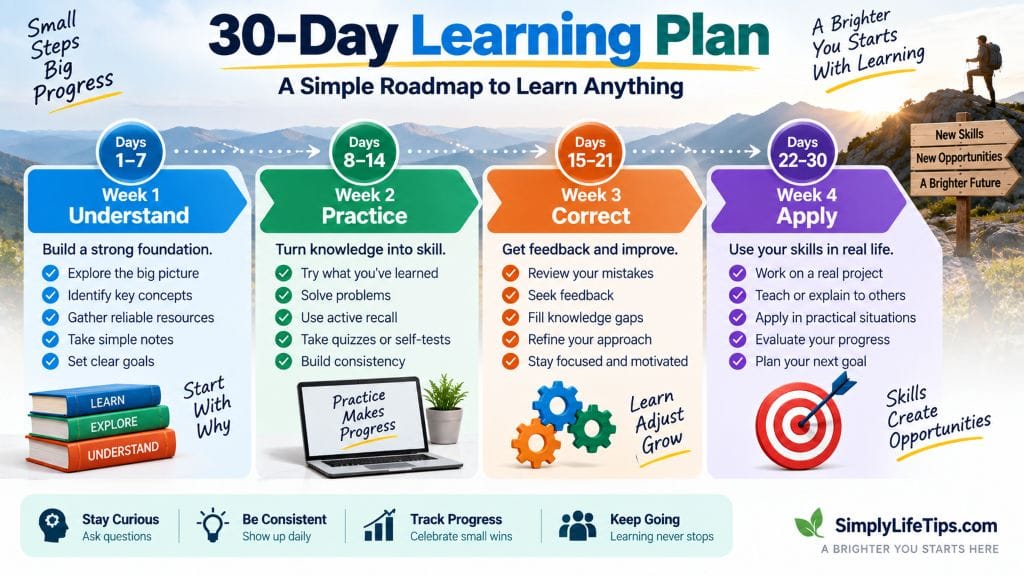
Week 1: Understand the Foundations
Define exactly what you want to learn.
Decide what level you want to reach.
Break the subject into essential components.
Choose a small number of reliable resources rather than trying to consume everything.
Learn the basic concepts and terminology.
Begin testing yourself before the week is over.
By the end of Week 1, you should understand the basic structure of the subject and know what you need to practice.
Week 2: Start Practicing
Move from understanding to action.
Spend more time using the skill than simply reading or watching content.
Take photographs, solve problems, speak the language, write, cook, code, draw, or perform whatever activity your skill requires.
Expect mistakes.
Keep notes on the problems you encounter.
Those problems will help determine what to practice next.
Week 3: Work on Your Weaknesses
By the third week, you should have enough experience to identify areas that are holding you back.
Do not spend most of your practice time repeating what you can already do comfortably.
Focus on specific weaknesses.
Break difficult areas into smaller parts.
Seek feedback when possible.
Practice deliberately.
If you keep making the same mistake, investigate why rather than simply repeating the same attempt.
Week 4: Apply What You Know
Use the skill in a realistic situation.
Create something.
Solve a meaningful problem.
Have a real conversation.
Complete a project.
Use the knowledge in the situation for which you originally wanted to learn it.
Real-world application often reveals gaps that are difficult to notice during study.
At the end of the month, review what you have learned, what you can now do, and what still needs improvement.
The 30-day plan is not the end of learning.
It is a way to build momentum and establish a repeatable learning habit.
The Most Important Skill Is Learning How to Learn
Once you understand how effective learning works, you become less dependent on someone else telling you exactly what to study.
You can begin asking better questions:
What do I actually need to learn?
What should I learn first?
Can I explain this without looking at my notes?
Can I use it?
Where am I making mistakes?
What should I practice next?
These questions turn learning into an active process.
You are no longer simply receiving information. You are deciding what matters, testing your understanding, identifying weaknesses, and adjusting your approach.
This becomes increasingly valuable when you encounter unfamiliar subjects.
You may not always have a teacher, course, or expert available.
But if you know how to define a goal, find reliable information, practice deliberately, test yourself, seek feedback, and adjust your strategy, you can make progress independently.
Learning how to learn also changes how you respond to difficulty.
Instead of immediately concluding that you are not talented enough, you can ask whether you need a different explanation, more focused practice, better feedback, or more time.
Mistakes become information.
Difficulty becomes a signal.
Practice becomes purposeful.
That does not make learning effortless. Difficult subjects still require patience and sustained effort.
The difference is that your effort becomes more intentional.
Conclusion
How to Learn Anything is ultimately a question about developing a better learning process.
You do not need to be naturally gifted at everything you want to learn. What matters more is understanding how to approach something unfamiliar, identify what matters, practice effectively, learn from mistakes, and keep improving.
The 15 methods in this article provide a practical foundation.
Start with the big picture.
Define your goal.
Break the skill into smaller parts.
Focus on what matters most.
Learn actively.
Use active recall and spaced repetition.
Explain what you learn.
Practice by doing.
Seek feedback.
Work deliberately on your weaknesses.
Review your strategy and adjust when necessary.
Learning faster does not mean rushing through information. It means reducing wasted effort and spending more time doing the activities that actually move you toward your goal.
Whether you are learning a language, preparing for an exam, developing a professional skill, pursuing a hobby, or simply exploring something because you are curious, the same basic principles can help.
Choose something worth learning.
Start small.
Practice consistently.
Learn from your mistakes.
Then continue the cycle.
So, what is one thing you have always wanted to learn—and what would happen if you started today?
FAQs about How to Learn Anything
1. What is the best way to learn anything?
The most effective approach combines understanding, active recall, deliberate practice, application, feedback, and spaced repetition. Start with a clear goal, break the subject into smaller parts, learn the fundamentals, and then practice what you learn.
2. How can I learn anything faster?
Focus on the most important concepts, remove distractions, practice actively, use active recall, get feedback, and spend more time applying knowledge instead of simply consuming information.
3. Can you really learn anything in 20 hours?
Twenty hours of focused practice may help you develop basic competence in some skills, but it does not mean you can master a complex subject in 20 hours. Mastery depends on the difficulty of the skill, your starting point, the quality of practice, and the level you want to achieve.
4. How can I remember what I learn?
Use active recall and spaced repetition. Connect new information to things you already understand, explain concepts in your own words, and apply what you learn in real situations.
5. What should I do if I am struggling to learn something?
Identify exactly what you are struggling with. Then break the skill into smaller parts, return to the fundamentals, practice the difficult component separately, and seek useful feedback. Struggling does not necessarily mean you cannot learn something. It can show you where your next practice should be focused.
References
Karpicke, J. D., & Roediger, H. L. (2008). The Critical Importance of Retrieval for Learning. Science, 319(5865), 966–968. Read the study
Cepeda, N. J., Pashler, H., Vul, E., Wixted, J. T., & Rohrer, D. (2006). Distributed Practice in Verbal Recall Tasks: A Review and Quantitative Synthesis. Psychological Bulletin, 132(3), 354–380. Read the study
Ericsson, K. A., Krampe, R. T., & Tesch-Römer, C. (1993). The Role of Deliberate Practice in the Acquisition of Expert Performance. Psychological Review, 100(3), 363–406. Read the study

Mathukutty P V is a Blogger, YouTuber, and Content Writer and the founder of Simply Life Tips. After taking voluntary retirement in 2017, he embraced a free lifestyle focused on learning, personal growth, and sharing practical wisdom to help others live with more purpose and positivity.