

Negative self-talk can quietly damage your confidence, increase stress, and prevent you from recognising your true potential. Have you ever told yourself, “I am not good enough,” “I will never succeed,” or “Nothing good will happen in my life”? These thoughts may seem harmless at first, but when they become a regular habit, they can influence how you feel, make decisions, and respond to everyday challenges.
Imagine hearing someone you love repeatedly say that they are useless, incapable, or destined to fail. Would you agree with them, or would you encourage them to recognise their strengths? Unfortunately, many people speak to themselves more harshly than they would ever speak to someone they care about.
This habit is known as negative self-talk. Understanding its effects and learning how to challenge unhelpful thoughts can help you develop greater self-confidence, emotional resilience, and a healthier mindset.
What Is Negative Self-Talk?
Negative self-talk refers to the critical, pessimistic, or discouraging thoughts we direct towards ourselves. It is the internal conversation that takes place in our minds throughout the day.
Everyone experiences negative thoughts occasionally. A disappointing result, an argument, a mistake at work, or an unexpected setback can make us question our abilities.
However, negative self-talk becomes a concern when these thoughts occur frequently, feel difficult to control, and begin influencing our emotions and behaviour.
Here are some common examples:
- “I am not intelligent enough to succeed.”
- “I always make mistakes.”
- “Nobody likes me.”
- “I cannot do anything right.”
- “I will never achieve my goals.”
- “Other people are better than me.”
- “There is no point in trying.”
These statements are not necessarily facts. They are interpretations of situations, often influenced by fear, disappointment, past experiences, or low confidence.
Common Types of Negative Self-Talk
Recognising negative thinking patterns is the first step towards changing them.
1. Personalising Everything
You automatically blame yourself when something goes wrong, even when several factors contributed to the situation.
Example: A colleague appears upset, and you immediately think, “I must have done something wrong.”
2. Catastrophising
You expect the worst possible outcome without considering other possibilities.
Example: You make a small mistake during a presentation and convince yourself that your career is ruined.
3. All-or-Nothing Thinking
You judge situations as complete successes or total failures, leaving no room for progress or improvement.
Example: You miss one day of exercise and conclude that you have completely failed at maintaining a healthy lifestyle.
4. Overgeneralising
You use one disappointing experience to make a negative judgement about your entire life.
Example: You fail an examination and tell yourself, “I will never succeed in anything.”
5. Comparing Yourself With Others
You constantly measure your achievements, appearance, income, or abilities against other people.
Example: You see someone else’s professional success on social media and feel that your own life is worthless.
Recognising these patterns helps you understand that a thought is not automatically a fact.
How Does Negative Self-Talk Affect Your Mental Health?
Persistent negative self-talk can influence your emotions, confidence, relationships, and everyday decisions. Its effects vary from person to person, but some common consequences include the following.
1. Reduces Self-Confidence
Repeatedly telling yourself that you are incapable can weaken your belief in your abilities.
For example, imagine receiving an opportunity to apply for a better job. Instead of preparing for the interview, you may think, “I am not qualified enough. They will certainly reject me.”
As a result, you might avoid applying altogether.
2. Increases Stress and Anxiety
Negative thinking can make ordinary challenges feel more threatening than they really are.
You may repeatedly imagine embarrassing situations, anticipate failure, or worry about things that have not happened.
Over time, this pattern can contribute to emotional distress and make it harder to manage everyday responsibilities.
3. Encourages Fear of Failure
When you constantly expect failure, taking risks becomes frightening.
You may avoid learning new skills, accepting responsibilities, or exploring opportunities because you are afraid of making mistakes.
Unfortunately, avoiding every challenge also prevents you from gaining valuable experience.
4. Affects Motivation and Productivity
Negative self-talk can make even simple tasks feel overwhelming.
For example, someone who wants to start a blog may repeatedly think, “Nobody will read my articles. I am not a good writer.”
Instead of publishing the first article and learning through experience, that person may continue postponing the project.
5. Damages Relationships
Negative beliefs about yourself can influence how you interpret other people’s behaviour.
You may assume that others dislike you, become excessively sensitive to criticism, or withdraw from social interactions.
These reactions can create misunderstandings and unnecessary distance in relationships.
6. Creates a Cycle of Negative Thinking
Negative thoughts, emotions, and behaviours can reinforce one another.
For example:
- You think, “I am not good enough.”
- You feel anxious and discouraged.
- You avoid an important opportunity.
- You miss the opportunity to gain experience.
- You interpret the outcome as proof that you are incapable.
This can become a self-reinforcing cycle. Learning to recognise and interrupt it is an important part of developing healthier thinking habits.
How Does Negative Self-Talk Affect Your Brain?
Our brains are capable of adapting throughout life. This ability is known as neuroplasticity.
Neuroplasticity describes the brain’s capacity to change its connections and patterns of activity in response to learning, experience, and repeated practice.
Repeated negative thinking does not automatically damage the brain or permanently change its structure. However, persistent patterns of thinking can influence emotional responses, attention, behaviour, and the way we interpret experiences.
For example, someone who repeatedly expects rejection may become increasingly alert to signs of criticism while overlooking positive feedback.
Similarly, a person who regularly practises a more balanced response to difficult situations may gradually become better at recognising alternative perspectives.
This does not happen overnight. Learning new responses requires practice, patience, and sometimes professional support.
Explore our detailed guide on neuroplasticity exercises and ways to train your brain to understand how learning and repeated practice can influence the brain.
How to Stop Negative Self-Talk: 7 Practical Ways
Changing negative self-talk does not mean forcing yourself to feel happy all the time. It means learning to recognise unhelpful thoughts, question their accuracy, and replace extreme self-criticism with more realistic and supportive thinking.
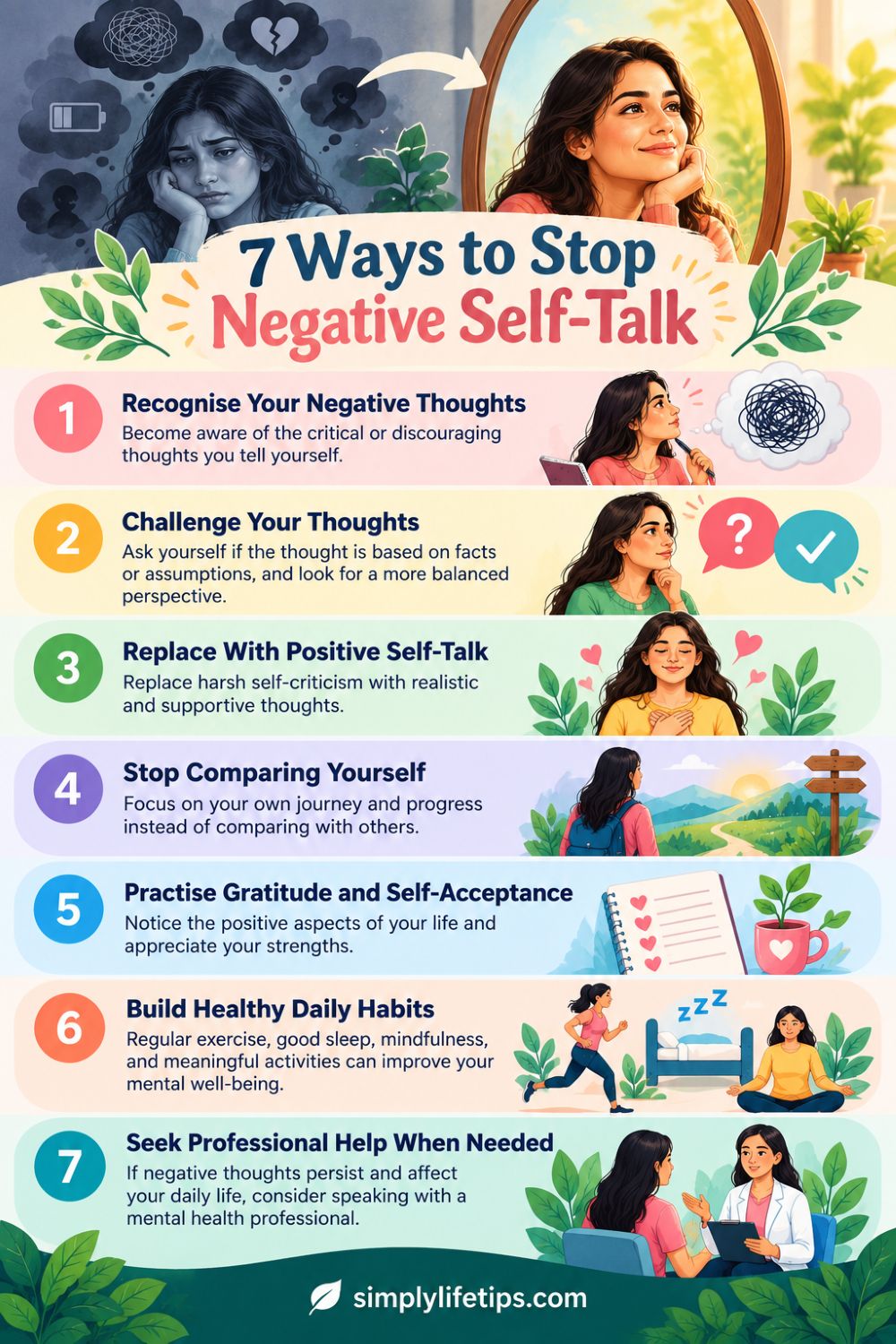
These seven strategies can help you recognise negative thinking patterns and respond to challenges more constructively. Start with one or two techniques that feel manageable, practise them consistently, and gradually incorporate the others into your daily routine.
1. Recognise Your Negative Thoughts
You cannot change a thinking pattern until you become aware of it.
Pay attention to the words you use when you make mistakes, face challenges, or compare yourself with others.
Whenever a negative thought appears, pause and identify it.
For example:
Instead of automatically accepting “I am a failure,” recognise that you are experiencing a thought about failure.
This small distinction helps you create some distance between yourself and the thought.
Try maintaining a simple thought journal. Write down what happened, what you thought, how you felt, and how you responded.
2. Challenge Your Negative Thoughts
Do not believe every thought simply because it appears in your mind.
Ask yourself:
- Is this thought based on facts or assumptions?
- Am I exaggerating the situation?
- What evidence supports this belief?
- Is there another way to understand what happened?
- What would I tell a friend facing the same problem?
For example:
Negative thought: “I failed once, so I will never succeed.”
Balanced thought: “This attempt did not work, but I can understand my mistakes and try a different approach.”
The aim is not to replace every negative thought with unrealistic optimism. It is to develop a more balanced understanding of situations.
The NHS explains this approach through its practical guide to reframing unhelpful thoughts.
3. Replace Self-Criticism With Supportive Self-Talk
Pay attention to how you speak to yourself.
If you would never use certain words to discourage a close friend, avoid using them against yourself.
Try replacing harsh statements with realistic alternatives.
| Negative self-talk | Healthier alternative |
|---|---|
| I cannot do this. | I can learn how to do this. |
| I am a failure. | I made a mistake, and I can learn from it. |
| I am not good enough. | I have strengths and areas to improve. |
| I will never succeed. | Success takes time, preparation, and effort. |
| Everyone is better than me. | I have my own journey and progress. |
| Nothing will change. | I can begin with one small change. |
Supportive self-talk is not about denying problems. It is about encouraging yourself to respond to them constructively.
4. Stop Comparing Yourself With Others
Constant comparison can make you overlook your own progress.
People have different backgrounds, opportunities, responsibilities, and challenges. Comparing your everyday struggles with someone else’s achievements gives you an incomplete picture.
Instead, measure your progress against your previous efforts.
For example, if you could not complete a task last month but can now manage it independently, that is meaningful progress.
Remember that your journey does not have to look like anyone else’s.
5. Practise Gratitude and Self-Acceptance
Negative thinking often makes us focus on what is missing rather than what is already going well.
Practising gratitude can help you pay attention to positive experiences without ignoring genuine difficulties.
Every evening, write down three things you appreciate about your day.
They do not have to be extraordinary.
- You completed an important task.
- Someone offered you encouragement.
- You enjoyed a peaceful walk.
- You learned something useful.
- You handled a difficult situation more calmly.
Also, accept that nobody is perfect. You can recognise your weaknesses while appreciating your strengths.
6. Build Healthy Daily Habits
Your daily routine can influence your mood, concentration, and ability to manage stress.
Consider including these habits:
- Physical activity: Take a walk or choose an exercise that suits your health and fitness.
- Adequate sleep: Maintain a regular sleep schedule.
- Mindfulness: Spend a few minutes observing your thoughts without immediately reacting to them.
- Meaningful activities: Make time for hobbies, reading, learning, or creative work.
- Supportive relationships: Spend time with people who encourage and respect you.
These habits do not guarantee that negative thoughts will disappear, but they can support overall emotional well-being.
7. Seek Professional Help When Necessary
Sometimes negative self-talk becomes persistent and difficult to manage without assistance.
If negative thoughts regularly interfere with your sleep, relationships, work, studies, or daily activities, consider speaking with a qualified mental health professional.
Cognitive Behavioural Therapy (CBT) is one approach that can help people identify unhelpful thinking patterns and develop more constructive ways of responding.
A trained therapist can help you understand the relationship between your thoughts, feelings, and behaviour.
You can learn more about Cognitive Behavioural Therapy (CBT) through the NHS.
Seeking help is not a sign of weakness. It is a positive step towards taking care of your mental health.
Positive Self-Talk Examples to Change Your Mindset
Sometimes a small change in the words you use can help you approach a difficult situation differently.
Here are some practical examples to try.
When You Make a Mistake
Instead of: “I always make mistakes.”
Say: “Everyone makes mistakes. I can learn from this experience.”
When You Face a New Challenge
Instead of: “I cannot do this.”
Say: “I may not know how to do it yet, but I can learn.”
When You Experience Failure
Instead of: “My life is a failure.”
Say: “This attempt did not succeed, but my life is not defined by one result.”
When You Feel Left Behind
Instead of: “Everyone is ahead of me.”
Say: “I have my own pace, and I can continue making progress.”
When You Feel Discouraged
Instead of: “Nothing good will happen.”
Say: “I cannot predict everything, but I can take one positive step today.”
When You Doubt Your Abilities
Instead of: “I am not talented enough.”
Say: “I can improve my abilities through learning, practice, and experience.”
The goal is to develop realistic encouragement rather than repeat positive statements that you do not believe.
Can You Change Your Thinking Habits?
Yes, many thinking habits can be changed or managed with awareness, practice, and appropriate support.
Understanding how people change also raises an interesting question. Read our article on whether human nature can change to explore how experiences, habits, and personal choices influence human behaviour.
However, change is rarely immediate. You may continue experiencing negative thoughts even after making progress.
Do not judge yourself for having an occasional difficult day.
Focus on practising healthier responses whenever possible. Over time, these efforts can help you approach challenges with greater flexibility and confidence.
Our article on how to train your mindset offers additional ideas for developing a growth-oriented approach to everyday challenges.
Remember that your past experiences may influence your thinking, but they do not have to determine every decision you make in the future.
Conclusion
Negative self-talk can become an invisible obstacle that affects confidence, emotional well-being, and personal growth. The good news is that you do not have to accept every critical thought as the truth.
Start by recognising your inner critic. Question unhelpful assumptions, treat yourself with kindness, and focus on practical steps that help you move forward.
You do not need to become perfectly positive. You need to become more understanding, realistic, and supportive towards yourself.
Remember, if someone you love makes a mistake, you would probably encourage them rather than repeatedly remind them of their failure. Why not offer yourself the same kindness?
The voice inside your mind should help you grow, not convince you to give up. What will you choose to tell yourself today?
Frequently Asked Questions About Negative Self-Talk
1. What is negative self-talk?
Negative self-talk is the habit of thinking or speaking critically about yourself. It includes thoughts such as “I am not good enough,” “I always fail,” or “I cannot achieve anything.” When persistent, it can affect confidence, emotions, and behaviour.
2. What are common examples of negative self-talk?
Common examples include blaming yourself for everything, expecting failure, comparing yourself with others, exaggerating mistakes, and believing that you are incapable of achieving your goals.
3. How can I stop negative self-talk?
Start by recognising negative thoughts, questioning whether they are based on facts, and replacing harsh self-criticism with realistic alternatives. Gratitude, mindfulness, healthy routines, and professional support can also help.
4. Can negative self-talk affect mental health?
Persistent negative self-talk can contribute to stress, anxiety, low confidence, and emotional distress. Its effects vary between individuals. If it interferes with everyday life, consider seeking professional support.
5. Is positive self-talk scientifically supported?
Supportive and balanced self-talk can be useful as part of psychological approaches that help people manage unhelpful thoughts. Cognitive Behavioural Therapy, for example, teaches people to examine negative thinking patterns and develop more helpful responses. Positive statements alone are not a substitute for professional treatment when it is needed.

Mathukutty P. V. is the founder of Simply Life Tips. He shares practical advice and useful insights on personal growth, health, well-being, technology, and everyday living. His goal is to help readers build positive habits and make informed decisions. He believes in continuous learning and sharing knowledge to help people live healthier, happier, and more meaningful lives.