

Music and dementia are attracting growing attention as researchers explore simple lifestyle activities that may support brain health in older adults. A familiar song can bring back childhood memories, improve someone’s mood, or reconnect them with a meaningful moment from the past.
But can listening to music also be associated with a lower risk of dementia?
A study led by researchers at Monash University in Australia found that older adults who always listened to music had a 39% lower risk of dementia than those who never, rarely, or sometimes listened to music. Playing a musical instrument was also associated with a lower risk. These findings show an association, not proof that music prevents dementia. You can read the original findings in the Monash University research report.
These findings are encouraging, particularly for older adults and families looking for enjoyable ways to support healthy aging. However, the study does not prove that music prevents dementia.
Let’s explore what the research found, how music may support memory and emotional well-being, and how families can use familiar songs to make everyday life more enjoyable.
What Does Research Say About Music and Dementia?
In 2025, researchers published a cohort study examining music-related leisure activities and dementia risk among older adults.
The study used data from 10,893 community-dwelling Australian adults aged 70 and older who did not have dementia when they entered the study.
The findings were published in the International Journal of Geriatric Psychiatry.
According to the study:
- Listening to music: People who always listened to music had a 39% lower incidence of dementia than those who never, rarely, or sometimes listened.
- Playing a musical instrument: Participants who played instruments had a 35% lower dementia risk.
- Listening and playing music: Those who regularly engaged in both activities had a 33% lower dementia risk.
- Cognitive performance: Regular music listening was also associated with better overall cognitive performance and episodic memory.
These results suggest that music-related activities may be associated with better cognitive health in later life.
Does listening to music prevent dementia?
Not necessarily. The researchers observed an association between music-related activities and dementia risk. They did not establish that music itself caused the reduction.
Other factors, including education, general health, social engagement, and lifestyle, may influence both musical activities and cognitive health.
Therefore, listening to music should be viewed as a potentially beneficial and enjoyable activity, not a guaranteed method of preventing dementia.
How Music May Support Brain Health
Listening to a song involves more than recognizing a melody. The brain processes sounds, rhythms, patterns, emotions, and familiar lyrics while drawing on different networks involved in attention and memory.
This makes music an interesting subject for researchers studying the aging brain.
1. Music engages multiple brain networks
When you listen to a familiar song, several processes may occur together.
Your brain recognizes the melody, follows the rhythm, anticipates the next line, and responds emotionally to the sound. If you know the lyrics, you may also recall words and sing along.
For example, hearing a song from your school days might remind you of old friends, a particular place, or a memorable event.
Music does not activate every brain region in exactly the same way for everyone. Nevertheless, it can engage interconnected systems involved in hearing, memory, emotion, attention, and movement.
2. Music May Evoke Familiar Memories
Have you ever heard an old song and suddenly remembered a moment from decades ago?
Music can act as a cue for autobiographical memories, which are memories of personal experiences.
A familiar melody might remind an older adult of a wedding, a family celebration, a childhood home, or a journey taken many years ago.
This connection between music, memory, and emotion helps explain why familiar songs can be meaningful in later life.
For more details, read our article on How Music Affects the Brain: 7 Powerful Insights.
3. Music Provides Enjoyable Mental Stimulation
Learning lyrics, following a melody, recognizing musical patterns, or practising an instrument can involve attention, memory, and coordination.
For older adults, these activities offer opportunities to remain mentally engaged while enjoying something personally meaningful.
However, researchers have not established that simply listening to music builds a protective cognitive reserve strong enough to prevent dementia. Music is best considered one possible part of a varied, active lifestyle.
4. Music May Support Mood and Relaxation
Music can influence how people feel. A gentle melody may help someone relax, while an energetic song may encourage movement or make an everyday task more enjoyable.
The effect depends on the person, the music, and the situation.
For example, an older adult who feels lonely might enjoy listening to familiar songs with a family member. The music provides a shared activity and an opportunity to talk about memories.
Music cannot replace treatment for depression, anxiety, or other health conditions, but it can be a valuable part of everyday emotional well-being.
5. Music May Encourage Engagement in People With Dementia
A person who struggles to follow a conversation may still recognize a familiar melody or respond when a favorite song begins.
For example, an older adult who enjoyed singing traditional songs in their youth might begin humming when a family member plays one of those songs.
The response may be brief, but it can create a meaningful shared moment.
Listening to familiar music may offer enjoyment and emotional connection for some people living with dementia. For more practical guidance, read our guide to dementia care.
6. Personalized Music May Help Ease Verbal Agitation
A randomized clinical trial published in the American Journal of Geriatric Psychiatry examined personalized music among 976 nursing-home residents with Alzheimer’s disease or related dementias.
The researchers found that residents in facilities receiving the intervention were more likely to be observed experiencing pleasure. The analysis also found fewer observations involving verbal agitation.
There was no significant effect on physically agitated behaviors or several other measured mood states.
These findings suggest that personalized music may help with certain aspects of engagement and behavior, although benefits are not universal.
Read the published clinical trial on personalized music and dementia.
7. Music Creates Opportunities for Social and Emotional Connection
Caregiving can become difficult when a loved one has trouble recognizing people, expressing feelings, or participating in familiar activities.
Music can offer another way to spend time together without requiring a long conversation.
A caregiver might play a favorite song, sit beside the person, gently tap along with the rhythm, or invite them to sing if they wish.
The goal is not to test memory or force a response. It is to provide comfort, enjoyment, and connection.
Music may offer several benefits for older adults, including those living with dementia. From bringing back familiar memories to supporting emotional well-being, music can be a simple and enjoyable part of daily life. The infographic below highlights seven potential benefits of music and explains how familiar songs may help create meaningful moments.
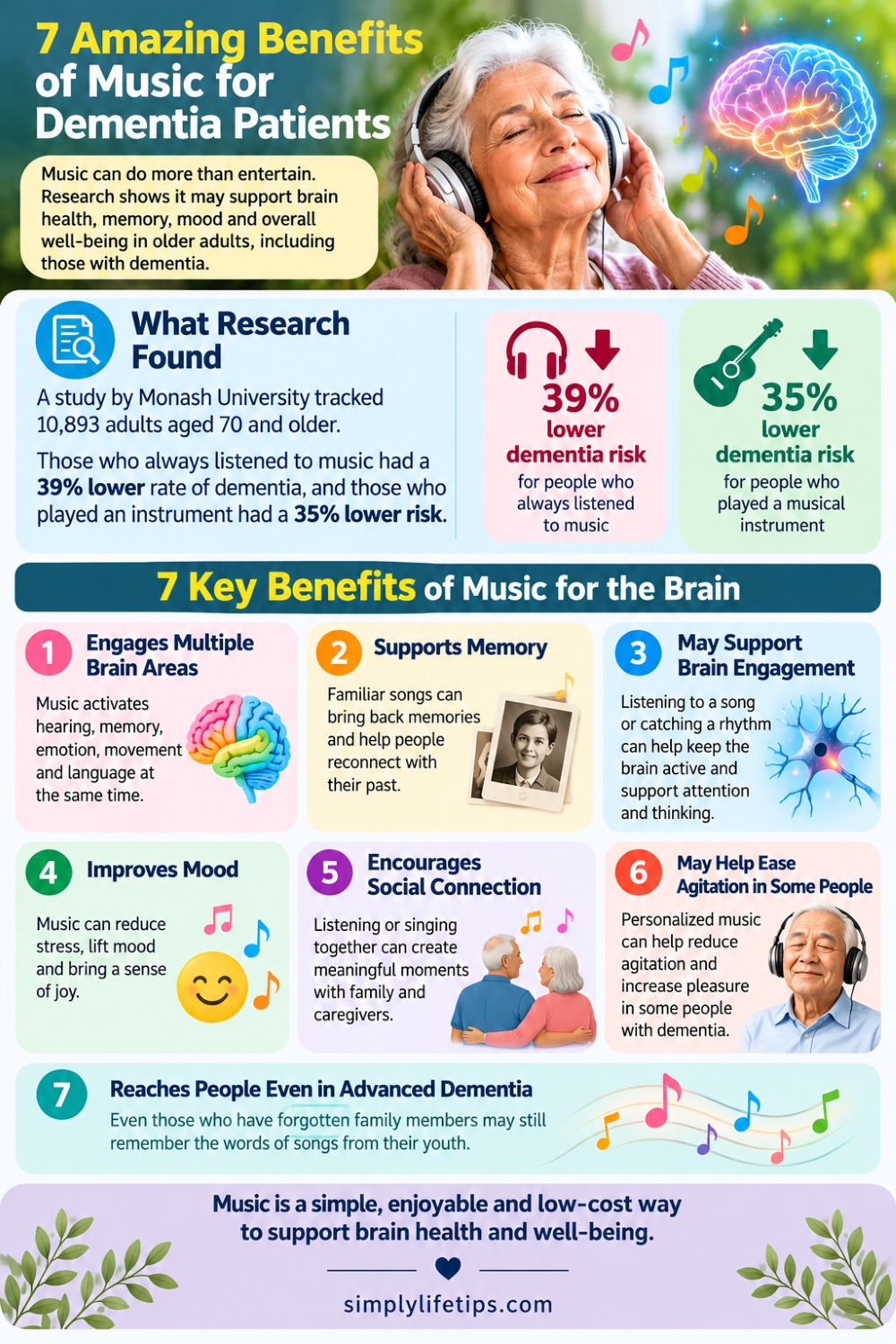
Although music can support enjoyment, engagement, and emotional well-being, its effects vary from person to person. Research linking music with lower dementia risk does not prove that listening to music prevents dementia. For someone living with dementia, choose familiar songs they enjoy, keep the volume comfortable, and observe their response. The goal is to encourage comfort, connection, and pleasure rather than to treat the condition.
How to Create a Personalized Music Playlist for an Older Adult
One simple way to put these ideas into practice is to create a playlist of songs the person genuinely enjoys.
You do not need expensive equipment, specialist software, or a complicated routine.
1. Choose songs from meaningful periods of life
Think about music the person enjoyed during their teenage years, young adulthood, marriage, working life, or family celebrations.
Ask relatives about favorite singers, films, religious or cultural songs, and memorable occasions.
For example, an older adult who enjoyed Malayalam film songs in their youth may appreciate hearing familiar melodies from that period.
Personal preferences matter more than choosing music simply because it is old.
2. Start with a short listening session
Begin with one or two familiar songs and observe the person’s response.
They may smile, hum, tap their feet, or simply listen quietly.
There is no need to make the session long. A few minutes may be enough to discover whether the music is enjoyable.
3. Adjust the music to their preferences
Some people enjoy lively songs, while others prefer gentle instrumental music or familiar devotional songs.
Keep the volume comfortable and avoid music that seems to cause distress, agitation, or unpleasant memories.
If a song produces a negative reaction, switch it off and try something else.
4. Make music part of an existing routine
Music can be incorporated into everyday activities without making it feel like a treatment session.
You could try:
- Playing a favorite song during morning tea.
- Listening to familiar melodies after lunch.
- Singing together during a quiet afternoon.
- Playing gentle music during a relaxed family visit.
- Using familiar songs as part of a comfortable evening routine, if the person enjoys them.
The purpose is to make the day more pleasant, not to promise a medical benefit.
5. Invite participation without pressure
If the person wants to sing, clap, dance gently, or talk about the song, encourage them.
If they prefer to listen quietly, respect that choice.
People living with dementia have individual preferences and abilities. Music should remain a source of enjoyment rather than another task they are expected to complete.
Other Daily Habits That Support Healthy Brain Aging
Music can be one enjoyable part of a broader approach to brain health. It should not be treated as a substitute for established health measures.
Stay physically active
Walking, swimming, gardening, and other suitable activities can support physical health and help maintain independence as people age.
Read our guide to Exercise and Brain Health: How It Helps Your Brain.
Maintain social connections
Regular conversations, family visits, community activities, and shared hobbies can help older adults remain socially engaged.
Music can complement these activities when people sing together, attend performances, or share favorite songs.
Protect sleep and manage health conditions
Adequate sleep and appropriate management of conditions such as high blood pressure and diabetes are important aspects of overall health.
Regular medical check-ups can help identify and manage health problems that may affect cognitive function.
Continue learning and enjoying hobbies
Reading, learning new skills, playing an instrument, gardening, and other meaningful activities can provide opportunities for mental engagement.
No single activity guarantees protection against dementia. A varied lifestyle is more sensible than relying on one habit alone.
For more practical suggestions, see How to Improve Brain Health: 9 Simple Habits.
Conclusion
Music and dementia are connected in ways that researchers are continuing to investigate. A major study involving more than 10,800 adults aged 70 and older found that regular music listening was associated with a 39% lower incidence of dementia, while playing a musical instrument was associated with a 35% lower risk.
These findings are promising, but they do not prove that music prevents dementia. More research is needed to understand the relationship and determine whether music-related activities can directly influence long-term cognitive outcomes.
For families caring for older adults, there is still a practical lesson worth taking away: familiar music can provide enjoyment, encourage engagement, and create opportunities for connection.
Start with a favorite song. Ask about the memories it brings back. Sing together if the person wishes, and pay attention to what makes them comfortable.
Music does not need to cure an illness to make a meaningful difference in someone’s day.
Frequently Asked Questions
1. Can listening to music reduce dementia risk?
A 2025 cohort study found that older adults who always listened to music had a 39% lower incidence of dementia than those who never, rarely, or sometimes listened. This was an association, not proof that music prevents dementia.
2. What type of music is best for people with dementia?
There is no single best type of music. Familiar songs, favorite singers, cultural music, and melodies associated with positive memories may be good starting points. Individual preferences and comfort should guide the choice.
3. Can music help people with advanced dementia?
Some people with advanced dementia respond to familiar music through humming, singing, facial expressions, or other signs of engagement. Responses differ, and music does not cure dementia or reliably restore lost memories.
4. Does playing an instrument lower dementia risk?
The Monash University-led study found that playing an instrument was associated with a 35% lower dementia risk. The observational findings do not establish that playing an instrument directly causes this reduction.
5. How long should an older adult listen to music each day?
There is no scientifically established daily listening duration that prevents dementia. Start with a comfortable session that suits the person’s preferences and routine. Short sessions can be worthwhile if the person enjoys them.
References
- Monash University: Music listening and dementia risk
- Original cohort study: Music-related leisure activities and dementia risk — PubMed
- Personalized music intervention for nursing-home residents with dementia — PubMed
Disclaimer: This article is for educational purposes only. Music is not a proven way to prevent or treat dementia and should not replace professional medical advice or care.

Mathukutty P. V. is the founder of Simply Life Tips. He shares practical advice and useful insights on personal growth, health, well-being, technology, and everyday living. His goal is to help readers build positive habits and make informed decisions. He believes in continuous learning and sharing knowledge to help people live healthier, happier, and more meaningful lives.