

Maternal instinct is often described as a mysterious force that seems to awaken when a child needs a mother most. A woman may sometimes feel unable to cope with a difficult situation in her own life, yet when her child’s wellbeing is at stake, she may discover extraordinary determination.
Where does that strength come from?
Is it love? Is it biology? Is it experience? Or is something happening inside the brain and body that changes the way a mother responds to her child?
Consider the remarkable story of Ramabai Ranveer, a 47-year-old mother from Ambajogai in Maharashtra’s Beed district.
Ramabai entered a roughly 3-kilometre running event called the Amrit Daud without formal running training or the equipment of an experienced athlete. She wore an everyday cotton sari and slippers. When her slippers began slipping during the race, she removed them, held them in her hands, and continued running barefoot.
She eventually crossed the finish line first and won ₹3,000. Her story was reported by PTI and other Indian news outlets.
But for Ramabai, the race was about more than winning.
She had entered hoping to win the prize money because it could help support the education of her two daughters. After the death of her husband, she had taken responsibility for raising them and worked as a cook to help support their education. She later said that she planned to use the ₹3,000 prize to buy books for her daughters.
For someone watching from the outside, ₹3,000 might seem like a modest prize.
For a mother thinking about her children’s future, it could represent something much bigger: an opportunity, a responsibility, and a reason to keep going.
Her story was reported by PTI and subsequently covered by several Indian news outlets.
Ramabai’s story raises an intriguing scientific question:
What happens inside the brain and body when caring for a child becomes one of the most important goals in a person’s life?
The answer is not that mothers suddenly acquire supernatural strength.
Instead, motherhood involves a complex interaction between hormones, brain networks, motivation, attention, attachment, stress responses, learning, and caregiving experience. Research in neuroscience shows that pregnancy and the transition to parenthood can be accompanied by substantial changes in the brain and nervous system, helping prepare parents for the demands of caregiving.
So when people talk about a mother’s “extraordinary strength,” there may be more science behind the expression than we realize.
It may not be a superpower.
It may be the remarkable way the human brain and body adapt when another person’s safety, wellbeing, and future become deeply important.
Motherhood can also bring emotional pressure, exhaustion, and difficult moments that are not always visible from the outside.
And that brings us to the fascinating question at the heart of motherhood:
What exactly is maternal instinct, and how much of it comes from biology?
What Is Maternal Instinct?
The phrase maternal instinct is widely used to describe a mother’s natural-seeming tendency to protect, nurture, respond to, and care for her child.
But scientifically, maternal instinct is not a single switch in the brain. Modern neuroscience increasingly views parental caregiving as a flexible process shaped by neural circuits, internal states, hormones, and social experience.
It is better understood as a collection of biological, psychological, emotional, and behavioral processes that can work together to support caregiving.
A mother may learn to recognize subtle differences in her baby’s cries. She may notice a change in facial expression, movement, breathing, or behavior. She may wake up because a particular sound from her baby feels different from ordinary household noise.
These responses can become highly sensitive through a combination of biology and experience.
Research on the parental brain shows that infant signals can engage networks involved in emotional processing, attention, motivation, reward, empathy, and behavioral regulation. These systems help parents interpret what a child may need and decide how to respond.
So when people say that a mother has a “sixth sense” about her child, there may be a less mysterious explanation.
She may have become exceptionally familiar with that particular child’s signals.
Her brain has learned them.
Her emotions are attached to them.
And her caregiving system is highly motivated to respond.
Is Maternal Instinct Biological?
Partly, yes—but biology is only one part of the story.
Pregnancy, childbirth, and the postpartum period involve dramatic physiological changes. Hormones such as estrogen, progesterone, oxytocin, prolactin, and others interact with the nervous system and help prepare the body for pregnancy, birth, lactation, and caregiving.
At the same time, the brain is not a fixed structure.
It is plastic.
That means the brain can change in response to hormones, experiences, relationships, learning, and the demands of everyday life.
Research published in Nature Neuroscience found that pregnancy is associated with substantial changes in brain structure. Some of these changes were associated with measures of postpartum maternal attachment and remained detectable for at least two years in that study. Pregnancy-related brain changes
More recent precision-imaging research has provided an even more detailed picture of neuroanatomical changes across pregnancy and into the postpartum period, showing widespread remodeling alongside major hormonal changes.
This does not mean that pregnancy simply makes a woman’s brain “better” or “stronger.”
Brain change is not automatically improvement.
Rather, it suggests that becoming a mother involves a period of substantial biological adaptation.
How Does Motherhood Change the Brain?
One of the most fascinating discoveries in modern neuroscience is that pregnancy and caregiving can influence the brain itself.
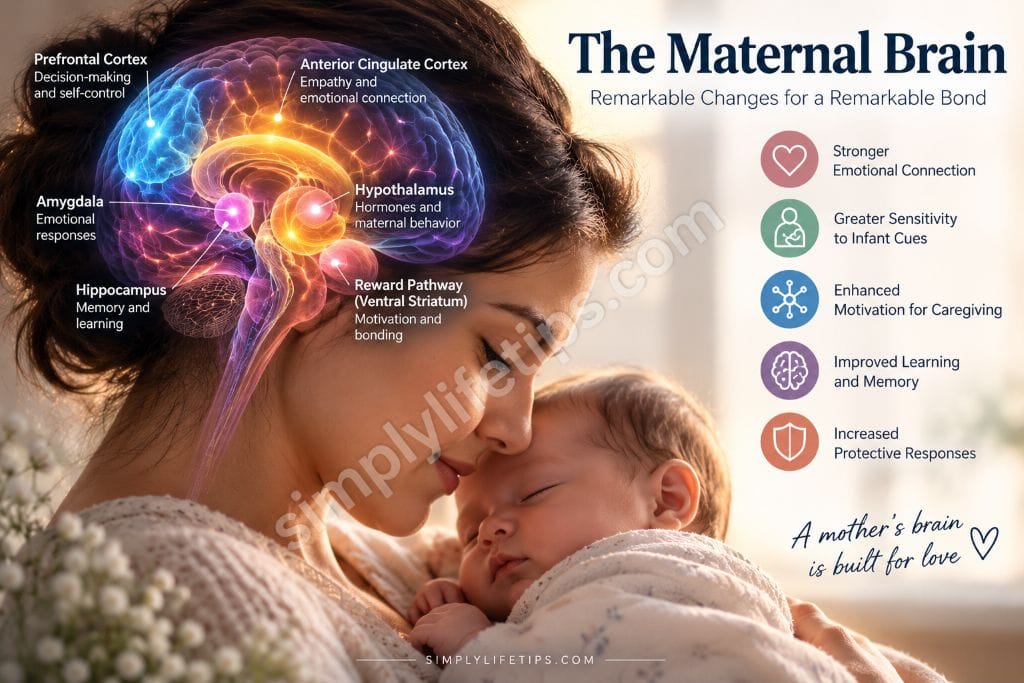
Developing awareness of our own emotional reactions can also help parents respond more thoughtfully rather than automatically.
Researchers studying the maternal brain have identified changes involving networks associated with:
- social cognition
- emotional processing
- attention
- motivation
- reward
- empathy
- decision-making
- stress regulation
- responses to infant signals
Studies of pregnancy and the postpartum period provide evidence of neural plasticity associated with the transition to motherhood and maternal caregiving.
A baby’s face or cry is not processed like an irrelevant sound or image.
For a parent, it can carry enormous emotional significance.
Studies using functional MRI have shown that infant cries and other infant cues can activate networks involved in arousal, salience, motivation, reward, emotion regulation, and cognitive processing.
This helps explain why a baby’s cry can instantly capture a parent’s attention.
The brain is essentially asking:
“What does this signal mean, and what should I do?”
That rapid interpretation can become especially important because infants depend heavily on adults for food, warmth, protection, comfort, and regulation.
The Maternal Brain Is Highly Responsive to Baby Signals
Imagine a mother sleeping at night.
The house is quiet.
A small sound comes from the baby’s room.
To another person, it might barely register.
But the mother may wake immediately.
This doesn’t necessarily mean that mothers possess an extraordinary hearing ability.
The difference may lie partly in attention and learned significance.
The brain constantly filters enormous amounts of sensory information. Most sounds do not receive our full attention. But signals associated with something emotionally important can receive priority.
For parents, infant cues can become highly salient.
Research examining parental responses to infant cries describes a network involving emotional, motivational, reward, and cognitive systems. These systems help transform an infant’s signal into an appropriate caregiving response.
This is one reason the phrase “my mother knows when something is wrong” can feel so familiar.
Sometimes what appears to be intuition is partly the result of thousands of tiny observations accumulated through caregiving.
Oxytocin and the Mother-Child Bond
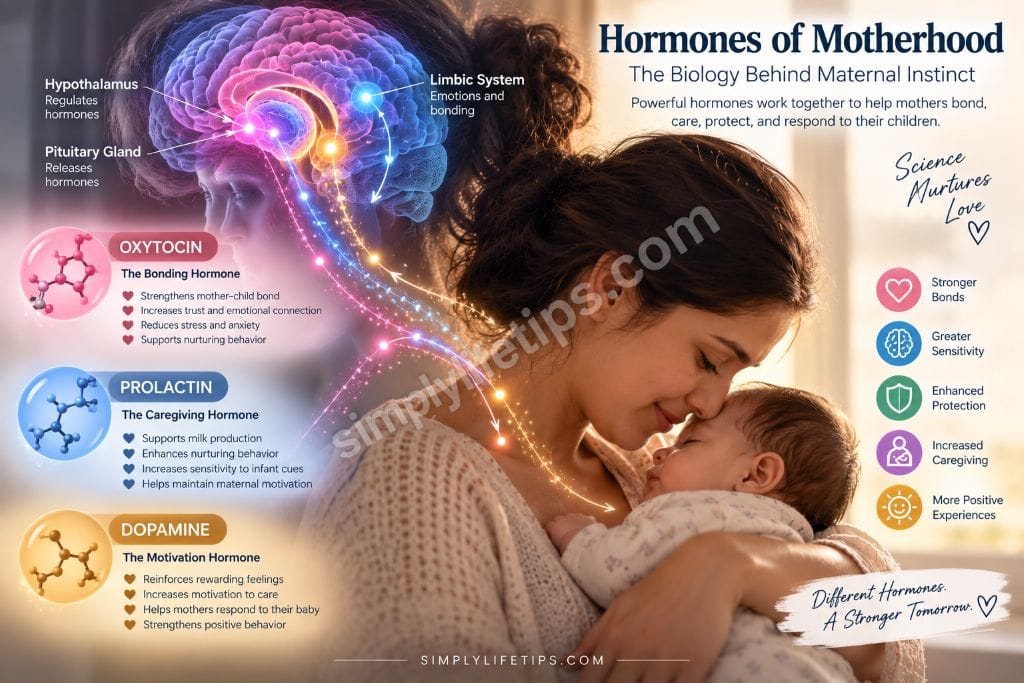
If there is one hormone most commonly associated with maternal bonding, it is oxytocin.
Oxytocin is a hormone and neuromodulator involved in several physiological and social processes. It plays important roles in childbirth and lactation and is also involved in systems associated with parent-infant bonding and caregiving.
During childbirth and breastfeeding, oxytocin has well-established physiological functions.
But its role in motherhood is more complicated than simply calling it the “love hormone.”
Oxytocin interacts with brain circuits involved in social attention, motivation, reward, and caregiving. Research suggests that oxytocin-related systems can contribute to the brain’s adaptation to infant cues and maternal caregiving behavior.
Oxytocin is involved in maternal physiology and caregiving, and research suggests that infant cues can influence oxytocin-related neural pathways.
This means oxytocin is not a magical chemical that automatically creates perfect maternal love.
Instead, it is one component of a much larger biological system.
Dopamine and the Motivation to Care
Another important player is dopamine.
Dopamine is commonly associated with the brain’s reward and motivation systems. It is not simply a “pleasure chemical,” as it is sometimes described in popular articles.
In caregiving, dopamine interacts with other neurochemical systems to influence motivation and the rewarding aspects of responding to a child.
Research examining oxytocin and dopamine suggests that their interaction is important for motivational components of maternal caregiving.
Think about the experience of comforting a crying baby.
The mother may be exhausted.
She may have slept very little.
She may have other responsibilities waiting.
Yet the child’s distress creates a powerful reason to act.
The caregiving system can make the child’s needs highly salient and motivate the parent to respond.
That motivation is one part of what people may perceive as extraordinary maternal strength.
What Is the Role of Prolactin in Motherhood?
Prolactin is best known for its role in milk production, but its biological story is broader.
Research on maternal behavior has identified interactions among prolactin, other reproductive hormones, and neural systems involved in caregiving. Much of the detailed mechanistic evidence comes from animal research, while human maternal behavior is influenced by a far more complicated combination of biological and environmental factors.
This distinction matters.
Scientists often learn about the biology of parenting by studying different species, but findings from animals cannot automatically be assumed to work in exactly the same way in humans.
Human motherhood is influenced by biology and psychology, relationships, culture, experience, resources, stress, and individual circumstances.
Why Does a Baby’s Cry Get a Mother’s Attention?
A baby’s cry is not simply a sound that a mother hears. It is an important distress signal that can rapidly capture a caregiver’s attention and trigger processes associated with caregiving.
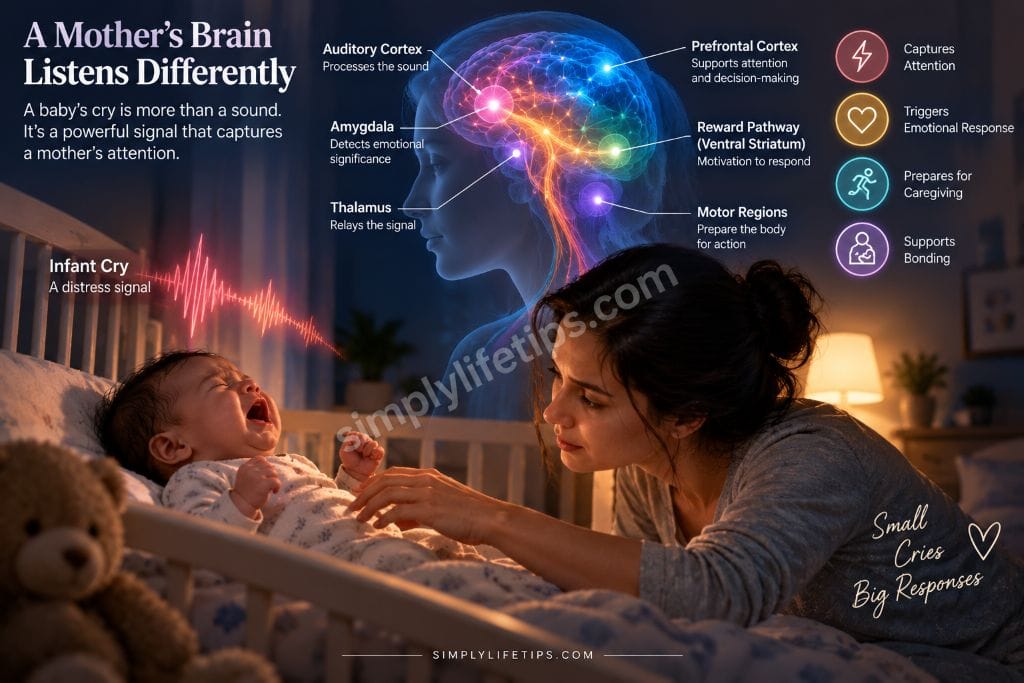
Research suggests that infant crying engages a network of brain regions involved in auditory processing, attention, emotion, motivation, movement, and caregiving. A meta-analysis of infant-cry research found involvement of the auditory system, thalamocingulate circuitry, the insula, motor-related regions, and areas of the prefrontal cortex. Parents also showed stronger recruitment of some brain networks than non-parents.
One large international study involving new mothers found that hearing their own infants’ cries was associated with brain activity in regions connected with hearing, movement, speech, motivation, and caregiving. The mothers’ behavioral responses commonly included picking up and holding their babies and talking to them.
This helps explain why a baby’s cry can feel almost impossible for a parent to ignore.
Understanding these signals is closely connected with the broader role of parental attention in helping children feel safe, noticed, and emotionally secure.
The response is not necessarily a conscious decision such as, “I should investigate that sound.” Instead, the infant’s distress signal can rapidly orient attention toward the baby and prepare the caregiver to respond.
Importantly, this response is not exclusive to mothers. Research on the parental brain suggests that fathers and other caregivers can also respond strongly to infant cues. Caregiving experience itself can shape the neural systems involved in attention and responsive caregiving.
So when a mother wakes suddenly because her baby is crying, what looks like extraordinary intuition may partly reflect a highly responsive caregiving system involving the brain, attention, emotions, motivation, and previous experience.
This is where the idea of maternal instinct becomes scientifically interesting: the response may feel automatic, but it is produced by a remarkably sophisticated biological and psychological system.
Research has identified a network of brain regions involved in how caregivers perceive and respond to infant cries.
What Happens When a Child Is in Danger?
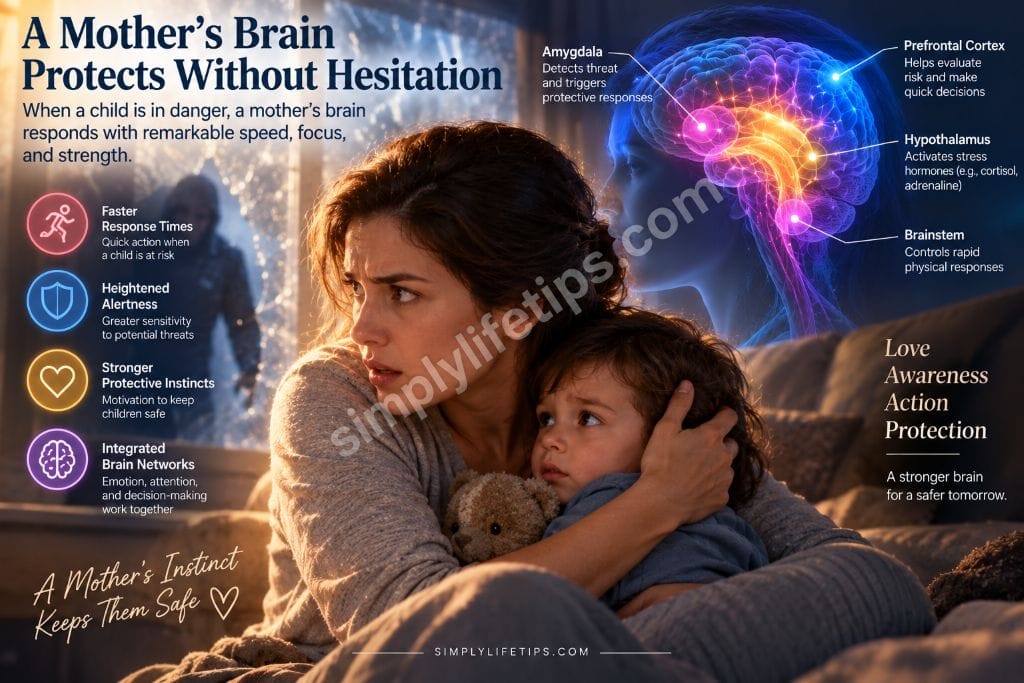
This is where the idea of a mother’s extraordinary strength becomes particularly interesting.
Imagine a child suddenly running toward a dangerous situation.
The parent may react before having time to consciously analyze every detail.
The body’s stress systems can become activated.
Heart rate may rise.
Attention can narrow toward the threat.
The sympathetic nervous system can prepare the body for rapid action.
Stress hormones can help mobilize energy and increase physiological readiness.
This is part of the body’s broader fight-or-flight response.
But there is an important scientific correction to the popular story.
A mother does not necessarily become physically superhuman when her child is threatened.
Rather, acute stress and intense motivation can temporarily alter attention, arousal, pain perception, and willingness to exert effort.
The result can look extraordinary from the outside.
Can Stress Make a Mother Act More Quickly?
Stress is not always harmful in the immediate sense.
Short-term stress can help an individual respond to a challenge. In the context of parenting, infant crying itself can activate stress-related physiological systems and motivate a caregiver to act. Research on the neuroendocrinology of parental responses describes interactions among cortisol, dopamine, oxytocin, endogenous opioids, and brain circuits involved in caregiving.
But stress is complicated.
Too little arousal may not produce a strong response.
Too much or prolonged stress can interfere with emotional regulation and sensitive caregiving.
Research suggests that chronic or excessive stress can alter maternal brain responses to infant cues and may interfere with adaptive caregiving processes.
So the relationship is not:
more stress = better mother.
The reality is much more nuanced.
Although short-term stress can increase alertness, chronic stress and exhaustion can make parenting considerably more difficult. Learning practical ways to manage stress therefore matters for both parents and children.
Why Can Pain and Fatigue Seem to Disappear?
This is one of the most popular ideas about maternal strength.
A mother may be exhausted but continue caring for a sick child through the night.
She may be hungry but make sure her child eats first.
She may be frightened but move toward a child who is in danger.
Does this mean maternal biology switches off pain?
No.
Pain and fatigue do not simply disappear because someone becomes a mother.
Instead, the experience of pain, fatigue, effort, and discomfort can be influenced by attention, emotional state, motivation, stress, and the perceived importance of a situation.
When the brain considers something extremely important, a person may tolerate discomfort that would otherwise cause her to stop.
This principle isn’t exclusive to motherhood.
Athletes, emergency workers, soldiers, caregivers, and ordinary people facing emergencies can sometimes continue functioning despite pain or exhaustion.
What makes maternal situations especially powerful is the emotional significance of the child.
Maternal Instinct Is Not the Same as Maternal Love
These terms are often used interchangeably, but they are not identical.
Maternal instinct generally refers to tendencies or responses associated with caring for and protecting a child.
Maternal love refers to emotional attachment, affection, concern, and bonding.
Maternal caregiving describes the actual behaviors involved in meeting a child’s needs.
And maternal attachment describes the emotional relationship that develops between mother and child.
These processes can influence each other, but none of them should be reduced to a single hormone or brain region.
A mother can love her child deeply while struggling with certain aspects of caregiving.
Another mother may need time to develop confidence in her role.
Some mothers may feel an immediate connection after birth, while others experience attachment gradually.
That variation does not make anyone less of a mother.
Do All Mothers Experience Maternal Instinct in the Same Way?
No.
This is one of the most important points to understand.
Popular culture sometimes portrays maternal instinct as an automatic force that appears instantly after childbirth.
Real life is more complicated.
Motherhood is an enormous transition, and women can experience it in very different ways.
Some feel an immediate sense of connection.
Some develop confidence gradually.
Some struggle with uncertainty.
Some may feel overwhelmed by the demands of caring for a newborn.
Biological factors matter, but so do sleep, stress, social support, previous experiences, relationships, mental wellbeing, economic circumstances, and the amount of practical help available.
Maternal caregiving is not simply about automatic reactions. Awareness, emotional connection, and the ability to respond thoughtfully are also important parts of healthy parenting.
Research on the maternal brain emphasizes individual differences and the influence of hormonal, behavioral, environmental, and experiential factors.
Therefore, not feeling an instant “maternal instinct” does not mean a woman is incapable of being a loving or effective mother.
Can Fathers Develop Similar Caregiving Responses?
Absolutely.
This is another reason to be careful with the phrase “maternal instinct.”
The human brain is remarkably adaptable.
Caregiving itself can shape the brain.
Research examining mothers and fathers has found substantial overlap in neural systems involved in parental caregiving, including networks associated with emotional processing, motivation, reward, vigilance, empathy, and social understanding.
One study comparing different groups of parents found that caregiving experience was associated with patterns of brain activity and connectivity, including in fathers who were primary caregivers.
Caregiving is not limited to mothers; fathers and other caregivers also play an important role in children’s emotional development.
This suggests something important:
The capacity to care is not exclusively a mother’s biological property.
Pregnancy creates unique physiological changes in the maternal body and brain, but caregiving experience can also shape the brains and behavior of fathers and other caregivers.
In other words, the human brain is capable of adapting to the responsibility of caring for another person.
Why Does a Baby’s Cry Feel So Powerful?
A baby’s cry is not merely a sound.
For a caregiver, it is a biological and emotional signal that demands interpretation.
Is the baby hungry?
Cold?
Tired?
In pain?
Lonely?
Overstimulated?
In need of comfort?
The caregiver has to make sense of the signal and decide what to do.
Research into parental responses to baby cries shows that infant vocalizations can engage brain systems involved in arousal, motivation, emotion, attention, and caregiving.
Over time, caregivers also learn the individual characteristics of a particular child.
That is why a parent may distinguish between different cries that sound almost identical to someone else.
What looks like instinct may therefore contain a remarkable amount of learning.
The Brain Learns the Child
Motherhood isn’t only about hormones.
It is also about repetition.
A mother spends countless hours observing her child.
She learns:
- how the baby sounds when hungry
- how the baby behaves when tired
- which expression means discomfort
- what kind of cry signals pain
- what calms the child
- what makes the child anxious
- when the child needs physical closeness
- when the child wants independence
Every interaction provides information.
The brain uses experience to improve prediction.
This is one reason caregiving becomes more sophisticated over time.
The mother is not simply reacting.
She is constantly learning.
The Amazing Plasticity of the Maternal Brain
The word plasticity can sound complicated, but the idea is straightforward.
Neural plasticity means that the brain can change in response to experience and biological conditions.
Pregnancy is one of the most dramatic biological transitions a human body can undergo.
Research has found structural and functional changes in the maternal brain during pregnancy and the postpartum period. Some studies have identified changes in areas involved in social cognition, motivation, emotional processing, and caregiving.
A 2024 Nature Neuroscience study provided a particularly detailed longitudinal map of one woman’s brain from before conception through two years postpartum, finding widespread neuroanatomical changes across pregnancy alongside hormonal changes.
One person’s brain cannot represent every mother’s experience, so such findings should not be generalized too broadly.
But together with earlier research, they provide strong evidence that the transition into motherhood involves substantial biological adaptation.
Is Maternal Instinct an Evolutionary Adaptation?
There is an evolutionary reason why caregiving would matter.
Human infants are highly dependent on adults.
A newborn cannot find food independently, protect itself from danger, regulate temperature effectively, or survive without sustained care.
Across human evolution, caregivers who responded effectively to vulnerable infants would have played an important role in infant survival.
Modern neuroscience therefore examines parental caregiving as a system involving motivation, emotional salience, reward, attention, protection, and behavioral responses.
But evolution does not mean every mother behaves identically.
Human behavior is never determined by biology alone.
Culture, family structure, personal history, resources, relationships, and individual personality all influence how caregiving is expressed.
Evolution may provide part of the foundation.
Experience builds much of the rest.
So Where Does a Mother’s Extraordinary Strength Come From?
Now we can return to the question that started this story.
Where does a mother’s strength come from?
Not from one hormone.
Not from one brain region.
Not from a magical maternal switch.
And not from an ability to become physically superhuman.
The answer is more interesting.
A mother’s extraordinary determination can emerge from the interaction of several systems:
Attachment makes the child’s wellbeing emotionally important.
Attention makes the child’s signals difficult to ignore.
Motivation and reward systems encourage caregiving behavior.
Hormonal systems support pregnancy, childbirth, lactation, bonding, and adaptation.
Brain plasticity helps the nervous system adapt to the demands of parenthood.
Stress systems can mobilize the body when something feels urgent or threatening.
Experience teaches the caregiver how to recognize and respond to the child’s individual needs.
And above all, purpose can change how much effort a person is willing to give.
That combination can produce behavior that looks extraordinary.
What Ramabai’s Story Really Tells Us
Think again about Ramabai running barefoot.
We should be careful not to claim that her body suddenly developed some scientifically measurable “maternal superpower.”
We don’t know exactly what she experienced physiologically during that race.
But we can understand the psychology behind her determination.
She had a goal that mattered deeply to her.
Her daughters’ future gave the effort meaning.
The reward was not simply ₹3,000.
It represented the possibility of doing something for her children.
That distinction matters.
Human beings can tolerate remarkable effort when they believe the outcome is important enough.
When that goal involves someone we love, the motivation can become even stronger.
The brain does not calculate effort in isolation.
It constantly weighs effort against importance, reward, threat, emotion, and anticipated outcomes.
For a mother, a child’s wellbeing can carry enormous emotional value.
That can transform the meaning of an otherwise difficult task.
A Mother’s Strength Is Not the Absence of Limits
There is another lesson worth remembering.
Calling mothers “strong” can sometimes create an unfair expectation.
A mother is still human.
She can become exhausted.
She can become frightened.
She can need help.
She can feel overwhelmed.
She can make mistakes.
She can need someone else to care for her while she cares for her child.
Maternal strength should not be used to suggest that mothers must carry every burden alone.
In fact, human caregiving evolved within social environments.
Support from partners, grandparents, relatives, friends, communities, and other caregivers can make an enormous difference.
The strongest mother is not necessarily the one who never asks for help.
Sometimes strength means recognizing when help is needed.
Maternal Instinct Is Powerful—but It Is Not Perfect
Another common misconception is that maternal instinct is always accurate.
It isn’t.
A mother’s intuition can be valuable because she knows her child extremely well, but intuition is not infallible.
A parent can misinterpret a symptom.
A child can behave unpredictably.
A mother can become anxious and assume something is wrong when it isn’t.
Conversely, a serious problem may not always be obvious.
This is why parental intuition should complement—not replace—appropriate medical advice and professional support when a child is genuinely unwell or in danger.
Science doesn’t diminish a mother’s intuition.
It helps us understand where some of that remarkable sensitivity may come from.
Motherhood Is a Biological Transformation—and a Human Experience
One of the most fascinating things about motherhood is that biology and experience cannot easily be separated.
Pregnancy changes the body.
Hormones influence the brain.
The brain adapts.
The baby provides thousands of sensory signals.
Caregiving creates repeated experiences.
Repeated experiences influence neural processing.
Emotional attachment makes those signals meaningful.
And meaningful signals motivate behavior.
It is a continuous feedback loop.
The mother changes in response to the baby.
The baby changes in response to the mother.
And their relationship develops through thousands of interactions.
That is much more fascinating than the idea of a single “maternal instinct” switch.
The Science Behind a Mother’s Courage
Perhaps this is why the phrase “mother’s strength” resonates so strongly across cultures.
Everyone has limits.
But limits are not always fixed.
When the stakes change, behavior can change.
A person who would never run barefoot for herself may do it for her child.
A person who is terrified of hospitals may remain calm beside a sick child.
A person who is exhausted after a sleepless night may still wake again when her baby cries.
A person who doubts herself may become fiercely determined when someone she loves needs protection.
The brain is capable of extraordinary flexibility when emotion, motivation, attention, and purpose converge.
Motherhood provides one of the most powerful contexts in which that convergence can occur.
The Real Meaning of Maternal Instinct
So, is maternal instinct real?
Yes—but probably not in the simple way popular culture often portrays it.
There is no single biological button that transforms a woman into a perfectly intuitive, endlessly patient, fearless mother.
Instead, maternal caregiving emerges from a sophisticated interaction of biology, brain plasticity, hormones, motivation, attachment, sensory processing, stress regulation, learning, and experience.
Pregnancy can reshape the maternal brain.
Infant cues can activate powerful caregiving networks.
Oxytocin participates in bonding and reproductive processes.
Dopamine contributes to motivation and reward.
Prolactin participates in lactation and interacts with systems involved in maternal behavior.
Stress responses can mobilize the body when a child needs immediate attention.
And experience teaches a mother to recognize her child’s unique signals.
Together, these processes can create something that looks almost magical from the outside.
But perhaps we don’t need to call it magic.
The science is already extraordinary.
A Mother’s Strength May Begin With Love—but It Doesn’t End There
The next time you see a mother doing something extraordinary for her child, it may be tempting to say:
“That’s a mother’s instinct.”
There is truth in that phrase, but there is also much more beneath it.
There is a brain that has adapted.
A nervous system that is constantly monitoring.
Hormones interacting with neural circuits.
A reward system that gives caregiving meaning.
Years, months, or even days of learning a particular child’s signals.
And an emotional bond that can make another person’s wellbeing feel deeply connected to one’s own.
That is why a mother may sometimes discover strength she did not know she possessed.
Not because she has no limits.
Not because she is biologically invincible.
But because when her child’s future, safety, or wellbeing becomes the goal, the brain and body can mobilize an extraordinary level of motivation to meet the challenge.
Perhaps that is what Ramabai’s barefoot run symbolizes.
The ₹3,000 was the visible reward.
The invisible force behind the effort was much larger: responsibility, hope, determination, and love for her daughters.
And that may be the most beautiful lesson science gives us about maternal instinct.
A mother does not become superhuman when her child needs her. She becomes deeply motivated to use every human resource available to her—her body, her brain, her experience, her courage, and her determination.
That is not supernatural strength.
It is the remarkable biology and psychology of caregiving.
Why does a mother respond so quickly to her baby’s cry?
A baby’s cry is a highly salient signal for caregivers. Research suggests that infant cries can engage brain networks involved in attention, arousal, emotion, motivation, and caregiving. Experience also helps parents learn the distinctive signals of their own child.
The science of maternal instinct brings together many fascinating pieces—from changes in the brain and hormones to the powerful response to a baby’s needs. This infographic summarizes the key ideas discussed in this article.
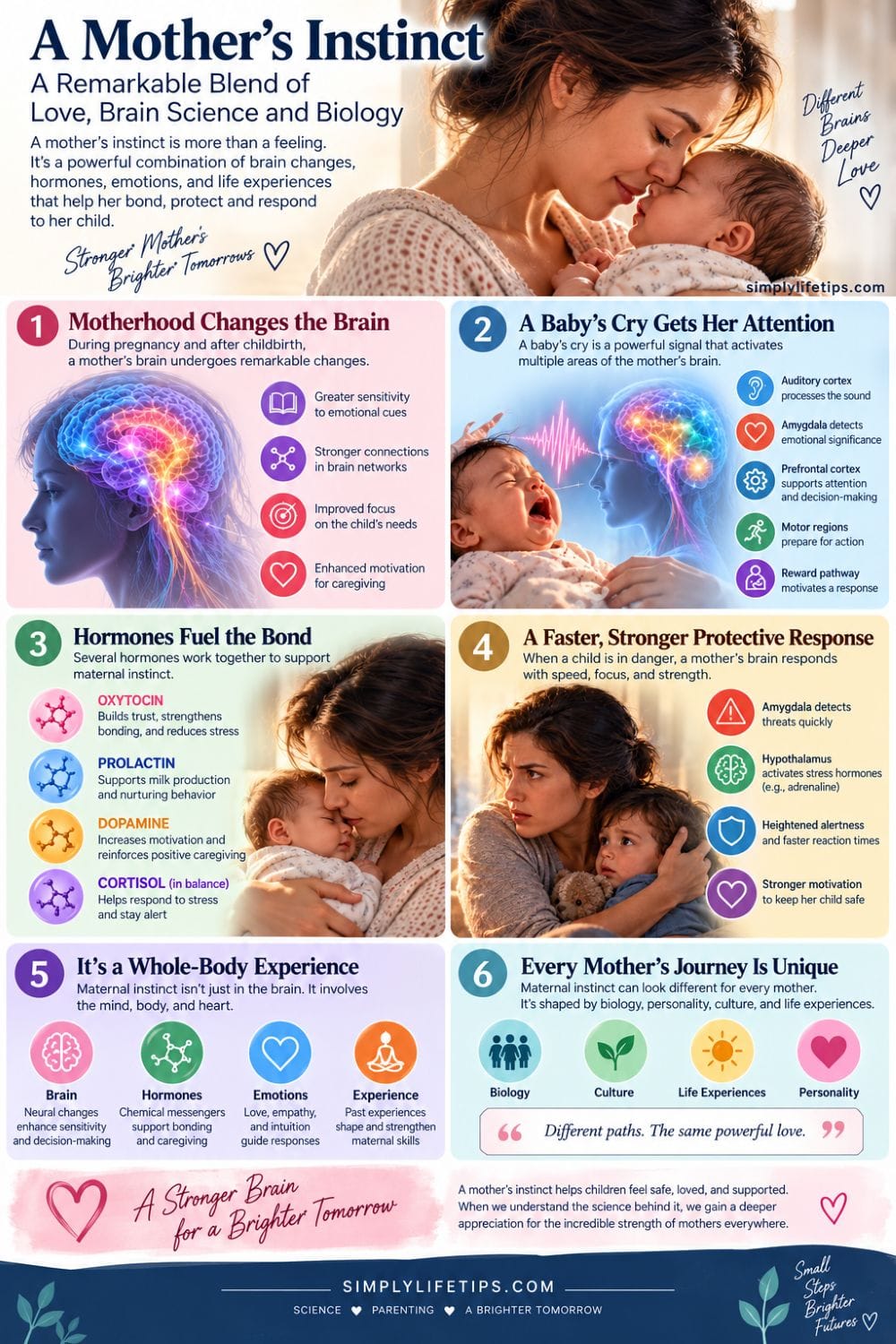
Maternal instinct is not simply a mysterious feeling. It reflects a complex interaction between biology, brain function, hormones, emotions, experience, and the powerful bond between a parent and child.
Conclusion
Maternal instinct may sound like a mysterious force, but science reveals something even more fascinating.
Motherhood can involve profound changes in the brain and body. Hormones, neural circuits, motivation, attachment, stress responses, and caregiving experience work together to help a mother respond to her child.
That does not make mothers superhuman.
It makes them human beings whose brains and bodies are capable of remarkable adaptation.
And when a child’s wellbeing becomes the goal, that adaptation can produce extraordinary courage.
Perhaps a mother does not ask, “Can I do this?”
Perhaps, in the most difficult moments, the more powerful question is:
“Does my child need me to do this?”
When the answer is yes, she may discover strength, determination, and courage that she never knew were there.
That is the fascinating science—and the deeply human story—behind maternal instinct.
Frequently Asked Questions About Maternal Instinct
What is maternal instinct?
Maternal instinct is a commonly used term for the natural tendency to protect, nurture, and respond to a child’s needs. Scientifically, it is not considered a single instinct or brain mechanism. Instead, maternal caregiving involves a complex interaction of hormones, brain networks, emotions, motivation, attachment, learning, and experience.
Is maternal instinct biological?
Yes, biology plays an important role in maternal caregiving. Pregnancy, childbirth, breastfeeding, hormonal changes, and changes in the brain can influence how a mother responds to her baby. However, maternal behavior is not determined by biology alone. Experience, relationships, social support, environment, and individual circumstances also matter.
When do maternal instincts kick in?
There is no universal moment when maternal instinct suddenly appears. Some women feel strongly connected to their baby during pregnancy, while others develop that connection gradually after birth. The experience of motherhood is different for every woman, and not feeling an immediate bond does not mean someone is incapable of being a loving mother.
Do fathers have maternal instincts?
Fathers do not experience the pregnancy-related biological changes associated with motherhood, but they can develop strong caregiving responses. Research suggests that fathers and mothers can engage overlapping brain systems involved in attention, bonding, motivation, emotional processing, and caregiving. Regular involvement in childcare can also strengthen these responses.
Why does a mother respond so quickly to her baby’s cry?
A baby’s cry is a highly important signal for caregivers. It can activate brain systems associated with attention, emotional processing, arousal, motivation, and caregiving. Experience also teaches parents to recognize their own baby’s different cries and behaviors, which can make their responses seem almost instinctive.
References
- Jamieson BB, Kohl J. Neural circuits for mammalian parental behaviour. Nature Reviews Neuroscience. 2026.
- Hoekzema E, et al. Pregnancy leads to long-lasting changes in human brain structure. Nature Neuroscience. 2017;20(2):287–296.
- Barba-Müller E, Craddock S, Carmona S, Hoekzema E. Brain plasticity in pregnancy and the postpartum period: links to maternal caregiving and mental health. Archives of Women’s Mental Health. 2019;22(2):289–299.
- Valtcheva S, et al. Neural circuitry for maternal oxytocin release induced by infant cries. Nature. 2023;621(7980):788–795.
- Witteman J, et al. Towards a neural model of infant cry perception. Neuroscience & Biobehavioral Reviews. 2019.

Mathukutty P V is a Blogger, YouTuber, and Content Writer and the founder of Simply Life Tips. After taking voluntary retirement in 2017, he embraced a free lifestyle focused on learning, personal growth, and sharing practical wisdom to help others live with more purpose and positivity.



