
Subconscious mind exercises can help you become more aware of the thoughts, habits, emotional reactions, and behavioral patterns that often operate automatically.
Think about how many things you do without consciously planning every step.
You may reach for your phone when you are bored. You may become defensive when someone criticizes you. You may automatically postpone an uncomfortable task. You may follow the same morning routine without thinking about each individual action.
These patterns are not necessarily bad. In fact, automatic behavior is an important part of everyday life. Research on habit psychology shows that people often repeat behaviors in recurring contexts, and repeated responses can become more automatic over time.
The useful question is not whether you can somehow control every process happening outside conscious awareness.
A better question is:
Which automatic patterns are helping me, and which ones would I like to change?
That is where subconscious mind exercises become useful.
They can give you structured opportunities to observe your thoughts, recognize triggers, practice alternative responses, and strengthen habits that support your goals.
You don’t need complicated techniques or hours of meditation.
Some exercises take only a few minutes.
The key is to practice consistently and connect the exercises with real behavior.
What Are Subconscious Mind Exercises?
The phrase subconscious mind exercises is widely used in personal development to describe practices intended to improve awareness of automatic thoughts, habits, beliefs, and responses.
The term itself is broader and less precise than the terminology used in psychology and neuroscience. For practical purposes, this article uses it to refer to exercises involving things such as:
- Awareness of automatic thoughts
- Habit observation
- Journaling
- Mindfulness
- Visualization
- Mental rehearsal
- Positive self-talk
- Goal setting
- Reflection
- Repeated behavioral practice
These practices should not be viewed as a magic method for instantly “reprogramming” the brain.
Instead, think of them as ways to create new opportunities for learning and behavioral change.
For example, imagine that you automatically check social media whenever you encounter a difficult task.
You could begin noticing:
Difficult task → discomfort → phone → scrolling → delayed work
Once you recognize that sequence, you have something concrete to work with.
You might introduce a different response:
Difficult task → discomfort → pause → five minutes of focused work
The new response may initially require conscious effort. With repetition, it can become more familiar.
Research on habit formation supports the importance of repeated behavior and recurring contexts in developing automatic responses.
If you want to understand the broader process first, read our guide on how to train your subconscious mind.
Why Practice Subconscious Mind Exercises?
Your automatic patterns can influence many areas of life.
Consider procrastination.
You know you should begin an important task, but you feel uncomfortable. You open your phone “for a minute,” check a few messages, browse social media, and eventually realize that half an hour has passed.
The phone isn’t necessarily the entire problem.
There may be an underlying sequence:
Challenge → discomfort → avoidance → temporary relief
Once you understand that sequence, you can experiment with a different response.
Another example is emotional reactions.
Someone says something you dislike.
Your automatic response may be:
Comment → anger → immediate reply → argument
A mindfulness pause could create:
Comment → pause → notice anger → breathe → choose response
That pause doesn’t guarantee that you’ll always respond perfectly. But it gives you an opportunity to make a deliberate choice.
This is the practical value of subconscious mind exercises.
They can help you move from:
automatic reaction
toward:
awareness → choice → practice
10 Subconscious Mind Exercises
1. Thought Awareness Exercise
One of the simplest subconscious mind exercises is learning to notice your thoughts without immediately accepting or acting on them.
Your mind produces thoughts throughout the day.
Some are useful.
Some are ordinary observations.
Some are worries.
Some are memories.
Some are assumptions.
Some are highly self-critical.
The important skill is learning to recognize them as thoughts rather than automatically treating every thought as a fact.
Try the five-minute thought exercise
Find a quiet place and sit comfortably.
Set a timer for five minutes.
Allow your thoughts to appear naturally.
When you notice one, don’t argue with it.
Simply identify it.
For example:
“Planning.”
“Worrying.”
“Remembering.”
“Judging.”
“Comparing.”
“Self-criticism.”
Then gently return your attention to your breathing or surroundings.
You don’t need to empty your mind.
The exercise is about observation.
Example
Suppose you’re about to start an important project and think:
“I’m going to mess this up.”
Instead of immediately believing the thought, try:
“I’m noticing the thought that I might fail.”
That wording creates a little distance.
You can then ask:
“What evidence do I have?”
and:
“What is the next useful action?”
The objective isn’t forced positivity.
It is greater awareness.
2. Automatic Habit Tracking
If you want to understand your automatic patterns, track them.
For seven days, record one or two behaviors that happen almost without thinking.
Use a simple table:
| Trigger | Automatic behavior | Result |
|---|---|---|
| Feeling bored | Check phone | Lose time |
| Difficult task | Avoid work | Temporary relief |
| Feeling stressed | Snack | Short-term comfort |
| Feeling tired | Skip exercise | Less activity |
| Notification | Immediately check phone | Interrupted focus |
You are looking for repetition.
A habit can involve a recurring cue and a learned response. Research describes habitual automaticity in terms of cue-response relationships, showing why particular situations can trigger familiar behaviors.
Look for the trigger
Instead of asking only:
“Why do I keep doing this?”
ask:
“What usually happens immediately before I do this?”
That question can reveal the cue.
For example:
Trigger: Difficult writing assignment
Automatic response: Open YouTube
Result: Avoid the difficult task
Now you have something you can change.
You could experiment with:
Trigger: Difficult writing assignment
New response: Work for five minutes before taking a break
That is far more practical than simply telling yourself:
“I need more discipline.”
3. Positive Self-Talk Exercise
The way you talk to yourself can influence how you interpret challenges.
But positive self-talk doesn’t mean pretending everything is wonderful.
If you are struggling with something, telling yourself:
“Everything is perfect!”
may feel unrealistic.
Instead, use credible and constructive language.
Change:
“I can’t do this.”
to:
“I haven’t learned how to do this yet.”
Change:
“I always fail.”
to:
“This attempt didn’t work. What can I learn from it?”
Change:
“I’m too lazy.”
to:
“I’m having difficulty starting. What is the smallest action I can take?”
Change:
“I’ll never succeed.”
to:
“Success may take time, but I can improve through consistent practice.”
The three-step method
Whenever you notice harsh self-talk:
1. Notice it
What exactly did you say to yourself?
2. Question it
Is it completely accurate?
3. Reframe it
Can you express the situation in a more realistic and useful way?
Example
Imagine you make a mistake at work.
Your automatic thought:
“I’m terrible at this.”
Reframe:
“I made a mistake in this task. I can identify what went wrong and improve the process.”
That doesn’t deny the mistake.
It changes the response to it.
4. Visualization Exercise
Visualization is one of the most popular subconscious mind exercises, but it is often misunderstood.
Simply imagining success is not the same as preparing yourself to act.
A more practical approach is process visualization.
Instead of only imagining the final result, imagine yourself performing the behaviors needed to get there.
Example: Building a writing habit
Suppose your goal is to write consistently.
Don’t only visualize having a successful blog.
Visualize:
- Sitting at your desk
- Opening your document
- Choosing the topic
- Putting your phone away
- Writing the first paragraph
- Continuing when the article becomes difficult
- Reviewing the draft
- Publishing the finished article
You are mentally rehearsing the process.
A three-minute visualization
Close your eyes.
Imagine the situation as specifically as possible.
Ask:
- Where will I be?
- What will I do first?
- What might distract me?
- How will I respond to that distraction?
- What will I do when the task becomes difficult?
Then finish the visualization by performing the first real action.
Visualization should support behavior, not replace it.
5. Mental Rehearsal Exercise
Mental rehearsal is especially useful when you know that a particular situation tends to trigger an automatic response.
For example, perhaps you become nervous before:
- A presentation
- A job interview
- A difficult conversation
- Speaking in public
- Meeting someone new
- Receiving criticism
- Asking for something important
Instead of simply worrying about the situation, mentally rehearse how you want to respond.
Example: Difficult conversation
Imagine:
Someone criticizes your work → you feel defensive → you pause → breathe → listen → ask for clarification → respond calmly.
You aren’t predicting exactly what will happen.
You’re practicing a response.
Another example
If you tend to procrastinate when a task looks overwhelming, rehearse:
Open task → identify first step → work for five minutes → continue if possible.
The purpose is to make the desired response more familiar.
6. Mindfulness Pause
A mindfulness pause is one of the easiest subconscious mind exercises to use during a busy day.
It can take just one minute.
Mindfulness-based approaches have been studied in relation to behavior change, attention, motivation, learning, and self-regulation.
The one-minute exercise
Stop.
Take one slow breath.
Then notice:
What am I thinking?
What am I feeling?
What am I about to do?
Is this an automatic response?
What would be a more useful response?
Then choose your next action.
Example: Angry message
You receive a message that makes you angry.
Your automatic reaction:
Read → anger → immediate reply
Try:
Read → pause → breathe → notice emotion → wait → respond
You haven’t eliminated the emotion.
You’ve changed the sequence.
That is an important distinction.
Mindfulness isn’t about never feeling anger, frustration, fear, or disappointment.
It can instead help you become more aware of your experience before acting on it.
7. Gratitude Journaling Exercise
Gratitude journaling can help direct attention toward things you genuinely appreciate.
But it shouldn’t become forced positivity.
If you had a difficult day, you don’t need to pretend it was wonderful.
Instead, find something real.
Try the three-item method
Each evening, write:
One person I appreciated today:
Someone who helped, encouraged, supported, or simply made your day better.
One experience I appreciated:
A conversation, meal, walk, achievement, or quiet moment.
One thing I appreciated about myself:
An effort you made, a difficult situation you handled, or something you learned.
Example
Instead of:
“I’m grateful for my family.”
try:
“I’m grateful that my brother called today when I was having a difficult afternoon.”
Specific details make the practice more meaningful.
If gratitude is already part of your personal-development routine, you can connect this exercise with our guide to the power of gratitude.
8. Journaling for Automatic Patterns
Journaling can become much more useful when you use it to investigate recurring patterns rather than simply record what happened.
At the end of the day, choose one event that produced a strong emotional reaction.
Then write:
What happened?
Describe the situation without exaggeration.
What did I think?
Write the first thought that appeared.
What did I feel?
Name the emotion.
What did I do?
Describe your response.
What happened afterward?
Consider the consequence.
What could I try next time?
Choose one alternative response.
Example
What happened?
Someone criticized an article I wrote.
What did I think?
“They don’t respect my work.”
What did I feel?
Anger and embarrassment.
What did I do?
I became defensive.
What happened afterward?
The conversation became uncomfortable.
What could I try next time?
Ask what specifically could be improved before responding.
This type of reflection can help you recognize patterns that are difficult to see when you’re caught up in the moment.
9. Pre-Sleep Reflection Exercise
The period before sleep can be a useful time for a short reflection routine.
You don’t need to make exaggerated claims about the sleeping brain or assume that every thought before bed directly “programs” your subconscious.
Instead, use the quiet period to review your day and prepare for tomorrow.
Try this five-minute routine
Before bed, answer four questions:
1. What went well today?
Write one thing.
2. What didn’t go well?
Choose one event without criticizing yourself.
3. What did I learn?
Identify the lesson.
4. What will I practice tomorrow?
Choose one specific behavior.
For example:
“Tomorrow, I will write for 20 minutes before checking social media.”
That’s much more useful than simply telling yourself:
“Tomorrow will be better.”
If you want to explore the broader nighttime approach, you can read reprogram your subconscious mind.
10. Goal-to-Action Exercise
One of the most useful subconscious mind exercises is turning a vague goal into a specific repeated behavior.
Consider:
“I want to become healthier.”
That’s a goal, but it doesn’t tell you what to do today.
Turn it into:
Goal: Become more active
Behavior: Walk for 20 minutes
Cue: After lunch
Location: Nearby road or park
Frequency: Five days a week
Now you have something repeatable.
Another example: Reading
Goal: Read more
Behavior: Read 15 minutes
Cue: Before bed
Environment: Phone away from the bed
Another example: Writing
Goal: Publish more articles
Behavior: Write for 30 minutes
Cue: After morning coffee
Environment: Phone outside the workspace
This is where goals and habits meet.
Research on habit formation shows that repeated behavior in stable contexts can strengthen automaticity, while recent research also highlights the role of context and reward structure in maintaining or changing habits.
How to Combine Subconscious Mind Exercises Into a Daily Routine
You don’t need to perform all ten exercises every day.
That would turn a simple practice into another overwhelming task.
Instead, combine a few exercises with routines you already have.
Morning: 5 minutes
Write your most important action for the day.
Ask:
“What behavior would make today meaningful?”
Then visualize yourself completing it.
During the day: 1 minute
Use the mindfulness pause whenever you notice:
- Stress
- Anger
- Procrastination
- Distraction
- An automatic urge
Evening: 5 minutes
Write down one automatic pattern you noticed.
Ask what triggered it and what response you want to practice next time.
Before sleep: 3 minutes
Write one thing you appreciated and one behavior you want to practice tomorrow.
This gives you a routine of roughly 10–15 minutes without requiring a major lifestyle change.
Now that you know the 10 subconscious mind exercises, you don’t need to practice all of them at once. Use this visual guide to quickly review each exercise and choose the ones that fit naturally into your daily routine.
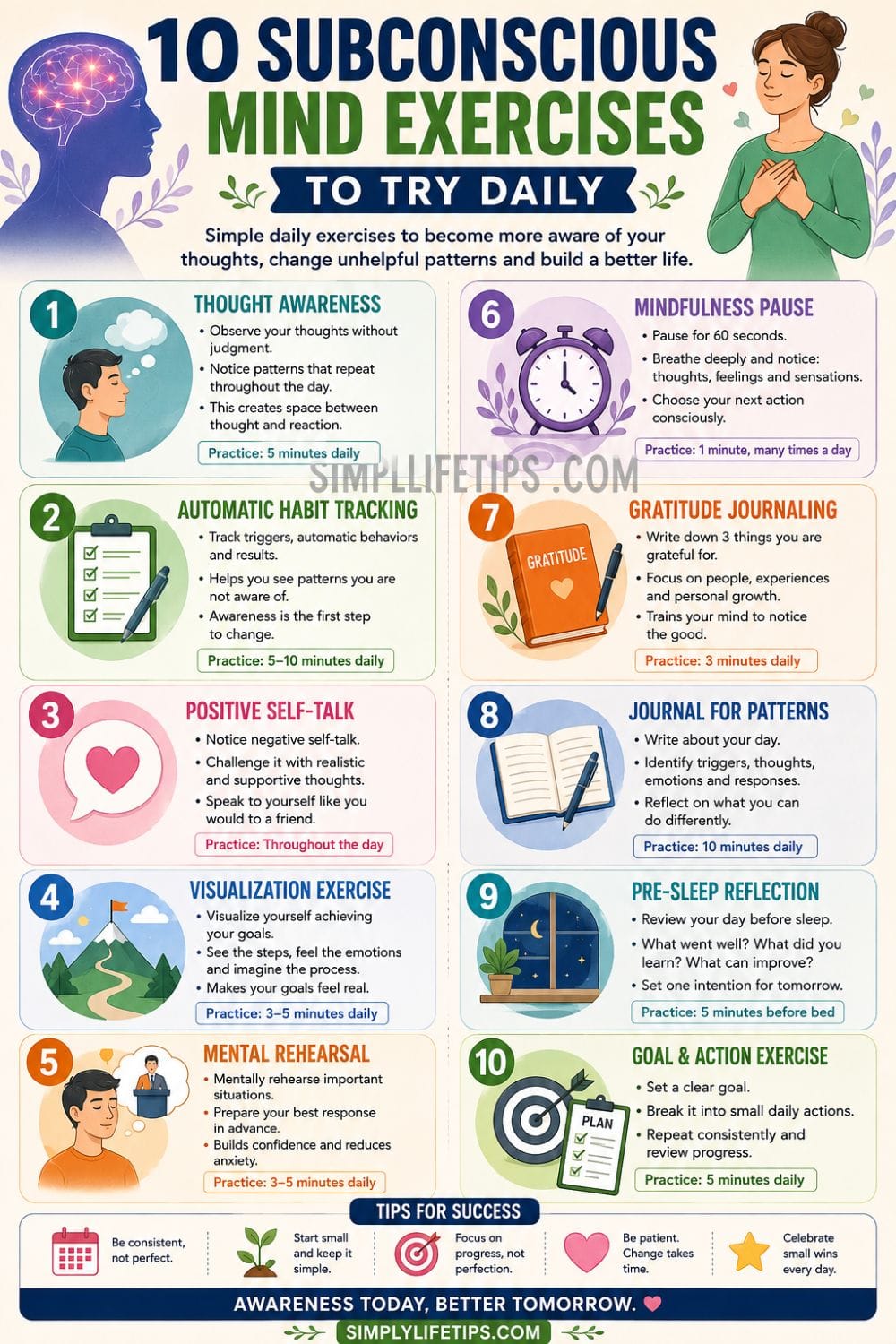
Start with one or two exercises rather than trying to change everything at once. A simple routine that you can repeat consistently is more useful than an ambitious routine that becomes difficult to maintain.
A 7-Day Subconscious Mind Exercises Challenge
If you’re new to these practices, start with seven days.
Don’t try to become a completely different person in one week.
The purpose is to observe and practice.
Day 1: Observe Your Thoughts
Spend five minutes noticing thoughts without trying to change them.
Write down three recurring thoughts afterward.
Day 2: Track One Habit
Choose one automatic behavior.
Record:
Trigger → behavior → result
Do this each time the behavior occurs.
Day 3: Reframe One Thought
Notice one negative automatic thought.
Write a more realistic alternative.
Day 4: Visualize the Process
Spend three minutes imagining yourself performing one behavior that supports your goal.
Focus on the process rather than just the result.
Day 5: Practice the Pause
Use a one-minute mindfulness pause during a stressful or distracting moment.
Notice what happens before you respond.
Day 6: Journal a Pattern
Choose one event from the week.
Write about the trigger, thought, emotion, behavior, and result.
Then identify one alternative response.
Day 7: Review
Look back over the previous six days.
Ask:
- Which pattern appeared most often?
- Which exercise felt easiest?
- Which exercise felt most useful?
- What trigger did I discover?
- What behavior do I want to continue?
Then choose two exercises to continue for another week.
How Long Should You Practice Subconscious Mind Exercises?
There is no universal number of days after which a subconscious mind exercise will suddenly “work.”
Habit formation varies considerably among people and behaviors.
A 2024 systematic review and meta-analysis of health-related habit formation found substantial individual variation in the time required for habits to develop. The studies reporting formation times found medians or means ranging from roughly two months upward, with individual differences ranging widely.
That is why I wouldn’t recommend promising readers that a particular exercise will completely change their subconscious mind in 21 or 30 days.
Instead, use a more useful question:
Can I make this practice easy enough to repeat?
If you can repeat a small behavior consistently, you have a better foundation for learning and habit development.
How Your Environment Can Strengthen These Exercises
Your environment can either support or interfere with your intentions.
Suppose you want to read before bed.
If your book is beside you and your phone is across the room, reading becomes easier.
If your phone is in your hand and the book is hidden in another room, scrolling becomes easier.
That is not simply a question of willpower.
Context can influence habit repetition and automaticity. Research has found that greater context stability can support automaticity and attainment of habit-repetition goals.
Make the desired behavior easier
Want to journal?
Keep the notebook on your desk.
Want to meditate?
Choose one regular place.
Want to exercise?
Prepare your clothes beforehand.
Want to reduce social-media use?
Turn off unnecessary notifications and move distracting apps away from your home screen.
Want to read?
Keep the book visible.
The principle is simple:
Make good habits easier to start and unwanted habits slightly harder to perform.
Understanding the habit loop can make these exercises easier to apply in everyday life. This infographic shows how a trigger can lead to an automatic response, and how awareness and a deliberate new response can help you build a different pattern over time.
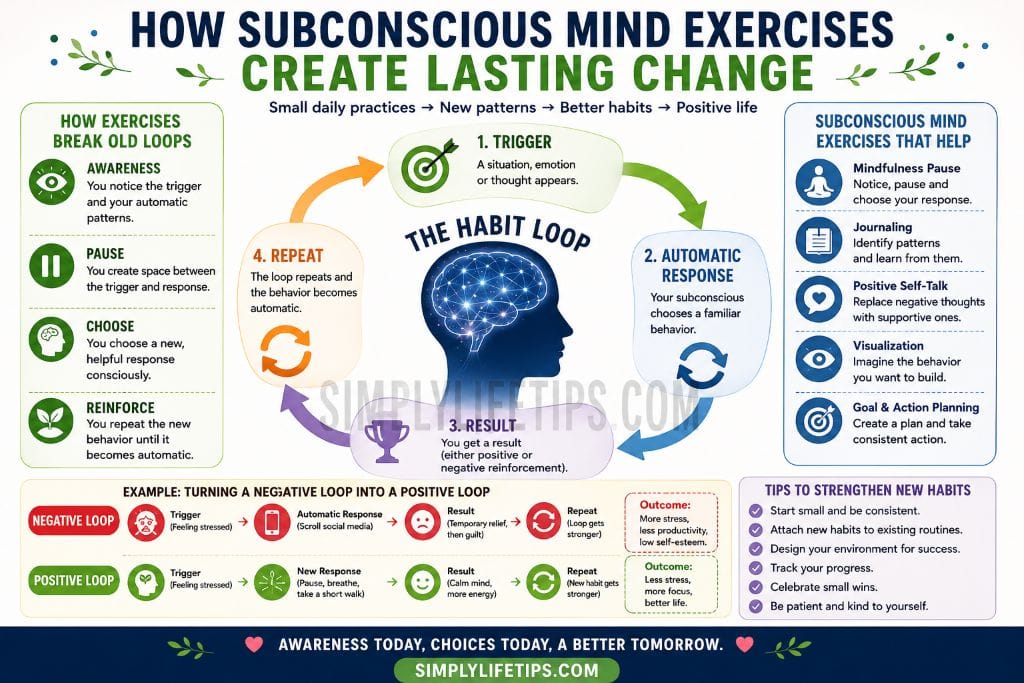
The goal isn’t to eliminate every automatic behavior. It’s to recognize the patterns that no longer serve you and create practical opportunities to practice something different.
Subconscious Mind Exercises for Different Goals
The best exercise depends on the pattern you’re trying to change.
If you procrastinate
Try:
- Automatic habit tracking
- Mindfulness pause
- Goal-to-action planning
- Mental rehearsal
Your goal is to identify what happens immediately before avoidance.
If you struggle with negative self-talk
Try:
- Thought awareness
- Positive self-talk
- Journaling
Focus on identifying recurring statements and replacing exaggerated conclusions with realistic alternatives.
If you become easily distracted
Try:
- Mindfulness pause
- Environment design
- Visualization
- Habit tracking
Reduce the cues that automatically pull your attention away from important work.
If you want to build confidence
Try:
- Mental rehearsal
- Process visualization
- Constructive self-talk
Practice the behavior you want to perform rather than simply imagining yourself as confident.
If you want better daily habits
Try:
- Goal-to-action exercise
- Habit tracking
- Pre-sleep reflection
- Stable cues and routines
The objective is to make the desired behavior specific and repeatable.
Common Mistakes With Subconscious Mind Exercises
Expecting instant results
One exercise won’t erase a pattern that has been repeated for years.
Give yourself time to practice.
Doing too many exercises
You don’t need ten exercises every day.
Choose one or two.
Treating every thought as truth
A thought can be automatic without being accurate.
Learn to observe it before reacting.
Using positive thinking to avoid real problems
Positive thinking shouldn’t mean ignoring genuine difficulties.
A constructive response acknowledges the problem and asks what can be done next.
Focusing only on visualization
Visualization can support preparation, but action is still necessary.
Imagine the process, then perform it.
Ignoring the environment
If your surroundings constantly trigger the behavior you’re trying to change, willpower alone may be difficult to sustain.
Change the environment where possible.
Giving up after a setback
Missing a practice session doesn’t erase previous effort.
Return to the routine.
Chasing a magic number
There is no universal 21-day rule or guaranteed timeline for habit formation. Research shows substantial variation.
Focus on repetition rather than a deadline.
Do Subconscious Mind Exercises Really Work?
The answer depends on what you expect them to do.
If you expect a five-minute exercise to magically unlock hidden mental abilities or completely rewrite your personality, that expectation is unrealistic.
But if you use these exercises to improve self-awareness, habit practice, attention, reflection, and behavioral consistency, they have a much more practical foundation.
Habit research shows that repeated behavior in recurring contexts can become increasingly automatic.
Mindfulness research also examines how present-moment awareness and self-regulation may contribute to behavior change.
So rather than thinking:
“This exercise will reprogram my subconscious overnight.”
think:
“This exercise gives me another opportunity to notice a pattern and practice a different response.”
That is a much more realistic way to approach personal change.
When Subconscious Mind Exercises Are Not Enough
These exercises are intended for general self-development.
They are not a substitute for professional support when someone is experiencing persistent psychological distress, trauma-related symptoms, severe anxiety, depression, or other mental-health difficulties.
Likewise, if a habit involves serious health risks or addiction, simply practicing self-help exercises may not be enough.
In those situations, professional guidance can be appropriate.
How to Make Subconscious Mind Exercises a Long-Term Habit
The biggest challenge isn’t learning the exercises.
It’s remembering to practice them.
The easiest solution is to attach them to something you already do.
For example:
After morning coffee → review your goal.
After lunch → take a mindful pause.
After dinner → write in your journal.
Before bed → practice gratitude and reflection.
This creates a predictable sequence.
Research on habit formation indicates that recurring contexts and repetition are important components of developing automatic behavior.
You can also make the practice smaller.
Instead of:
“I will journal for 30 minutes every night.”
start with:
“I will write three sentences.”
Instead of:
“I will meditate for an hour.”
start with:
“I will pause and take five slow breaths.”
Instead of:
“I will completely stop checking my phone.”
try:
“I will keep my phone away during the first 20 minutes of work.”
Small practices are easier to repeat.
Conclusion
Subconscious mind exercises don’t need to be mysterious, complicated, or dramatic.
The most useful practices are often simple: notice a thought, identify a trigger, pause before reacting, visualize a behavior, write down a pattern, practice constructive self-talk, and repeat a useful action in a consistent context.
You don’t need to control every thought that enters your mind.
You don’t need to become perfect.
And you don’t need to believe that your entire subconscious mind can be rewritten overnight.
Instead, start with one exercise.
Practice it for a week.
Observe what you notice.
Then decide whether it is worth continuing.
Over time, this approach can help you become more aware of automatic patterns and more deliberate about the behaviors you want to strengthen.
The real goal isn’t to fight your subconscious mind.
It is to understand your patterns better and give yourself more opportunities to choose what comes next.
Frequently Asked Questions
What are the best subconscious mind exercises?
Useful options include thought awareness, habit tracking, positive self-talk, visualization, mental rehearsal, mindfulness, gratitude journaling, reflective journaling, pre-sleep reflection, and goal-to-action planning. The best exercise depends on the specific habit or pattern you want to work on.
How often should I practice subconscious mind exercises?
Start with a routine you can realistically maintain. Five to fifteen minutes a day can be a practical starting point. Consistency is more important than creating a long routine that becomes difficult to maintain.
Can subconscious mind exercises change negative thoughts?
They can help you notice recurring thoughts and practice more constructive responses. The aim isn’t to eliminate every negative thought but to become less automatic in how you respond to it.
What is the best exercise to activate the subconscious mind?
There is no scientifically established exercise that literally “activates” a hidden subconscious system. For practical purposes, mindfulness, thought awareness, journaling, visualization, and repeated habit practice can help you become more aware of automatic patterns.
Can I do subconscious mind exercises before sleep?
Yes. Pre-sleep reflection, gratitude journaling, mental rehearsal, and planning one small action for the following day can fit naturally into an evening routine.
References
- Wood, W., & Rünger, D. Psychology of Habit. Annual Review of Psychology.
- Neal, D. T., Wood, W., & Quinn, J. M. Research on the automatic component of habit and cue-response relationships.
- Stojanovic, M., Grund, A., & Fries, S. Context Stability in Habit Building Increases Automaticity and Goal Attainment. Frontiers in Psychology.
- Schuman-Olivier, Z., et al. Mindfulness and Behavior Change. Harvard Review of Psychiatry.
- Singh, B., Murphy, A., Maher, C., & Smith, A. E. Time to Form a Habit: A Systematic Review and Meta-Analysis of Health Behaviour Habit Formation and Its Determinants. Healthcare.

Mathukutty P V is a Blogger, YouTuber, and Content Writer and the founder of Simply Life Tips. After taking voluntary retirement in 2017, he embraced a free lifestyle focused on learning, personal growth, and sharing practical wisdom to help others live with more purpose and positivity.



