

Signs of memory loss can be easy to dismiss, especially when they appear in an older parent or loved one. We may smile when Dad asks the same question twice, or tell ourselves, “He is getting older. A little forgetfulness is normal.”
Sometimes it is.
But what happens when the questions become repetitive? When familiar tasks suddenly become difficult? When someone who has always managed the household bills begins struggling with them? Or when a person gets confused in a place they have known for years?
These signs of memory loss should not automatically be assumed to be Alzheimer’s disease. Memory problems can have many causes.
The important question is not simply, “Did they forget something?”
It is:
“Has the person’s memory or thinking changed enough to affect everyday life?”
What Are Signs of Memory Loss?
Memory naturally changes throughout life. Occasionally forgetting a name, misplacing your keys, or walking into a room and forgetting why you went there can happen to anyone.
The concern arises when memory problems become more frequent, more noticeable, or more disruptive.
The Alzheimer’s Association identifies memory loss that interferes with daily life as one of the important warning signs associated with Alzheimer’s and other dementias.
This does not mean that every memory problem is Alzheimer’s.
It means that a noticeable change deserves to be understood rather than simply dismissed as aging.
Recognizing these signs of memory loss does not mean assuming the worst. It means noticing a meaningful change and understanding when it may deserve further evaluation.

The following signs of memory loss are worth paying attention to, particularly when they are persistent or begin affecting everyday life.
7 Signs of Memory Loss You Shouldn’t Ignore
These changes do not always mean that someone has Alzheimer’s disease, but recognizing early signs of memory loss can help families know when further evaluation may be appropriate.
1. Forgetting Recently Learned Information
One of the most noticeable changes can be difficulty remembering information that was learned recently.
A person may forget a conversation from earlier in the day, an appointment that was discussed several times, or something that happened recently.
For example:
“Mom, we told you yesterday that your appointment is today.”
“Oh, I forgot.”
Occasional forgetfulness is not necessarily unusual. The concern is when this happens repeatedly and becomes a pattern.
A person may also begin relying increasingly on notes, reminders, calendars, or family members for information they previously remembered independently.
2. Asking the Same Question Again and Again
Repeated questions can be particularly noticeable to family members.
Dad asks:
“When are we going to the doctor?”
You answer:
“At 3 p.m.”
A few minutes later:
“When are we going to the doctor?”
You answer again.
Then the same question returns.
Repeatedly asking for the same information can be more concerning than occasionally forgetting something and remembering it later.
It is one reason family members are often among the first people to notice that something has changed.

3. Struggling With Familiar Tasks
Another possible sign is difficulty completing once-routine tasks.
Someone who has cooked the same meals for decades may suddenly struggle to follow a familiar recipe.
Someone who has always handled household bills may become confused about how to pay them.
A person who regularly used a familiar appliance, telephone, or other everyday object may suddenly find the task difficult.
The important issue is not whether the person has forgotten how to do something once.
It is whether a previously familiar activity has become consistently difficult.

4. Having Trouble Managing Money, Medicines, or Bills
Problems with planning and handling everyday responsibilities can sometimes become visible before families recognize them as memory problems.
A person may:
- Forget to pay bills
- Pay the same bill twice
- Have difficulty counting money
- Forget when medicines should be taken
- Become confused about routine financial matters
- Struggle with tasks that previously required little effort
These changes deserve particular attention because mistakes involving finances or medication can create real safety risks.
If you notice a significant change, do not embarrass or shame the person. Instead, try to understand what has changed and consider discussing it with a healthcare professional.
5. Frequently Struggling to Find Words
Everyone occasionally forgets a word.
You may know exactly what you want to say but temporarily be unable to remember the word.
That alone is usually not a reason to panic.
But increasing difficulty communicating can be different.
A person may repeatedly stop during conversations because they cannot find a familiar word. They may substitute unusual words, lose track of what they were saying, or repeat themselves.
Changes in language and communication can occur alongside other cognitive changes in Alzheimer’s disease and other conditions.
6. Getting Lost in Familiar Places
Getting confused about time or place can be another warning sign.
Someone may become unsure about the date or season. More concerningly, they may become lost in a familiar neighborhood or have difficulty understanding how they arrived somewhere.
For example, a person who has travelled to the same market for years may suddenly be unable to find the way home.
This should not simply be dismissed as ordinary aging, particularly if it is a new or worsening change.
7. Noticeable Changes in Judgment or Thinking
Memory is not the only part of cognition that can change.
Family members may notice changes in judgment, planning, problem-solving, or decision-making.
A person who was previously careful with money may begin making unusual financial decisions.
Someone who normally handled household matters confidently may suddenly struggle to organize simple tasks.
One isolated poor decision does not establish a medical condition. What matters is a persistent change from the person’s usual abilities.
Not Every Memory Problem Means Alzheimer’s
This is one of the most important things families should understand.
Memory loss does not automatically mean Alzheimer’s disease.
Sleep problems, depression, medication effects, thyroid disorders, vitamin deficiencies, and other medical or psychological conditions can contribute to problems with memory or thinking.
That is why it is better to seek an evaluation than to make a diagnosis at home.
Memory changes can have several possible causes, including medication side effects, sleep problems, depression or anxiety, vitamin B12 deficiency, and thyroid problems, so a proper evaluation is important. Learn more about common causes of memory problems (NIA link).
A healthcare professional can consider the person’s symptoms, medical history, medications, daily functioning, and other possible causes.
Normal Aging or a Concerning Change?
There is an important difference between an occasional lapse and a persistent decline.
For example:
| Occasional forgetfulness | Changes that deserve attention |
|---|---|
| Occasionally forgetting a name | Frequently forgetting recently learned information |
| Misplacing keys occasionally | Regularly losing things and being unable to retrace steps |
| Forgetting an appointment but remembering later | Repeatedly forgetting important appointments |
| Occasionally searching for a word | Increasing difficulty following or participating in conversations |
| Making an occasional mistake | Increasing difficulty managing familiar tasks |
| Forgetting the day but figuring it out later | Becoming repeatedly confused about time or place |
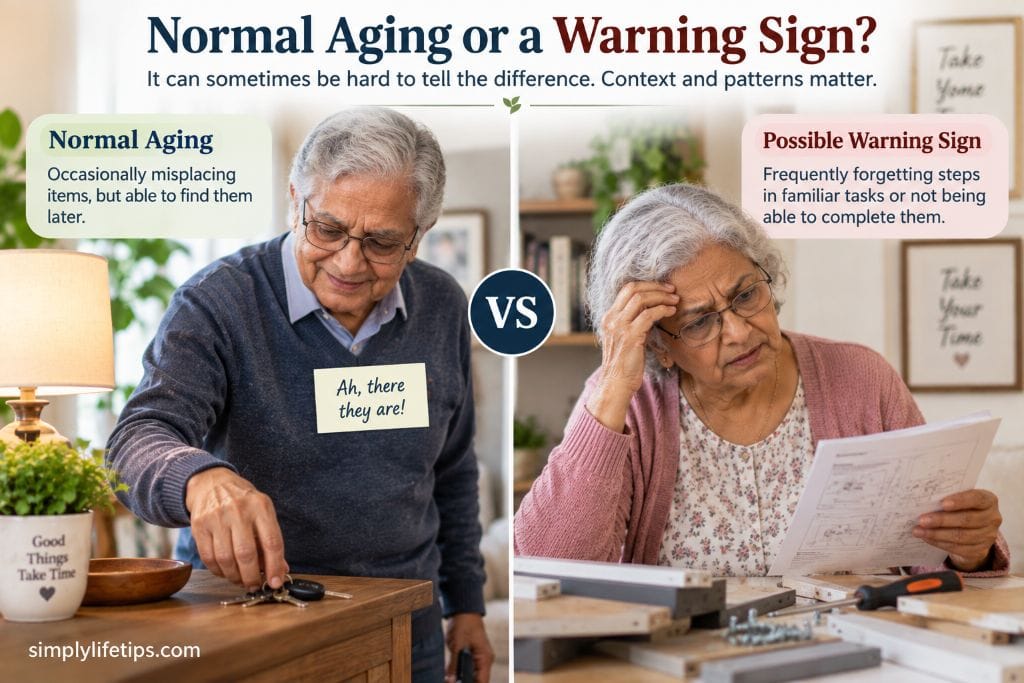
The pattern matters.
A single forgotten name is very different from a progressive inability to manage familiar daily activities.
Healthy aging involves more than simply getting older. Small everyday habits can support physical and mental well-being as we age. Read our guide to small habits that support healthy aging for practical ideas you can incorporate into daily life.
Is Memory Loss a Sign of Dementia?
Memory loss can be associated with dementia, but memory loss and dementia are not interchangeable terms. Dementia is a broad term describing a decline in cognitive abilities that becomes serious enough to interfere with everyday life. Alzheimer’s disease is one possible cause of dementia.
If memory problems eventually lead to a diagnosis of dementia, families may need practical guidance on communication, routines, safety, nutrition, daily activities, and caregiver support. Our guide to dementia care covers these important aspects of supporting someone with dementia.
Memory changes are a symptom. Dementia is a clinical syndrome. Alzheimer’s disease is one possible underlying cause.
Alzheimer’s Changes May Begin Before a Diagnosis
The biological changes associated with Alzheimer’s can develop before obvious symptoms become apparent.
Abnormal accumulation of beta-amyloid and changes involving tau are among the biological features associated with Alzheimer’s disease. Modern research has also made it increasingly possible to detect Alzheimer’s-related biomarkers through brain imaging, cerebrospinal fluid, and, in appropriate clinical settings, blood-based tests.
However, this does not mean that someone should order a test simply because they occasionally forget something.
Diagnosis involves the whole clinical picture.
There is no single test that should be interpreted in isolation. Doctors may consider medical history, cognitive testing, laboratory tests, brain imaging, and appropriate biomarkers depending on the individual situation.
How Is Memory Loss Evaluated?
A medical evaluation may involve questions about:
- When the memory changes began
- Whether they are getting worse
- Changes in daily activities
- Medicines and supplements
- Sleep
- Mood
- Other medical conditions
- Family history
- Changes in behavior or personality
Doctors may also perform cognitive assessments and standard medical tests to look for other possible explanations.
Depending on the situation, evaluation can include MRI, CT, PET, cerebrospinal fluid testing, or blood-based biomarkers.
The goal is not simply to put a label on the problem.
It is to understand what is causing the change and what can be done about it.
A medical evaluation may include a review of symptoms and medical history, cognitive testing, laboratory tests, and other assessments to help identify the possible cause. The National Institute on Aging explains how Alzheimer’s disease is evaluated and diagnosed
Why Early Evaluation Matters
Earlier evaluation can give individuals and families more time to understand what is happening and discuss appropriate care and treatment options.
It can also provide time to:
- Review available treatment options
- Address potentially treatable causes
- Plan future care
- Review medicines and health risks
- Discuss financial matters
- Consider legal and practical arrangements
- Make appropriate safety changes
- Support the person’s independence for as long as possible
A diagnosis can be difficult to hear.
But uncertainty can also be difficult.
Knowing what is happening can help a family move from guessing to planning.

Caring for a Parent With Memory Problems
Perhaps the hardest part is watching someone who once cared for you begin to need help themselves.
The parent who taught you how to walk may eventually need someone to remind them where they are going.
The person who once reminded you about every appointment may begin forgetting their own.
That reversal can be emotionally difficult.
Care should therefore involve more than medication.
Depending on the person’s needs, families may need to think about:
- Medication management
- Nutrition
- Sleep
- Personal hygiene
- Mobility
- Fall prevention
- Driving and transportation
- Financial safety
- Communication
- Social interaction
- Daily routines
- Emotional support
Families do not have to manage every stage alone.
Depending on the situation, neurologists, geriatric specialists, psychologists, physiotherapists, occupational therapists, speech-language professionals, nurses, and trained caregivers may all contribute to care.
Professional support is not a sign that a family has failed.
Sometimes, getting the right help is one of the ways a family protects the person they love.

When Should You See a Doctor?
Consider arranging a medical evaluation when memory or thinking changes are:
- Persistent
- Becoming more frequent
- Getting progressively worse
- Interfering with everyday activities
- Affecting medication or financial management
- Causing confusion about familiar places
- Affecting communication
- Noticeably different from the person’s previous abilities
If possible, a family member who has observed the changes can accompany the person to the appointment.
They may be able to describe changes that the person does not recognize themselves.
If several signs of memory loss appear together or continue to worsen, a medical evaluation can help identify the possible cause.
Don’t Wait Until the Memory Problems Become Severe
The goal is not to become frightened by every forgotten name.
The goal is to notice meaningful changes.
If an older parent asks a question twice, that alone does not mean they have Alzheimer’s.
But if the same person increasingly forgets recent conversations, struggles with familiar tasks, becomes confused in familiar places, or can no longer manage everyday responsibilities, it is worth paying attention.
Early evaluation can help determine whether the problem is related to normal aging, another treatable condition, Alzheimer’s disease, or another form of cognitive impairment.
A Message for Families
“It’s just old age” can sometimes become an easy explanation.
But aging should not become a reason to ignore significant changes.
The person who once remembered your school timetable may one day need you to remind them what day it is.
The person who once reminded you to take your medicine may eventually need you to remind them.
That does not erase who they are.
And it does not mean that everything must be solved in one day.
Notice the change.
Talk about it.
Seek appropriate medical advice.
And when help is needed, accept it without shame.
Sometimes the most loving thing we can do for someone who cared for us is to notice when they need us to care for them.
Conclusion
Signs of memory loss are not always easy to recognize, particularly when they develop gradually.
Occasional forgetfulness can happen with normal aging. But persistent or worsening memory problems, repeated questions, difficulty with familiar tasks, problems managing everyday responsibilities, language changes, getting lost in familiar places, or noticeable changes in judgment deserve attention.
Not every memory problem means Alzheimer’s disease. That is exactly why professional evaluation matters.
If something has changed, don’t simply say, “They are getting older.”
Notice it. Talk about it. Get it evaluated.
Because when we recognize a problem earlier, we may have more time to understand it, plan for the future, and support the person we love.
Sometimes the people who once reminded us of everything are the people we eventually need to remember for.
Medical perspective
This article is based in part on health information shared by Dr. Arun Oommen, Senior Consultant – Neurosurgery, VPS Lakeshore Hospital, Kochi. The content has been independently edited for Simply Life Tips for educational purposes. Original Facebook post
Medical Disclaimer
This article is for general educational purposes only and is not a substitute for professional medical advice, diagnosis, or treatment. Memory and thinking changes can have many possible causes. Anyone experiencing persistent, worsening, or concerning symptoms should consult a qualified healthcare professional.
Frequently Asked Questions
1. What are the common signs of memory loss?
Common concerning signs can include repeatedly forgetting recently learned information, asking the same questions, struggling with familiar tasks, difficulty managing everyday responsibilities, increasing problems finding words, getting confused in familiar places, and noticeable changes in judgment or thinking.
2. Is memory loss a normal part of aging?
Some changes in memory can occur with normal aging, such as occasionally forgetting a name and remembering it later. Memory problems that repeatedly interfere with daily life are different and should be discussed with a healthcare professional.
3. Does memory loss always mean Alzheimer’s disease?
No. Memory problems can have many causes, including certain medications, sleep problems, depression, thyroid disorders, vitamin deficiencies, and other medical conditions. Alzheimer’s disease is one possible cause, which is why proper evaluation is important.
4. When should someone see a doctor about memory loss?
A medical evaluation is appropriate when memory or thinking changes persist, worsen, or begin affecting everyday activities, communication, medication management, finances, or navigation.
5. Can Alzheimer’s be detected through a blood test?
Blood-based biomarkers for Alzheimer’s have advanced significantly, but they are part of a broader diagnostic process rather than a standalone answer for every person. Depending on the clinical situation, doctors may also use cognitive assessment, medical history, laboratory tests, brain imaging, or cerebrospinal fluid biomarkers.

Mathukutty P. V. is the founder of Simply Life Tips. He shares practical advice and useful insights on personal growth, health, well-being, technology, and everyday living. His goal is to help readers build positive habits and make informed decisions. He believes in continuous learning and sharing knowledge to help people live healthier, happier, and more meaningful lives.



