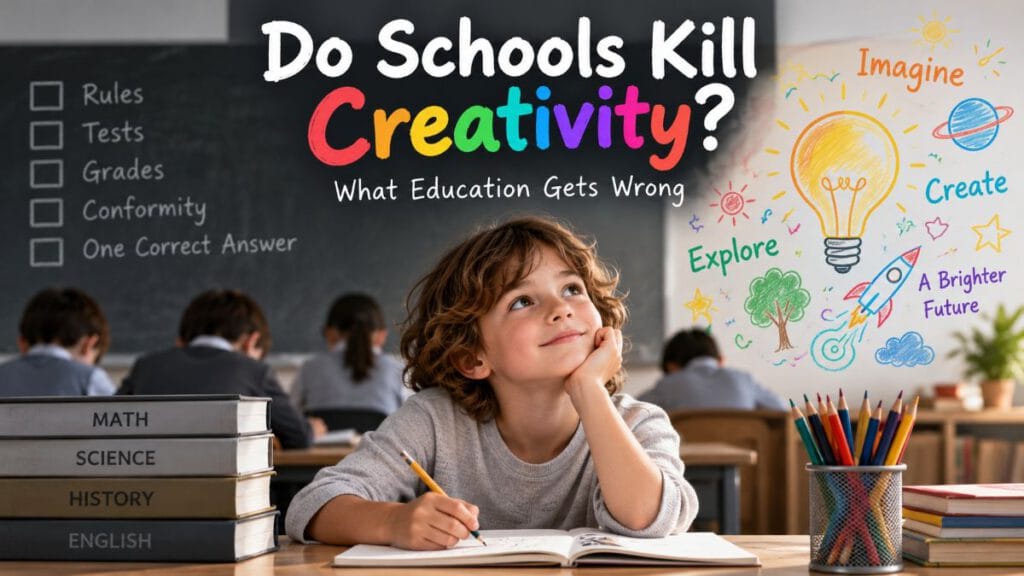
Do schools kill creativity, or does the way we educate children sometimes leave too little room for imagination, curiosity, experimentation, and original thinking? It is a question Sir Ken Robinson famously brought to a worldwide audience two decades ago, but it is still worth asking today. In fact, the question may be more important now than it was when Robinson delivered his celebrated TED Talk.
Children naturally ask questions, invent games, imagine impossible worlds, draw pictures, build things, tell stories, and look at ordinary objects in extraordinary ways. Yet as children move through formal education, many begin to associate learning with finding the one correct answer, avoiding mistakes, passing examinations, and meeting predetermined expectations. Somewhere along the way, the freedom to explore can become less important than the ability to perform.
That does not mean schools deliberately destroy creativity. Teachers work within educational systems, curricula, examinations, time limits, and expectations that are often outside their control. The deeper issue is whether an education system designed primarily around standardization and measurement can give creativity the same importance it gives academic achievement.
Sir Ken Robinson’s famous question “Do Schools Kill Creativity?” gives us a useful starting point, but the discussion should not end with his TED Talk. Education has changed considerably since he delivered it. Technology has transformed how students learn, artificial intelligence is changing the workplace, and creative thinking has become increasingly important in a world where information is available almost instantly.
The real question today is not simply do schools kill creativity, but whether schools are giving children enough opportunities to develop creativity.
What Did Sir Ken Robinson Mean by “Do Schools Kill Creativity?”
When people ask do schools kill creativity, they are often responding to the tension between standardized education and the natural curiosity of children. Sir Ken Robinson’s 2006 TED Talk became one of the most influential presentations on creativity and education. In his presentation, Robinson questioned whether traditional education systems give creativity the attention it deserves. The original presentation “Do Schools Kill Creativity?” is available through TED Talks, while the video can be embedded from YouTube for readers who want to watch the complete talk.
Robinson argued that education systems frequently place greater emphasis on certain academic subjects while giving less attention to creative disciplines such as art, music, dance, drama, and other forms of creative expression.
His argument was not that mathematics, science, reading, or writing are unimportant. Rather, he questioned why some forms of intelligence are often treated as more valuable than others.
A child who is excellent at mathematics may be recognized as gifted. A child who can compose music, create remarkable drawings, invent stories, perform on stage, design objects, or solve problems in unusual ways may not receive the same recognition.
This creates a narrow definition of what it means to be intelligent.
Robinson’s argument became memorable because it connected education with something many adults have experienced themselves: the gradual loss of confidence in their own creativity.
Children often have little fear of being wrong. They try something, fail, laugh, change their approach, and try again. Adults, however, may hesitate because they have learned that mistakes can bring criticism, poor grades, embarrassment, or failure.
When that fear becomes part of learning, creativity can suffer.
Why Is Creativity Important in Education?
Creativity is much more than drawing a picture or writing a story. It is the ability to generate ideas, make connections, explore possibilities, solve problems, and approach familiar situations from new perspectives. Understanding do schools kill creativity also requires understanding what children lose when creative thinking is not encouraged.
Consider a student who is asked to solve a difficult problem. There may be a standard method taught in class, but the student might discover another approach. If the student is encouraged to explore it, that experience can develop independence and problem-solving ability.
The same principle applies outside the classroom.
An entrepreneur needs creativity to identify opportunities. An engineer needs creativity to design solutions. A scientist needs creativity to develop hypotheses. A writer needs creativity to communicate ideas. A teacher needs creativity to explain difficult concepts. Even someone working in an apparently routine job may need creative thinking when something unexpected happens.
The future does not belong only to people who can remember information. It increasingly belongs to people who can understand information, question it, connect ideas, and use knowledge in useful ways.
That makes creativity an educational skill, not merely an artistic talent.
This also connects with the broader importance of developing the mind intentionally. Building a habit of questioning automatic thoughts and examining different possibilities can strengthen independent thinking. You can explore this idea further in our article on the power of your subconscious mind.
Are Schools Really Killing Creativity?
The phrase “kill creativity” is powerful, but it should not be interpreted too literally.
Schools are not inherently anti-creativity. Many teachers actively encourage students to ask questions, experiment, collaborate, create projects, and express themselves. Excellent schools can provide environments where creativity flourishes.
The problem is that certain educational practices can unintentionally suppress creative behavior.
When students are repeatedly rewarded for producing the expected answer, they may become reluctant to offer unusual answers. When mistakes are treated primarily as failures, students may avoid taking intellectual risks. When academic success is measured almost entirely through examinations, students may naturally prioritize memorization and test performance.
Over time, students can learn an unintended lesson: give the teacher the answer they want.
That is very different from exploring what the answer could be.
Creativity needs room for uncertainty. Education needs structure, but excessive rigidity can make students afraid to explore beyond the structure.
The Problem With One Correct Answer
Traditional education often requires correct answers, and there is nothing wrong with that in itself. This is one reason the question do schools kill creativity continues to resonate with parents and educators.
There is a correct answer to many mathematical problems. There are established facts in science. Historical events happened in particular ways. Grammar has rules. Students need foundational knowledge before they can use it creatively.
The difficulty appears when the search for correct answers becomes the dominant model for every kind of learning.
Imagine asking students to write a story about a rainy day. If every student is expected to produce the same type of response, creativity has little room to develop. But if students are allowed to decide whether the rain represents happiness, sadness, adventure, mystery, or something completely unexpected, they begin making their own connections.
Both approaches involve learning. The second simply gives imagination a larger role.
Creative education does not mean abandoning standards. It means recognizing that some valuable questions have multiple reasonable answers.
Why Are Children Afraid of Making Mistakes?
One of the biggest obstacles to creativity is the fear of being wrong.
Young children usually experiment without worrying too much about whether their ideas are impressive. Give a child a box, and it might become a car, a house, a spaceship, a robot, or a treasure chest.
Adults tend to see a box.
The difference is not necessarily a lack of imagination. Children are often more willing to experiment because they have not yet developed the same fear of judgment.
As children grow, feedback from adults, teachers, classmates, examinations, and society begins shaping their behavior. They learn which answers are praised and which are rejected.
If mistakes repeatedly produce embarrassment or punishment, children may stop taking risks.
That is a serious problem for creativity because creative thinking almost always involves some degree of uncertainty.
An inventor may build something that does not work. A writer may produce several poor drafts before finding a good one. A scientist may test a hypothesis that turns out to be wrong. An entrepreneur may develop a product nobody wants.
Failure is not always the opposite of creativity.
Sometimes it is part of the creative process.
This is closely connected with developing a healthier relationship with mistakes and setbacks. Our discussion of how to develop a growth mindset can complement this idea by looking at how beliefs about ability influence learning and improvement.
When Grades Become More Important Than Learning
Grades can be useful. They can help teachers understand student progress, provide feedback, and give students measurable goals.
But grades become problematic when they are treated as the complete definition of achievement.
A student may receive an excellent grade because they are skilled at memorizing and reproducing information. Another student may have exceptional curiosity, imagination, practical intelligence, or problem-solving ability but perform poorly in a particular examination format.
That does not mean grades are meaningless. It means they measure certain abilities better than others.
A student who constantly hears that marks are the most important measure of success may eventually avoid activities where success is uncertain.
Why attempt something creative if there is no guaranteed reward?
Why experiment if the experiment might fail?
Why ask an unusual question if classmates might laugh?
Education should help students develop the courage to explore questions whose answers are not immediately obvious.
Do Schools Give Enough Space to Art and Creativity?
Creative subjects are sometimes treated as optional extras compared with mathematics, science, languages, or other academically emphasized subjects.
This can send an unintended message.
A child may begin to believe that mathematics is “important” while music is something they do only after the important work is finished. Drawing may be considered a hobby. Drama may be treated as entertainment. Writing creatively may be separated from serious academic work.
Yet creative activities develop skills that extend beyond the arts.
Music can develop listening and pattern recognition. Drawing can strengthen observation. Drama can develop communication and confidence. Storytelling can improve language and perspective-taking. Designing and building can develop spatial reasoning and problem-solving.
The goal should not be to turn every student into an artist.
The goal is to avoid telling children, directly or indirectly, that creativity is less valuable than other forms of ability.
The UNESCO framework on culture and arts education also reflects the broader international recognition that arts and culture have an important place in education.
Creativity Is Not Only About the Arts
One common misunderstanding is that creative students are simply those who enjoy painting, music, writing, or performance.
Creativity is much broader.
A student who finds a new way to organize a science experiment is being creative. A child who invents a new game with unusual rules is being creative. A student who discovers a different method for solving a mathematical problem is using creative thinking.
Even asking a thoughtful question can be an act of creativity.
Creativity begins when a person moves beyond simply accepting what already exists and starts exploring what might be possible.
That is why creative thinking belongs in every subject.
What Happens When Students Stop Asking Questions?
Curiosity is one of the foundations of learning.
A curious child does not simply accept information. The child asks: Why? How? What if? What would happen if we changed this? Is there another way? Could this work differently?
Those questions can lead to deeper learning.
But students can gradually stop asking questions if they feel that questions slow the lesson down, reveal ignorance, or have no connection to examinations.
A classroom where students are afraid to ask questions may appear orderly and successful while missing an important opportunity.
Good education should not only provide answers. It should teach students how to ask better questions.
Curiosity also connects with lifelong learning. People who continue questioning and exploring are more likely to adapt when circumstances change rather than assuming that what worked yesterday will always work tomorrow.
The question do schools kill creativity becomes especially important when students gradually stop questioning what they are taught.
What Can Teachers Do to Encourage Creativity?
Teachers do not need unlimited resources or completely redesigned classrooms to encourage creativity.
Small changes can make a meaningful difference.
Instead of immediately correcting an unusual answer, a teacher can ask the student to explain the reasoning behind it. Instead of always asking students to reproduce information, teachers can ask them to apply it to unfamiliar situations.
A science lesson, for example, could move beyond explaining a concept and ask students to design a simple experiment demonstrating it. A history lesson could ask students to consider how an event might have unfolded differently if one important decision had changed.
These activities do not eliminate factual learning. They build upon it.
The teacher’s role becomes more than delivering information. The teacher becomes someone who creates conditions in which students can investigate, question, test, and discover.
What Can Parents Do to Protect Creativity?
Creativity is not something that should exist only at school.
Parents can encourage creative thinking through ordinary daily interactions.
When a child builds something unusual, instead of immediately explaining how it should be done, a parent can ask what the child is trying to create.
When a child gives an unexpected answer, asking “Why do you think that?” can be more valuable than simply saying “That’s wrong.”
Children also benefit from having time when they are not constantly directed toward structured activities.
Boredom can sometimes create space for imagination.
A child who has nothing immediately planned may invent a game, draw, build something, explore the surroundings, write a story, or simply imagine.
Not every moment needs to be productive in the conventional sense.
Should Children Be Allowed to Fail?
If we want children to become creative thinkers, we have to reconsider our relationship with failure.
A child who builds a tower and watches it collapse has learned something. A student who writes a story that does not work has an opportunity to revise it. A young inventor whose design fails can examine what went wrong.
Failure becomes destructive when it is treated as evidence that the person is incapable.
It becomes useful when it is treated as information.
This distinction is important.
Instead of asking only, “Did you get it right?” we can sometimes ask, “What did you discover?”
That simple change can create a very different attitude toward learning.
What Has Changed Since Ken Robinson’s TED Talk?
Much has changed since Robinson delivered his TED Talk.
Students today grow up surrounded by smartphones, social media, digital platforms, online courses, and artificial intelligence. Information that once required hours of research can often be accessed within seconds.
This creates a new educational challenge.
If technology can increasingly retrieve information, generate text, create images, summarize material, and assist with problem-solving, education cannot focus only on remembering information.
Students need to understand how to use information intelligently.
They need to distinguish reliable information from misinformation. They need to ask good questions. They need to evaluate answers rather than blindly accept them. They need to combine knowledge from different fields.
And they need to create.
Nearly two decades later, the question do schools kill creativity has taken on a new meaning in a technology-driven classroom.
Does Artificial Intelligence Make Creativity More Important?
Artificial intelligence makes the question of creativity even more interesting.
AI tools can generate writing, images, music, presentations, software, and ideas. That does not make human creativity irrelevant. Instead, it changes the nature of the creative process.
A student who simply asks an AI system to produce an answer may learn very little. A student who uses AI to generate possibilities, challenges those possibilities, checks the information, develops an original direction, and improves the result is using technology differently.
The important skill is not simply producing something.
It is knowing what is worth producing.
Human judgment, curiosity, imagination, context, empathy, and the ability to recognize meaningful problems remain important.
Education therefore needs to prepare students not merely to consume AI-generated information but to think critically and creatively alongside increasingly capable technology.
The World Economic Forum has also highlighted creative thinking among the skills becoming increasingly important in the changing world of work. Its Future of Jobs research provides useful wider context for understanding why creative thinking matters beyond school.
In the age of AI, asking do schools kill creativity is no longer only about traditional classrooms; it is also about how students learn to think independently when machines can generate answers.
What Should Schools Teach Children for the Future?
Nobody can predict exactly what the world of work will look like decades from now.
Jobs will change. Some occupations will disappear or be transformed. New occupations will emerge.
That uncertainty makes adaptability extremely valuable.
Students need strong foundations in literacy, mathematics, science, technology, and other academic disciplines. But they also need communication, collaboration, critical thinking, creativity, resilience, curiosity, and the ability to learn continuously.
The future does not require children to choose between knowledge and creativity.
It requires both.
Knowledge gives creativity something to work with. Creativity gives knowledge new possibilities.
A person cannot creatively solve a problem they do not understand. But understanding a problem is not always enough to solve it.
That is why education needs both sides.
Can Traditional Education and Creativity Coexist?
Absolutely.
The choice does not have to be between a disciplined education system and complete creative freedom.
Children need structure.
They need to learn basic skills. They need practice. They need knowledge. They need guidance. They need to understand that some tasks require accuracy and persistence.
At the same time, they need opportunities to explore.
A strong education system can teach multiplication while allowing students to explore different ways of understanding mathematical patterns. It can teach scientific principles while encouraging students to design experiments. It can teach language while giving students opportunities to write stories, debate ideas, and communicate creatively.
The objective is balance.
Creativity without knowledge can become directionless. Knowledge without creativity can become rigid.
Education should develop both.
What Would a Creativity-Friendly School Look Like?
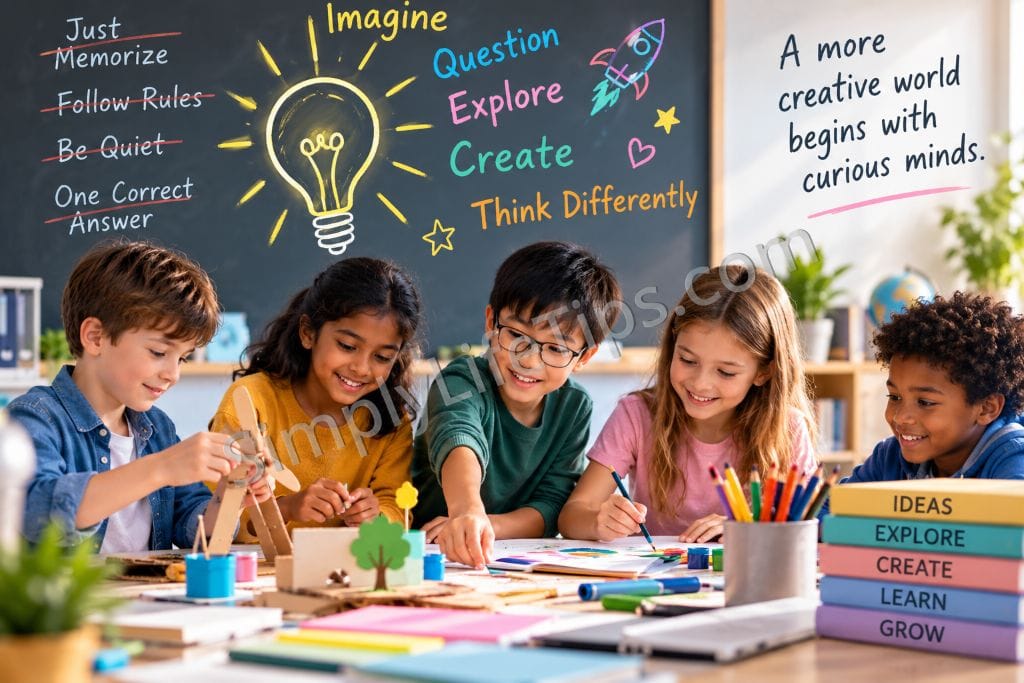
A creativity-friendly school would not necessarily look dramatically different from a traditional school.
The difference might be found in the questions teachers ask and the opportunities students receive.
Students might be asked to explain their reasoning rather than simply provide answers. They might work on projects that require several skills at once. They might be encouraged to propose solutions before being shown the standard method.
Mistakes could become part of classroom discussion rather than something to hide.
Students could encounter situations where there is no single perfect answer.
Most importantly, they could learn that having an unusual idea is not automatically a problem.
A creativity-friendly classroom does not have to be chaotic.
It can be structured, purposeful, and academically demanding while still leaving room for imagination.
So, Do Schools Kill Creativity?
The most honest answer is: sometimes educational practices can suppress creativity, but schools do not have to do so.
The problem is not education itself.
The problem occurs when education becomes so focused on conformity, examination performance, standardized answers, and measurable outcomes that curiosity and experimentation receive little space.
Children do not suddenly lose their imagination because they enter a classroom. But they can gradually learn to hide it.
They may stop raising their hands because they are afraid of being wrong. They may stop drawing because they are told to concentrate only on “important” subjects. They may stop asking unusual questions because there is not enough time to explore them.
These small experiences can accumulate.
That is why the question remains valuable.
“Do Schools Kill Creativity?” is not simply an accusation against teachers or schools. It is an invitation to examine what we value in education.
If we say that creativity matters, our classrooms, examinations, curricula, and expectations should give students genuine opportunities to use it.
The Lesson We Should Not Forget
Every child begins life as a learner.
Children observe. They imitate. They experiment. They ask questions. They make connections. They create stories. They test boundaries. They discover that one object can become something completely different when imagination enters the picture.
Education should not take that curiosity away.
Instead, education should help children develop it into something more powerful.
A creative child does not necessarily need to become an artist. A curious student does not necessarily need to become an inventor. Creativity is valuable because it helps people approach life with an open mind.
The goal of education should not be to produce children who can simply reproduce everything they have been taught.
It should help produce people who can take what they have learned and do something meaningful with it.
Conclusion
Do schools kill creativity? They do not have to. Education can either narrow a child’s curiosity or give it the knowledge, confidence, and direction needed to grow.
Sir Ken Robinson asked the question two decades ago, but the question remains relevant because education is never simply about what children know. It is also about what they believe they are capable of imagining, questioning, creating, and becoming.
The answer is not to remove structure, academic subjects, examinations, or discipline from education. Children need knowledge and guidance. But they also need permission to wonder, experiment, make mistakes, and discover that there can sometimes be more than one way to approach a problem.
In a world increasingly shaped by technology and artificial intelligence, creativity may become even more valuable. Machines can process enormous amounts of information, but human beings still need to decide which questions matter, which problems are worth solving, and what kind of future they want to create.
Perhaps asking do schools kill creativity is really a way of asking whether our education systems are preparing children to think for themselves—and whether we are willing to build schools that help creativity survive and grow.
FAQs about Do Schools Kill Creativity?
Who said “Do Schools Kill Creativity?”
Sir Ken Robinson gave the famous TED Talk “Do Schools Kill Creativity?” in 2006. The talk became one of the most widely viewed TED Talks and sparked a broad discussion about education, creativity, and the way schools recognize different forms of ability.
What is the main idea of Do Schools Kill Creativity?
The central idea is that traditional education can place greater value on certain academic abilities while giving insufficient attention to creativity and other forms of intelligence. Robinson argued for an education system that recognizes and develops a wider range of human abilities.
Does school actually destroy creativity?
Schools do not automatically destroy creativity. However, educational practices that excessively emphasize standardized answers, examination performance, conformity, and fear of mistakes can discourage creative behavior. Supportive teachers and flexible learning environments can instead help creativity develop.
Why is creativity important for students?
Creativity helps students develop problem-solving, curiosity, adaptability, communication, imagination, and original thinking. These abilities are useful not only in artistic fields but also in science, technology, business, education, and everyday life.
Is Ken Robinson’s message still relevant today?
Yes. The educational environment has changed considerably since Robinson’s TED Talk, particularly because of digital technology and artificial intelligence. These changes make creative and critical thinking even more important because students now have unprecedented access to information and increasingly powerful tools for producing content.

Mathukutty P V is a Blogger, YouTuber, and Content Writer and the founder of Simply Life Tips. After taking voluntary retirement in 2017, he embraced a free lifestyle focused on learning, personal growth, and sharing practical wisdom to help others live with more purpose and positivity.